Wednesday, April 1, 2026

Trump v. Mail Ballots

Our most recent book is The Comeback: The 2024 Elections and American PoliticsThe second Trump administration has been full of ominous developments.

Rick Hasen:

President Trump has signed a second executive order purporting to regulate federal elections (especially mail ballots). His first executive order from March 2025 has already been enjoined in key parts for violating the Constitution. As Judge Kollar-Kotelly wrote in one of the opinions, “Put simply, our Constitution does not allow the President to impose unilateral changes to federal election procedures.” This one is likely to fare no better before the courts.

... 

The basic idea of the actual EO that the President issued on Tuesday is this: DHS is going to craft a list of citizens above the age of 18. States will get that list. If a state does not submit a list (presumably to be compared to the federal list [UPDATE: See here on the relationship between state and federal lists]), and give the post office the citizen-approved list of voters (and do other things like add bar codes to mailed ballots), USPS will not deliver the mail. (USPS would have to craft regulations to implement this.)

To put this in plain terms: the order would use the USPS, which is not under the direct control of the President, to interfere with a state’s lawful transmission of ballots. If the state does not comply with these rules, federal law would purport to interfere with a state’s conduct of its own elections.

The President does not have the authority to do this. He cites to two federal voting statutes and the part of the Constitution that says that the United States shall guarantee to each state a Republican form of government. These sources do not give him authority to force states to change their election rules.

...

Finally, the timing here makes this virtually impossible to implement in time for November’s elections. This calls for rulemaking and DHS compiling these lists. These will take time. There will be inaccuracies or worse, and there will be lawsuits, many lawsuits. It seems highly unlikely any of this could be implemented for 2026, even if it were not blocked by courts.

It raises the question if this is just more election denialism theater. That’s what it looks like, rather than a serious effort to craft a law that could be implemented and withstand constitutional scrutiny.

Tuesday, March 31, 2026

Dark Ending to March 2026

 Our most recent book is The Comeback: The 2024 Elections and American Politics. The second Trump administration has been full of ominous developments -- now including a war in the Middle East.

Alexandra Banner at CNN:

Gas prices in the US hit an average of $4 per gallon today, their highest level since 2022, according to AAA. Average prices at the pump are now higher than at any point during President Donald Trump's two terms. Gas prices have surged since the start of the war in the Middle East, rising by about $1 per gallon over the past month. Oil prices also rose slightly today, a day after US crude oil settled above $100 per barrel for the first time since July 2022. This comes after Trump threatened that he would "obliterate" Iran's energy sources if a deal to end the war is not reached and the Strait of Hormuz is not reopened, deepening fears the conflict could escalate further.

Gallup:


Monday, March 30, 2026

Bizarro GOP Plan: Cut Health Spending to Pay for an Unpopular War


In early February, a YouGov poll found majorities of Americans supported increasing government spending on veterans (74%), Social Security (69%), Medicare (67%), aid to the poor (64%), Medicaid (59%), and the environment (52%).   Only 34% wanted to increase defense spending -- that that was before the Iran war, which is unpopular.  Last week, Pew found 61% disapproved of Trump's handling of the war, and 59% said that US made the wrong decision to use military force in Iran.

In that light, the House GOP's spending plans sound politically insane.  Peter Sullivan at Axios:
Republicans are considering reductions in federal health spending to help pay for a budget bill containing as much as $200 billion to fund the Iran war and immigration enforcement.

Why it matters: New efforts to rein in health programs are sure to be controversial and open the GOP up to election-year attacks that they're cutting health care to pay for an unpopular war.

Driving the news: Top House Republicans are looking at health care offsets addressing fraud in federal programs, as they did during last year's debate over the budget law that made deep cuts to federal Medicaid spending and imposed first-time work requirements.


Sunday, March 29, 2026

Ominous

Our most recent book is The Comeback: The 2024 Elections and American Politics. The second Trump administration has been full of ominous developments -- now including a war in the Middle East.

Samuel Benson and Liz Crampton at Politico:

In Nevada, a gallon of gas is approaching $5. In Pennsylvania, farmers are fretting about the prices of fertilizer. And in Michigan, supply chain woes are throwing a wrench into the manufacturing and auto industry operations.

One month into the war in Iran, a new political reality is sinking in for Republicans in these and other battlegrounds: The war may not end as quickly as they initially hoped, and the literal and figurative costs keep rising.

Una Hajdari at EuroNews:

European Central Bank President Christine Lagarde has warned that financial markets are underestimating the severity of the economic fallout of the Iran war, saying investors may be in denial about how long the disruption will last.

Speaking to The Economist, Lagarde said the conflict represented "a real shock" that was "probably beyond what we can imagine at the moment."

She pushed back on market optimism, arguing that technical experts saw no quick return to normality given the extent of damage to energy infrastructure. "Most people are actually talking about years," she highlighted.
Lagarde also warned that the true economic consequences were only becoming clear gradually, citing supply chain knock-on effects that markets had yet to fully price in.

She pointed to helium — much of which transits the Strait of Hormuz — as an example of a critical input for microchip production whose scarcity was not yet reflected in semiconductor costs.

"We are learning almost bit by bit, day by day, what the actual consequences will be."


Saturday, March 28, 2026

Trump Doesn't Listen

Our most recent book is The Comeback: The 2024 Elections and American Politics. The second Trump administration has been full of ominous developments -- now including a war in the Middle East.


 SCOTT WALDMAN, BEN JOHANSEN and SOPHIA CAI at POLITICO:

NATE SWANSON spent nearly two decades in the U.S. government, including most recently as the National Security Council’s director for Iran. Days before the U.S. bombed Iran, Swanson published a piece predicting that Iran would do exactly what it has done should the U.S. attack.

That’s expertise President DONALD TRUMP had available to him — until Swanson, an BARACK OBAMA holdover, was “forced out” of his post after a critical tweet from LAURA LOOMER, Swanson said. Neither the White House nor Loomer returned a request for comment.

In his piece for Foreign Policy published Feb. 24, Swanson wrote that Iran would not capitulate after a bombing campaign, but rather escalate and “target global oil flows and international shipping, sending energy prices up and creating a serious political liability for Trump.” And indeed, Iran has made scattershot attacks on energy targets and others across the region, as well as throttling passage through the Strait of Hormuz by threatening attacks on ships.

In an interview with POLITICO this week, Swanson predicted that the Trump administration’s negotiations with Iran will not go well because both sides are “irrationally confident” in their positions. Neither side seems willing to find an off-ramp at this point, he said.
...

Trump keeps saying Iran’s response has surprised him — that no one told him Iran would retaliate against regional energy infrastructure. How does that kind of comment from the president sit with you?

"Obviously, it’s not true. There are many people in the government who told him that there was high risk involved. He just chose not to listen to them. And as someone who was forced out of the government and wrote pretty much exactly what was fairly obviously going to happen, that doesn’t sit super well."


Among the people to whom he does not listen is former Secretary of Defense Mattis.


Friday, March 27, 2026

Another Midterm Omen: Retirements


[Sam] Graves [R-TN] is among a wave of lawmakers leaving Congress after this term, with more than 50 House members announcing they won’t seek another term—recently hitting a record for a midterm election. About half of those members are seeking a different elected office.

As of this morning, 36 of 57 House retirees are Republicans. 

Some of the GOP retirees are retiring because of the prospect of losing their seats (e.g., Issa, a casualty of the CA gerrymander). But Graves and others have safe seats.  Why are they in the departure lounge?  One reason is that they expect their party to lose the majority, and they know it is unpleasant to serve in the House minority.


Thursday, March 26, 2026

Corruption Update

Our new book is The Comeback: The 2024 Elections and American Politics. The second Trump administration has been full of ominous developments. Scandals persist.

Megan Lebowitz and Kyle Stewart at NBC:

Former special counsel Jack Smith's team had evidence that President Donald Trump had classified documents, including materials relevant to business interests, after he left office following his first term, according to a memo the Justice Department gave to Congress.

The memo, obtained by NBC News, summarizes what prosecutors were working on as of January 2023 related to an investigation of allegations that Trump mishandled classified documents.

“Trump had in his possession some highly sensitive documents — the type of documents that only presidents and officials with the most sensitive authority have,” the memo said. They included one document that was previously “accessible by only 6? people, including the president.”

“That document is one we will need,” prosecutors said in the memo.

Smith’s team also wrote, “Trump had many documents in his possession — so many and in so many different places that it is hard to fathom that he was not aware.”

The memo said Smith’s team believed Trump may have shown a classified map to other people on a flight to his golf club in Bedminster, New Jersey, an event that the team says was witnessed by Susie Wiles, now Trump’s chief of staff.

Jamie Raskin of Maryland, the top Democrat on the House Judiciary Committee, summarized the memo's content in a letter to Attorney General Pam Bondi on Tuesday, saying that the document included "damning evidence" about Trump's procurement of highly sensitive documents.
Aimee Picchi and Mary Cunningham at CBS:
Financial markets experts are raising concerns about possible insider trading after an unusual spike in oil futures trading only minutes before President Trump announced talks with Iran on Truth Social.

Mr. Trump's announcement, which he posted on social media shortly after 7 a.m. EST on Monday, caused oil prices to tumble and the Dow Jones Industrial Average to surge more than 1,000 points. The president also touted what he described as "productive" peace talks with Iran, providing relief to investors concerned about rising oil prices and their impact on inflation and economic growth.

The message amounted to a sudden shift from Mr. Trump's post on Saturday that threatened to "obliterate" Iran's power plants unless it reopened the Strait of Hormuz to ship traffic. That abrupt change, which caught investors by surprise, has drawn scrutiny over unusual trading activity just before Mr. Trump issued Monday's market-moving announcement.
"Massive spike"

In the minutes before Mr. Trump's Monday morning post, there was a spike in oil futures trading, according to Bloomberg News and the Financial Times. Between 6:49 a.m. and 6:50 a.m., about 6,200 Brent and West Texas Intermediate futures contracts changed hands, with a notional value of $580 million, according to the Financial Times' analysis of Bloomberg data.

The average trading level for the same time period over the previous five trading days was about 700 contracts, Bloomberg News reported.

Wednesday, March 25, 2026

Florida Specials

Our most recent book is The Comeback: The 2024 Elections and American PoliticsIt includes a chapter on congressional and state elections

Khaleda Rahman at Newsweek:

President Donald Trump faced a bruising election night on Tuesday, as two Democrats flipped seats in reliably red Florida and the North Carolina Senate leader the president had endorsed for reelection conceded defeat in his primary race..

... 

The results serve as another sign of trouble for Republicans, who are embarking on a difficult campaign to keep control of both the House and Senate in November’s midterm elections. Historically, the party in power usually gives up seats in midterm elections. Trump has urged the GOP to redraw congressional maps across the country to give Republican candidates an advantage ahead of November's elections, although the effort that could end up backfiring.

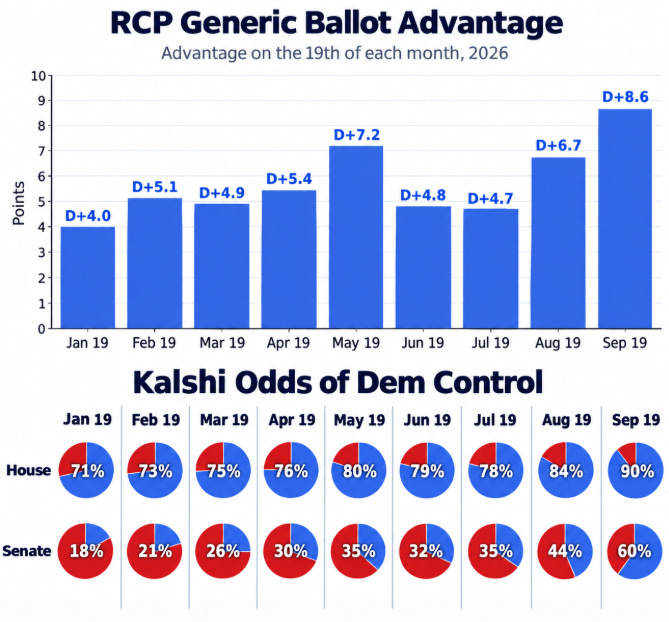
Democrats have celebrated Tuesday’s victories in Florida as another signal that voters are turning against Trump and Republicans. They are the latest in a series of special election victories for Democrats across the country since the president returned to the White House more than a year ago
In Florida, Democrat Emily Gregory won a special election to represent the state’s 87th House district, flipping a seat that includes Trump’s Mar-a-Lago estate. The president carried the district by double digits in the 2024 election.
Trump had endorsed Gregory's Republican rival, Jon Maples. In a post on his Truth Social platform on Monday, he urged voters to turn out to vote, saying Maples was backed “by so many of my Palm Beach County friends.”

Also in Florida, Democrat Brian Nathan declared victory in a tight race to replace Republican Jay Collins in State Senate District 14, after Collins was tapped by Florida Governor Ron DeSantis to serve as his lieutenant governor.

The win is a major upset in a Tampa-area district that Collins won by almost 10 percentage points in 2022 and where there are about 22,000 more registered Republican voters than Democrats.

The two seats are the 29th and 30th seats that Democrats have flipped from Republican control since Trump returned to office, Heather Williams, president of the Democratic Legislative Campaign Committee, said in a statement to Newsweek.


Tuesday, March 24, 2026

Struggling

Our most recent book is The Comeback: The 2024 Elections and American Politics. The second Trump administration has been full of ominous developments 

Sarah Fioroni at Gallup:

For the first time since Gallup began measuring the life evaluation of the American workforce, more U.S. workers are struggling in their lives (49%) than thriving (46%). This contrasts with 2022 and 2023, when the reverse was true, with the share of U.S. employees considered “thriving” staying in the low-to-mid 50s — a mark of relative resilience after pandemic disruptions. After staying steady between 57% and 60% from 2009 to 2019, the thriving rate among workers fell to 55% in 2020 before rebounding in 2021 then steadily decreasing after that.


Monday, March 23, 2026

Trump Blinks Twice

Our most recent book is The Comeback: The 2024 Elections and American Politics. The second Trump administration has been full of ominous developments -- now including a war in the Middle East. It's good that he backed down from his reckless threat to Iranian energy.  It's bad that he had to.


Sunday, March 22, 2026

Trump Gloats About Mueller's Death

 Our books have discussed Trump's low character, which was on display this weekend.


In 2016, Trump asked Russia to hack Hillary Clinton's emails  As the Mueller report note,  the Russian military quckly did has he had asked.  From the Mueller report.


Trump later claimed that he was just kidding.  He was not. When reporter Katy Tur asked him if the request gave him pause, he said, "It gives me no pause."  When she pressed him, he told her, "Be quiet."

Saturday, March 21, 2026

Shell Super PACs


 Clara Ence Morse and Dan Merica at WP:
The political arm of the American Israel Public Affairs Committee funneled over $5 million to other groups as part of its work to defeat Illinois Democrats critical of Israel in House primaries held Tuesday, filings made public late Friday show. The secretive giving is the latest example of how outside groups are obscuring their spending in competitive campaigns.

The contributions, which didn’t have to be disclosed until after Election Day under federal campaign finance regulations, funded part of a record-breaking total of outside spending: $225 million has been spent to influence midterm elections so far, according to a Post analysis of federal election data. Special interest groups, including AIPAC, have sometimes tried to veil their spending by using affiliated organizations that appear unrelated to the parent organization’s stated policy goals.

AIPAC, a pro-Israel group that has grown increasingly unpopular with Democratic primary voters, cloaked its spending in a trio of innocuously named organizations — Chicago Progressive Partnership, Affordable Chicago Now and Elect Chicago Women — and ran ads that attacked candidates, including Evanston Mayor Daniel Biss, for a variety of reasons other than his position on the Israeli-Palestinian issue.
“It’s awful for politics,” said Jim Kessler, an executive at Third Way, a center-left think tank and advocacy organization. The use of shell super PACs, he added, shows these groups know “what you’re peddling is not popular with voters.”

The groups behind the spending argue they are using legal tools to further their goals and hinted they will do so in future primaries. Critics argue that the masking is underhanded, noting that the practice suggests the groups know their policy objectives are unpopular, or they would otherwise be willing to reveal the spending before the races are decided

Friday, March 20, 2026

Trump Coalition

Our most recent book is The Comeback: The 2024 Elections and American Politics. The second Trump administration has been full of ominous developments -- now including a war in the Middle East.

Ian Ward at Politico:

With the 2026 midterms fast approaching, those divides have fueled speculation that MAGA voters might defect en masse from the GOP in November. But that’s not the primary threat facing the Trump coalition: Recent polling suggests that self-identified “MAGA Republicans” are standing firmly with Trump on the war and a host of other divisive issues, underscoring the stubborn reality that — as Trump has pithily put it — “MAGA is me.”

Yet as several conservative commentators have recently pointed out, Trump didn’t win reelection in 2024 merely on the strength of MAGA voters. His winning coalition paired his core MAGA constituency with a broader constellation of other non-traditional Republican constituencies — disillusioned Democrats and “MAHA moms” and “manosphere” podcast bros among them.

It is that broader Trumpian coalition — rather than the core base of MAGA supporters — that some Trump backers fear has been endangered by Trump’s policy choices. As the conservative activist Mike Cernovich put it this week, “A generational coalition, squandered.”


The issues:


Wednesday, March 18, 2026

Save America Act Would Backfire on the GOP

 Our most recent book is The Comeback: The 2024 Elections and American Politics. The second Trump administration has been full of ominous developments.  Trump keeps pushing the myth of widespread fraud in US elections. He is demanding that the Senate pass the Save America Act. It would backfire on the GOP.

 Amy B Wang, Scott Clement and Lydia Sidhom at WP:

Everyone would need to present a photo ID to cast a ballot. But the bill would have the greatest impact on the registration process. While the bill does not explicitly require everyone to reregister to vote, a significant number of currently registered voters could be asked to provide documentation to remain on the rolls. Others may have to reregister because of a move or a name change. And this registration would need to take place in person.

An analysis by The Washington Post found that a greater number of Republican-held congressional districts have at least 5 percent of residents who would need to reregister to vote because they are considered “inactive voters.” That means they failed to verify their address with election officials, haven’t voted in two or more consecutive federal elections, or have no valid or current address on file. In about 54 percent of Republican-held congressional districts, at least 5 percent of residents would have to reregister to vote, more than the 36 percent of Democratic-held congressional districts in which at least 5 percent of residents would need to reregister.

About 21 million U.S. citizens of voting age (9 percent) do not have or lack easy access to documents proving their citizenship, according to a 2023 survey conducted by the University of Maryland’s Center for Democracy and Civic Engagement, VoteRiders and the Brennan Center for Justice.

About 2.6 million Americans of voting age (1 percent) do not have any government-issued photo ID, while 34.5 million (15 percent) do not have a driver’s license or official state ID card that has their current name and address, according to the survey. Under the Save America Act, student IDs and other state licenses or ID cards would not be accepted.

As many as 69 million married women in the United States do not have a birth certificate that matches their legal name, according to the Center for American Progress, and they could face additional hurdles if they need to register to vote.

Much of the real-world impact would ultimately depend on how states implement the verification requirements — whether they already collect proof of citizenship from voters, for example.

Wren Orey and William T. Adler at the Bipartisan Policy Center:

Research from Pew Research Center finds that Republican women are about half as likely as Democratic women to keep their last name after marriage (10% versus 20%), suggesting that Republican voters may be somewhat more likely to have to complete additional steps 4 linking their birth certificate to their current voter record.

In short, birth certificates are a less reliable form of documentary proof than passports. Because Republicans are more likely to rely on them than Democrats, they may ultimately be more disadvantaged by documentary proof requirements.

Democrats do better among voters with more years of education.  And they find that this variable correlates with passport possession:

  • No HS 16%
  • HS 30%
  • 2-yr 41%
  • Some college 37%
  • 4-yr 61%
  • Postgrad 72%


Marc Novicoff  at The Atlantic:

One recent YouGov poll showed that 64 percent of Harris voters reported having a valid passport compared with 55 percent of Trump voters. According to an analysis by the voting-rights nonprofit Secure Democracy USA, the 13 states in which people are least likely to have a passport voted for Trump in 2024. Passports are especially rare in rural counties, where Republicans run up the score, Daniel Griffith, the author of the report, told me.


Tuesday, March 17, 2026

Trumpism's Three Pillars Collapse


Ian Ward at Politico:
The three issues that stood as the unshakable pillars of Trumpism have all at once become political millstones around his neck.

Start with immigration. In line with his 2016 campaign promises, Trump has indeed swept away whatever remained of the GOP’s pro-immigrant past, replacing it with a new nativist orthodoxy that seeks not merely to stem the tide of mass migration but to reverse the demographic changes of the past half-century.

But following the pushback to ICE’s aggressive immigration raids in Minneapolis and elsewhere, the administration is confronting the political risks of that new orthodoxy: Recent polls suggest that nearly half of all Americans — including 1-in-5 voters who backed Trump in 2024 — think his mass deportations campaigns are “too aggressive.” In response, the White House has reportedly urged congressional Republicans to soften their hardline rhetoric on mass deportations, warning them that it could cost the GOP key voting blocs in the 2026 midterms.

The situation doesn’t look much better on trade. As with immigration, Trump’s successful campaign to get the GOP on board with trade protectionism has come with a significant political cost: over 60 percent of Americans disapprove of Trump’s tariffs, according to some recent polls, and even Republican voters are split about the upsides of his trade war. Even worse for the administration is the slew of recent polling suggesting that a majority of voters blame Trump’s tariffs for raising the cost of living — a significant political liability in an election year where “affordability” remains a top concern for voters.

On foreign policy, Trump’s military moves abroad remain broadly popular with self-identified “MAGA” Republicans. But there are signs that his forays into foreign interventionism —  including the ongoing war with Iran — are unpopular with the critical independent and swing voters who pushed Trump over the top in 2024. Inside the White House, Trump’s senior advisers appear increasingly anxious that those numbers could get even worse if the war continues to push up gas and energy prices.

That said, foreign policy poses the most vexing question of the political downsides of Trump’s fidelity (or lack thereof) to pure and uncut “Trumpism.” Unlike on trade or immigration, where the blowback has been prompted by Trump’s fulfillment of an original campaign promise, there’s a case to be made that the president is courting political disaster by betraying Trumpism’s original promise on foreign policy — to prioritize American interests by keeping America out of foreign wars.


A crack in the MAGA wall:


Monday, March 16, 2026

Bad Days for Trump


Will Wessert at AP:
In the two weeks since the U.S. and Israel launched strikes on Iran, President Donald Trump increasingly has been knocked on his political heels.

He’s grown more agitated with news coverage and has failed to find a way to explain why he started the war — or how he will end it — that resonates with a public concerned by American deaths in the conflict, surging oil prices and dropping financial markets. Even some of his supporters are questioning his plan and his overall poll numbers are declining.

Meanwhile, Moscow is getting a boost from the war’s early days after Trump eased sanctions on some Russian oil shipments. That, combined with rising oil prices, undercut the yearslong push to crimp President Vladimir Putin’s ability to wage war in Ukraine.

Then there are Democrats, who were left reeling after Trump won the 2024 election. With control of Congress at stake in November’s midterms, the party has come together to oppose Trump’s Iran policy and point to the economic turmoil as proof that Republicans haven’t kept their promises to bring down everyday costs.

Jim VandeHei and Mike Allen at Axios:

Trump is working to help break the Persian Gulf oil jam. But in doing so, he risks getting caught in an "escalation trap," where a stronger force is incentivized to keep attacking to demonstrate dominance amid diminishing returns.A senior Trump administration official practically admitted as much, telling Axios' Marc Caputo: "The Iranians f*cking around with the Strait makes [Trump] more dug in."

State of play: Israel wants regime change in Iran and more dramatic military destruction as it weighs an invasion of Lebanon. Bibi Netanyahu has shown several times that when it comes to Iran, he has the ability to convince Trump to take his side.Iran wants survival — and to prove it can impose pain, militarily and economically, to scare off future attacks.

...

A source close to the administration said some key officials around Trump were reluctant or wanted more time. "He ended up saying, 'I just want to do it,'" the source said. "He grossly overestimated his ability to topple the regime short of sending in ground troops." The source said Trump was "high on his own supply" after last summer's quick strikes in Iran and January's abduction of Venezuelan President Nicolás Maduro: "He saw multiple decisive quick victories with extraordinary military competence."

Tom Nichols:

This kind of thinking is an old problem, and it has a name: “victory disease,” meaning that victory in battle encourages leaders to seek out more battles, and then to believe that winning those battles means that they are winning the larger war or achieving some grand strategic aim—right up until the moment they realize that they have overreached and find themselves facing a military disaster or even total defeat. It is a condition that has afflicted many kinds of regimes over the course of history, one so common that my colleagues and I lectured military officers about it when I was a professor at the Naval War College. The issue is especially important for Americans, because when national leaders have exceptionally capable military forces at their disposal—as the United States does—they are even more likely to be seized by victory disease.

The Persian emperor Xerxes had it; that’s how he found himself eventually suffering a historic defeat in Greece at the Battle of Salamis. Napoleon had it; that’s how he ended up freezing in the Russian snow after years of brilliant victories over other European states. The French in 1870 had it; that’s how they confidently marched to catastrophes against a superior Prussian army. The Axis had it; that’s how Germany and Japan convinced themselves that their early successes meant that they could quickly defeat the Soviet Union and the United States, respectively.

Sunday, March 15, 2026

Trying to Control the Media

Our most recent book is The Comeback: The 2024 Elections and American Politics. The second Trump administration has been full of ominous developmentsHe and his allies are using legal and regulatory pressure to stifle dissent.

Ashley Ahn at NYT:
Brendan Carr, the chairman of the Federal Communications Commission, threatened on Saturday to revoke broadcasters’ licenses over their coverage of the war with Iran, his latest move in a campaign to stomp out what he sees as liberal bias in broadcasts.

As the war entered its third week, Mr. Carr accused broadcasters of “running hoaxes and news distortions” in a social media post and warned them to “correct course before their license renewals come up.”

“Broadcasters must operate in the public interest, and they will lose their licenses if they do not,” he said.

Mr. Carr shared a Truth Social post by President Trump that criticized the news media for its coverage of the war with Iran. Mr. Trump referred to a story published by The Wall Street Journal that reported five American refueling planes had been struck in Saudi Arabia, claiming its headline was “intentionally misleading.” He accused the news media of wanting the United States to lose the war.

Dow Jones & Company, which publishes The Wall Street Journal, did not immediately respond to a request for comment.

Defense Secretary Pete Hegseth, in a similar vein, delivered a lengthy complaint about CNN’s coverage of the war in the Middle East during a news conference Friday, saying that he looked forward to the news network being controlled by the billionaire David Ellison.


Saturday, March 14, 2026

Dire Strait of Hormuz

 Our most recent book is The Comeback: The 2024 Elections and American Politics. The second Trump administration has been full of ominous developments -- now including a war in the Middle East.

Alexander Wardm Lara Seligman, Alex Leary, and Vera Bergengruen at WSJ:

Before the U.S. went to war, Gen. Dan Caine, the chairman of the Joint Chiefs of Staff, told President Trump that an American attack could prompt Iran to close the Strait of Hormuz.

Caine said in several briefings that U.S. officials had long believed Iran would deploy mines, drones and missiles to close the world’s most vital shipping lane, according to people with knowledge of the discussions.

Trump acknowledged the risk, these people said, but moved forward with the most consequential foreign-policy decision of his two presidencies. He told his team that Tehran would likely capitulate before closing the strait—and even if Iran tried, the U.S. military could handle it.

Now, two weeks into the war, Iran’s leaders have refused to back down, and the Strait of Hormuz has emerged as Tehran’s most potent leverage point.
Adam Cancryn et al. at CNN:
Instead of rapid collapse, the Iranian regime has consolidated control, and responded more aggressively than US officials expected, firing on targets across the Middle East, including oil tankers in the region. Iran has effectively halted the flow of oil through the Strait of Hormuz, sparking a global energy crisis that the administration is now struggling to contain.

Trump has continued to tout the war as a resounding success, seizing on the scale of the military operation and suggesting the US could declare victory at any moment. But two weeks in, the administration is no closer to articulating a defined strategy for finishing a conflict that has grown only more complicated by the day, according to interviews with more than a half-dozen people familiar with the internal deliberations.

Thirteen American service members have died thus far, and roughly 140 others have been wounded since the fighting began. Across the US, there is little indication in early polling that the public is on board with the idea of war.
...

On Friday, the average per-gallon price of gas in the US stood at $3.63, an increase of 65 cents since the war began and the highest level in nearly two years.

Within the Republican Party, the surge has undercut a core element of its political pitch ahead of midterm elections focused chiefly on the cost-of-living, erasing all the progress made toward lower gas prices since Trump took office.


Friday, March 13, 2026

State Legislative Elections and the Midterm


Natalie Fertig at Politico:
Democrats have flipped 28 Republican-held seats in state legislatures across the country over the past 14 months, a sign that the GOP is indeed at risk of losing control of the House, and maybe even the Senate, in the midterms.

Democratic wins have come even in deep red states, including Texas, Arkansas and Mississippi, and often by margins that make Republican leaders uneasy.

“I’m ringing the alarm bell,” said Brendan Steinhauser, a Texas GOP consultant who has run campaigns for Republicans in the state, including Sen. John Cornyn and Rep. Dan Crenshaw.

The results of these state-level elections reflect the immediate concerns of the electorate, provide a launching pad for the next generation of national leaders and could influence the future makeup of Congress through redistricting. They may also give both Republicans and Democrats a preview of the midterm battles to come.

Wednesday, March 11, 2026

Miscalculation

 Our most recent book is The Comeback: The 2024 Elections and American Politics. The second Trump administration has been full of ominous developments -- now including a war in the Middle East.

Mark Mazzetti, Tyler Pager and Edward Wong at NYT:

On Feb. 18, as President Trump weighed whether to launch military attacks on Iran, Chris Wright, the energy secretary, told an interviewer he was not concerned that the looming war might disrupt oil supplies in the Middle East and wreak havoc in energy markets.

Even during the Israeli and U.S. strikes against Iran last June, Mr. Wright said, there had been little disruption in the markets. “Oil prices blipped up and then went back down,” he said. Some of Mr. Trump’s other advisers shared similar views in private, dismissing warnings that — the second time around — Iran might wage economic warfare by closing shipping lanes carrying roughly 20 percent of the world’s oil supply.

The extent of that miscalculation was laid bare in recent days, as Iran threatened to fire at commercial oil tankers transiting the Strait of Hormuz, the strategic choke point through which all ships must pass on their way out of the Persian Gulf. In response to the Iranian threats, commercial shipping has come to a standstill in the Gulf, oil prices have spiked, and the Trump administration has scrambled to find ways to tamp down an economic crisis that has triggered higher gasoline prices for Americans.

The episode is emblematic of how much Mr. Trump and his advisers misjudged how Iran would respond to a conflict that the government in Tehran sees as an existential threat. Iran has responded far more aggressively than it did during last June’s 12-day war, firing barrages of missiles and drones at U.S. military bases, cities in Arab nations across the Middle East, and on Israeli population centers.

Monday, March 9, 2026

Bad Optics

 Our most recent book is The Comeback: The 2024 Elections and American Politics.  For a reality-TV guy, Trump has seemed remarkably inattentive to optics.