Search This Blog

Friday, February 12, 2016

An IRS Win for GPS

Matea Gold reports at The Washington Post:
The Internal Revenue Service has granted tax-exempt status to Crossroads GPS, a conservative group that has aggressively pioneered in a new form of political engagement by nonprofit groups sanctioned by the Supreme Court's Citizens United decision.
The decision by the IRS -- first reported by OpenSecrets.org, the website of the nonpartisan Center for Responsive Politics -- means that Crossroads GPS has been deemed a "social welfare" nonprofit under Section 501(c)(4) of the tax code. Such groups can raised unlimited sums from individuals and corporations and spend money on direct political activity, as long as they do not spend the majority of their funds on campaigns. Unlike political committees, they are not required to reveal their donors.
“We have always taken compliance very seriously, so we’re not surprised by the final result," president Steven Law said in a statement. "What we were surprised by was how long it took and how people outside the IRS improperly tried to influence and politicize the process, not just against us but against many other law-abiding advocacy groups.”

Thursday, February 11, 2016

Wednesday, February 10, 2016

But Seriously...

My take at Fox and Hounds:
When George Wallace ran for the Democratic presidential nomination in 1972, his slogan was “Send Them a Message!” Last night’s winners might as well have used the same catchphrase. The New Hampshire primary was a political Festivus, in which Donald Trump and Bernie Sanders performed feats of strength while the electorate undertook the airing of grievances. Voters wanted to show that they were fed up with the political and economic establishments, and the double-digit margins got the message across quite vividly.
Trump and Sanders have become the voices of discontent by positioning themselves as “outsiders.” In neither case is the mantle a perfect fit. Sanders has held office for 33 of the past 35 years, and has always caucused with congressional Democrats. His avowed socialism scarcely sets him apart in a party that has galloped leftward ever since Bill Clinton let go of the reins in 2001. Trump has direct experience in government. Rather, he bought his seat at the table of power by spreading money liberally among New York politicians. If Trump supporters are right that most political insiders are prostitutes, then Trump has distinguished himself by being a john.
In the weeks ahead, as the delegate totals increase and the general election draws nearer, voters might start to realize that they are not just sending messages but picking people who could actually become president of the United States. Will this realization change the way that they think about their choices? If it does, then Sanders and Trump will have some problems. It’s not just that either would be the oldest man ever to enter the White House. What’s more important, both would also face questions about their qualifications.
For all his years in office, Sanders seems to have some gaps in his knowledge. James Hohmann of The Washington Post reported on last week’s debate: “The Vermont senator, leading in polls ahead of Tuesday’s primary, conceded that the former secretary of state has more experience on international issues, but he argued that he has superior judgment. When pressed for specifics, though, Sanders offered simplistic answers that were anything but reassuring to experts and elites.” Sanders is scarcely more reassuring on domestic policy. He recently wrote: “Any Supreme Court nominee of mine will make overturning Citizens United one of their first decisions.” Apparently he did not realize that the court cannot change precedents at will: it has to wait for actual cases to come before it. And in any case, no president can bind justices to vote a certain way.
Trump’s qualification problems are even worse. His misstatements of fact are so numerous that fact-checkers have practically given up counting them. When someone does catch him in a whopper – such as his preposterous claim that he saw thousands of American Muslims cheer the attack on the World Trade Center – he just sticks to his false story. Given that a president has to make life-or-death decisions based on judgments about foreign intelligence, it would be disturbing to have a president who thinks, “If I believe it, then it’s so.”
George Washington could not tell a lie. Joe Isuzu could not tell the truth. Donald Trump cannot tell the difference.

New Hampshire's GOP Storm

Byron York recalls a January New Hampshire GOP gathering:
What was extraordinary about the gathering was that I talked to a lot of people there, politically active Republicans, and most of them told me they personally didn't know anyone who supported Trump. Asked about the Trump lead, one very well-connected New Hampshire Republican told me, "I don't see it. I don't feel it. I don't hear it, and I spend part of every day with Republican voters."
Readers of the story came to one of two conclusions. Either New Hampshire Republican leaders were so out of touch that they couldn't tell something huge was happening right under their noses, or there really weren't very many Trump voters, and the Trump phenomenon was a mirage that would fade before election day.
Now, with Trump's smashing victory in the New Hampshire primary, we know the answer. There really were a lot of Trump voters out there, and party officials could not, or did not want, to see them.
CNN reports:
Exit poll results from the New Hampshire primary on Tuesday night showed deep discontent with the Republican Party and the federal government, and the candidate who railed hardest on those topics, Donald Trump, won with multiple groups of voters.
Trump won New Hampshire's primary by carrying a range of demographic and ideological groups with more than 30% of the vote. He topped the rest of the field among both men and women, voters under age 64, voters without a college degree, and those who have a college degree but no postgraduate study.
He won among conservatives and moderates, first-time voters and those who've voted before and registered Republicans and those who are undeclared.
Trump won 6-in-10 voters who said they were looking for an outside candidate.
But New Hampshire also exposed a weakness for Trump: late-deciding voters, who made up almost half the Republican vote, broke evenly between Trump and Ohio Gov. John Kasich.
At The Washington Post, Philip Bump looks at how Rubio crashed:
We can say pretty conclusively that a look at polls in New Hampshire on the day of the Iowa caucuses (when Rubio had an average of 9.5 percent) and a look at the final result would suggest that Rubio had no bump during the last week -- or that, if he did, the tide went out as suddenly as it came in.

Rubio was the favorite target of other people in that middle tier over the week, which was precisely why Christie went after him. Maybe that, as much as the debate, was what New Hampshire was reacting to, if it was reacting to anything.

Rubio's speech on Tuesday night may have been wrong. But it was purposeful. Rubio recognized that he did badly in New Hampshire, and, in front of his supporters, pointed to the broken part of his campaign that he said had caused it.

Tuesday, February 9, 2016

The Case Against the Autopsy

At National Review, Jim Geraghty argues that the RNC autopsy report erred badly on immigration:
The Republican base may or may not be on board with the idea of deporting every last illegal immigrant, but there exists a broad consensus that we must make our southern border as impenetrable as possible and that illegal immigrants should face significant consequences for breaking the law. While there are very few who think legal immigration should cease entirely, 67 percent of Republicans (and 49 percent of all Americans) think legal immigration should be reduced from current levels.
The RNC report’s advocacy for a path to citizenship was a slap in the face to those Republicans who had long been angry about illegal immigration. Businesses big and small made the decision to employ illegal immigrants in violation of the law. A generation of Washington politicians responded with a tacit shrug, even after 9/11. That same generation of politicians, running a government infrastructure capable of reading all of our e-mails and vacuuming up the metadata from all of our cell phones, didn’t seem to care that millions of visitors had overstayed their visas and disappeared from the system. Local governments that will nail you for an expired parking meter announced they were “sanctuary cities” and would no longer cooperate with federal efforts to deport those here illegally. And Immigration and Customs Enforcement, charged with leading those efforts, botched its most basic duties.

Again, in late 2012 and early 2013, it wasn’t easy for the RNC team to foresee that these scandals would capture the public’s attention and remain at the forefront of Republicans minds. But it wasn’t exactly impossible, either.

Monday, February 8, 2016

Old Trump

Donald Trump turns 70 on June 14.  If he won the presidential election, he would be the oldest person ever to take the oath of office for the first time.  (Reagan was a couple of weeks shy of 70 on January 20, 1981.)  At The Washington Post, Jose Del Real reports that he is showing his age:
Republican presidential candidate Donald Trump, dressed as always in a suit and tie, stepped into the quaint Chez Vachon diner in Manchester on Sunday morning to make the sort of down-home campaign stop his critics accuse him of never attempting. He slowly walked through the must-see election destination, smiling reflexively as he shook hands with patrons and posed for pictures with nervous supporters.
It seemed like a humble gesture by the celebrity mogul to New Hampshire voters, who notoriously insist on meeting candidates multiple times before rewarding them with their votes. But after two days without public campaign events in the Granite State, it also served to highlight the extent to which Trump — who seemed weary after Saturday’s debate — has failed to meet regularly with Granite State voters on their terms.

Sunday, February 7, 2016

Rubio's Bad Night

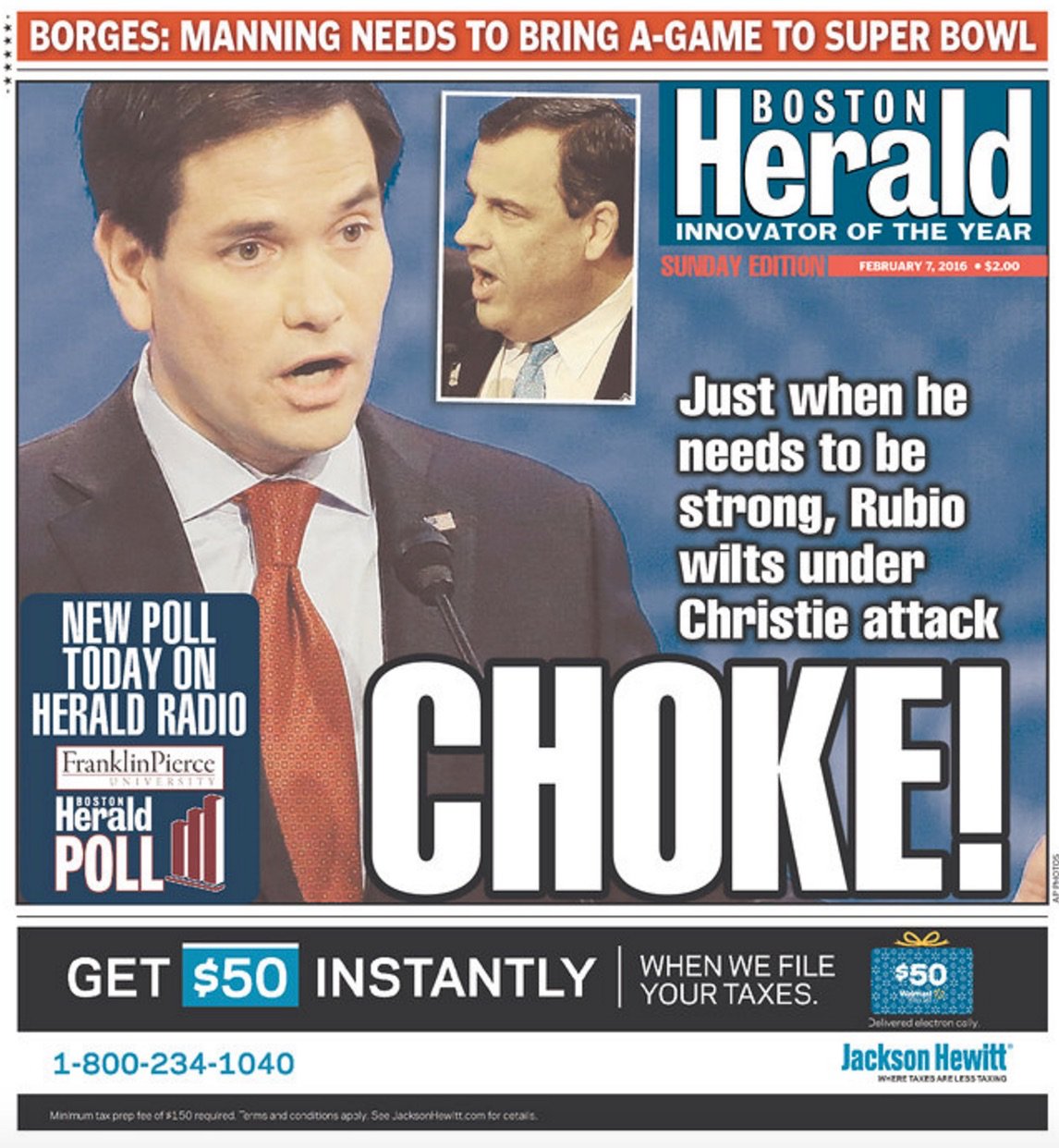
Rubio's debate performance last night got brutal reviews.  John Podhoretz is one of many:
Just as the key story for the GOP presidential race in the past week has been the rise of Marco Rubio, so the key question arising from the GOP presidential debate in New Hampshire is: How seriously did the Florida senator hurt himself?

The most consistently excellent debater in the Republican field had a dreadful five minutes in the debate’s opening portion. Under relentless attack from New Jersey Governor Chris Christie, who likened him to Barack Obama in 2008 as an inexperienced lightweight in over his head, Rubio found himself defaulting to the exact same sound bite four times over — and I mean exact.

He said he wanted to dispel the “fiction that Barack Obama doesn’t know what he’s doing. He knows exactly what he’s doing.” Christie pushed back. And Rubio said: “This notion that Barack Obama doesn’t know what he’s doing is just not true. He knows exactly what he’s doing.”

“There it is,” Christie said, “the memorized 25-second speech.”
Unfortunately for Rubio, many New Hampshire voters read this paper:


How many New Hampshire voters saw a Saturday night debate on Super Bowl weekend?  Will the stories about Rubio influence voters who did not see the debate? How many will care?   The answers will be obvious by Wednesday morning. Meanwhile, Nate  Silver wisely urges caution:
As I wrote after the previous debate, political reporters are in the “fog of war” phase of the campaign where our reactions aren’t necessarily good matches for those of voters at home. Some of the reason we reporters thought Rubio’s answer was so awful is because it confirmed some of our gossip about Rubio, namely that he tends to give pat, repetitive answers. But we tend to be more sensitive about that stuff, because we watch every debate from start to finish, and then we see lots of the candidates’ stump speeches and town halls on top of it. There’s a fine line between a candidate who seems stilted and repetitive and one who seems “on message” instead.
Is there any evidence that home viewers saw Rubio’s performance differently? Well, maybe. On Google Trends, there was a huge spike in searches for Rubio during the debate — but it came not during his glitchy moments but instead after an effective answer he delivered on abortion about two hours into the debate. Meanwhile, a Google Consumer Surveyspoll conducted midway through the debate found respondents thought that Trump, Rubio and Cruz (in that order) were winning the debate. Undoubtedly, this mostly just reflects the fact that Trump, Rubio and Cruz are the most popular Republican candidates to begin with, but it’s also a reminder that one bad answer, or one bad evening, may not weigh all that much on voters’ minds.