Search This Blog

Showing posts with label Bernie Sanders. Show all posts

Wednesday, June 26, 2024

Bye Bye Bowman

Our most recent book is titled Divided We Stand: The 2020 Elections and American Politics.  Among other things, it discusses state and congressional elections.

Nicholas Fandos at NYT:

Representative Jamaal Bowman of New York, one of Congress’s most outspoken progressives, suffered a stinging primary defeat on Tuesday, according to The Associated Press, unable to overcome a record-shattering campaign from pro-Israel groups and a slate of self-inflicted blunders.

Mr. Bowman was defeated by George Latimer, the Westchester County executive, in a race that became the year’s ugliest intraparty brawl and the most expensive House primary in history.

It began last fall when Mr. Bowman stepped forward as one of the leading critics of how Israelis were carrying out their war with Hamas. But the contest grew into a broader proxy fight around the future of the Democratic Party, exposing painful fractures over race, class and ideology in a diverse district that includes parts of Westchester County and the Bronx.

Mr. Bowman, the district’s first Black congressman and a committed democratic socialist, never wavered from his calls for a cease-fire in Gaza or left-wing economic priorities. Down in the polls, he repeatedly accused his white opponent of racism and used expletives in denouncing the pro-Israel groups as a “Zionist regime” trying to buy the election.

...

A super PAC affiliated with the American Israel Public Affairs Committee, a pro-Israel lobby, dumped $15 million into defeating him, more than any outside group has ever spent on a House race.

.. 

Mr. Bowman, 48, struck a defiant tone in his concession speech. He accused AIPAC and other super PACs involved in the race of spending huge sums to “brainwash people into believing something that isn’t true” and contended that “when we say ‘Free Palestine’ it is not antisemitic.” [He defended the annihilationist phrase "From the River to the Sea."]

“I would like to make a public apology for sometimes using foul language,” he said. “But we should not be well adjusted to a sick society.”

 Politico Playbook notes that it was not just about Bowman's radicalism and antisemitism.

— Mind your voting record and personal behavior: As our colleagues Nick Reisman, Rich Mendez and Emily Ngo write, the ads against Bowman barely mentioned Israel. Instead, the focus was largely on Bowman’s votes against Biden’s infrastructure law and against raising the debt ceiling.

And then there’s the fire alarm. As NYT’s Nicholas Fandos writes, the timing of the episode that resulted in a misdemeanor plea and House censure “could hardly have been worse. Opposition researchers turned up old blog posts dabbling in 9/11 conspiracy theories and publicized video of Mr. Bowman calling reports that Hamas sexually abused Israeli women during its attack ‘propaganda.’ (He later apologized.)”

— Don’t alienate your friends back home: A more skilled politician might have survived those travails with a local support network in place. Bowman didn’t have that; local political leaders instead flocked to Latimer, who as county executive had built close ties with mayors and town councilors, as AP’s Anthony Izaguirre writes, while Bowman had his eye on the national stage.

That relative lack of local backup extended to a notable Brooklynite — House Minority Leader HAKEEM JEFFRIES, who helped Bowman with a $5,000 leadership PAC donation and a late robocall, but did not exactly move heaven and earth to rescue him, as Akela Lacy of The Intercept reports.

— Don’t alienate your colleagues in Washington: Expect to hear plenty in the next few days about what Bowman’s loss means for the progressive movement writ large. But we heard yesterday from a House Democrat who represents a competitive district who wanted to vent about how Bowman’s loss was completely avoidable.

It was less about ideology, this lawmaker said, and more about how he went about his job: “Nobody who cares about them tried to help, tried to stop them, tried to say, ‘Hey, there's a better way. You don't need to do this. You can advocate for your position without alienating the vast majority of voters.’”

The frustration inside the caucus, the member continued, isn’t about any other member’s particular views on Israel or Medicare for All or any other issue. It’s about a lack of focus on winning a majority and focusing on the job of passing legislation.

“If you're going to start huge fights as opposed to governing,” the person said, “there are consequences.”

Russell Berman at The Atlantic:

Bowman’s progressive allies tried to rescue him in the closing days of the race. Ocasio-Cortez and Senator Bernie Sanders of Vermont headlined a rally for him in the South Bronx on Saturday. But despite being billed as a “get out the vote” event, the rally took place outside Bowman’s district, about seven miles away from any of his constituents. Three days later, they voted him out.


Wednesday, September 2, 2020

MA Primary

In Defying the Odds, we discuss state and congressional elections as well as the presidential race.  Progressives have done fairly well in Democratic primaries.

Russell Berman at The Atlantic:
Overall, the Massachusetts primary results did not fit neatly into a larger national narrative. They represented a vindication for incumbents but a mixed bag for progressives, who succeeded in protecting Markey but failed in their bid to oust long-serving Representative Richard Neal, the chairman of the House Ways and Means Committee. Neal defeated a young progressive challenger, Holyoke Mayor Alex Morse, in his bid for a 17th term.
...'
Kennedy jumped into the race a year ago after a pair of polls showed him well ahead of Markey in a hypothetical matchup; the surveys were a testament to both the Kennedy brand in Massachusetts and the lack of one for Markey, despite his having represented the state in Congress since before Joe Kennedy was born. By a margin of 18 points, Democratic voters in a Boston Globe poll identified Kennedy as the more liberal candidate. The genius of Markey’s campaign was that it took his biggest vulnerability and used it as an opportunity: The senator didn’t have much of a political identity in Massachusetts, so his supporters created one for him.

Markey became “someone who most people in Massachusetts who follow politics would say is unrecognizable,” Mary Anne Marsh, a veteran Democratic strategist in the Bay State, told me.

The identity Markey’s camp created—that of a tenacious progressive fighter who often took lonely stands against his party—closely resembled Sanders’s. They dug up a vintage 1970s TV ad from when Markey first ran for Congress, in which he boasted that party bosses had thrown his desk out into a hallway. The linchpin of the strategy was Representative Alexandria Ocasio-Cortez, who endorsed Markey after he partnered with her to introduce the Green New Deal just weeks after she took office in 2019. Progressive groups such as the Sunrise Movement joined her in backing Markey, rewarding his leadership on climate change while forgiving his votes for the Iraq War, NAFTA, and the 1994 crime bill. (Activists on the left assailed former Vice President Joe Biden for a similar record during the Democratic presidential primary.) A three-minute video hailing Markey as the “Green New Dealmaker” and co-opting a famous Kennedy refrain became a sensation, and an ad featuring Ocasio-Cortez ran on TV in the state more than 1,200 times.

Sunday, August 16, 2020

The Wolf Through the Gate

In Defying the Odds, we discuss the 2016 campaign. The 2019 update includes a chapter on the 2018 midterms. The 2020 race, the subject of our next book, is well underway.  

Dan Balz at WP:
The Democratic National Convention will open Monday in a spirit of unity and shared purpose, with the party’s often-warring moderate establishment and galvanized liberal wings agreeing for now to set aside their differences to defeat President Trump in November and deliver the White House to Joe Biden.

...

That Democrats today appear far more unified is testament in part to the work of Biden, Sanders and their teams over the past several months to avoid a repeat of the 2016 experience. But the unity owes much more to the occupant of the White House, whom many Democrats fear could inflict lasting damage to the country and its democratic institutions if he gains a second term.

“Four years ago, you could point to Donald Trump as the wolf at the gate, but it was still theoretical,” said Pete Buttigieg, the former South Bend, Ind., mayor who ran unsuccessfully against Biden in the primaries. “Now the wolf is through the gate, eating the chickens.”
...
Robby Mook, who was Clinton’s campaign manager in 2016, said there are major differences between the eve of this convention and four years ago. One is Trump’s presidency, another the personal relationship between Biden and Sanders, which is better than the one between Sanders and Clinton, and then the impact of the pandemic in focusing people’s attention.

But Mook also cited a fourth difference, which is the result of Democrats having to stage a virtual convention rather than a traditional gathering. “There’s no convention,” he said. “In 2016, they [the most ardent Sanders supporters] had a stage on which to play. That stage is gone.”
..

A major piece of the strategy was the Biden campaign’s creation of issue task forces composed of elected officials and others who represented the full breadth of the party. Perhaps the most symbolically significant pairing was the task force on climate, which included former secretary of state John F. Kerry, an establishment Brahmin and close friend of Biden, and Rep. Alexandria Ocasio-Cortez (D-N.Y.), the star of the party’s insurgent wing.

Democrats this year have put together the most liberal platform in the party’s history, including ideas that were advanced by Sanders in his 2016 campaign but rejected then by many in the party’s center-left cohort.

Director Ava DuVernay on Instagram:
There is no debate anymore. There’s no room for it in my book. We either make this happen. Or literally, more of us perish. People are dying. Someone I love died. This virus is real. If it hasn’t visited your doorstep, it will. Oh but, Kamala did this or she didn’t do that. I hear you. I know. And I don’t care. Because what she DIDN’T DO is abandon citizens in a pandemic, rip babies from their mother’s arms at the border, send federal troops to terrorize protestors, manufacture new ways to suppress Black and Brown votes, actively disrespect Indigenous people and land, traffic in white supremacist rhetoric in an effort to stir racist violence at every turn, attempt to dismantle most American democratic systems of checks and balance, degrade women all day everyday, infect the Supreme Court with another misogynist hack, demolish America’s standing on climate, actively cultivate and further white supremacist structures and systems across all aspects of American daily life. I mean, that’s what she DIDN’T do. So I don’t wanna hear anything bad about her. It doesn’t matter to me. Vote them in and then let’s hold them accountable. Anything other than that is insanity. It’s ego. It’s against our own interests. It’s selfish. It’s disrespectful to our elders. It’s nonsense. It’s talking to hear yourself talk. This is a matter of life or death. We need all our energy focused. This is a fight for more than can be expressed here. There is no debate anymore. Not for me anyway. #voteblue2020

Wednesday, June 24, 2020

Sanders, the Left, and African Americans

In Defying the Odds, we discuss the 2016 campaign. The 2019 update includes a chapter on the 2018 midterms. The 2020 race, the subject of our next book, is well underway.  

At NYT, Sydney Ember notes that there has been a surge in progressive activism,  but it is not the kind that Bernie Sanders promoted.
Mr. Sanders, whose slogan on his campaign was “Not me, us,” described the protests as a validation of his theory of social change: “What I have said for a very long time is that real change is never going to come from the top on down, it’s always from the bottom on up.”

But during his presidential bid, Mr. Sanders at times seemed uncomfortable speaking overtly about race. At a presidential forum in April 2019 for women of color, he offered few specific policy details, and drew some groans from the audience when he referred to marching with the Rev. Dr. Martin Luther King Jr. in response to a question about how he would handle current challenges.

And more recently, during an event in Flint, Mich., in March that campaign aides had billed as an opportunity for him to speak directly to black voters, he decided not to deliver a planned speech and instead largely ceded the stage to panelists including the academic Cornel West.

When Mr. Sanders spoke about racial equality, it was often in the context of economic equality, championing proposals and prescriptions that he believed would improve the lives of all working Americans. He said that policies like single-payer health care would address higher maternal and infant mortality rates in black communities. And he wanted to legalize marijuana and end cash bail, policies he said were aimed in particular at helping black Americans and other people of color.

These proposals, however, also amounted to an implicit expectation that voters trust the government — an especially difficult sell for those including older black voters who feel they have been historically let down by the government.

They were shortcomings that help explain why Mr. Sanders lost to former Vice President Joseph R. Biden Jr. in the Democratic primary race: Unable to win over older black voters, he came in a distant second to Mr. Biden in South Carolina, then went on to lose to Mr. Biden in every Southern state on Super Tuesday. Those defeats, Mr. Sanders’s allies say, contributed to the perception that Mr. Biden was more electable and would fare better against President Trump in the general election in November — a notion that helped propel Mr. Biden to victory in the primary.

Monday, May 18, 2020

Frustration on the Left

In Defying the Odds, we discuss the 2016 campaign. The 2019 update includes a chapter on the 2018 midterms. The 2020 race, the subject of our next book, is well under  way.  

Natalie Andrews and Eliza Collins at WSJ:
Progressive Democrats’ disappointment with House coronavirus legislation this week caps a frustrating start to 2020 for the left flank of the party, which has seen its favored presidential candidates exit the race, down-ballot hopefuls meet mixed results and some priorities stall in Congress.

House Democratic leaders left a plan pushed by the Congressional Progressive Caucus to guarantee Americans’ paychecks up to $100,000 out of their latest package aimed at combating the effects of the coronavirus pandemic.
That comes as the group has been unable to get the support of House Speaker Nancy Pelosi (D., Calif.) on some priorities, such as expanding Medicare and the Green New Deal. And the presidential candidates backed by most progressives, Sens. Bernie Sanders and Elizabeth Warren, lost to former Vice President Joe Biden, a relative moderate.
Despite polls showing popularity for much of their platform, interviews with more than 20 politicians, activists and aides showed the party’s left flank has grown frustrated that it hasn’t made more progress since Democrats took control of the House a year and a half ago.

“Congress is infamous for having to try to catch up to where people are, and they’re doing a pretty crappy job of catching up in this moment,” said Paco Fabian, the director of campaigns at Our Revolution, the progressive electoral group started by Mr. Sanders after his 2016 run for president.

Mr. Sanders, however, said those feeling demoralized need to “take a deep breath.” He said polls that show progressive ideas growing more popular are a sign of success.
A Wall Street Journal/NBC News poll in March found that 67% of Democratic primary voters supported a Medicare for All system, while a Pew Research survey in January found that 63% of U.S. adults supported making public college free, both priorities of Mr. Sanders’s during his 2020 presidential run.
Still, exit polls in many states found the share of Democratic primary voters who identified as moderate grew this cycle, while fewer Democrats called themselves liberal.
Alex Thompson at Politico:
Three highly-touted liberal House candidates — Jessica Cisneros in Texas, Robert Emmons in Illinois, and Morgan Harper in Ohio — lost their primary races against more moderate members of Congress. They are now playing defense as Rep. Rashida Tlaib, one of the four members of the “squad,” faces a stiff primary challenge in Michigan. And Sen. Ed Markey (D-Mass), who’s managed a late-career makeover into a left-wing darling, with endorsements from Rep. Alexandria Ocasio-Cortez (D-N.Y.) and other progressive groups, is consistently outpolled by primary challenger, Rep. Joe Kennedy (D-Mass.).
The movement has also had limited influence on the proposals House Democrats have put forward to address the coronavirus, with leadership rejecting its most ambitious ideas.

Friday, May 8, 2020

Super PAC, Left and Right

In Defying the Odds, we discuss the 2016 campaign. The 2019 update includes a chapter on the 2018 midterms. The 2020 race, the subject of our next book, is well under  way.  

Zach Montellaro at Politico:
Justice Democrats, the hub for insurgent Democrats, has joined the rank of super PACs. On Friday, the group’s PAC filed a notice with the Federal Elections Commission announcing that it intends to become a so-called Carey Committee (which is also known as a hybrid PAC) — effectively forming a super PAC in addition to their already active PAC. 
The move is the latest example of the party’s liberal wing embracing the fundraising strategies that have been scorned by some on the left. (A spokesperson for the Justice Democrats did not respond to a voicemail or email left by Score on Sunday asking to talk about the group’s plans.) A group of top aides to Sanders’ presidential bid announced last week that they were forming a super PAC of their own to convince Sanders’ supporters to back Biden. Chuck Rocha, another Sanders aide, also formed his own super PAC, called Nuestro PAC, that aims to mobilize Latino voters.
Rocha poked at that underlying tension among some progressives who are wary of super PACs in a video he posted to Twitter over the weekend. “Just because Nuestro PAC is a quote-unquote super PAC, we ain’t taking no money from corporations. We ain't going out to work for none of these assholes I hate all my life,” Rocha said in the video. “We are literally going to the movement and trying to raise money to go out and get more Latinos to vote.”
The devil will be in the details (and the FEC reports) with these new groups. Sanders actually had over $700,000 worth of super PAC support during the primaries — but it was from Vote Nurses Values PAC, which has been funded by a nurses’ union and didn’t draw anywhere near the same kind of ire that other outside groups drew. Also worth remembering is Our Revolution, the Sanders-founded dark money nonprofit group. To try to fend off charges of hypocrisy, the group had voluntarily released the name of donors who gave over $250 — but not the exact dollar amount, which is less than the level of disclosure for super PACs. (The group said its largest donor gave $25,000.)

 Anna Massoglia and Karl Evers-Hillstrom at Open Secrets: 
After lying low for several election cycles, influential Republican super PAC American Crossroads is jumping into the 2020 presidential election to back President Donald Trump.

American Crossroads recently reported spending nearly $367,000 to support Trump in a 13-state text messaging campaign. The group placed its biggest bet of more than $89,000 in Florida, where presumptive Democratic nominee Joe Biden is polling slightly ahead of Trump.

The super PAC’s early investment indicates that Trump’s reelection bid may find support from outside groups that didn’t back his 2016 run. American Crossroads spent $91 million to support Mitt Romney and oppose President Barack Obama in 2012. But it spent just $135,000 to oppose Hillary Clinton in 2016 and spent nothing to support Trump.

Thursday, April 30, 2020

The Post-Primary

In Defying the Odds, we discuss the 2016 campaign. The 2019 update includes a chapter on the 2018 midterms. The 2020 race, the subject of our next book, is well under  way.   The Democratic nomination contest has now ended.

Stephen Ohlemacher and Bill Barrow at  Associated Press
Presumptive Democratic nominee Joe Biden has agreed to let former primary rival Bernie Sanders keep hundreds of delegates he would otherwise forfeit by dropping out of the presidential race in a deal designed to avoid the bitter feelings that marred the party in 2016 and helped lead to Hillary Clinton's defeat.
Under party rules, Sanders should lose about a third of the delegates he’s won in primaries and caucuses as the process moves ahead and states select the people who will attend the Democratic National Convention. The rules say those delegates should be Biden supporters, as he is the only candidate still actively seeking the party’s nomination.

However, in a memo obtained by The Associated Press, the Biden campaign says it will work with Sanders and state parties to fill those positions with Sanders supporters. The joint memo from the Biden and Sanders campaigns was being sent to state Democratic parties on Thursday.

“We must defeat Donald Trump this fall, and we believe that this agreement will help bring the party together to get Trump out of the White House and not only rebuild America, but transform it,” the two campaigns said in a joint statement.

In some ways, the delegate count is a moot point. While Biden has yet to formally win the 1,991 delegates needed to claim the Democratic nomination on the first ballot at the convention, he is the Democrats' presumptive nominee. All of his rivals — including Sanders — have endorsed him after ending their own campaigns.

The deal, however, is a major step in the two camps avoiding the acrimony between the Democratic establishment and progressive insurgents that marked Sanders' 2016 primary fight with Clinton, the eventual nominee. In that campaign, Clinton and Sanders battled for delegates until the end of the primary calendar and then jousted over the party platform and rules well into the summer.
Why is Biden so eager to make concessions?  Rebecca Morin at USA Today:
Bernie Sanders may have endorsed Joe Biden, but almost a quarter of the Vermont senator’s supporters aren’t jumping on board just yet, according to a new poll.
Nearly 1 in 4 Sanders supporters (22%) said they would vote for a third party candidate, vote for President Donald Trump, not vote in November or were undecided about who to vote for, according to a USA TODAY/Suffolk Poll. When broken down, 2% said they would vote for Trump, 8% said they would vote for a third party candidate, 2% said they would skip voting and 8% are still undecided.
However, the vast majority of Sanders supporters (77%) said they will vote for Biden in the general election in November.

Tuesday, April 14, 2020

A Good Day for Democrats

In Defying the Odds, we discuss the 2016 campaign. The 2019 update includes a chapter on the 2018 midterms. The 2020 race, the subject of our next book, is well under  way.   The Democratic nomination contest has now ended.

Reid J. Epstein at NYT:
Democrats scored a significant victory in Wisconsin on Monday night when a liberal challenger upset a Trump-backed incumbent to win a State Supreme Court seat, a down-ballot race that illustrated strong turnout and vote-by-mail efforts in a presidential battleground state.
The victory, by upward of 120,000 votes as of Monday night, came as a shock to Republicans and Democrats alike in Wisconsin, where contests for president, governor and the state’s high court in the last four years have all been decided by about 30,000 votes or less. It followed weeks of Democratic anger over Republicans’ insistence on holding elections amid the coronavirus pandemic.
Wisconsin’s map on Monday night looked like a dream general election result for former Vice President Joseph R. Biden Jr., the presumptive Democratic nominee — stronger than typical for Democrats in the suburbs and a respectable showing among the state’s blue-collar white voters in rural counties. But officials from both parties cautioned against overinterpreting the Supreme Court results, given the bizarre circumstances surrounding the high court race.
The challenger for the court seat, Jill Karofsky, ousted the conservative incumbent, Justice Daniel Kelly, in a contest with broad potential implications for voting rights in Wisconsin’s November general election. Justice Kelly became just the second incumbent State Supreme Court justice to be ousted at the polls since 1967. President Trump had boasted that his endorsement of Justice Kelly had unnerved Democrats in the state.
Bernie endorsed Biden:


Transcript:
Joe Biden: (03:25)
We all have to know the clock is ticking. We don’t have a moment to waste in combating the climate crisis. It’s existential threat to us. In short, we need to build a fair, more inclusive and more resilient America. And with that in mind, I’d like to welcome to this conversational a leader who shares those values and has been an outspoken advocate for that vision for a long time. My friend, Senator Bernie Sanders. Bernie, welcome.

Bernie Sanders: (03:55)
Joe, thank you very much for your remarks and thank you for welcoming me to your livestream here. As you’ve indicated, we are living in an unbelievably unprecedented moment. You and I were chatting a few months ago, not in a million years would we have believed that we would be talking to each other in our respective homes, that we could not do rallies, that we could not get out of the house. We would not have believed that we’d be looking not only at a pandemic, which as you indicated has taken over 20,000 lives in our country. Half a million people infected but has cost us 16 million jobs and that’s probably a conservative number. The real number is probably higher than that. So, we are in a terrible moment, an unprecedented moment. And I know we share the understanding that we’ve got to go forward right now and out of this in an unprecedented way to address the terrible pain that so many of our fellow Americans are feeling.

So today I am asking all Americans, I’m asking every Democrat, I’m asking every independent, I’m asking a lot of Republicans to come together in this campaign to support your candidacy, which I endorse to make certain that we defeat somebody who I believe, and I’m just speaking just for myself now, is the most dangerous president in the modern history of this country.

Trump carried Arizona in 2016.  Predictive Insights reports that Biden is leading there:
As Arizona residents endure a stay-at-home order and thousands of people suffer from coronavirus, President Donald Trump continues to fall in a head-to-head matchup with former Vice President Joe Biden.

Biden has expanded his lead over Trump in the April edition of OHPI’s Arizona Public Opinion Pulse (AZPOP), now leading the president 52 to 43 with 5 percent of voters undecided.

Monday, April 13, 2020

Additional Reasons Why Biden Won and Sanders Lost

 In Defying the Odds, we discuss the 2016 campaign. The 2019 update includes a chapter on the 2018 midterms. The 2020 race, the subject of our next book, is well under  way.  

Why did Biden win and Bernie lose?

One reason was the decline of caucuses:

Another was Biden's appeal to older voters.  People over 40, who backed Biden, turn out in greater numbers than the younger voters who supported Sadners.

Brian Arbour at The Hill:
While Biden won his party’s nomination on the strength of his fellow senior citizens and with voters over the age of 50, Sanders was the clear winner among more than just college students , as many outlets reported.
My examination of voting patterns in this year’s Democratic primaries shows the real break between Sanders and Biden is not at college graduation, but at age 40.

Data from the Fox News Voter Analysis/AP Votecast of Super Tuesday found that Sanders finished first among voters between the ages of 30 and 39, with 43 percent of the vote. Among those in their 40s, Sanders only won 31 percent of the vote.

This pattern continued in the remaining contests that voted in March. Sanders won 60 percent of the votes among thirty-somethings in Arizona, but only 39 percent of those in their 40s; a 21 percent difference. There were similar large differences between the views of those ages 30 to 39 and those 40 to 49 in Missouri (59 percent to 38 percent), Illinois (54 percent to 35 percent) and Florida (45 percent to 24 percent). The numbers show those 40 and up were much less likely to vote for Sanders.

Thursday, April 9, 2020

Bernie Is Out

 In Defying the Odds, we discuss the 2016 campaign. The 2019 update includes a chapter on the 2018 midterms. The 2020 race, the subject of our next book, is well under  way.  

Sen. Bernie Sanders (I-Vt.) dropped out of the presidential race Wednesday, ending his second White House bid, which revolutionized the way political candidates raise money and talk about wealthy campaign donors.

Sanders’ exit comes weeks after he ceased all fundraising activities for his campaign and raised over $2 million for charities providing resources amid the coronavirus outbreak. With former Vice President Joe Biden set to challenge President Donald Trump, 80 percent of Sanders supporters said they would back Biden, 15 percent said they would vote for Trump.
“While we are winning the ideological battle and support of so many young people and working people throughout the country, I have concluded that this battle for the Democratic nomination will not be successful,” Sanders said to his supporters during a livestream on Facebook.
Coronavirus hurt Sanders in two ways.  First, there is some evidence that the crisis moved some Democratic voters toward the "safer," more moderate candidate.  Sanders promised upheaval, but coronavirus provided all the upheaval that Americans could handle right now. 

What is the impact of anxiety on vote choice? Building on a well-documented phenomenon in finance, we posit that voters will exhibit a “flight to safety” by turning toward establishment candidates. We test this theory in the context of the Democratic primary election of 2020 by examining changes in the vote shares of Bernie Sanders, a candidate promising disruptive change. We use the outbreak of the novel coronavirus across both space and time to identify a causal effect of anxiety on voting. By comparing counties with and without reported cases in their local media market, before and after the outbreak of the virus, we show that COVID-19 anxiety resulted in diminished support for Sanders as compared to his support in the 2016 election. Our findings contribute empirical evidence to an as-yet underappreciated preference for “safe” candidates in times of social anxiety
Second, it severely limited campaign activities.  Sanders had to campaign hard to catch up with Biden, but now he could not really campaign at all.  On March 13, he said: "We do more rallies than anybody else, and (they’re) often very well attended. I love to do them,This coronavirus has obviously impacted our ability to communicate with people in the traditional way that we do. That’s hurting.”

Moreover, the economic fallout made it hard for him to raise money.  He relied on small donations, particularly from working-class voters -- exactly the people who are suffering the most from the economic crisis.

Wednesday, April 8, 2020

Democratic Factions

In Defying the Odds, we discuss the 2016 campaign. The 2019 update includes a chapter on the 2018 midterms. The 2020 race, the subject of our next book, is well under  way.  

Thomas B. Edsall at NYT:
Once the mainstream of the Democratic Party’s electorate settled on a candidate to support in this year’s campaign, however flawed Joe Biden may be, Bernie Sanders’s call for a revolution overturning the current American variant of capitalism no longer had a chance.
The fact is that a decisive majority — 60 percent — of the Democratic electorate is made up of men and women loyal to the centrist party establishment, such as it is, and to organizations, from unions to party committees, that are aligned with it.
And there is little or no evidence that the greater part of the American people have the desire, or the stomach, for political revolution.
Earlier this month, Shom Mazumder, a political scientist at Harvard, published a study, “Why The Progressive Left Fits So Uncomfortably Within The Democratic Party,” that analyzed data from a 2019 survey of 2,900 likely Democratic primary voters. “I saw two clear poles emerge within the Democratic Party,” he writes:

The “establishment” and the “progressive left.” A third group also emerged, and while it’s not as clearly defined as the other two, it has some overlap with the establishment and tends to be more fond of Wall Street, so I’m calling that “neoliberals.”
“Establishment” voters, in this scheme, means center-left voters who make up just over 60 percent of the total. They stood out as favorably inclined to Nancy Pelosi, Chuck Schumer, Barack Obama and the Democratic National Committee — in other words, to the Democratic establishment.

“Progressive left” Democrats, at just under 20 percent, were most favorable to labor unions, Black Lives Matter, the #MeToo movement, Alexandria Ocasio-Cortez and the Democratic Socialists of America. These Democrats viewed business interests — as exemplified by Wall Street — negatively, and they weren’t happy about Joe Manchin, the centrist senator from West Virginia, either.
The third group, “neoliberal” Democrats, at 20 percent, is as large as the progressive wing. These voters like what the progressives don’t like — Wall Street, Manchin — and dislike pretty much everything progressives favor, including Ocasio-Cortez and the Democratic Socialists of America.

Saturday, March 28, 2020

Why Bernie Fell

In Defying the Odds, we discuss the 2016 campaign. The 2019 update includes a chapter on the 2018 midterms. The 2020 race, the subject of our next book, is well under  way.  

As the 78-year-old democratic socialist considers how long to continue his historic campaign, his disconnect from black voters threatens to sharply limit his influence in a party that is soon expected to belong to Biden.

Now some who worked on the front lines of his campaign, including black staffers and surrogates, are speaking out about what they believe was a negligent strategy that underestimated the significance of the first primary with a majority-black electorate — a blueprint they said they tried and failed to redirect, and one that ultimately put the campaign on a devastating trajectory.
Sanders sees the United States through the prism of class, but the 2020 primary has in some ways reaffirmed that for many Americans, the racial divide is more urgent. The senator built a coalition of millennials, working-class whites and Latinos, wagering that a strong showing in the first three states — none of which has many black voters — would power him through South Carolina and beyond.

As a result, many African Americans felt disconnected from him. “I think the distinguishing attitude for Sanders, that you didn’t see associated with Biden, was an angry white man,” said Ivory Thigpen, a state representative who served as co-chair for Sanders in South Carolina and believes strongly in his message. “In the African American culture,” he said, “nonverbal communication and body language is huge.”

Conveying a personal touch was never Sanders’s strength, Thigpen added. But he added, “I think being accessible would have made up for it.”

Wednesday, March 18, 2020

St.Patrick's Primaries

In Defying the Odds, we discuss the 2016 campaign. The 2019 update includes a chapter on the 2018 midterms. The 2020 race, the subject of our next book, is well under way. Coronavirus presents unprecedented challenges to the electoral process.

At The Guardian, Lloyd Green sums up:
On Tuesday, Joe Biden delivered a crushing blow to Bernie Sanders’ already dimming chances. The former vice-president scored imposing wins in Arizona, Florida and Illinois.
Pro tip: turning a race into a referendum on Fidel Castro as Sanders did is a bad idea. In the Sunshine state, Biden’s margin was nearly 40 points. Looking back, the Vermont senator’s 2016 performance was more a function of disdain for Hillary Clinton than his call to revolution.
Biden has built a rainbow coalition that cuts across class. Indeed, the Delaware Democrat captured the votes of white people without college degrees, a prize that eluded Clinton and a bloc Donald Trump calls his own. A global pandemic and a market crash will sorely test the president’s hold.
As for Sanders, his quest has morphed into the quixotic, an exercise in rule or ruin, or all of the above. Reportedly, he will continue to tilt at windmills into late April, waging war in Pennsylvania and New York. But he lost both states four years ago and there is no reason to assume this time will be different.
Biden has now amassed more than 1,000 delegates, more than half way to clinching the nomination. The primary battle is over in all but name.
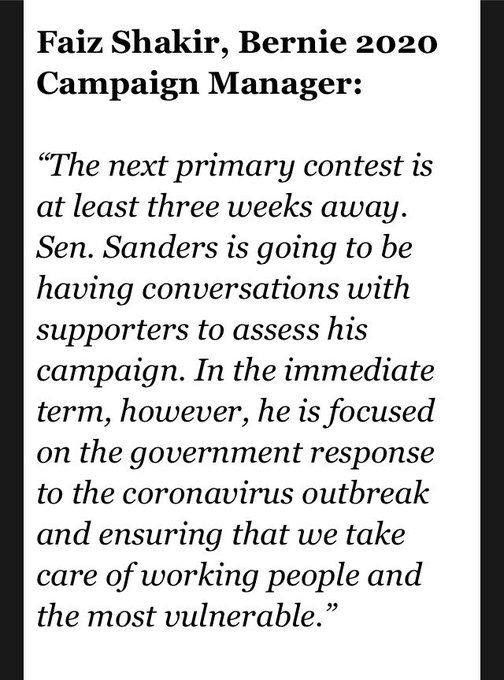
INBOX: Statement from Bernie Sanders’ campaign manager Faiz Shakir after last night’s primary losses to Joe Biden
View image on Twitter
See Laura Litvan's other Tweets
There was some good news for Democatic progressives.  Cameron Joseph reports at Vice:
One of the last — and loudest — pro-life Democrats left in Congress lost his primary Tuesday night.

Rep. Dan Lipinski (D-Ill.) lost to former advertising executive Marie Newman, trailing by 48%-44% with 90% of precincts reporting.
Newman came just short of beating Lipinski two years ago, with the backing of a broad coalition of progressive groups. This time, she jumped into the election early, and they lined up to boost her past Lipinski, outspending him by a wide margin. EMILY’s List, which backs pro-choice Democratic women, backed Newman early on, as did a plethora of other groups including NARAL Pro-Choice America, Planned Parenthood Action Fund, MoveOn, Indivisible, The Sierra Club, Service Employees International Union and Our Revolution.
And note Cam's observations on the decline of traditional machine politics:
[Lipinski had] largely avoided tough primaries in the solidly Democratic district because of strong support from the Chicago Democratic machine. Lipinski was handed his seat in Congress by his father, former Rep. Bill Lipinski (D-Ill.), and has a close relationship with Illinois House Speaker Mike Madigan (D), who runs the state party and the city’s machine.
But that machine has weakened in recent years — and Lipinski’s district has continued to grow more liberal and more heavily Hispanic. After barely surviving in 2018, it was too much for him this time around.