Search This Blog

Tuesday, March 31, 2015

Reid: The End Justifies the Means

In his book The Good Fight, Harry Reid wrote:  "No amount of spin will make a falsehood the truth."

Chris Cillizza writes:
One of the more outlandish moments of the 2012 campaign came when Senate Majority Leader Harry Reid went to the floor of the world's greatest deliberative body and accused GOP nominee Mitt Romney of not paying any taxes at all for the past 10 years. Reid's evidence? Someone had told him. (That "someone" is alleged to be Jon Huntsman, father of the former Utah governor. Huntsman denies involvement.)
Reid's claim, which seemed outrageous on its face, was widely dismissed by fact-checkers. .
..
And yet, the clip above shows Reid, in an interview with CNN's Dana Bash, not only refusing to apologize for the claim but defending it — in a very weird way.
"Romney didn't win, did he?" Reid said in response to Bash's question of whether he regretted what he had said about Romney.
Think about that logic for a minute. What Reid is saying is that it's entirely immaterial whether what he said about Romney and his taxes was true. All that mattered was that Romney didn't win.


Monday, March 30, 2015

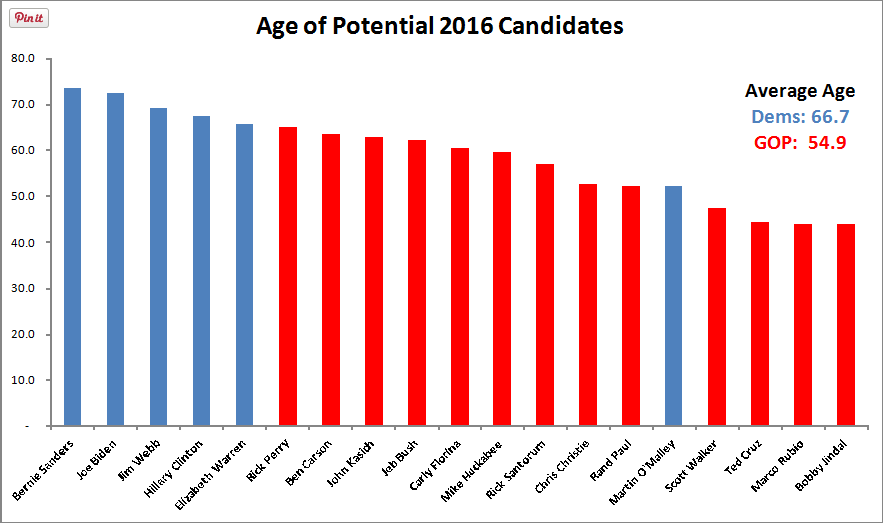
The Tale of the Age Tape

At RealClearPolitics, Tom Bevan has the tale of the age tape, from Bernie Sanders to Bobby Jindal:

Embedded image permalink

Israel and Republicans

Matt Brooks, executive director of the Republican Jewish Coalition, writes in The Washington Examiner:
I lead a partisan organization concerned with getting more Jewish Americans to vote for Republicans. My job is inherently political, but recently I have been shocked at how Israel, once a bipartisan issue, has become so very partisan.
Today, there is daylight between the state of Israel and the Democratic Party, owed in large part to Barack Obama. This daylight has been nurtured by a president who has allowed personal enmity for Prime Minister Netanyahu and a vainglorious attempt at a foreign policy legacy to hijack one of our most important international relationships.
Recently, Rep. Steve Israel, D-N.Y., wrote an op-ed in Politico complaining that Republicans were playing a "dangerous game" on Israel. Unfortunately it seems that Congressman Israel cannot escape his own bias in understanding the problems we face. It is the cynical political game Democrats and this president are playing with Israel, not Republicans.
Peter Baker reports at The New York Times:
That shift really began in earnest under President George W. Bush. Although he, too, had his differences with Jerusalem at times — he was the first president to make support for a Palestinian state official American policy — he became known as probably the strongest ally Israel had ever had in the Oval Office.
Ari Fleischer, the White House press secretary at the time, recalled a flare-up of violence between Israel and Arabs. He was given talking points with a typical American message for such episodes urging both sides to refrain from violence.
“I took them to Bush, and Bush said: ‘No, don’t say that. Just say this: Israel has a right to defend itself,’” Mr. Fleischer said. “It was one of those decisions that sent shock waves through the bureaucracy. But that was Bush.”
Mr. Bush, and other Republicans, came to identify with Israel’s struggle with terrorism. “Sept. 11 made it vivid, made it real and made it powerful,” said Mr. Fleischer, now a member of the Republican Jewish Coalition’s board of directors. “It happens to them, it happens to us, we’re on the same side. Being pro-Israel is a no-brainer, absolutely moral issue to take inside the Republican Party.”

Sunday, March 29, 2015

Asians, Hispanics, and Turnout: A Case Study in Orange County

A Los Angeles Times analysis of a recent Orange County supervisorial race shows how Republicans can still win because Asian American voter turnout tops Latino turnout.
The outcome, the analysis found, turned on the high number of Santa Ana voters who failed to return the absentee ballots that had been mailed to them.
In the core of Santa Ana, where voting heavily favored [Democrat Lou] Correa, only 22% of the absentee voters got around to returning their ballots, far below the state and county's 50% return rate for absentee ballots in the 2014 general election. The unreturned ballots represented tens of thousands of votes.
[Republican] Andrew Do, by contrast, got a big boost because more than 40% of the absentee voters in Little Saigon returned their ballots.
The special election swung nearly entirely on mail-in ballots, which made up about 84% of the total vote.

Destruction of Evidence

Paul Mirengoff writes at Power Line:
The latest news about Hillary Clinton’s email destruction may take her emails saga to another level. As John and Scott have discussed, Clinton apparently had her server wiped clean of emails after a congressional committee had been established to investigate matters as to which she knew her emails were relevant Even more importantly, Trey Gowdy says that Clinton made this decision after October 28, 2014, when the Department of State for the first time asked her to return her public record.
The destruction of documents after they have been requested by a body authorized to do so is a quite a serious matter. As Scott says, in a court of law such conduct ordinarily result in sanctions if, as must be the case here, the destruction was intentional.
Scott mentions one sanction — the drawing of an adverse inference, i.e., concluding that the documents destroyed contained information that hurts the destroyer’s position in the case. Monetary sanctions in one form or another are often awarded as well.
In extreme cases, courts may go further and rule adversely on one or more of the destroying party’s contentions or claims. Courts may even dismiss the plaintiff’s case entirely or enter judgment against the defendant.
Here, the operative court is the court of public opinion. John asks, “Will the Democrats really hold their noses and nominate Hillary?”

Saturday, March 28, 2015

Reid Retires

Harry Reid has announced his retirement. As Buzzfeed, John Stanton takes a skeptical look at his career.
[O]ver the last 12 years, Reid has increasingly leaned on his pugnacious side as he picked often personally bitter fights with Republicans. And as Reid became increasingly consumed with fighting first President George W. Bush, then Minority Leader Mitch McConnell, and then Mitt Romney, his conference — and the Senate — followed suit.

At the behest of the White House, Reid used his political muscle to force through Obamacare with virtually no Republican support, eschewing the time honored traditions of the chamber.

Following the 2010 rise of the Tea Party, legislating essentially came to an end in the Senate, which held fewer and fewer votes as partisan warfare took hold. Then, Reid spent most of 2012 using the Senate as a platform to wage war against Romney and any Republican who happened to be in his way.

And, again, the chamber followed suit. Aside from a bipartisan immigration bill that died in the House, the Senate essentially ground to a halt. Days, weeks would go by between procedural votes as Republicans filibustered virtually anything Reid put on the floor.

True, Reid had plenty of help from Republicans. Immediately following President Obama’s election, McConnell and other top Republicans vowed to blockade anything the new president sought to pass. And when Republicans retook the House in 2010, conservatives insisted on a brand of confrontational politics that essentially precluded the notion of compromise.
But Reid’s role in transforming the Senate into a partisan Thunderdome is all the more remarkable because of his past devotion to the institution’s rules and social mores. Last year, the same man who railed against former Senate Majority Leader Bill Frist for considering changing the filibuster rules and who bitterly criticized Bush’s use of signing statements and executive orders, suddenly championed not only the end of filibusters for most nominations but President Obama’s use of executive power in the absence of congressional action.

Jeb Bush and Christian Conservatives

Tim Alberta and Tiffany Stanley write at National Journal:
[P]owerful Christian conservatives are operating what amounts to a stealth campaign on Bush's behalf. Some are old allies from the Florida days; others are holdovers from George W. Bush's 2000 and 2004 campaigns. Some are both, including Ralph Reed, president of the Faith and Freedom Coalition, a longtime friend of Jeb's who served as Southeast regional chairman of George W.'s 2004 reelection effort (and thus practically lived in Florida). Multiple GOP sources say that Reed has been urging Jeb Bush for several years to make a 2016 run and spoke with him recently to game out the campaign. Like many of the organizations that Bush's supporters lead, Reed's coalition demands impartiality from its leaders, so Reed can't openly back his man—unless, as some suspect will happen, Reed ultimately decides to join the campaign officially. (Reed declined to comment for this story.)
While the candidate isn't hitting the hustings to woo rank-and-file Christian voters, he's been busy surreptitiously building a formidable coalition of socially conservative luminaries. Last summer, Bush flew to Colorado for a private luncheon with the brass of Focus on the Family. Several of America's best-connected evangelicals broke bread with Bush, including Jim Daly, Focus's president, whose radio program reaches a large, loyal audience, and Tim Goeglein, who was the faith liaison in George W. Bush's White House. People familiar with the meeting—and unaffiliated with Bush—say the former governor made a striking impression, one that echoed through the uppermost echelons of the evangelical world. (Neither Daly nor Goeglein would comment.)
...
In this endeavor, his old friend Jim Towey will be a key asset. When Bush first ran for governor in 1994, Towey was on the other side, serving as Gov. Chiles's director of Florida's Health and Human Services agency. The loss that sparked Bush's conversion led to an after-election lunch with Towey, a relative stranger but also a high-profile Catholic whose brain Bush was eager to pick. The two quickly became the closest of friends, and that friendship, in turn, led to Towey's appointment as the second director of George W. Bush's faith-based initiatives. Towey is now president of Miami's Ave Maria University, one of the nation's foremost incubators of conservative Catholic doctrine, while serving unofficially as Bush's point man for religious outreach.