Tuesday, November 8, 2016
Fearless Forecast
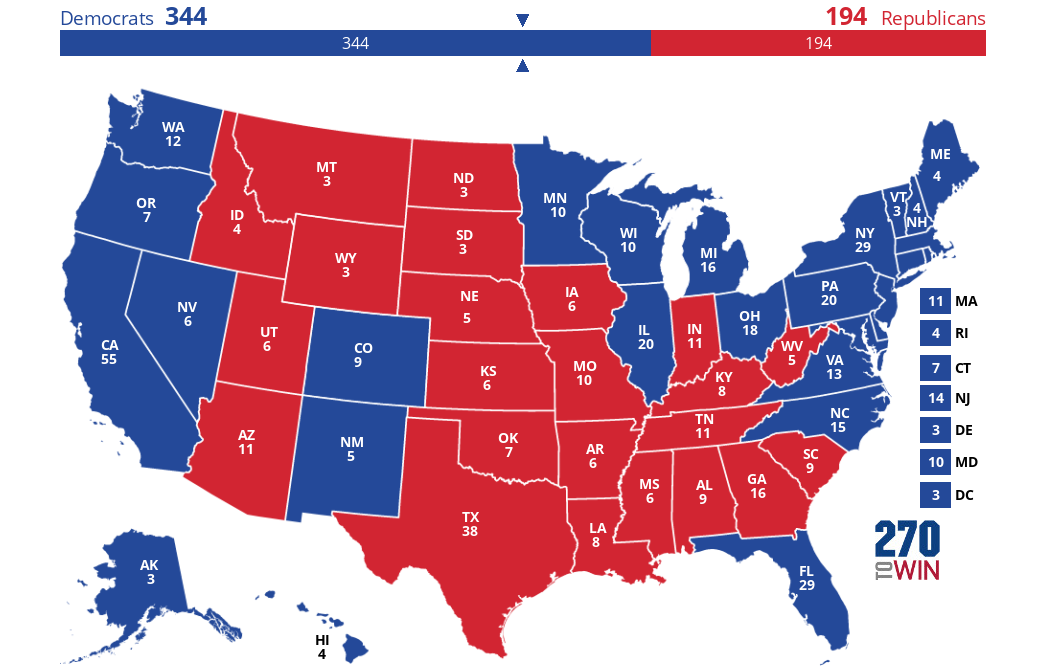
 Click the map to create your own at
 Popular vote:Clinton 49 Trump 44 Johnson 4 Stein 2 Other 1
House: net GOP loss of 19 seats, including 4 in California (Issa, Denham, Valadao, Knight)
Senate: Dems win North Carolina, Missouri, Illinois, Wisconsin, Pennsylvania, for a 51-49 majority.
My D numbers are a bit higher than consensus, for two reasons.
1. Demographics. I think the likely-voter screens are missing some Latino low-propensity voters who will turn out for Clinton. RCP average has Trump ahead in Nevada, even though Clinton has already locked up the state thanks to Hispanic early voters. I suspect that the same dynamic will tip Florida. In North Carolina, black early vote was down, in part because there weren't enough early-voting sites. Dems will make up some of that deficit today. Also, the D advantage among college-educated whites will make a difference in NC, too.
2. Mobilization. Democrats have an even greater advantage in GOTV than they did 4 years ago, which is saying a lot.
The story of key Senate races is a revolt against insiders. That's why Blunt and Burr are in trouble, and why Bayh will probably fail.
Note Alaska. My Hail Mary longshot prediction is that Clinton wins. Not as crazy as it sounds: she has actually led some polls there. Reason: Trump's issues do not resonate with Alaska whites, but they have alienated Native Alaskans.


Monday, November 7, 2016
Foes in the Same City
Jake Petzold writes at Medium:
Jake A. Petzold Writer, vice presidential historian, urbanist. Angeleno experimenting with New York.
1 hr ago
Jake A. Petzold Writer, vice presidential historian, urbanist. Angeleno experimenting with New York.
1 hr ago
For the First Time, Two Presidential Nominees in One City
On Tuesday night, the next president will be in Manhattan. And so will their defeated opponent.
For the first time maybe ever and at least since 1860, both major presidential candidates will be in the same city on election night.
It’s a surprising and trivial first in this campaign cycle of many. But this is the fourth time the two major presidential nominees come from the same state. And the third time New Yorkers have opposed each other in a presidential election. So why haven’t presidential candidates from the same state been in the same city on election night — in New York or elsewhere? Here are the close calls:
1940 & 1944: Roosevelt and His Challengers
President and former New York Governor Franklin Roosevelt faced fellow New Yorkers as he ran for reelection in both 1940 and 1944. On Election Day 1940, President Roosevelt voted at the town hall near his family home in Hyde Park, about 85 miles north of New York City. He tabulated the results in the dining room with his secretaries while Eleanor Roosevelt hosted about 40 supper guests at her nearby cottage at Val-Kill. After the win became clear, FDR informally addressed his neighbors and guests from his front porch in Hyde Park. Roosevelt’s White House staff followed returns from a temporary office in a Poughkeepsie hotel a few miles away.
His opponent, New York corporate executive Wendell Willkie, voted early at Manhattan’s P.S. 6, at Madison Avenue and 85th Street, then enjoyed a leisurely drive through Central Park before spending the day at home at 1010 Fifth Avenue. Willkie later ate dinner and listened to election news with family and friends at his personal headquarters on the 14th floor of the Commodore Hotel on West 42nd Street. Shortly after midnight, Willkie spoke to about 1,500 supporters in the hotel’s Grand Ball Room, vowing not to give up his cause, but knowing he had almost certainly lost. (The Commodore Hotel would become the Grand Hyatt decades later, after Donald Trump and the Hyatt Corporation purchased and rebuilt it.)
In 1944, Roosevelt again spent the day in Hyde Park, voting at the town hall and tabulating the returns in his dining room. He similarly addressed Hyde Park villagers from his front porch, noting that while it was too early to know whether or not he had been elected to a fourth term, “It looks like I’ll be coming up here from Washington again for another four years.”
In 1944, the New York Governor Thomas Dewey, Republican presidential nominee, started Election Day at the Executive Residence in Albany. He took a special train to Grand Central Terminal in Manhattan then proceeded straight to his polling place at 48th Street near Park Avenue. Dewey and his family spent the evening at the Republican National Headquarters at the Roosevelt Hotel, Dewey’s Manhattan residence. By 3:15 the following morning, Dewey conceded by radio.
1920: Ohio’s Newspapermen
In 1920, two Ohio newspaper publishers — the state’s Governor and one of its U.S. Senators — faced each other in the presidential election. Election Day was Senator Warren Harding’s 55th birthday. He voted at a private garage around 10:30, then was driven 40 miles to Columbus for a round of golf. Harding returned home to eat dinner, celebrate his birthday, and receive election bulletins with friends and colleagues. A two-story house next door to the Harding home served as his campaign headquarters, while Harding smoked a cigar in his home’s library. At some point in the evening, a group of Marion Daily Star employees called on Harding, and he thanked them for their support. He left formal remarks on his victory for the following Thursday.
About 90 miles away in Dayton, Governor James Cox’s overnight train from Toledo arrived around 3:00am on Election Day. He voted around 10:00am, smoking a borrowed cigar as he waited in line. Cox visited his home at Trail’s End then spent the evening in his office at the Dayton Daily News. He received friends and visitors, but made no remarks. His newspaper declared Harding the victor by 11:00pm.
1904: The First Modern Same-State Contest
In 1904, President Theodore Roosevelt sought election to the office in his own right, having been elevated by William McKinley’s assassination. The former New York Governor and New York City Police Commissioner faced Alton Parker, the Chief Judge of the New York Court of Appeals. President Roosevelt took an overnight train from the White House to his home precinct in Oyster Bay on Long Island. He voted and greeted townspeople before immediately returning to Washington, not even visiting his home at Sagamore Hill or stopping in New York City. He received election returns at the White House with Cabinet members and friends.
Judge Parker spent Election Day with his family at Rosemount, his estate in Esopus, New York, about 90 miles north of Manhattan. In the morning, he voted a straight Democratic ticket in Kingston then had a dental examination — his Election Day tradition. He spent the afternoon walking his estate with his family before dining with friends and listening to returns in his library. At 8:30pm, Parker conceded to Roosevelt by telegram and made no further statement.
A Good Summary of What's Behind Trumpism
Salena Zito writes at The Washington Examiner:
The public no longer has faith in big banks or big companies or big government. People cannot trust the banks because they create sham accounts to meet sales targets, or trust technology companies because they make shoddy cell phone equipment that blows up in our hands only to be replaced with another shoddy phone that blows up in our hands.
And the governing class has failed us miserably, from wars in the Middle East that never end, to a healthcare bill that erodes our income to the politicization of the once trustworthy institutions of the Pentagon, NASA and the Justice Department.
To them, the system is genuinely rigged, and the divide between the Ivy League educated and the state or trade school educated, between the haves and the have-nots, has become so deep that there is no bridge long or sturdy enough to connect them.
It is that very thing that explains why so many Americans are attracted to the deeply flawed candidacy of Donald Trump.
Sunday, November 6, 2016
California Tea Leaves
Even though the presidential candidates have largely bypassed the state, and despite the absence of party competition in the Senate race, turnout is likely to be high. The Secretary of State has reported record-high voter registration, both in absolute numbers (19.4 million) and as a percentage of eligible citizens (78.04%). Since July 7, Democratic registration has increased 7 percent, while Republican registration has gone up only 3 percent.
US Senate
In the Democrat-on-Democrat race for the United States Senate, Attorney General Kamala Harris will easily defeat Rep. Loretta Sanchez. Both PPIC and Field show Harris leading by more than 20 points.
US House
Republicans will probably lose seats. The Cook Political Report lists three GOP incumbent races as tossups:
State Legislature
The Democrats will continue to control both chambers of the state Legislature. The question is whether they can win the two-third supermajorities they need to raise taxes. This year, Democrats held 52 Assembly seats and 26 Senate seats. If they keep their current seats, they need least two additional Assembly seats and one Senate seat to get to supermajorities. Half a dozen or so races in each chamber will decide the issue. The 29th Senate district, spanning Los Angeles, Orange, and San Bernardino Counties, is especially crucial. Indeed, it is so important that President Obama has endorsed Josh Newman, the Democratic challenger to incument Ling Ling Chang. The president has also endorsed:
US Senate
In the Democrat-on-Democrat race for the United States Senate, Attorney General Kamala Harris will easily defeat Rep. Loretta Sanchez. Both PPIC and Field show Harris leading by more than 20 points.
US House
Republicans will probably lose seats. The Cook Political Report lists three GOP incumbent races as tossups:
- CA-10 Rep. Jeff Denham
- CA-25 Rep. Steve Knight
- CA-49 Rep. Darrell Issa
State Legislature
The Democrats will continue to control both chambers of the state Legislature. The question is whether they can win the two-third supermajorities they need to raise taxes. This year, Democrats held 52 Assembly seats and 26 Senate seats. If they keep their current seats, they need least two additional Assembly seats and one Senate seat to get to supermajorities. Half a dozen or so races in each chamber will decide the issue. The 29th Senate district, spanning Los Angeles, Orange, and San Bernardino Counties, is especially crucial. Indeed, it is so important that President Obama has endorsed Josh Newman, the Democratic challenger to incument Ling Ling Chang. The president has also endorsed:
- Cheryl Cook Kallio, challenging Assemblywoman Catherine Baker (R-San Ramon) in AD 16
- Abigail Medina, who's running against Assemblyman Marc Steinorth (R-Rancho Cucamonga) in AD 40
- Al Muratsuchi, a former assemblyman in a rematch against Assemblyman David Hadley (R-Manhattan Beach) in AD 66
- Proposition 51 — School construction bonds – supported by the Chamber, opposed by Governor Brown. It could lose. When polls show support under 50%, California ballot measures tend to go down. PPIC has it at only 46%.
- Proposition 52 — State Fees on Hospitals. Federal Medi-Cal Matching Funds – supported by the Chamber. It will probably pass. Field has it at 66%
- Proposition 53 — Revenue Bonds – opposed by the Chamber and Governor Brown. There is no public polling, but Brown is worried enough that he is running ads against it.
- Proposition 55 — Tax Extension on High Wealth Individuals – opposed by the Chamber. It will probably pass. PPIC has it at 55% support, and Field at 59%.
- Proposition 64 — Marijuana Legalization – supported by Lieutentant Governor Newsom. It will probably pass. PPIC has it at 55%, Field at 57%.
Saturday, November 5, 2016
Catch and Kill
The company that owns the National Enquirer, a backer of Donald Trump, agreed to pay $150,000 to a former Playboy centerfold model for her story of an affair a decade ago with the Republican presidential nominee, but then didn’t publish it, according to documents reviewed by The Wall Street Journal and people familiar with the matter.
The tabloid-newspaper publisher reached an agreement in early August with Karen McDougal, the 1998 Playmate of the Year. American Media Inc., which owns the Enquirer, hasn’t published anything about what she has told friends was a consensual romantic relationship she had with Mr. Trump in 2006. At the time, Mr. Trump was married to his current wife, Melania.
Quashing stories that way is known in the tabloid world as “catch and kill.”Alex Weprin reports at Politico:
As The Washington Posted noted in March, the Enquirer endorsed Trump, and pushed for him to run back in 2011. Trump has also written numerous columns for the tabloid.
During the Republican primary, the Enquirer published a number of stories about Trump's opponents, accusing Dr. Ben Carson of leaving a sponge in a patient's brain, and Ted Cruz's father of being involved in President Kennedy's assassination. Trump, meanwhile, has been spared as a target of the tabloid.
Friday, November 4, 2016
The GOP and Cities
At the New York Times, Emily Badger and Quoctrung Bui write:
Only three of the 25 largest cities in America now have Republican mayors. In the House of Representatives, Republicans from dense urban congressional districts have become extinct. In the 2012 presidential election, the counties containing Manhattan, the Bronx, Brooklyn, Washington, San Francisco and Philadelphia each gave less than 20 percent of their vote to Mitt Romney. In this coming election, Donald J. Trump is unlikely to do better — and may fare worse.
...
In the 1950s, in presidential election results compiled by the Stanford political scientist Jonathan Rodden, a county’s population density was a poor predictor of how its residents voted. Today, the pattern is remarkably consistent: The denser the county, the more overwhelmingly its residents vote Democratic.
,,,
The anti-city strategy holds up today only because Democrats, with their tight clusters of urban support, are at a structural disadvantage in Congress.
“One of the most important implications of all this is that ignoring cities can be a winning strategy in House races,” Mr. Rodden said. “The mix of positions that the Republicans have taken has served them really well in winning the House. But it’s not working out so well in presidential elections.”
Thursday, November 3, 2016
California Blues for the GOP
California Republicans have big problems. Thanks to the top-two primary system, no Republican made it to the general election ballot for the US Senate race. Javier Panzar writes at The Los Angeles Times:
When 818,000 voters in Los Angeles County fill out their ballots this election, they will find themselves in strange political territory: The only Republican names they’ll see will be presidential nominee Donald Trump and his running mate Mike Pence.
In this GOP “dead zone” — spanning parts of five congressional districts, five state Assembly districts and one state Senate district — not a single Republican candidate made it on to the November ballot.
...
Excluding the U.S. Senate race, 27 of 153 down-ballot contests across California will have candidates from the same political party. During state elections in 2012 and 2014, there were 28 and 25 same-party contests, respectively, according to data compiled by the nonpartisan election guide California Target Book.
But during those years, at least seven of the intraparty contests were between Republicans. This year there are only four Republican-on-Republican battles — all Assembly races.
“This is new territory for us,” said Raphael J. Sonenshein, executive director of the Edmund G. "Pat" Brown Institute of Public Affairs at Cal State L.A.
The idea behind Proposition 14, the voter-approved measure that created the top-two primary, was to elevate moderate candidates in districts where a single party dominated, Sonenshein said.At CalMatters, Matt Levin reports that the GOP is losing Vietnamese Americans:
But research on the moderating effects of the top-two system has been mixed. And the Harris-Sanchez contest has shone a bright light on the issue, with critics saying California is approaching one-party rule.
The generational split among Vietnamese voters is stark. About 4 in 10 Vietnamese voters over age 55 are registered Republicans. That number drops to 1 in 10 among 18 to 34 year-olds. And perhaps more troublingly for the GOP, those younger Vietnamese voters appear more inclined to register Democrat than your average Californian of the same age.
“Vietnamese Millennial voters in some ways are similar to other Millennials with issues like racial justice and social justice,” says Ramakrishan. “You also have this dynamic, similar to the Cuban community, where anti-communism and U.S. foreign policy have been the dominant issue for the first generation…but for the younger generation, it’s not as big a draw.”
The GOP’s “tough on communism” reputation may have less allure for younger U.S.-born Vietnamese with no memory of the Cold War, but that’s not all that’s motivating the shift away from the right.
Janet Nguyen, the Republican state senator from Orange County, also faults past GOP missteps in failing to show enough empathy for low-income Vietnamese households, many of which receive some form of government assistance. Children in those households are now of voting age.
“Going back to the 90’s, if you came to me and said those on welfare milk the system, that’s offensive to me,” said Nguyen. “That’s what you might see a lot for the younger generation, knowing their family came here extremely poor.”David Siders reports at Politico:
Yet the party had taken steps to revive itself before Trump left the GOP nationally in disarray.
It installed a highly regarded tactician, Jim Brulte, as chairman, shifting the party’s focus from ideology to fundraising and voter registration. It removed the term “illegal alien” from its platform and recruited moderate Republican candidates to run for office. In the mid-term elections in 2014, Republicans picked up seats in the state Legislature.
Two years later, once-safe Republicans are facing a barrage of Democrats attempting to yoke them to a highly unpopular nominee. Trump is running at a historically low 28 percent in California, according to the most recent Public Policy Institute of California poll. Meanwhile, Republican Party registration has fallen below 27 percent statewide, down from 30 percent in 2012.
“Right as we’re righting the ship in California, Trump comes on the scene and blows the whole thing up,” said Mike Madrid, a Republican consultant who specializes in Latino politics in California. “It gets harder and harder for Republicans to hold on to what were Republican seats.”
Subscribe to:
Posts (Atom)