Search This Blog

Showing posts with label Redistricting. Show all posts

Tuesday, September 8, 2026

Redistricting and Realignment in NC

Our most recent book is The Comeback: The 2024 Elections and American Politics. It includes a chapter on congressional and state elections.


Sunday, September 6, 2026

World War G in September

 Our most recent book is The Comeback: The 2024 Elections and American Politics. It includes a chapter on congressional and state elections.

The 2026 movie Pressure dramatizes the clash of Allied meteorologists in the run-up to D-Day.  The Americans relied on analog forecasting, looking for past weather maps that matched current conditions, and assuming that the weather would play out the same way.  The British were more alert to differences that the analog maps did not capture. Like the American forecasters in 1944, the Republicans assumed that the patterns of 2024 would remain in place in 2026.  They did not count on the extent to which Trump's actions alienated Hispanics and other voters.

They had similar problems in previous elections.

Andrew Howard and Aaron Pellish at POLITICO:
Republicans are growing increasingly worried their mid-decade gerrymandering push isn’t going to save their House majority.

The norm-breaking plan hatched by the White House last summer to draw new maps to protect the party from an unfavorable midterm environment is not on track to bear the fruits they hoped it would. Two months out from Election Day, Republicans are sweating races they thought they would win comfortably when they redrew district boundaries, according to conversations with a dozen Republican strategists on Friday.

...

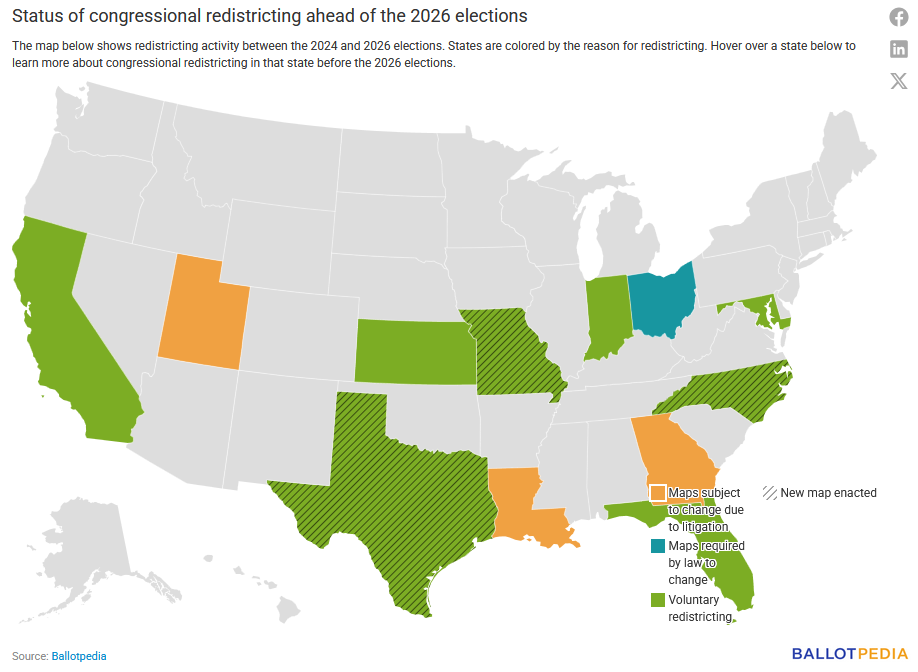
Republicans redrew maps in eight states — Texas, Missouri, North Carolina, Ohio, Florida, Tennessee, Louisiana and Alabama — while Democrats only pulled off a gerrymander in California. (They got another seat from a Utah court decision but had their Virginia gerrymander blocked in court.) In a less hostile political environment, that could have netted the GOP more than a dozen seats.

But they’re not all looking so solid. Texas Republicans are growing increasingly worried that newly drawn Latino-heavy seats Trump carried by double digits in 2024 are looking shaky, and the five-seat net they’d hoped out of the state looks increasingly unrealistic by the day.“The Texas redistricting effort will for sure yield a two-seat gain, and more than likely yield a three-seat gain,” said Alfredo Rodriguez, a Dallas-based Republican strategist. “Picking up five seats will be difficult considering the environment and headwinds Republicans face this cycle.”In North Carolina, Democratic Rep. Don Davis looks very much alive in a tough seat redrawn by the GOP to take him out.
And Florida’s new gerrymander isn’t looking bulletproof, either, with Democratic Reps. Darren Soto, Kathy Castor and Jared Moskowitz running hard to hold onto newly red-leaning territory.

Tuesday, May 19, 2026

Gerrymanders and Waves

Our most recent book is The Comeback: The 2024 Elections and American Politics. It includes a chapter on congressional and state elections.

Bill Scher at The Washington Monthly:

While it’s likely that Democrats will maintain a healthy generic congressional ballot lead heading into Election Day, the math linking the national House popular vote to House seats is murkier than ever. In 2006, a Democratic 7.9-point popular vote advantage translated to 233 House seats, a net gain of 30. In 2010, the Republicans leveraged a 6.8-point vote edge into 257 seats, a net gain of 63. Eight years later, an 8.4-point margin gave Democrats 40 more seats, bringing their total to 241.

Today, thanks to increased political polarization, geographic sorting, and aerobic gerrymandering, political handicappers envision fewer competitive House districts, which means big popular vote swings may not translate into big numbers of seat flips. That’s why political handicappers such as The Cook Political Report with Amy Walter classify relatively few House districts, just 18, as toss-ups with another 17 as leaning towards one party (12 Democrat, five Republican). The other 400 are considered likely or solidly with a party.

Still, a strong political wind typically blows most toss-up districts towards the popular vote winner. In 2018, Democrats won 21 of the 30 toss-ups, or 70 percent, according to Cook. Moreover, Cook’s race ratings shifted in the Democrats’ favor over the course of the year, as often happens when political analysts receive more district-level poll data. Twelve districts considered toss-ups on May 18 were moved to the “Lean Democratic” or “Likely Democratic” columns by November, and Democrats swept those races. Plus, they picked up three seats from the “Lean Republican” and “Likely Republican” columns.

This November, based on today’s Cook ratings, if Democrats sweep their Lean and Likely races and pick up 70 percent of the toss-ups, they will win 219 seats, just one more seat sufficient for a majority. And that would only mean a net gain of four seats, well below the post-war 25-seat average. A big reason is the explosion of Republican gerrymandering greenlighted by the U.S. Supreme Court’s rollback of the Voting Rights Act, coupled with the Democrats’ loss at the Virginia Supreme Court, scotching their voter-approved gerrymander. As Amy Walter explained to the New York Times, before the judicial rulings, Cook classified 217 House seats as at least leaning Democratic; now that number is down to 207.


Friday, May 8, 2026

World War G: Republicans Score Wins in VA and TN

Our most recent book is The Comeback: The 2024 Elections and American Politics. It includes a chapter on congressional and state elections.

Sabrina Moreno at Axios:

The Virginia Supreme Court overturned the results of the state's redistricting referendum, which voters narrowly approved last month.

Why it matters: The ruling upends one of the most closely watched redistricting fights in the country.It follows months of legal challenges over whether the referendum was unconstitutional.

The big picture: The decision effectively blocks Democrats from redrawing congressional maps mid-decade.That's after the state spent $5.2 million to pay for the special election, and outside groups raised nearly $100 million to sway voters.

The new map would have been in effect for the November midterms and was expected to shift the state's congressional split from 6-5 favoring Democrats to 10-1.

 Katherine Chui and Emily Cochrane at NYT:
When the Supreme Court weakened the Voting Rights Act of 1965 last week, Republicans saw new political opportunities across the South. Congressional districts that were considered strongholds for Democrats, often with majority Black populations, could be redrawn for the first time in decades.

Among Southern states, Tennessee was the first to redo its map, which Gov. Bill Lee signed into law on Thursday. The new map breaks the Ninth Congressional District — a longtime Democratic base encompassing Memphis — into three Republican-leaning districts.

The new map divides areas of Memphis where most of the population is Black among three districts with overwhelmingly white populations, eliminating the state’s sole majority Black district in the process.


Thursday, April 30, 2026

Voting Rights And World War G

 Our most recent book is The Comeback: The 2024 Elections and American Politics. It includes a chapter on congressional and state elections.

Amy Howe at SCOTUSblog::

The Supreme Court on Wednesday, in the case of Louisiana v. Callais, struck down a Louisiana congressional map that a group of voters who describe themselves as “non-African American” had challenged as the product of unconstitutional racial gerrymandering. By a vote of 6-3, the justices left in place a ruling by a federal court that barred the state from using the map, which had created a second majority-Black district, in future elections. Although Wednesday’s ruling did not strike down a key provision of the federal Voting Rights Act, as Louisiana and the challengers had asked the court to do, Justice Elena Kagan suggested in her dissent (which was joined by Justices Sonia Sotomayor and Ketanji Brown Jackson) that the majority opinion by Justice Samuel Alito had rendered the provision “all but a dead letter.”

Jack Blanchard and Dasha Burns at POLITICO:

Excitable Republicans hailing the Supreme Court ruling on the Voting Rights Act as the start of a golden age of neverending House majorities may need to pause and take breath.
...

How far can they go this year? With the ruling less than 24 hours old — and with the midterms just six months away — there’s uncertainty about what’s possible. But even in a maximalist scenario for Republicans, none of the experts Playbook spoke to believed this ruling will net the GOP more than a handful of House seats in November.
...

ABOUT THAT UNCERTAINTY: Four big factors will ultimately decide the extent of further Republican redistricting this year.

1. TIME PRESSURE: This was an extraordinary moment for the Supreme Court to drop this ruling. (In Louisiana, absentee ballots for next month’s primaries have already been sent out.) Those Southern states keen to redistrict before November are in for an almighty scramble. What’s possible will vary state to state.

2. GOP APPETITE: Not every state-level Republican will want to redraw maps on short notice. Some may see 2028 as a more realistic target. Others may be reluctant to move mid-decade at all. Don’t forget that state legislatures in Republican-run Indiana and Democratic-run Maryland already resisted pressure to accept redrawn maps this cycle.

3. TRUMP: The president remains the decisive factor. How hard the White House pushes for new maps this cycle remains an unknown factor, but may prove critical in how many states move immediately. Trump sounded keen yesterday —- “I would think that they would want to do it,” he told reporters — but had only just learned about the ruling.

4. LEGALITY: This wasn’t the “clean kill” Republicans hoped for, watering down rather than completely gutting Section 2 of the VRA. Experts believe there are legal uncertainties still to be ironed out. Pro-VRA litigation — even if ultimately fruitless — could slow the process down.

Democrats will likely retaliate.  (And after the midterms, they might control more legislative chambers.)

Reid J. Epstein at NYT:

Some Democrats who backed new redistricting commissions in the 2010s now look back on those efforts as tying one hand behind their back for the future.

“It seemed like a pitchfork moment. It did seem good,” said Michael Li, a senior counsel for the Democracy Program at the Brennan Center for Justice. “The lesson is that there are some states that are never going to be able to do this. If you’re not going to do it nationally, you’re going to have an unlevel playing field.”
The California and Virginia referendums to let Democrats seize redistricting power represented mea culpas about political idealism that could spread to other blue states.

One of the nation’s oldest redistricting commissions is in Washington State, where voters in 1983 adopted a provision to shift map-drawing power from elected officials. Now Shasti Conrad, the state’s Democratic Party chairwoman, said that it could be undone if Democrats were to flip a handful of seats in the State Legislature and seize supermajority control next year.

If they do, Ms. Conrad said, Washington voters are likely to be asked in 2027 to allow lawmakers to enact a new congressional map. Now, Democrats hold eight of 10 House seats in the state.

“People have been asking, ‘What can Washington do with redistricting?’” Ms. Conrad said. “They’re seeing other states like Virginia do it, so why can’t we?”

Democratic regrets over their redistricting hurdles tend to quickly morph into the party’s most reliable political stance over the last decade: blaming Mr. Trump.

Wednesday, April 22, 2026

Virginia Redistricting

 Our most recent book is The Comeback: The 2024 Elections and American Politics. It includes a chapter on congressional and state elections. 

Erin Doherty and Aaron Pellish at POLITICO:

After a narrow loss in Virginia, Republicans are pointing fingers as President Donald Trump’s national gerrymandering fight slips into a stalemate.

Multiple Republicans say the party should’ve spent much more, much earlier to have a better shot at blocking Democrats’ Virginia map, which could give the party as many as four more House seats. And pressure is now growing on Florida Gov. Ron DeSantis to make up for Democrats’ gains with a GOP-led redistricting effort in his state, as soon as next week.

...

Tuesday’s results in Virginia, combined with gains in California and a new court-drawn seat in Utah, have effectively erased the advantage Republicans built off new maps in Texas, North Carolina, Ohio and Missouri. It’s a stark reversal nearly nine months after Trump first urged Republicans in the Lone Star State to redraw maps, upending the midterm battlefield.


Sunday, February 15, 2026

Immigration Issues and the Texas Gerrymander

 Our most recent book is The Comeback: The 2024 Elections and American Politics. It includes a chapter on congressional and state elections.  

Myah Ward and Megan Messerly at Politico:

Home builders are warning President Donald Trump that his aggressive immigration enforcement efforts are hurting their industry. They’re cautioning that Republican candidates could soon be hurt, too.

Construction executives have held multiple meetings over the last month with the White House and Congress to discuss how immigration busts on job sites and in communities are scaring away employees, making it more expensive to build homes in a market desperate for new supply. Beyond the affordability issue, the executives made an electability argument, raising concerns to GOP leaders that support among Hispanic voters is eroding, particularly in regions that swung to Trump in 2024.

Hill Republicans have held separate meetings with White House officials to share their own electoral concerns.

This story is based on eight interviews with home builders, lawmakers and others familiar with the meetings.

“I told [lawmakers] straight up: South Texas will never be red again,” said Mario Guerrero, the CEO of the South Texas Builders Association, a Trump voter who traveled to Washington last week.

...

The meetings this month came after Democrats crushed a Republican in a special runoff election for a state senate seat in a Trump-friendly district in Tarrant County, which includes most of Fort Worth, rattling Republicans nationally. New research from the American Business Immigration Coalition and Comité de 100, first obtained by POLITICO, shows how slipping support among Latino voters could affect Republican-leaning districts in Texas, Pennsylvania, Florida and California.

Monday, February 9, 2026

The House Map and the Aggregate Vote

 Our new book is The Comeback: The 2024 Elections and American Politics. It includes a chapter on congressional and state elections.  

Hans Nichols and Kavya Beheraj at Axios:

House Democrats will need to overperform Vice President Harris by roughly three percentage points in swing districts to capture the majority in 2026, according to an Axios analysis of presidential margins in congressional districts.

Why it matters: In special elections over the last year, Democrats have been surpassing Harris' 2024 margins by double digits, putting the majority clearly in reach.

But the universe of competitive House seats is historically small, meaning that even an unambiguous national move toward the Democrats will result in a relatively narrow Democratic majority.

Flashback: The 2018 midterms saw a 6.5 percentage point swing in Democrats' favor compared to President Trump's 2016 margins, giving them 41 new seats for a 235 -199 majority, according to the Cook Political Report. A similar shift in 2026 would translate into 12 additional Democratic seats, giving them a 227-208 majority, according to the data, which includes redistricted maps, according to The Downballot and Sabato's Crystal Ball.

The other side: If GOP candidates fare just 1% better than Trump did last cycle, House Speaker Mike Johnson (R-La.) could add another 12 seats to his majority, putting him at a comfortable 232-204 margin.

Zoom out: Democrats are banking that the electorate will look a lot less Trumpy when the president's name is not on the ballot. Their voters, Democrats argue, are highly motivated and engaged when Trump is in office.

...

Zoom in: Presidential performance in a congressional district doesn't guarantee a predetermined outcome, but in the Trump era, the number of crossover districts is at a historic low.Thirteen House Democrats prevailed in seats that Trump carried in 2024. A total of three Republicans held on in Harris districts.
n 2008, after President Obama's first election, there were 83 crossover districts.Two of the best lawmakers at convincing voters to split their ticket — Rep. Don Bacon (R-Neb.), who won in a Harris +4.6 district, and Rep. Jared Golden (D-Maine), who won in a Trump +9 district — are both retiring.

What we're watching: After tit-for-tat redistricting in six states, Republicans appear to have drawn themselves another three seats.Democrats on Thursday proposed adding another four in Virginia (pending judicial review), but Republicans are plotting to equalize in Florida.

Tuesday, January 13, 2026

Trump's Threat to Voting

 Our most recent book is The Comeback: The 2024 Elections and American Politics. The second Trump administration has been full of ominous developments.

 Patrick Marley and Yvonne Wingett Sanchez at WP:

Trump, openly fearful that a Congress controlled by Democrats could investigate him, impeach him and stymie his agenda, is using every tool he can find to try to influence the 2026 midterm elections and, if his party loses, sow doubt in their validity. Many of these endeavors go far beyond typical political persuasion, challenging long-established democratic norms.

They include unprecedented demands that Republican state lawmakers redraw congressional districts before the constitutionally required 10-year schedule, the prosecution of political opponents, a push to toughen voter registration rules and attempts to end the use of voting machines and mail ballots.

The administration has gutted the role of the nation’s cybersecurity agency in protecting elections; stocked the Justice Department, Homeland Security Department and FBI from top to bottom with officials who have denied the legitimacy of the 2020 election; given a White House audience to people who, like the president, promote the lie that he won the 2020 election; sued over state and local election policies that Trump opposes; and called for a new census that excludes noncitizens. The wide-ranging efforts seek to expand on some of the strategies he and his advisers and allies used to try to reverse the 2020 results that culminated in the attack on the U.S. Capitol on Jan. 6, 2021.

...

Trump issued an executive order in March that sought to prevent election officials from accepting mail ballots they received after Election Day, even if voters sent them before then. A court has blocked the provision, but the Supreme Court in November agreed to hear a Mississippi case addressing the same issue. Its ruling is expected to govern whether the late-arriving ballots can be counted in all states. Complicating the issue is a new U.S. Postal Service guideline that says some mail won’t be postmarked until days after it is placed in a mailbox.

NYT interview with Trump:

President Trump: Well, I’d love to stop mail-in ballots. It takes two to tango. Think of it. The Democrats will not approve voter ID. There’s only one reason they won’t approve it, because they cheat, and if they didn’t cheat, they couldn’t win. Here’s the thing: They have policy that’s so bad. The Democrats’ policy is so bad that if they didn’t cheat, they could never win an election.

David E. Sanger: You once threatened, I think, during the 2020 election, to use the National Guard to seize election boxes. You may remember that. You didn’t, in the end, do it.

President Trump: Well, I should have
.

David E. Sanger: Would that have been, would that be an option?

President Trump: I don’t know that they are sophisticated enough. You know, they’re good warriors. I’m not sure that they’re sophisticated enough in the ways of crooked Democrats and the way they cheat, to figure that out.

David E. Sanger: OK, would you think of using them?

President Trump: But many, many things took place in the 2020 — and it’s coming out already — the 2020 election. And by the way, the 2024 election, there was a lot of cheating, too, but I won by a lot because it was too big to rig.

 Alan Feuer and Ashley Ahn at NYT:

The remarks by Mr. Trump in the interview last week harked back to one of the most perilous moments from his first term in office, when he was urged by some advisers to order his national security agencies to take control of machines manufactured by Dominion Voting Systems in an effort to find evidence that they had been hacked to rig the election against him.

The statement also came as he has continued his attacks on digital voting machines, saying that he wants to “lead a movement” to get rid of them altogether in advance of this year’s midterm elections.

...
Mr. Trump’s expression of regret, while somewhat vaguely worded, was nonetheless a warning sign that he had not given up on the idea that voting machines were dangerous or that they could be seized in an effort to curb fraud.

Just last week, he reposted several social media messages that continued to push the claim that Dominion machines had been rigged against him. And last month, he sought to pardon Tina Peters, a former Colorado county clerk who is serving a nine-year prison sentence on state charges of tampering with Dominion machines in an effort to prove that they were used in a plot against Mr. Trump.

Sunday, December 14, 2025

World War .G: Status at the End of 2025

Our new book is The Comeback: The 2024 Elections and American Politics. It includes a chapter on congressional and state elections.  The passage of Prop 50 in CA will offset the Texas gerrymander.  The D victory in VA will partly offset GOP gerrymanders elsewhere.

Jason Lalljee at Axios:
Indiana lawmakers' rejection of a plan to create two more Republican congressional seats Thursday delivered a blow to the White House's scramble to redistrict ahead of midterm elections, but the state isn't the only egg in President Trump's basket.

The big picture: Six states have already implemented new congressional maps, and more could follow.

Republicans hold only a narrow lead in the House of Representatives, 220 seats to Democrats' 213, and the sitting president's party tends to lose seats in midterm elections.
That means that control of the House could come down to just a few races.
Projections for the six states that have essentially locked in their efforts — Texas, California, Ohio, Missouri, North Carolina and Utah — show Republicans set to gain a net one to four seats in November and any gains from Democrats likely cancelled out by Republican wins.

Between the lines: Of the six, California and Utah were the only states where Republicans weren't favored in redistricting efforts.Democrat-led states are enacting their own redistricting in contrast to what the GOP is doing — and California did it successfully — but several Democratic leaders find their hands tied by independent redistricting commissions they had once championed.

Friday, December 12, 2025

World War G: Trump Loses the Indiana Battle

Our new book is The Comeback: The 2024 Elections and American Politics. It includes a chapter on congressional and state elections.  The passage of Prop 50 in CA will offset the Texas gerrymander.  The D victory in VA will partly offset GOP gerrymanders elsewhere.

Mitch Smith at NYT:

Republican members of the Indiana Senate bucked President Trump on Thursday and joined Democrats in voting down a new congressional map that would have positioned Republicans to sweep the state’s U.S. House seats.

The 19 to 31 vote was a highly public defeat for Mr. Trump, who has spent significant political capital pushing for redrawn maps in Republican-led states and who repeatedly threatened political consequences for Indiana Republicans who did not fall in line. The defiance of Mr. Trump comes as he faces other signs of rifts within his own party.

Speaking to reporters in the Oval Office after the vote, Mr. Trump downplayed the result in Indiana, saying that “we won every other state.” He also said that he hoped the president pro tem of the Indiana Senate, who voted against the map, loses his next primary.

The rejection of the map in the State Senate, where Republicans hold 40 of the 50 seats, followed months of presidential lobbying that turned increasingly pointed in recent weeks as it became clear that some holdouts were not budging. Mr. Trump had called some of them out by name on social media, openly questioning their loyalty to the party and pledging to back primary challengers against them.

Friday, November 7, 2025

CA GOP: Dead Parrot

Our new book is The Comeback: The 2024 Elections and American Politics. It includes a chapter on congressional and state elections.  The  passage of Prop 50 in CA will offset the Texas gerrymander.  The D victory in VA will partly offset GOP gerrymanders elsewhere.

Maya C. Miller at CalMatters:
Proposition 50’s landslide win owes its success in part to the abject failure of a disarrayed No on 50 campaign low on funds and unable to keep up with the Yes side’s deluge of savvy advertising.

McCarthy reportedly told his former Republican congressional colleagues that he would help raise up to $100 million to defeat the measure. But that money never materialized. Instead, his No on 50: Stop the Sacramento Power Grab committee only pulled in $11.6 million, with $1 million of that from McCarthy’s defunct congressional campaign account.

While the House Republicans’ super PAC pitched in $5 million to the Stop the Power Grab committee and $8 million to the state Republican Party, no financial help came from President Donald Trump or the White House donor circle, and the president only engaged at the last minute to call the election “rigged” and discourage Republicans from trusting mail-in voting.

Rob Stutzman, a California Republican political strategist, said he didn’t know what happened to the promised $100 million, but his best guess is the decision came from Trump and the White House to not open the fundraising floodgates. After all, a Republican from Texas, Missouri or North Carolina is just as valuable to building a House majority as a Republican from California — and far less expensive to elect.

Wednesday, November 5, 2025

Big Blue Night


Elena Schneider, Erin Doherty and Jessica Piper at Politico:
Abigail Spanberger and Mikie Sherrill cruised to double-digit victories in Virginia and New Jersey. Two Georgia Democrats flipped seats on the state’s Public Service Commission, the first non-federal statewide wins for a Democrat in nearly two decades. Democrats flipped a pair of Republican-held state Senate seats in Mississippi, cracking the GOP supermajority in a deep-red state. And a successful California ballot measure delivered five additional seats for the party’s House margins ahead of the 2026 midterms, offsetting Texas’ redistricting push.

It was an injection of life into a depleted, depressed Democratic Party that had been cast into the political wilderness by Donald Trump’s decisive victory a year ago. Democrats, locked out of power in Washington, have spent the last year soul-searching and data-digging, as their brand sagged to historic lows.

But they also started to overperform in special elections, hinting that the tide was turning. And on Tuesday, their first big electoral test of the second Trump era, they didn’t just match the wins from eight years ago that had been a harbinger of a blue wave in the 2018 midterms — in several key races, they exceeded them.

Wednesday, October 29, 2025

GOP Problems in World War G

Our new book is The Comeback: The 2024 Elections and American Politics. It includes a chapter on congressional and state elections.

The California Legislature has approved a special election to redraw congressional district lines. Democrats stand to pick up five seats to offset a recent Texas gerrymander.  The war is spreading, but the GOP plans is running into problems.


Will McCarthy at Politico:
Republicans appear to have all but abandoned their efforts to defeat a Democratic gerrymander of California’s House districts one week before it goes before voters.

As Democrats pummel the state with Yes on 50 advertising, the Republican side of the battle has gone quiet. Major GOP donors and party leaders have effectively vanished from the front lines.


 Andrew Howard at Politico:

At the urging of the White House, Republicans have already drawn seven new GOP-leaning House seats via mid-decade redistricting in three states, with more on the way. But the nationwide remapping effort is losing steam, largely due to these state-level Republicans refusing to blink at the Trump team’s threats of primaries. And while cracks are forming in Trump’s strategy, Democrats are waking up to the dangers ahead, POLITICO reported this week.

The few Republicans willing to defy the president constitute a dying breed in a party that’s become solidly MAGA under Trump’s thumb.

“If they want to threaten me with something, I don’t know what it’d be,” Kansas Republican Rep. Mark Schreiber, who is among holdouts in the state, said in an interview. “I’m fine with the stance I’m at.”
As Trump desperately tries to cling to control of Congress for the remainder of his term, he’s leaned heavily on redistricting congressional lines to block Democrats from their coveted takeover of the House. They need to net just three seats to regain a measure of influence in Washington.

But despite support from within Congress and the broader base, Republicans in state houses are showing that Trump and his team cannot coerce veteran local politicians, many of whom are elderly, in safe seats and unconcerned with the national political landscape.

Sunday, October 26, 2025

World War G: The Battlefield Expands

Our new book is The Comeback: The 2024 Elections and American Politics. It includes a chapter on congressional and state elections.

The California Legislature has approved a special election to redraw congressional district lines. Democrats stand to pick up five seats to offset a recent Texas gerrymander.  The war is spreading.

Reid Epstein at NYT:

The next front in the nation’s pitched battle over mid-decade congressional redistricting is opening in Virginia, where Democrats are planning the first step toward redrawing congressional maps, a move that could give their party two or three more seats.

The surprise development, which was announced by legislators on Thursday, would make Virginia the second state, after California, in which Democrats try to counter a wave of Republican moves demanded by President Trump to redistrict states to their advantage before the 2026 midterm elections. No other Democratic state has begun redistricting proceedings, while several Republican states have drawn new maps or are deliberating doing so.

Bruce Mehlman:

Traditionally redistricting is usually done once per decade, though this is not dictated by the Constitution or a specific law. President Trump is pushing Republican states to redraw maps in 2025 to maximize GOP advantage for 2026, and three have already done so (TX, NC, MO) with two more coming (OH, UT). Many Democratic governors such as California’s Gavin Newsom are moving to “fight fire with fire” with hyper-partisan gerrrymanders of their own. Up to 15 states in total (so far) are considering or acting: the 5 above plus CA, FL, IL, IN, KS, LA, MD, NE, SC, VA & WI.
...


Democrats could be in danger of losing around a dozen districts across the South if the court strikes down Section 2 of the 1965 Voting Rights Act in Louisiana v. Callais, a case the court heard two weeks ago. “Without Section 2, which has been interpreted to require the creation of majority-minority districts, Republicans could eliminate upward of a dozen Democratic-held districts across the South.” (NYT)


Saturday, September 13, 2025

World War G: Cleaving Cleaver

Our new book is The Comeback: The 2024 Elections and American Politics. It includes a chapter on congressional and state elections.

The California Legislature has approved a special election to redraw congressional district lines. Democrats stand to pick up five seats to offset a recent Texas gerrymander.

 Fredreka Schouten at CNN:

Missouri’s Republican-controlled Senate on Friday passed a new congressional map, taking final legislative action to target one of the state’s Democratic seats in the US House and boost the GOP’s chances of retaining its fragile majority in the chamber.

The 21-11 vote came just two weeks after the state’s GOP Gov. Mike Kehoe first unveiled the map and ordered a special legislative session to approve it. It targets longtime Democratic Rep. Emanuel Cleaver by carving up his Kansas City-area district and stretching its boundaries into rural, Republican-friendly areas of central Missouri.

...

Missouri is the latest state to undertake a mid-decade redistricting as part of an extraordinary, multi-state campaign by President Donald Trump and his allies to preserve the balance of power in the House by changing district lines.

Republicans hope to win seven of Missouri’s eight congressional seats under the new map in next year’s midterm elections. The GOP currently controls six seats, and Democrats hold two.

Wednesday, September 10, 2025

CA GOP: AWOL in World War G

Our new book is The Comeback: The 2024 Elections and American Politics. It includes a chapter on congressional and state elections.

The California Legislature has approved a special election to redraw congressional district lines. Democrats stand to pick up five seats.


DUSTIN GARDINER and BLAKE JONES at POLITICO:
The California Republican Party finds itself on the periphery of a national effort by conservatives to beat back Democrats’ gerrymandering campaign.

It’s partially the result of an internal rift within the state GOP that some party strategists fear could hamper its efforts to fight redistricting — a self-inflicted wound that could put the party in a weaker position as it competes with Democrats’ fundraising machine.

A chorus of Republicans are now openly questioning the state GOP’s ability to lead the opposition to a redistricting map that could cripple their party’s influence here. …. They complain about sluggish fundraising and a lack of organization and cohesive messaging.

Instead, political committees outside of the purview of the state party apparatus and Chair Corrin Rankin are leading the effort to defeat Proposition 50, the Nov. 4 redistricting measure.

Riverside County Sheriff Chad Bianco, who’s running for governor, told Playbook the party has struggled to craft an anti-redistricting message that will resonate with independent voters and others beyond the Republican base.

“It’s not a cohesive, ‘All for one and one for all’” strategy, Bianco said. “We’re not coming together to say, ‘We’ve got to get the best message for everyone.’ We should be talking to California — we shouldn’t be talking to Republicans.”

Assemblymember Carl DeMaio, a Republican from San Diego and frequent critic of the state GOP, vented about what he called a lack of party leadership to fight Prop 50 during an interview at the state party convention in Orange County this past weekend — a concern echoed by several prominent attendees.

“Open communication would be helpful,” DeMaio said. “The party hasn’t done a good job of that. It’s certainly hurting us.”

Tuesday, September 2, 2025

Bad News, Good News for GOP

Our new book is The Comeback: The 2024 Elections and American Politics. It includes a chapter on congressional and state elections.

 For Republican prospects in 2026, the economy is a problem:

Alex Isenstadt:

Republican operatives and lawmakers are increasingly anxious about how inflation could affect the GOP in the 2026 midterms, and want President Trump to take more aggressive steps to address rising prices.

Why it matters: GOP insiders and lawmakers believe the cost of drugs and consumer items — and how the White House deals with Trump's tariffs potentially turbocharging prices and creating shortages — will be key to whether the GOP keeps control of Congress next year.

Zoom in: Republicans on Capitol Hill and beyond praise Trump's recent focus on crime, but many are alarmed by internal polls and focus groups showing persistent — and increasing — concerns about prices.

Katherine Hamilton and Alison Sider:

For the American middle class, it has been a summer of cooling confidence.

Consumer sentiment dropped nearly 6% in August, after trending up in June and July, according to a closely watched index from the University of Michigan. Pessimism about the job market increased, with more people surveyed saying they expect their income to decline, according to polling done by think tank the Conference Board.

The middle class—generally considered to include households making roughly $53,000 to $161,000 a year—is playing an outsize role in that waning optimism. After months of tracking high-income earners’ increasing confidence about the economy, households making between $50,000 and $100,000 made an abrupt about-face in June. They now more closely resemble low-income earners’ gloomier views, according to surveys done by Morning Consult, a data-intelligence firm.

“There was a period of time, briefly, where the middle-income consumer looked like they were being dragged up by all that was going well in the world,” said John Leer, chief economist at Morning Consult. “Then things fell off a cliff.”


But....

At Politico, Lisa Kashinsky, Elena Schneider and Nicholas Wu write that Democrats are "hamstrung by constitutional restrictions or independent commissions in some states, while Republicans are generally free of those legal barriers and have leadership trifectas in Indiana, Florida, Missouri and Ohio, promising state lawmakers fewer restrictions to draw Democratic rivals out of their seats. Florida’s constitution has language restricting partisan gerrymandering, though its conservative-majority state Supreme Court recently upheld a GOP redraw."


Nate Cohn at NYT: "[If] the new maps are enacted in all of these states, Democrats will need to win the national popular vote by two or three percentage points to be favored to retake the House, according to projections based on recent congressional and presidential election results."