Search This Blog

Showing posts with label Santorum. Show all posts

Sunday, December 20, 2015

Rubio'sGround Game in Iowa

At FiveThirtyEight, Joshua Darr writes that Rubio has only one field office in Iowa.
According to political science research, Rubio avoids the establishment of a ground game at his peril. Field offices work because they provide a location for the coordination and training that make voter contact valuable. Campaigns that can contact supporters personally to encourage them to vote should make every effort to do so. Knocking on doors can increase turnout by nearly 10 percent, and effective phone calls can encourage an additional 4 percent of voters to head to the polls. Without a field office in an area, candidates will find it much more difficult to translate these tactics into victory.
To be fair, neither canvassing nor phone calls technically require a field office. If a campaign’s main goal is merely to contact as many voters as possible, staff members will often spare themselves the time, effort and cost of training local volunteers by hiring professional callers and recruiting canvassers from out of state. But when campaigns take this shortcut, they often pay the price.
...

Over the past few presidential elections, field offices have clearly generated higher local turnout. Obama opened 786 field offices in 449 counties in 2012, and each office delivered him approximately an additional 0.3 percent of vote share — or roughly the equivalent of airing 1,000 additional campaign ads. In 2008’s battleground states, Obama earned about 200,000 votes — about 7 percent of his margin of victory in those states — from his network of field offices. These offices accounted for 50 percent of Obama’s margin of victory in Indiana, and they likely made the difference in his win in North Carolina.
These effects seem small, but they make a difference where it matters most. Rick Santorum won the 2012 Iowa caucuses by 0.03 percentage points, or 34 votes out of 121,501. Field offices can be expensive — the estimated cost per vote earned by having a field office is $49.40 — but the earned media and momentum benefits from a victory in Iowa are huge.
Or maybe Rubio figures that he will not win Iowa no matter what, so he is putting his scarce resources elsewhere.

Thursday, August 6, 2015

Burying the "Next in Line" Myth

There is a common assumption that the Republicans nominate the candidate who is "next in line." By any important metric, that candidate is Rick Santorum.  In the 2012 GOP nomination contest, he got the second-highest number of delegates (267).  He got the second-highest number of votes in primaries (3.9 million).  He also led Romney in national polls for a time in February 2012.

And yet he has not scored well enough in the polls to make tonight's prime-time debate.  He is laying off staff, and shows no signs of resurgence.

Let us bury the "next in line" theory.  It rests on half a dozen examples, which hardly make for an iron law.  As we point out in After Hope and Change, the "next in line" candidate for the 2000 nomination was Steve Forbes, who had scored surprisingly well four years earlier but who could not even come close to George W. Bush.  In 2012, the Republican who was next in line was arguably Mike Huckabee, who had won more delegates than Romney in 2008.  He did not even bother to run.

Tuesday, January 27, 2015

Four GOP Brackets

Charles Cook identifies four brackets in the GOP nomination contest:
First there is the establishment bracket, with former Florida Gov. Jeb Bush, New Jersey Gov. Chris Christie, and possibly former Massachusetts Gov. Mitt Romney competing for that semifinal slot. Former Hewlett Packard CEO Carly Fiorina would likely fit into this group. GOP nominees traditionally come from this bracket.

Then there is the conservative governor/former governor slot—with, potentially, Ohio Gov. John Kasich, Indiana Gov. Mike Pence, former Texas Gov. Rick Perry, Michigan Gov. Rick Snyder, and Wisconsin Gov. Scott Walker competing, all seeking to be non-Washington and non-Congress candidates, but each with more conservative, or at least better conservative, credentials than Bush, Christie, or Romney. In this anti-Washington environment, being able to say that you effectively governed, in contrast with Congress and Washington, certainly has some advantages among the non-purist conservatives.
In the third bracket are the more identifiably tea-party candidates, principally Sens. Ted Cruz of Texas and Rand Paul of Kentucky, but also former Rep. Michele Bachmann of Minnesota, possibly former 2008 vice presidential nominee and former Alaska Gov. Sarah Palin and even real-estate mogul Donald Trump (though both Palin and Trump are unlikely to make it past the first lap if they end up entering at all). This bracket is for the "mad as hell and not going to take it anymore" conservatives.
Finally, there is the social, cultural, and religious conservative bracket, made up primarily of former Arkansas Gov. Mike Huckabee and former Sen. Rick Santorum of Pennsylvania, tapping into the same feelings as the third group but with a distinctly moral dimension.

Saturday, January 24, 2015

Problems of the Legacy Candidates

At The Washington Examiner, Byron York lays out 12 keys to understanding the GOP presidential contest. Several involve the legacy candidates, who have either run before (Romney, Huckabee, Santorum) or, in Bush's case, have a family history.  It is hard to put the band back together:  times change, people move on.
Romney loyalists are deeply ambivalent about another run. A remarkable number of former Romney staff and supporters admire him tremendously and remain steadfastly loyal. They have told him as much on a number of occasions over the last few years. But now some worry that Romney has perhaps misinterpreted their heartfelt expressions of support as encouragement to run again in 2016. They still believe he would be a good president, but they do not think it will be possible for Romney to rid himself of 2012 baggage in order to get the clean start necessary to run a winning campaign.
The Bush family network isn't as strong as some believe. There has been much talk of the vaunted Bush political machine, which is said to give Jeb Bush a big advantage even before the 2016 race officially begins. Jeb Bush himself has been calling donors and has told some of them that he hopes they will again support "the family." But the fact is, it has been a while since the Bush machine was in operation here in Iowa. It was last up and running in 2004, for the re-election of George W. Bush, and last at work for the caucuses in 2000, for W's first run. For the 2016 race, that means the machine has been out of action for a long time. Many Bush donors from 2000 and 2004 became Romney donors in 2008 and 2012. They have conflicted loyalties, and not all of them will rejoin the family.
...
Rick Santorum is in very bad shape. One would think the former Pennsylvania senator, as the (narrow) winner of the 2012 caucuses, would have a lot of standing for another race. He doesn't. Many Republicans believe Santorum's earlier success was the result of a set of peculiar circumstances involving a weak and fragmented 2012 field. They admire how hard he worked that year, traveling around Iowa with a thoroughness and intensity that no other candidate could match. But they don't see it happening again with a stronger field in 2016. And they don't see Santorum surviving a loss in the state he won before.
York notes that Rick Perry has a slim chance.  Another point about Perry:  last time, much of his money came from Texas business interests eager to court the favor of the incumbent governor.  Now that he is out of office, a lot of that money will evaporate.

Tuesday, December 16, 2014

2016 Presidential Race Begins

ABC reports that Jeb is in, kinda:
Jeb Bush announced this morning that he will "actively explore the possibility of running for president of the United States."
Bush said he made the decision over the Thanksgiving holiday in consultation with his family.
"As a result of these conversations and thoughtful consideration of the kind of strong leadership I think America needs, I have decided to actively explore the possibility of running for President of the United States," he said in a message posted on Facebook today.
“In January, I also plan to establish a Leadership PAC that will help me facilitate conversations with citizens across America to discuss the most critical challenges facing our exceptional nation. The PAC’s purpose will be to support leaders, ideas and policies that will expand opportunity and prosperity for all Americans,” Bush said in the message, which he also tweeted. "In the coming months, I hope to visit with many of you and have a conversation about restoring the promise of America.”
At National Review, Eliana Johnson writes of Cruz:
His strategists aren’t planning to make a big play for so-called independent voters in the general election if Cruz wins the Republican nomination. According to several of the senator’s top advisers, Cruz sees a path to victory that relies instead on increasing conservative turnout; attracting votes from groups — including Jews, Hispanics, and Millennials — that have tended to favor Democrats; and, in the words of one Cruz strategist, “not getting killed with independents.”
...
The strategy has its critics. Henry Olsen of the Ethics and Public Policy Center calls it “fantasy.” The Republican base, he says, simply isn’t large enough to win an election nationally, and the Republican nominee must “energize establishment Republicans and people who don’t call themselves conservatives.”
At National Journal, Rick Santorum talks to Alex Roarty:
Look, the last time around, it turned out to be a pretty good thing to be under the radar the whole time and not be shot at by everybody at the very first go. And you had an opportunity to build out your team. And so, if we do this again, it looks like we'll have a similar opportunity this time around. Usually you don't get two chances at that.
Also at National Journal, Shane Goldmacher writes of Rand Paul's outreach to the US Chamber and the broader business community:
Paul's political team has made a point of reaching out to influencers at the chamber and across Washington to aggressively "correct the record," as they see it, about misconceptions about their boss. Throughout 2014, Paul's media strategist, Rex Elsass, hosted a series of off-the-record dinners at his Capitol Hill home to introduce the Kentucky senator to some of Washington's power brokers. Reed, who managed Bob Dole's 1996 presidential bid, attended one such meal this spring along with Paul, Paul's wife, Kelley, and others that stretched deep into the night.
There is also activity on the Democratic side.  At RealClearPolitics, Scott Conroy notes Elizabeth Warren's use of the present tense:
In a Monday morning interview with NPR, the first-term Massachusetts Democrat was asked four different variations of the same query: Would she consider running for president in 2016?

In each instance, Warren answered the same way she has whenever someone wants to know if she harbors White House ambitions: “I am not running for president.”

That statement may sound like a Shermanesque denial at first blush, but placed in its proper context, it is anything but.

As NPR’s Steve Inskeep and many other observers have noticed, Warren always answers the presidential query in the present tense and assiduously avoids any deviation that might rule out a future bid.

Warren may not be “running for president” at the moment, but neither is anyone else, for that matter. 

Sunday, August 17, 2014

Santorum to Israel

A release from Patriot Voices:
Former U.S. Senator, former Republican presidential candidate and Chairman of Patriot Voices Rick Santorum will travel to Israel on Sunday, August 17, for a 3-day mission with prominent conservative and business leaders.
The trip will focus on three goals:

  • To show solidarity with the State of Israel - with her courageous people and leaders - who are engaged in a fight for their lives and freedom against the twin evils of Radical Islam and Repugnant Anti-Semitism.
  • To reaffirm the moral and strategic imperative of maintaining a strong, close, enduring U.S.-Israeli alliance.
  • To pray for the peace of Jerusalem and all who live in the Middle East.

The trip will be mainly in Jerusalem and also include a visit to an Iron Dome facility. The delegation will make visits to Mount of Olives, City of David, Mount Herzl Military Cemetery and other sites.

Senator Santorum and the delegation will meet with Israel government and military leaders, Israeli soldiers, local residents directly affected by the violence, religious leaders, and Israeli Ambassador Ron Dermer.
The delegation will include:

Tuesday, December 17, 2013

The Twitter Primary

At The Washington Examiner, Hugh Hewitt writes about the Twitter power of potential GOP presidential candidates.
We won't know until three years from now what percentage of Twitter followings as of Dec. 13 turned into actual campaign activists or contributors, but there is no reason not to think that the "Twitter followers" number doesn't mean something given the importance the MSM talking heads pay to their own running totals. These totals are at least a measure of the potential candidates' online efforts.
Here's the Twitterific facts on the Twitter primary as of that day. Where the potential candidate has more than one account, I used the higher number of the two (or three). I have also rounded to the thousand. Their relative rank in "Twitter power" follows their actual number of "followers."
— Bolton: 108,000; 10
— Bush: 101,000; 11
— Christie: 420,000; 3
— Cruz: 234,000; 6
— Huckabee: 318,000; 5
— Jindal: 143,000; 9
— Kasich: 56,000; 13
— King: 17,000; 16
— Paul: 351,000; 4
— Perry: 210,000; 8
— Rubio: 475,000; 2
— Ryan: 561,000; 1
— Santorum: 222,000; 7
— Snyder: 30,000; 14
— Thune: 27,000; 15
— Walker: 73,000; 12

Thursday, June 20, 2013

Invisible Primary

At National Journal, Reid Wilson writes:
While the race for the White House might seem like it's only in its Washington cocktail-party gossip phase, several potential and probable contenders are already making overt moves to court activists in key states and build organizations that can transition easily to a presidential campaign. Their maneuvers are less than subtle: Sen. Rand Paul of Kentucky has already traveled to Iowa; he'll be back for a state-party fundraiser in July. Sen. Ted Cruz of Texas has already visited South Carolina; he'll attend the July fundraiser in Iowa with Paul. Sen. Marco Rubio of Florida first went to Iowa way back in November 2012, ostensibly to celebrate Gov. Terry Branstad's birthday. All three, along with other potential contenders including Louisiana Gov. Bobby Jindal and former Sen. Rick Santorum of Pennsylvania, have been invited to an August forum in Ames, Iowa, organized by a Christian conservative group that's aiming to play big in the 2016 caucuses.

Friday, March 22, 2013

Gingrich and Santorum Almost Formed a Unity Ticket


Joshua Green writes at Bloomberg Business Week:
It’s one of the great untold stories of the 2012 presidential campaign, a tale of ego and intrigue that nearly upended the Republican primary contest and might even have produced a different nominee: As Mitt Romney struggled in the weeks leading up to the Michigan primary, Newt Gingrich and Rick Santorum nearly agreed to form a joint “Unity Ticket” to consolidate conservative support and topple Romney. “We were close,” former Representative Bob Walker, a Gingrich ally, says. “Everybody thought there was an opportunity.” “It would have sent shock waves through the establishment and the Romney campaign,” says John Brabender, Santorum’s chief strategist.

But the negotiations collapsed in acrimony because Gingrich and Santorum could not agree on who would get to be president. “In the end,” Gingrich says, “it was just too hard to negotiate.”

Sunday, December 9, 2012

Post-Election Conferences

Politico reports on a conference at Robert J. Dole Institute of Politics at the University of Kansas on Thursday and Friday:
“The bottom line is that the Obama campaign [had] a candidate that was very hard to lay a glove on because he was somebody that the American people, by and large, had decided that they just liked,” said Romney’s deputy campaign manager Katie Packer Gage.
...
“It was one of the most frustrating things in our campaign,” Gage added. “In focus group after focus group, when you would sit down with this sort of narrow slice of voters — undecided female voters who had voted for Barack Obama in 2008 — they weren’t ready to vote for Barack Obama yet, but when we would test message point after message point after message point, there was almost nothing that would stick to this guy because they just liked him personally.”
...
The Obama team believes that the selection of Paul Ryan cost Romney Florida, eating into his support among Cubans because of his past opposition to the embargo, galvanizing Sunshine State volunteers for Obama and raising doubts among seniors over what his budget plan might do to Medicare.
We needed to make this a state-by-state race, and we needed to take a state like Florida and turn it into a battle over each precinct,” [national field director Jeremy] Bird said.
...
“Traditionally you win a primary and somebody drops out because resources just stall,” said Gage. “When we came out of our short-lived win in Iowa, you would have typically seen several candidates drop out at that point, but all of these candidates had one or two big, big donors that could keep them alive a while longer. And that’s what created this long slog effect.”
Gage said Romney’s inner circle thought frequently about how to persuade mega-donors like Sheldon Adelson and Foster Friess to stop financing the conservatives like Newt Gingrich and Rick Santorum, who both forced Romney to the right.
Politico also reports on a meeting of GOP  operatives:

The Romney campaign is in the process of transferring all of its voter contact data to the RNC — a database that includes one million donor contacts and 2.2 active email addresses from theRomney list, as well as 300 pages of strategy memos and analytics information.
How to build on those contacts in the next four years and continue to grow the party’s email database is the central question facing the GOP now, said veteran GOP strategist Peter Pasi, a partner at Emotive who did digital work for Rick Santorum’s campaign, among others, and who attended Thursday’s meeting.
“How can we build structures … that can last 10 years and be refined no matter who’s the chairman and who’s in the White House?” he told POLITICO earlier this week, adding that the party needs to build “a digital infrastructure that reflects kind of a movement and a belief — not just [one] campaign.”

In addition to building that database, Republicans need to figure out how to standardize their voter information to include all kinds of data like the Obama campaign did in 2012. The Obama campaign was able to micro-target voters by cross-referencing such things as television-viewing habits and information collected from Facebook and email.
“The Obama campaign found a way to integrate social media, technology, email databases, fundraising databases and consumer market data,” said GOP digital strategist Vincent Harris, who did digital work for Newt Gingrich and Rick Perry in 2012. “That does not exist on the Republican side to that degree.”

CNN "Gut Check" asked IOP director Trey Grayson for lessons from the Harvard conference:
GUT CHECK: What are the three bullet points that future campaign advisers are going to take away from the lessons learned in the 2012 presidential campaign?
GRAYSON: 1. Even with all the analytics and data that campaigns have and use, the individual contact of going door-to-door or friend-to-friend on Facebook is still the most effective way to reach voters 2. Utilizing social media to reach those voters that you otherwise could not reach. For example, Obama supporters were Facebook friends with 98% of U.S. voters. 3. Diminishing returns of television advertising late in the campaign.


Thursday, November 29, 2012

The 2012 Republican Nomination Contest in Retrospect

Notes for class lecture, November 29, 2012

Early starts and the "next in line" theory:
  • Richard Nixon in 1960 and 1968
  • Ronald Reagan in 1980
  • George H.W. Bush in 1988
  • Bob Dole in 1996
  • John McCain in 2008
Front-runner strategy -- Dan Balz compares Romney's approach in 2008 and 2012:
When Romney lost both Iowa and New Hampshire, his campaign was essentially over. He went on to win elsewhere, but he no longer controlled his own fate. Weakened in South Carolina, he was dependent on Huckabee to block McCain’s strengthening campaign, and Huckabee failed. Flummoxed in Florida, Romney saw all hope for the nomination dissipate with McCain’s victory in the Sunshine State.

Fast-forward to this year and see the differences. Romney’s campaign advisers say their strategy is based on two major assumptions: No state will determine Romney’s fate, and delegates matter. 
The next-in-line candidates who did not run:
Others who did not run:
The candidates who challenged Romney:
  • Perry
  • Cain
  • Gingrich
  • Santorum
  • Bachmann
  • Paul
  • Huntsman
Raise and Spend Big Bucks Early: Campaign Receipts through December 31, 2011:

Romney
56,073,108
Paul
25,901,305
Perry
19,775,136
Gingrich
12,648,565
Bachmann
10,100,742
Huntsman
  5,882,409
Santorum
  2,178,703


It was a race of multiple bounces.

Not in Wayne:  Super PACs:

For Romney: Restore Our Future


For Gingrich: Winning Our Future


For Santorum: Red, White, and Blue Fund


Also not in Wayne:  Debates, Twitter, and YouTube in the 2012 race:


Thursday, August 30, 2012

Time, Chance, and Mitt Romney

Tonight, Mitt Romney accepts the GOP nomination. One school of thought is that his nomination was more or less inevitable because Republicans pick the "next in line."  But although Romney had major advantages going into the race, there was nothing inevitable about his victory.

For one thing, Mike Huckabee won more delegates in 2008 than Romney, so he had as good a claim to the "next in line" title.  But he decided not to run.  Had Mitch Daniels or Haley Barbour gotten into the race, either could have raised serious money. Similarly, if Jon Huntsman had declined to serve in the Obama administration, he would have been much more credible to Republican primary voters and he would have had more opportunity to build his organization and warchest. By the time he actually ran, however, most Republicans knew little about him, and the rest thought he was tainted by the Obama connection.

Any of these three could have taken a big chunk of the traditional/establishment vote that went to Romney, thus making him more vulnerable to a credible challenge from the right.

That challenge could have come from Rick Perry -- if had started earlier and worked harder.  But Byron York nailed it back in October:
For Romney, debate preparation involves taking all the things he has already thought through and finding the most effective way to present them in one-minute answers. For Perry, debate preparation is trying to learn new stuff about national issues that he should have been thinking about a long time ago.
It's often pointed out that since Perry entered the Republican race late, on Aug. 13, he had little time to build a campaign organization and hone a campaign pitch. That's true, but the fact is, if Perry wanted to be president, he should have been thinking seriously about the substance of national issues -- not just money-raising and state chairmen -- years before he declared his candidacy.
Even before his famous "oops" moment, his campaign was heading south.

Bachmann, Cain, and Gingrich had moments in the sun, but none of them ever had a real chance of nomination.  Santorum, on the other hand, might have made life tougher for Romney if just a couple of things had gone differently.  If the Iowa GOP had produced an accurate vote count on caucus night, the story would have been "Santorum edges Romney in stunning upset."  If Santorum hadn't disrespected JFK, he might have carried the Catholic vote in the Michigan primary, which could have been enough for him to score yet another stunning upset.

In other words, "the race is not to the swift, nor the battle to the strong, neither yet bread to the wise, nor yet riches to men of understanding, nor yet favour to men of skill; but time and chance happeneth to them all." -- which is the Bible's way of saying "You didn't build that."

Friday, April 13, 2012

Santorum's Exit

At CBS, Rebecca Kaplan reports on the real reasons behind Santorum's exit:
When Rick Santorum ended his presidential bid on Tuesday, he spoke about the illness of his three-year-old daughter, Bella, and expressed a desire to spend more time with her as a parent. But on Thursday, the former Pennsylvania senator suggested the decision largely came down instead to a simple reality: He was out of cold, hard cash.

After losing Wisconsin's April 3 primary to rival Mitt Romney by seven points - a contest, Santorum said, that his campaign viewed as necessary to win in order to do well in his home state of Pennsylvania - his fundraising dried up.

"For the first time the campaign had a debt, the debt was from my perspective a little bit more substantial than I was comfortable with. And I'll be honest with you, Tony, in the last week after Wisconsin we basically raised almost no money," Santorum told Family Research Council President Tony Perkins in a radio interview, his first since announcing he was ending his bid. "We had solicitations going out and people were just emailing back saying the race is over and you gotta join the crew and there were others who would say not but it was a very, very small trickle of funds that were coming in."
Santorum had also been hoping that Gingrich would withdraw and that Pennsylvania would go his way.  But Newt stayed in and polls showed that the state was trending to Romney.

Though Santorum will get with the team, BuzzFeed saved his toughest anti-Romney ads. 

Sunday, April 1, 2012

Cost Per Vote, Cost Per Delegate

At National Journal, Major Garrett does the math:
The Paul math goes like this: According to his latest filing with the Federal Election Commission, Paul has spent $32,766,465. He's received 1,079,753 votes for a cost-per-vote total of $30.35. He's won 66 delegates for a cost-per-delegate total of $496,461.
Doug Wead, a senior Paul adviser offered the following:
"The delegate counts, such as those promoted by the New York Times and The Associated Press are pure media fiction. So your delegate-per-dollar is skewed. For example, they (NYT and AP) say the delegate count in Iowa is Santorum 14, Romney 12 and Paul 1. We have one delegate in Iowa? Hmm. I don't want to reveal too much, but our delegate strategy is doing just fine and it is worth every dollar."
Maybe so. But the raw numbers based on available delegate counts don't look good for Paul.

Romney's cost-per-vote (CPV) total is $16.18. His cost-per-delegate (CPD) is $118,218.
The math: $66,793,395 spent with 4,127,917 votes and 565 delegates.
Santorum's CPV is an amazing $4.56 cents. That's just over a quarter of Romney's and about a seventh of Paul's.

Santorum's CPD is $50,873.
He's spent $13,023,588 and won 2,850,546 votes and 256 delegates. Imagine if Romney or Paul were this efficient? Imagine if the federal government or a private business was this efficient? 

Tuesday, March 27, 2012

Primary Turnout

With 100% of precincts reporting, the Louisiana Secretary of State’s website reports that 186,377 Republicans cast a ballot in Saturday’s primary for their candidate and against President Barack Obama. That’s a record for voter turnout in a Louisiana GOP primary.
Please see the graph below for historical context:

Year Type GOP Turnout
1980 Primary 41,683
1984 Primary 16,687
1988 Primary 144,773
1992 Primary -
1996 Primary 77,789
2000 Primary 102,912
2004 Primary 72,010
2008 Primary 161,169
Just before Louisiana, Aaron Blake wrote at The Washington Post:
Reports of the GOP’s turnout problems appear to have been slightly premature.
A Fix review of turnout in the Republican presidential nominating process shows that it has rebounded in recent weeks, and GOP voters are now turning out in consistently higher numbers than they did in 2008.
In addition, in the most competitive Republican contests held this year, turnout is up almost universally, with just a couple exceptions.
Turnout is up in all four states that have held major contests since Super Tuesday — Kansas, Alabama, Mississippi and Illinois — and is up overall in eight of 12 contests held this month for which there was a comparable contest held four years ago.
The only states where turnout has been down so far this month have been Massachusetts and Georgia, the home states of Mitt Romney and Newt Gingrich, and in Oklahoma and Tennessee. In Tennessee, it was down 1 percent, while in Oklahoma it was down 15 percent.
FOR A TABLE OF PRIMARY TURNOUT DATA, SEE THE  UNITED STATES ELECTIONS PROJECT.

Monday, March 26, 2012

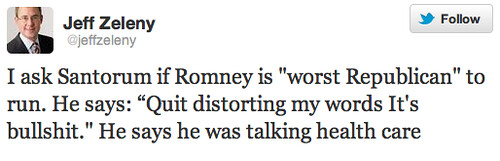
Santorum Calls BS on NYT

Rick Santorum called bs on Jeff Zeleny of The New York Times:


On the one hand, the incident raises the issues of the Santorum temper, which has sometimes flared in public.

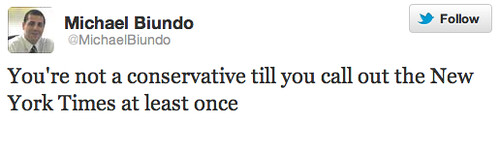
On the other hand, we have seen that Republican primary voters hate the elite media, so it may work to his benefit.  At Slate, David Weigel writes:

I wasn't there, but doesn't it sound like Santorum had a point? Here's the Zeleny tweet:
Screen shot 2012-03-26 at 9.15.33 AMHe "says" he was? He was! Maybe it's just karmic justice for all of the dopey teleprompter jokes Republicans have been making, but for the second time in a week Santorum was making a familiar point, changing one phrasing, and getting punished for it. The campaign's response, understandably, is to stroke the conservative id. This is Santorum's CM on Twitter:
Screen shot 2012-03-26 at 9.03.17 AMThat tweet went out before a fundraising email from Santorum himself, which recast the Zeleny tiff as a St. George/dragon moment. "I didn't back down, and I didn't let him bully me," said Santorum in the email. "I think it is high time that conservatives find the courage to expose the liberal press for what they are, a defender and enabler of Romney's and Obama's liberal agendas." 

Saturday, March 24, 2012

Why Santorum Won Louisiana

A strongly conservative, religiously inspired Republican electorate turned the tables on Mitt Romney in Louisiana, supplying Rick Santorum with both an easy win and a sharp riposte to Romney’s victory in Illinois four days earlier.
Santorum was boosted by one of the highest concentrations of very conservative voters in any primary this year. Evangelicals, while less dominant than in most other Southern states, backed him by a record margin over Romney. And Santorum’s tally was his best to date among voters focused on supporting a candidate who shares their religious beliefs.
Even in this inhospitable environment, Romney again prevailed as most likely to defeat Barack Obama in November, by 43 to 33 percent vs. Santorum. But that was Santorum’s best score on this question in any of the nine contests to date in which it’s been asked. In previous races, voters picked Romney as more electable by a 32-point margin; in Illinois, by 38. In Louisiana, Santorum shaved that to 10. 
Though Romney has usually won the Catholic vote, Louisiana was different:  Santorum won this group 48-30 percent.
Religiously inspired voting more generally ran high in the state. Sixty-four percent of primary voters said they go to church at least weekly; they backed Santorum by 56-24 percent, while less-frequent (or non-) churchgoers much more narrowly favored Romney, 39-28 percent. More, 73 percent, said it mattered to them to support a candidate who shares their religious beliefs, and 41 percent said it mattered a great deal – more than said so in Illinois by 17 and 18 points, respectively.

Friday, March 23, 2012

Summing Up Entrance & Exit Polls So far

AEI has a nice compilation:

  • In every state in which an entrance or exit poll was conducted, voters have selected the ability to defeat Obama as the candidate quality that mattered most.
  • Romney has usually won the votes of those who checked “can defeat Obama” as the most important candidate quality for them. With the exception of Massachusetts, he has not won the votes of those who checked “true conservative.”
  •  Ideological, class, and religious divisions continue in the Republican electorate. Romney usually loses “very conservative” voters, but he does well with the “somewhat conservative” and “moderate/liberal” voters. He does better among suburban voters than rural ones and less religious than more religious voters. He has won at least a plurality of non-evangelical voters in every exit/entrance poll state except Georgia where Gingrich won them narrowly. Romney does well with college-educated and upper-income voters. He has almost always done better with college than non-college voters. With the exception of South Carolina and Georgia, Romney has won the votes of those with family incomes of $100,000 or more.
  • Romney has done pretty well with Tea Party supporters, but not with strong Tea Party supporters.
  •  Tea Party supporters have backed the winner in every contest except Ohio, where Santorum edged out Romney by 1 percentage point. Santorum and Gingrich split their votes in Mississippi.
  • In exit and entrance poll states, the Republican electorate has been about 90 percent white. In Florida, whites were 83 percent of voters. 
  • Abortion was cited as the top issue by more than 10 percent of voters in Michigan, Mississippi, Iowa, Ohio, Tennessee, and Oklahoma. In 15 of the 17 states for which we have exit/entrance poll data, “illegal immigration” was included as a category voters could check. In no state for which we  have an entrance or exit poll was it the top issue. In no state did 15 percent of voters select it as the number-one issue. Only in Arizona did more than 10 percent of voters check it as their top issue. The economy has been the top issue everywhere.

The table also shows that Romney has carried the Catholic vote everywhere except Tennessee and South Carolina.

Is Proportional Allocation a GOP Problem?

At Bloomberg View, Josh Putnam and John Sides dispute the conventional wisdom that proportional allocation of delegates has prolonged the GOP contest:
The Republican Party has traditionally allowed states to allocate delegates in a variety of ways. Some states used a proportional method, others used winner-take-all, still others used hybrids that fell between those two poles. In 2008, the nearly 40 Republican primary states were split about evenly among the three methods.
The 2012 campaign is essentially no different. The rules do not mandate strict proportionality but allow a mix of systems. For example, states can proportionally allocate their at-large delegates while allocating their congressional district delegates on a winner-take-all basis, according to the vote within each district. States can also use a conditional winner- take-all rule: If a candidate receives the majority of the vote statewide, then that candidate is awarded all of a state’s delegates or all of the at-large delegates.
As a result, differences between the 2008 and 2012 rules are not drastic. ...

To gauge the effect of the 2012 rules, we calculated what the 2012 delegate count would be so far using the 2008 delegate rules. Any such simulation rests on the tenuous assumption that all other things about the process are equal -- an obvious drawback. Still, the results are instructive.
Using the 2008 rules, we found, would have produced a slightly slower primary process. What’s more, Romney above all should be grateful for the change. Far from elevating the current front-runner, the 2008 rules would have reduced his current delegate count by 56. Under the old rules, Newt Gingrich would have earned 5 fewer delegates and Ron Paul 8 fewer. Rick Santorum would have come out with 15 more delegates.
But the rules do count in one important way:
If anything is extending the Republican nomination process, it’s the new, longer primary calendar. In 2008, more than half of the delegates had been awarded by the first week in February. In 2012, the halfway point won’t arrive until this weekend’s Louisiana primary.

Wednesday, March 21, 2012

Illinois and Aftermath

At ABC, Gary Langer sums up the reasons for Romney's double-digit win in Illinois:
An improved sense that he understands voters’ problems boosted Mitt Romney to victory in the Illinois primary, as did a less religiously focused, less strongly conservative electorate than he’s faced in other contests, especially to the south. But a shortfall among less well-heeled Republicans marks his continued challenges.
Indeed exit poll results indicated that Romney owed his victory in Illinois to two groups: voters with more than $100,000 in household incomes and those with college degrees. Among those less educated, or less well-off, he only split the vote with Rick Santorum.
Other factors helped Romney. Six in 10 Illinois voters said he has the best chance of beating Barack Obama, better than his average in exit polls this year. And Romney narrowly led Santorum as the candidate who “best understands the problems of average Americans.” It was only the second state, of seven where the question’s been asked, in which Romney’s prevailed on empathy. The other was Florida.
Among other advantages for Romney, the Illinois primary was characterized by far fewer evangelicals than most of the Southern contests and fewer voters seeking a candidate who shares their religious beliefs, two groups in which he’s struggled. Forty-three percent were evangelicals, about half their share in Alabama and Mississippi last week. Nearly half in those states were highly focused on shared religious beliefs; it was just a quarter in Illinois, fewer even than in Ohio early this month.
Bloomberg reports:

Republican presidential candidate Mitt Romney got a boost for his campaign's effort to paint his nomination as inevitable after a win in the Illinois primary led to an endorsement from former Florida Governor Jeb Bush.
"Now is the time for Republicans to unite behind Governor Romney and take our message of fiscal conservatism and job creation to all voters this fall," Bush, the son of one president and brother of another, said in a statement today.
At  The Washington Times, Ralph Z. Hallow writes:

The organization that ignited the tea party as a national mass movement gave Mitt Romneyperhaps his biggest victory yet, deciding to drop its opposition to his candidacy, a top executive in the group told The Washington Times.
FreedomWorks, which organized the Sept. 12, 2009, mass demonstration on the Mall, says that while it will not give an explicit endorsement, the time has come for Republicans to unite around the former Massachusetts governor and focus on defeating President Obama.
“It is a statistical fact that the numbers favor Mitt Romney,”FreedomWorks Vice President Russ Walker told The Times on Tuesday. “We are dedicated to defeating Obama and electing a conservative Senate that will help Romney repeal Obamacare and address the nation’s economic and spending challenges.”