Search This Blog

Showing posts with label Huckabee. Show all posts

Monday, December 5, 2016

Post-Ideology v. Identity Liberalism

At The Washington Post, James Hohmann reports on the post-election conference at HKS.  He quotes Trump pollster Tony Fabrizio:
“We really live in a world where everybody thinks that ideology is linear, and that, ‘If you answer these 10 questions correctly, that makes you a conservative.’ But not every conservative is pro-life. Not every conservative is anti-gay marriage. Not every conservative puts 100 percent emphasis on this or that.”
“One of the problems is many people tried to look at the Donald Trump phenomenon through the ideological lenses which had defined previous Republicans presidential nominating contests,” Fabrizio added. “Donald Trump is post ideological. His movement transcends ideology … Through his own antennae – and, trust me, many times I had this conversation with him – Donald Trump understood the fold in American politics. It’s the reason so many Trump supporters and so many (Bernie) Sanders supporters agreed on so many things.”
....
“Every time he said something … and doubled down, that was proof to voters he’d speak his mind and not lie to them. It’s what they wanted,” Fabrizio said of Trump.“His best group of voters were those who said they were ‘angry.’ And let me tell you, in the Republican primary, a third of voters would tell you they were outright angry. With another 60 percent telling you they were dissatisfied. So he had a rich pool to tap into.”
...
-- Policy didn’t matter. “What we missed was that nobody cared about solutions,” said Sarah Huckabee Sanders, who managed Mike Huckabee’s campaign until he dropped out and then joined Trump’s operation as a consultant soon after. “They just wanted to burn it all down. They didn’t care about building it back up. They wanted to burn it to the ground and then figure out what to do with the ashes afterwards. There was no understanding of this electorate and the anger on the front end in terms of just how pissed off they were. You may have the best policy in the world to get every single American the best job they’ve ever had. Nobody cared.”
-- Experience didn’t matter. From Marco Rubio campaign manager Terry Sullivan: “We got hit with commercial after commercial about how little experience (Marco had) and how many missed votes in the Senate. It didn’t matter. People don’t care. The Senate sucks. Why would we want to be there? We’re not voting. Who cares? And voters bought into that. Experience was a liability. It was not an asset. We figured that out early, but Trump took it to the next level.”
At The New York Times, Mark Lilla writes:
One of the many lessons of the recent presidential election campaign and its repugnant outcome is that the age of identity liberalism must be brought to an end. Hillary Clinton was at her best and most uplifting when she spoke about American interests in world affairs and how they relate to our understanding of democracy. But when it came to life at home, she tended on the campaign trail to lose that large vision and slip into the rhetoric of diversity, calling out explicitly to African-American, Latino, L.G.B.T. and women voters at every stop. This was a strategic mistake. If you are going to mention groups in America, you had better mention all of them. If you don’t, those left out will notice and feel excluded. Which, as the data show, was exactly what happened with the white working class and those with strong religious convictions. Fully two-thirds of white voters without college degrees voted for Donald Trump, as did over 80 percent of white evangelicals.
(Compare and contrast with Bill Clinton in 1992). 

Tuesday, November 24, 2015

Associating with a Nut

Earlier this month, three Republican presidential candidates – Ted Cruz, Mike Huckabee, and Bobby Jindal (who has since dropped out of the race) – appeared at a National Religious Liberties Conference held in Des Moines and hosted by Kevin Swanson, a Colorado pastor and host of the Generations Radio Show. A member of the Christian Reconstructionist Movement (Christian Reconstructionists believe in theocracy and the restoration of Mosaic Law), Mr. Swanson gave the conference’s opening and closing remarks and interviewed Messrs. Cruz, Huckabee, and Jindal.
Here’s the thing: Pastor Swanson is a man consumed with hatred for gays. He has spoken wistfully about the passing of a period in which the death penalty applied to gays. He also supports Uganda’s draconian anti-gay laws, which punishes some homosexual behavior with life in prison. (“In Uganda, these guys are standing strong.”)
...
I have several thoughts on all this, the first of which is that Republican presidential candidates ought to have no part of a conference like the one hosted by Swanson and should have nothing to do with him. Pleading ignorance about what Pastor Swanson has said (which Cruz and Huckabee have done) is lame. Any campaign doing due diligence would be aware of Swanson’s views, and Cruz was told by CNN’s Jake Tapper some of what Swanson has said. Mr. Swanson is a man overflowing with venom, and his views should disqualify him from any association with Republican presidential hopefuls and, really, any serious person.

Thursday, August 6, 2015

Burying the "Next in Line" Myth

There is a common assumption that the Republicans nominate the candidate who is "next in line." By any important metric, that candidate is Rick Santorum.  In the 2012 GOP nomination contest, he got the second-highest number of delegates (267).  He got the second-highest number of votes in primaries (3.9 million).  He also led Romney in national polls for a time in February 2012.

And yet he has not scored well enough in the polls to make tonight's prime-time debate.  He is laying off staff, and shows no signs of resurgence.

Let us bury the "next in line" theory.  It rests on half a dozen examples, which hardly make for an iron law.  As we point out in After Hope and Change, the "next in line" candidate for the 2000 nomination was Steve Forbes, who had scored surprisingly well four years earlier but who could not even come close to George W. Bush.  In 2012, the Republican who was next in line was arguably Mike Huckabee, who had won more delegates than Romney in 2008.  He did not even bother to run.

Saturday, May 9, 2015

Conservative Bucks Against Huck

Russ Choma writes at Open Secrets:
As for Huckabee’s pledge to raise his funds from regular Americans making small donations, there’s both good news and bad news for him on that front. Although the total number of donors to federal candidates and political committees is declining (even as the cost of elections continues to rise) and larger donors seem to be growing more important, there are nevertheless strong networks of conservative grassroots donors. Organizations like Club for Growth and Senate Conservatives Fund have been raising large sums, both from large donors to their super PACs and from vast numbers of donors who contribute small amounts that the groups then pass on to candidates they support.
In 2014, Club For Growth’s PAC raised $2.8 million from individual donors to its PAC and passed $2.2 million onto candidates in the last cycle. That same cycle, Club For Growth’s super PAC raised $9.3 million, albeit from a much smaller number of donors, many of whom rank high in the ranks of the .01 percent of American political contributors — like hedge fund manager Robert Mercer, who donated $1.1 million to the group. The super PAC spent those millions on ads supporting Republican candidates like Chris McDaniel who were running to the right of the GOP establishment.
The bad news, for Huckabee, is that as vibrant as those outside-the-establishment conservative groups and their networks of smaller donors are, they are unlikely to be available to Huckabee. Club For Growth’s super PAC spent $100,000 on television ads attacking him on his first day as a candidate for raising taxes when he was governor of Arkansas.

Friday, May 8, 2015

Huckabee and the Great Communicator

At The Washington Post, Steve Hendrix writes of Mike Huckabee: "But mostly, here is Mike the Microphone, the consummate radio and TV guy who’s been logging airtime for nearly half a century, the folksy showman commanding a mike (in this case, a skinny tube extending from an earpiece) to sell his book, his ideas and himself."

Sounds like someone else we know.

In his 2013 book, The Presidential Debates: Fifty Years of High Risk TV, Alan Schroeder wrote: "The cumulative experience of fifty years as a radio announcer, film actor, television host, corporate spokesman, and political celebrity gave Reagan an edge in debates other candidates could only of."

Monday, April 20, 2015

Why Huck Matters

Nate Cohn writes that Huckabee is a force because he appeals to the large GOP evangelical faction, which is dominant in Iowa and much of the South.
In 2008 and 2012, the above-average number of evangelical voters in the Iowa caucuses allowed culturally conservative candidates like Mr. Huckabee and Rick Santorum to win. In 2008, Mr. Huckabee won 46 percent of evangelical voters, and early polls suggest he has substantial support again. He has received little news media coverage, but his share of the vote has been good for second place in an average of recent Iowa polls,including the lead in an NBC/Marist poll conducted in early February
A conservative candidate who hopes to win Iowa, like Mr. Cruz or Scott Walker, needs a substantial chunk of the evangelical vote. If Mr. Huckabee enters the race, he could pose a big roadblock to both. Even if he doesn’t win, he will make it easier for a relatively secular conservative candidate to win than has been the case in recent contests. And if Mr. Huckabee does win — as he very plausibly could over a strong, divided field — he will deny a more viable conservative candidate the easiest opportunity to consolidate the conservative opposition to Jeb Bush, or whoever wins New Hampshire.
...
It is unlikely that Mr. Huckabee could ever appeal to the relatively secular half of the Republican Party. He has adopted an increasingly strident tone on cultural issues and is strongly opposed by many fiscal conservatives, who have criticized him for raising taxes, increasing spending and opposing school vouchers as governor of Arkansas. The Club for Growthvowed to fight his candidacy.
In the terms of our taxonomy of Republican candidates from a couple of weeks ago, Mr. Huckabee is a classic factional candidate: someone whom the rest of the party would almost certainly rally to defeat if he seemed within striking distance of the nomination, but whose strength among a large faction of the party allows him to play a crucial, even possibly decisive, role in the race.

Saturday, March 21, 2015

Familiarity and Favorability

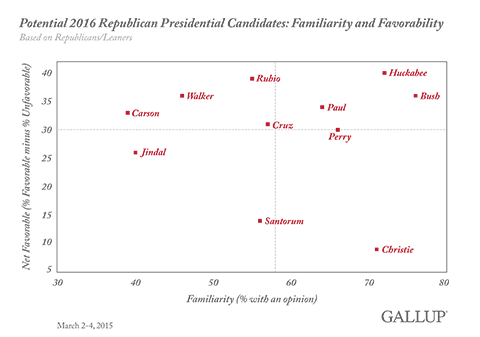
A March 2-4 survey of  653 Republicans and Republican-leaning independents has bad news for Christie. Frank Newport writes at Gallup:
Of 11 potential candidates for the 2016 Republican presidential nomination, Mike Huckabee and Jeb Bush are the most well-known and have the highest net favorable ratings among Republicans and Republican-leaning independents. While Chris Christie is one of the most familiar Republican figures among the party base, he has the lowest net favorable rating.
Potential 2016 Republican Presidential Candidates: Familiarity and Favorability, March 2015
.

Wednesday, March 11, 2015

Rubio and Walker

Michael Warren writes at The Weekly Standard:
A new poll from the Wall Street Journal and NBC News shows Florida senator Marco Rubio and Wisconsin governor Scott Walker have the most goodwill among Republican primary voters ahead of both men's possible bids for the presidency.

Rubio, however, received a higher percentage of those saying they could not see themselves supporting him for president (26 percent) compared to Walker (17 percent).The wide-ranging poll surveyed registered GOP presidential primary voters about the long list of potential candidates, asking if they could see themselves supporting each one. Of those polled, 56 percent said they could see themselves supporting Rubio, with 53 percent saying the same about Walker.
The other candidates register significantly worse ratings on one or both questions. Former Arkansas governor Mike Huckabee, for instance, has 53 percent of voters who say they could see themselves supporting him—but 40 percent who say they could not. There are similar numbers for former Florida governor Jeb Bush (49 percent who could support, 42 percent who could not), Kentucky senator Rand Paul (49 percent and 40 percent), and former Texas governor Rick Perry (45 percent and 40 percent).

Friday, March 6, 2015

A Very Bad Choice by Mike Huckabee

Mike Huckabee has severely undermined his own credibility by becoming a pitchman.  Last month, Max Brantley reported at The Arkansas Times:
My ears did not deceive me. I DID hear Mike Huckabee in a radio ad this morning extolling the benefits of the "diabetes solution kit," purported to be a "natural" solution to diabetes.
It appears to include a video about healthy habits, most of which can be found for free at numerous websites, and a tout of herbal supplements, such as cinnamon. Barton Publishing has been around selling this 'solution' for a processing fee, add-on charge and subsequent pitches for additional items since at least 2012.
The full news release of Huck's involvement is on the jump. It quotes Huckabee as saying he's "fit as a fiddle" and said he'd used the "techniques" in the diabetes solution kit to lose 110 pounds and reverse his Type 2 diabetes after a diagnosis in 2004.
The news release adds:
Huckabee admits he has put back some of the weight recently, but is working on losing the pounds again.
"The only way I know to achieve this is by making the right food choices and engaging in simple exercises," he said.
"I may not run for president again. And I may not get to be Governor again. But I definitely won't be a victim of diabetes again. There's simply no reason for it," he said.
I can't think of another presidential candidate working in spare time as a radio pitch man for natural health cures — for a "nominal fee." Can you? Here's a website that contains some unhappy customer reports about Barton publishing.
See another website with customer reports. 

This is not the first time he has engaged in moneymaking and campaigning at the same time.  In the 2008 race, he kept making paid speeches.

Moreover, his PAC has paid $400,000 to family members.

Such activity feeds the narrative that he is a profiteer.

Wednesday, February 25, 2015

Early Polls

PPP's  national  poll has Walker is at 25% to 18% for Ben Carson, 17% for Jeb Bush, 10%
for Mike Huckabee. Chris Christie and Ted Cruz at 5%, Rand Paul at 4%, and Rick Perry and Marco Rubio at 3%.

In South Carolina, PPP  has Bush in a statistical tie with Walker 19%-18%.  Carson and Graham tie for in third at 13%, Huckabee with 12%, the rest in single digits.

Quinnipiac has Walker at 25% among likely Iowa Republican caucus participants with 13% for Paul, 11 %each for Carson and Huckabee and 10 % for Jeb Bush. No other candidate is above 5% and 9% are undecided.  In a combination of first and second choices, Walker has 37%, with 21% percent for Paul, 20% for Bush, 19% for Carson and 18%  for Huckabee.

The Field Poll finds Wisconsin Governor Scott Walker at 18%, and former Florida Governor Jeb Bush at 16%, holding a small lead in California over a host of other Republican hopefuls who divide another 47% of the vote. About one in five likely GOP primary voters (19%) are undecided.


..................................First Choice Second Choice
1. Ted Cruz .................20% .............12%
2. Scott Walker ...........19 ................15
3. Jeb Bush ...................9 ................6
4. Ben Carson ...............9 ................13
5. Rick Perry ................8 ..................8
6. Mike Huckabee ........5 ..................7
7. Rand Paul .................4 ................7
8. Marco Rubio ............4 ..................7

Monday, February 2, 2015

Iowa Poll

As a rule of thumb, unfavorables are harder to move than favorables. So while early polls require a skeptical reading, the signs from Iowa are not good for the establishment candidates.

Aaron Blake writes at The Washington Post:
Witness this new Bloomberg Politics/Des Moines Register poll of 2016 caucuses. The big takeaway Sunday was that Wisconsin Gov. Scott Walker has taken the lead (a statistically insignificant one, albeit). More specifically, the big takeaway was that the erstwhile front-runners -- Mitt Romney and Jeb Bush -- don't lead. (The survey was conducted before Romney announced Friday that he won't run.)
The reason: The Iowa caucuses just aren't friendly to establishment Republicans.
We noted Friday that Romney's unfavorable rating among likely caucus-goers was 40 percent -- a very high number, given that these are members of Romney's own party.
Well, he's not the only one. While Romney's favorable/unfavorable split is 57/40, Bush's is even worse: 46/43. And New Jersey Gov. Chris Christie's image is downright bad: 36 percent favorable vs. 54 percent unfavorable. Again, this is among Republicans.
Other, less establishment-oriented Republicans don't have this problem. Sen. Rand Paul (Ky.) is at 64/25. Former Arkansas governor Mike Huckabee is at 66/28. Walker is an unparalleled 60/12. None of the Democrats have this problem, either; Hillary Rodham Clinton is at 84/15, Vice President Biden is at 78/20, and Sen. Elizabeth Warren (Mass.) is at 58/11.
This is precisely why the caucuses picked Huckabee in 2008 and former senator Rick Santorum (Pa.) in 2012. It's why Sen. John McCain (Ariz.) didn't compete in 2008 and why Romney almost didn't in 2012.

Tuesday, January 27, 2015

Four GOP Brackets

Charles Cook identifies four brackets in the GOP nomination contest:
First there is the establishment bracket, with former Florida Gov. Jeb Bush, New Jersey Gov. Chris Christie, and possibly former Massachusetts Gov. Mitt Romney competing for that semifinal slot. Former Hewlett Packard CEO Carly Fiorina would likely fit into this group. GOP nominees traditionally come from this bracket.

Then there is the conservative governor/former governor slot—with, potentially, Ohio Gov. John Kasich, Indiana Gov. Mike Pence, former Texas Gov. Rick Perry, Michigan Gov. Rick Snyder, and Wisconsin Gov. Scott Walker competing, all seeking to be non-Washington and non-Congress candidates, but each with more conservative, or at least better conservative, credentials than Bush, Christie, or Romney. In this anti-Washington environment, being able to say that you effectively governed, in contrast with Congress and Washington, certainly has some advantages among the non-purist conservatives.
In the third bracket are the more identifiably tea-party candidates, principally Sens. Ted Cruz of Texas and Rand Paul of Kentucky, but also former Rep. Michele Bachmann of Minnesota, possibly former 2008 vice presidential nominee and former Alaska Gov. Sarah Palin and even real-estate mogul Donald Trump (though both Palin and Trump are unlikely to make it past the first lap if they end up entering at all). This bracket is for the "mad as hell and not going to take it anymore" conservatives.
Finally, there is the social, cultural, and religious conservative bracket, made up primarily of former Arkansas Gov. Mike Huckabee and former Sen. Rick Santorum of Pennsylvania, tapping into the same feelings as the third group but with a distinctly moral dimension.

Sunday, January 11, 2015

Huck's Bucks

At Open Secrets, Russ Choma writes that Huckabee starts with good name identification from his previous race and his Fox TV show, among other things.
And from a money perspective, he’s not in terrible shape starting out. Huck PAC, the leadership PAC he founded in 2008 that he now uses as his main political vehicle, had raised $2.2 million in the 2014 cycle through Nov. 24. It still had $493,000 in cash on hand. The PAC can accept up to $5,000 per year from a donor (either an individual or another PAC.)
That’s well short of $25 million, but it compares not unfavorably to other potential candidates who are considered serious. Sens. Rand Paul (R-Ky.), Marco Rubio (R-Fla.) and Ted Cruz (R-Texas) all have leadership PACs they’ve deployed to push their presidential prospects, and have raised, respectively, $3.6 million, $3.8 million and $2 million. And those three have been fundraising at full pace as active politicians, while Huckabee hasn’t been in elected office since 2007.
Like those senators, Huckabee has used his leadership PAC to develop a team of consultants to advise him on politics and fundraising. All told, the PAC has spent more than $431,000 on consultants in the 2014 cycle, with the largest sum ($329,000) going to Legacy Consulting, an Arkansas-based firm led by former Huckabee aide Chad Gallagher. But the majority of the money has been spent ratcheting up a fundraising machine. A full $1.2 million of the total $1.9 million spent by Huck PAC in the most recent cycle has gone for fundraising — $988,000 on mass mailing and calls alone.
The trick for Huckabee now is to unearth some deep-pocketed donors to help him get to $25 million. In the 2014 cycle, Huck PAC showed a knack for connecting with smaller donors. Traditionally that’s a good thing, but given the new rules of the game, with more money coming from fewer contributors who are now able to give the maximum to as many candidates and committees as they want, the wealthy contributor is more prized than ever. Of the money raised by Huck PAC in 2014, $1.67 million came from small donors — those contributing $200 or less — and just $400,000 came from larger donors.

Monday, January 5, 2015

Huck Might Be Running

Mike Huckabee has left Fox to explore a presidential race.  At The Daily Beast, Lloyd Green writes:
Practically speaking, Huckabee must win in places like Florida, Texas and Virginia, which is no small task given Bush’s footprint in Florida, and Sen. Ted Cruz’s favorite son status in Texas. For the moment, national polls show Bush and New Jersey’s governor, Chris Christie, at the front of the Republican field, with Huckabee, Paul, and Ben Carson in contention, and Cruz looking like an also-ran.
Huckabee will also need to establish a reliable fundraising base, something that up until now has proved to be elusive. In 2008, Huckabee raised a little over $16 million, with less than $55,000 coming from political action committees. By contrast, John McCain, the eventual GOP nominee, had raised approximately $12.7 million in the first quarter of 2007 alone.
Despite his fundraising challenge he has some advantages.  He is well-liked, enjoys enthusiasm among religious conservative, and appeals to the base on taxes.
More to the point, Huckabee has a natural appeal to a party that has come to represent the bulk of working class white voters. He has taken a tough stance on unilateral presidential amnesty for illegal immigrants, and has backed “fair trade,” in the face of globalization. Huckabee is also not burdened by, or beholden to, foreign investors. In a sense, Huckabee may be America’s UKIP candidate, melding nationalism with traditionalism.
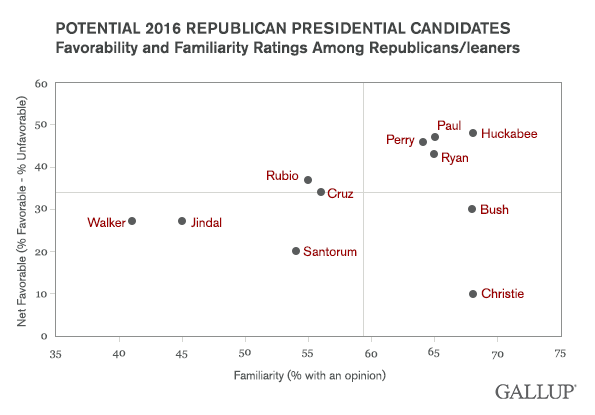
 In July, Gallup found that "he reigns as the single candidate with the best combination of familiarity and net favorability among Americans who identify with or lean toward the Republican Party nationwide."
Potential 2016 Republican presidental candidates favor and familiar ratings
As for problems, back to the Green article:
As for his campaign staff, Huckabee is going with people who were with him in 2008, Chip Saltsman, the Republican National Committeeman from Tennessee, and Alice Stewart, his 2008 press secretary—but that may not necessarily be the best thing. Saltsman is best known for circulating a CD containing the satirical ditty, “Barack the Magic Negro,” as part of Saltsman’s own failed bid to be tapped as chairman of the Republican National Committee. As for Stewart, she is known and generally liked by the press corps, and she’s a veteran of Michele Bachmann’s short-lived 2012 presidential campaign and the equally successful Santorum drive.
Despite his ease in front of the camera, he also has to watch out for damaging gaffes.

Sunday, December 28, 2014

2016: Nobody Can Win

It seems that every potential 2016 presidential candidate has at least one electability problem.  Some have more than one.

Hillary Clinton is tied to the Obama administration's foreign policy and the Clinton administration's scandals.  Born October 26, 1947, she would be 69 years old on Election Day, which would make her the second-oldest president after Ronald Reagan.

Elizabeth Warren, born June 22, 1949, is almost as old as Clinton. She has won only one election, in liberal Massachusetts, and her progressive politics probably would not travel well in a general election. (Think Dukakis and Kerry.) The false claims of Cherokee heritage won't help, either.

Jeb Bush is named Bush.  He also supports Common Core.

Paul Ryan proved in 2012 that he is very bright but uninspiring on the campaign trail.  Vice presidential candidates seldom help their tickets, and he was no exception:  the Republicans lost his home state of Wisconsin.  And as chair of the House Ways and Means Committee, he has a real job that would severely limit his campaign time.

Mike Huckabee is well-liked.  He also tends to make the kind of gaffes that would sink candidates who reach the top tier.

Chris Christie flunked his 2012 vice presidential vetting. Bridgegate might not bring him down, but the other stuff could.  Also, his temper -- like Warren's liberalism -- will not appeal outside the Northeast.

Rand Paul has shown terrible judgment in associating both with neo-Confederates and Al Sharpton.

Marco Rubio has alienated much of the GOP base over the issue of immigration. And if Bush gets in, much of his anticipated Florida money will disappear.

Scott Walker won reelection in 2014 despite a campaign finance scandal.  In a presidential race, however, the relevant documents will be subject to scrutiny by a large cadre of more-skillful and better-equipped opposition researchers. The email trove will be like a natural gas well that reopens when a new technology becomes available.  Call it political fracking.

Ted Cruz has alienated colleagues in the party with counterproductive legislative tactics.  Many Republican officials hate him, and they will undercut him in ways both obvious and subtle.

Bobby Jindal is still best-known for his disastrous State of the Union response.  He is unpopular back home in Louisiana.

Rick Perry is still best-known for "Oops."  Perhaps it will lower expectations for him. But another problem is that he will no longer be governor of Texas, and will not be able to gather "access money."

John Kasich expanded Medicaid, which might not hurt him in a general election but would cost him conservative support in GOP primaries.  And if Christie and Bush get in the race, it is hard to see that there will be many votes left in the establishment bracket

Dr. Ben Carson is a world-class surgeon but has never held office or run a large organization.  Every president has had one of those two experiences.  His oratory may give him an early boost, but at some point, his lack of qualifications will kick in.

Carly Fiorina, like Dr. Carson, has never won an election, but she has run an organization (HP).  That's her problem:  HP sacked her for poor performance, and her stewardship opens her up to the kind of "callous clueless rich person" attack that hurt Romney.  And at least Romney could make a plausible case that he was successful at Bain.


Monday, September 29, 2014

Huckabee and Tax Reform

At The Daily Beast, Lloyd Green talks to Mike Huckabee about tax reform:
Huckabee viewed the tax trap this way: “Most working families… need tax reform they can understand and follow easily. They need time to see their kids’ ball games and dance recitals instead of having to gather information for the tax man.” At the recent Values Voters Summit, Huckabee also acknowledged that same disconnect between the GOP’s base and Washington, saying, “Some of you are frustrated and even upset and angry about America, and I get it.”
As a former governor of a rural state, Huckabee is also mindful of the effects inheritance taxes can have on family farms and small businesses. Says Huckabee, “Some families have assets in long-held land that has to be sold to pay inheritance taxes. Why should a generation be punished for seeking to leave something for one’s family?” At present, the federal estate tax kicks in at estates valued at more than $5.34 million.
In Huckabee’s view, tax reform should not harm the middle class or undermine the family. As corollary, Huckabee opposes tax reform that is based on curbing charitable deductions or undermining the home interest mortgage deduction—which Mitt Romney refused to rule out in 2012.
According to Huckabee, “If we continue the current system, then we should keep deductions that benefit the community and the country, such as charitable contributions or mortgage payments.” To be sure, Huckabee still views the Fair Tax as “the better option.”
Huckabee also has his eye on revamping the corporate tax structure, which seems to be driving American corporations offshore, and revenues overseas. ...
Ironically, the brains behind corporate tax inversions are actually the President’s own donor base. According to Bloomberg News, the lawyers and bankers who facilitated and structured tax inversions, as well as companies that have relied upon them, have contributed to the President. Not surprisingly, Obama has refused to return campaign donations from the very individuals who benefited from these “unpatriotic measures,” much the same way as Obama tapped Lew as his Treasury Secretary, despite Lew’s investments in Cayman Island based entities.

Monday, September 22, 2014

Huck Speaks

At The Daily Beast, Lloyd Green reports on an interview showing that Mike Huckabee will not bee the elites' candidate in 2016:
For example, domestically, Huckabee views America’s policies as running counter to the needs of middle-class America. Huckabee points out that “Open immigration policies bring foreign labor to work on the cheap—even in high-tech sectors where students who worked in STEM [science, technology, engineering, and mathematics] programs are being passed over for immigrants.”

Huckabee’s stance is likely to put him at odds with influential Silicon Valley moguls and the U.S. Chamber of Commerce, but the Arkansan is in sync with public sentiment. When Obama seeks to punt immigration to a lame duck Congress—that is, when the voters are least likely to be paying attention— that is a tell-tale sign that our porous borders are a loser with the public at large, a notion that even Hillary Clinton appears to be embracing.
...

Domestically, the former governor offers an avowedly nationalistic agenda, focused on American self-sufficiency. As he says, “We should focus on three things: Feed ourselves (agriculture), Fuel ourselves (energy), and Fight for ourselves (manufacture our own weapons of defense and not outsource it).”

Energy policy and production are not just national security items on his agenda, but go to the very heart of giving the middle class a boost. Huckabee adds, “High energy and higher food costs take away any upward mobility of the middle class. Extracting our own energy is not only job creation, but wealth retention for the middle class.”
...
Yet, where Huckabee is actually groundbreaking is the Middle East, where he rejects decades of stated U.S. policy and received wisdom. With Barack Obama having made an Israeli-Palestinian peace a priority at the beginning of his administration to no avail, and then giving Secretary of State John Kerry free rein to endlessly shuttle between Jerusalem and Ramallah and having nothing to show for it, Huckabee put it bluntly: “The so-called two-state solution is a politician’s pipe dream.”

Tuesday, August 5, 2014

Christie v. Huckabee

At The Daily Beast, Lloyd Green sizes up some 2016 contenders:
Christie was clearly what non-Southern high-end Republicans wanted--a hawk who kept his eye on the bond market. That Christie had posed a serious vetting problem for the Romney campaign back in 2012 was but a minor detail for Republicans, especially after eight years of Barack Obama. Likewise, Christie’s use of 9/11 and the fall of the Twin Towers to justify NSA overreach met with approval by Wall Street Republicans.
Huckabee, on the other hand, is closer to where the Republican Party lives and worships. He is an evangelical in a party in which half of its presidential primary voters are themselves evangelicals. Huckabee’s roots are rural and, as a party, the GOP is the home of white rural America. From the looks of things, Huckabee’s profile is well-tailored for 2016’s early contests, in a way that Christie’s bluster-filled mien is not.
The tentative 2016 primary calendar paints a picture of early wins for Huckabee in Iowa and South Carolina, a brawl between Paul and Christie in New Hampshire, a big industrial state primary in Michigan on February 23, and a March 1 demolition derby in Florida, Texas, and Virginia. If Christie does not score a win in New Hampshire or Michigan, his political obituary will read like Giuliani 2.0, a Northeast ex-prosecutor and pol who managed to offend more than charm.

Friday, July 18, 2014

Keep an Eye on Huckabee

The Gallup poll shows that Hillary Clinton is the best-known and best-liked potential presidential candidate.  That is utterly unsurprising in light of her long record.  The more noteworthy poll finding involves a Republican:
Former Arkansas governor and current talk show host Mike Huckabee is arguably in a slightly better position image-wise among the national adult population than other potential Republican presidential candidates. His +12 net favorable rating edges out Kentucky Sen. Rand Paul's +9 for the highest among Republican candidates. Huckabee's 54% familiarity score trails those for New Jersey Gov. Chris Christie (65%) and former Florida Gov. Jeb Bush (65%), but is above the 52% average for the 11 Republicans measured in the poll. Christie's and Bush's net favorable ratings are among the lowest.
As we discuss in After Hope and Change, Huckabee went into the 2012 election with high favorables and would have been a serious contender had he chosen to run.  Four years later, with more money in the bank (his need to build up personal assets played a part in his noncandidacy) and no obvious front-runner, he might decide to go for it.


Sunday, January 26, 2014

Women, Huckabee, and Walker

In an interview with PostTV, Wisconsin Gov. Scott Walker (R) said Republicans should avoid “taking the bait” on divisive social issues. The comments were in response to controversial remarks about birth control from former Arkansas governor Mike Huckabee. Walker said while part of Huckabee’s comments that referred to a “woman’s libido” were taken out of context, in general, Republicans would be better served by focusing on their economic messages.
Walker’s comments come the day after fellow Wisconsinite and Republican National Committee Chairman Reince Priebus told the RNC’s winter meeting the GOP needs to be “very conscious of the tone and choice of words” when it communicates its policies.
In his remarks to the RNC, Huckabee encouraged Republicans to push back against the narrative that they are hostile to women and aggressively seek their votes - but it was how he delivered the message that caused a stir.
"If the Democrats want to insult the women of America by making them believe that they are helpless without Uncle Sugar coming in and providing for them a prescription each month for birth control because they cannot control their libido or their reproductive system without the help of the government, then so be it," Huckabee said. "Let's take that discussion all across America."