Search This Blog

Showing posts with label 1988 election. Show all posts

Saturday, August 29, 2020

1988 and 2020

In Defying the Odds, we discuss the 2016 campaign. The 2019 update includes a chapter on the 2018 midterms. The 2020 race, the subject of our next book, is well underway.  

Thomas B. Edsall at NYT:
Asked to describe how the politics of today compare to the politics of 1988, when Biden first ran for president, Sean Westwood, a political scientist at Dartmouth, replied that what stands out to him is how animosity is driving the current versions of both parties.
The electorate in 1988 was far more likely to view the other side with respect. Voters believed that both candidates sought to better the American way of life. Contrast this with today’s candidates who are both focused on corralling anger to their advantage, with Biden searching for those angry with Trump and Trump searching for angry middle-class whites.

Over the past three-plus decades, the Democratic Party has been on the leading edge of change, one step or more ahead of the nation as a whole.

Democrats have become decisively more liberal, especially on cultural issues; more dependent on states on the East and West Coasts; more diverse; more ideologically orthodox, less religious, less white; and in many cases more highly educated.

“The race and religion gap jumps out to me, specifically white Christians vs. everyone else,” Ryan Burge, a political scientist at Eastern Illinois University, wrote in an email describing how the parties have changed in recent decades.

While “the Republican Party doesn’t look terribly different than it did in the 1980s: about 88 percent were white Christians in 1984; in 2018, it’s still 75 percent.”

In contrast, the Democrats have changed radically, Burge continued: “About 68 percent of Democrats were white Christians in 1984, today it’s 38 percent.”

From 1991 to 2018, the share of Democrats who describe themselves as religiously unaffiliated has grown from 10 percent to 38 percent. While a majority of Democrats say they believe in God, the party has become the home on nonbelievers.

Wednesday, December 5, 2018

The 15 Largest Counties: 1988 and 2016

In Defying the Odds, we discuss the historical context of the  2016 presidential race.

One measure of change in the electorate is the performance of Republican presidential candidates in the 15 largest counties in 1988 and 2016.  On average, GOP performance dropped about 19 percent.


19882016
Los Angeles CA46.90%22.40%-24.50%
Cook IL (Chicago)43.40%20.80%-22.60%
Harris TX (Houston)57.00%41.60%-15.40%
Maricopa AZ (Phoenix)64.90%47.70%-17.20%
San Diego CA60.20%36.60%-23.60%
Orange CA67.70%42.30%-25.40%
Miami Dade FL55.30%33.80%-21.50%
Kings NY (Brooklyn)32.60%17.50%-15.10%
Dallas TX58.40%34.30%-24.10%
Riverside CA59.50%44.40%-15.10%
Queens NY39.70%21.80%-17.90%
Clark NV (Las Vegas)56.40%41.70%-14.70%
King WA (Seattle)44.80%21.00%-23.80%
San Bernardino CA60.00%41.50%-18.50%
Tarrant TX61.20%51.70%-9.50%
-19.26%

Tuesday, December 4, 2018

The Magnitude of Bush's 1988 Victory

In Defying the Odds, we discuss the historical context of the  2016 presidential race.

In 1988, George H.W. Bush, the 41st president, got a higher share of the popular and electoral vote than any presidential candidate since then.


                                    Popular %        Electoral Vote

1988    Bush 41           53.4                 426   79.1%
1992    Clinton, B.       43.0                 370   68.8%
1996    Clinton, B.       49.2                 379   70.4%
2000    Bush 43           47.9                 271    50.4%
2004    Bush 43           50.7                 286    53.2%
2008    Obama             52.9                 365    67.8%
2012    Obama             50.9                 332    61.7%
2016    Trump              46.0                 304    56.5%

Monday, December 3, 2018

California, Then and Now

In  Defying the Odds, we discuss Trump's impact on America.

In the 1988 campaign, California was up for grabs.  Bush and Dukakis both campaigned here.  On the day before the election, Dukakis held rallies in San Francisco and  Los Angeles.

Bush won the state, 51-48 percent.  It was a modest margin, but it was also the last time to date that a Republican presidential candidate carried the state.  

Figures for the six largest counties in the state illustrate the shift between 1988 and 2016.


Bush 1988Trump 2016
Los Angeles47%22%
Orange68%42%
Riverside59%44%
San Bernardino60%42%
San Diego60%37%
Santa Clara47%21%

Sunday, November 11, 2018

The Geography of the Vote

In Defying the Odds, we discuss state and congressional elections as well as the presidential race. 
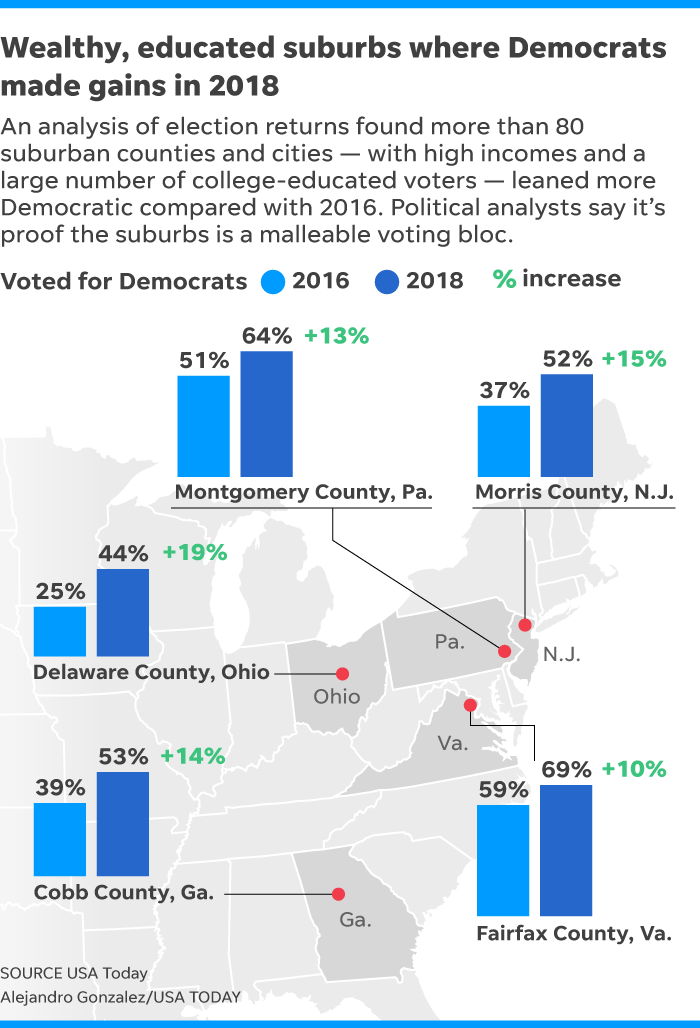
From USA Today:


Jazmine Ulloa and Joe Mozingo at LAT:
Rep. Dana Rohrabacher has lost the congressional seat he held for 30 years in one of the most conservative stretches of Orange County, a stunning defeat for the GOP as other Republicans’ early leads receded in the latest ballot counts, putting the party in fear of losing all six tightly contested House races in California.

The defeat to Democrat real estate entrepreneur Harley Rouda represents a landmark shift away from the GOP for suburban America. No county — no part of a county — has been at the heart of conservatism since the 1960s like the coast between Dana Point and the Los Angeles County line.

“The district became much more of an anti-Trump suburb, and he no longer connected to the people there,” [Tony] Quinn said. “He had an opponent who was a former Republican businessman, not some wild-eyed lefty. And for at least two years, people were willing to try something new.”

It is a stark change for the region once embodied by the legendary movie cowboy John Wayne — its international airport’s namesake — who was an ultra-right John Birch Society member and lived on the harbor in Newport Beach.

Republicans have now lost three of the six races Democrats targeted most in the state. They have fallen behind or are holding thin leads in the remaining unresolved races, as suburban voters nationwide rebuked Trump and his allies in the House of Representatives.

Democrats earlier won the seats of GOP Reps. Darrell Issa of Vista, who declined to seek reelection, and Steve Knight of Palmdale, who was ousted by Katie Hill.

On Friday, Democrat Josh Harder overtook Republican Rep. Jeff Denham in the latest tally in a Modesto-area district.
...

“This is more than just a bad year,” said Mike Madrid, a GOP political strategist. “This is essentially a realignment in California politics, and the traditional base that has served the Republican Party no longer exists.”


David M. Drucker at The Washington Examiner:
“We’ve got to be worried about what’s happening in the suburbs. We get wiped out in the Dallas suburbs, Houston suburbs, Chicago suburbs, Denver suburbs — you know there’s a pattern — Detroit suburbs, Minneapolis suburbs, Orange County, Calif., suburbs,” [Karl] Rove said Saturday during a panel discussion for the Washington Examiner’s Sea Island Summit.
“When we start to lose in the suburbs, it says something to us,” Rove continued. “We can’t replace all of those people by simply picking up [Minnesota’s First Congressional District] — farm country and the Iron range of Minnesota — because, frankly, there’s more growth in suburban areas than there is in rural areas.”

Tuesday, November 7, 2017

Donna Brazile and Paul Manafort, 1988

In Defying the Odds, we discuss the mechanics of the 2016 campaign and other problems that brought down the Democrats. 

I am currently writing a book about the 1988 campaign.

Donna Brazile has courted controversy with a new book about that campaign.  She was controversial in the 1988 campaign, too.

The Los Angeles Times, October 21, 1988:
A Democratic presidential campaign official resigned Thursday after the Dukakis campaign disavowed her comment that "George Bush owes it to the American people to fess up" about a rumor concerning an extramarital affair that rippled through Wall Street on Wednesday.
Dukakis personally apologized to Bush for the remarks, made by deputy field director Donna Brazile, when the two candidates met Thursday night in New York for the Catholic archdiocese's annual fund-raising dinner.

Brazile told reporters accompanying the Democratic candidate that "the American people have every right to know if Barbara Bush will share that bed with him in the White House."
Paul Manafort is in trouble over foreign lobbying.  On September 11, 1988, Robin Toner reported at The New York Times: 
Escalating his response to Bush campaign efforts to raise doubts about him, the Massachusetts Governor demanded at a news conference in Boston that Mr. Bush ''answer some questions that are being raised about the fact that several of his top campaign advisers had a contract with a foreign government, some of whose top officials were under investigation for drug profiteering.''
Mr. Dukakis read from a memorandum from Black, Manafort & Stone, a Republican consulting firm whose partners work as unpaid consultants to the Bush campaign. In the memo, he said, the firm ''brags about its ability to reach into high offices in this Administration as a result of what it calls back channel relationships.'' He added, ''I think the American people have a right to know that the back door of the White House will not be the front door for paid agents of foreign governments.''
''In a Dukakis White House,'' he continued, ''there will be no back door for foreign lobbyists. My staff will not have divided loyalties.''

Thursday, January 19, 2017

1988 and 2016

The remarkable thing is that Obama was unable to transfer enough of this popularity to Clinton, his chosen successor, despite the dramatic improvement in the devastated economy he inherited in January 2009. Consider the 1988 election as a comparison: According to Gallup, Ronald Reagan had a 51% approval rating in late October 1988, but the incumbent was a key factor — maybe the key factor — in Vice President George H.W. Bush’s 53%-46% victory over Massachusetts Gov. Michael Dukakis.
...Clinton ran well ahead of Obama in Mega Cities (and there are quite a few in this region), though she “wasted” a lot of these votes in Atlanta. Everywhere else was a bit of a disappointment. She only tied Obama in large cities (though this is still ahead of Bill’s performances in the region), but ran behind Obama (and Bill) everywhere else. In large towns, she ran about even with Michael Dukakis, and in rural counties and small towns, she ran behind Dukakis by significant amounts. Again, rural counties and towns don’t cast a lot of votes standing alone, but they do add up.
... 
From 1988-1996, the Democrats’ coalition was well balanced. Bill Clinton basically took the Dukakis vote, and tacked on 10 points across the board. But beginning with Al Gore, the distributions are increasingly skewed toward the mega cities. The gains there are significant, but they aren’t enough to offset the losses in rural areas.
...'
As of 1988, the Democrats had a robust coalition in the South. They showed strength across Appalachia, in the “black belt” (named for the fertile soil), and in the Rio Grande Valley. Southern Louisiana (Catholics) and Arkansas outside the traditionally red northwest portion of the state were blue. Republicans, by contrast, were strong in the historically Republican areas of southeastern Kentucky, eastern Tennessee, and western North Carolina. They also held the cities, as metro areas like Miami, Dallas, Houston, Atlanta, and Northern Virginia were all purple-to-red.
...
In summary: In 2009, we identified the outlines of what would become a Democratic problem: weakness among traditionally Democratic voters in rural areas and towns. In 2016, this weakness became significant enough that it overwhelmed Democratic strength in urban areas in two states that President Obama had won. As we saw above, this is significant, because while urban areas are growing, they are growing at a slower rate than many analysts seem to appreciate.
And the Midwest:
As you can see, the Massachusetts governor performed well in the region, especially in the western division. This is in part because of the farm recession, but as we’ll see, it wasn’t limited to this. We note Democratic strength in eastern Ohio, which is part of Appalachia, along the Lake Erie coast (reflecting the strength in old industrial cities), in the Upper Peninsula of Michigan, and in the Balkans (a rural, yet ethnically diverse section of southeastern Kansas). But in general, it is difficult to identify any particular home for the Democratic Party here. Democrats perform well in all sorts of places. This helped Dukakis carry Iowa, Minnesota, and Wisconsin, while coming close in South Dakota, Missouri and Illinois.
...

 Again, the Democratic decline in rural areas is apparent, although Clinton performed worse than any Democrat since 1988 in almost every area (and worse even than Dukakis in rural and small-town areas)...
As late as 1996, Bill Clinton ran strong in [Ohio portion of] Appalachia, and dominated in the industrial Northeast and along Lake Erie. The state had strong east/west and north/south splits that gradually disappeared over the course of the decades. In 2016, Democrats ran strong in Lucas (Toledo), Cuyahoga (Cleveland), Summit (Akron), Athens (Ohio University), Franklin (Columbus) and Hamilton (Cincinnati) counties. Again, these are significant prizes. But the drop-off in rural areas and the towns looks much like it does in the southern region, with Clinton running almost 15 points behind Dukakis in the rural areas, and about 10 points behind him in the towns...
During the summer, Dukakis told Slate's Isaac Chotiner:
My first convention was in Los Angeles in 1960 with Jack Kennedy. [Laughs.] So I go back a long way. We had a very good convention in 1988 and this was a very good convention. But my demise demonstrates pretty clearly that you can have a great convention and get beat.

Saturday, November 26, 2016

Don't Unpack

At The Atlantic, Ron Brownstein writes:
Except for 1988, when George H.W. Bush prevailed after two terms of Ronald Reagan, neither side has held the White House for more than eight consecutive years since 1952. (That’s despite the fact that Democrats since 1992 have now twice won the popular vote in three consecutive elections.)
And while Republicans are understandably euphoric that they will control the White House and both congressional chambers next year, neither party since 1968 has maintained such unified control for more than four consecutive years, a far more rapid turnover than in earlier generations. History suggests the best advice for Republicans now celebrating their unified control might be three simple words: Don’t unpack everything.

Saturday, June 11, 2016

Sanders and Jackson

Like Jesse Jackson in 1988, outsider Bernie Sanders is going to seek various concessions from the Democratic Party's nominee. At RealClearPolitics, Richard Benedetto writes:
Sanders and Jackson are kindred spirits and go way back in their friendship. Sanders, then mayor of Burlington, Vt., was one of the few white elected officials to endorse Jackson for president, first in in 1984 and again in 1988.

“We are going to give our support to a candidate for president who has done more than any other candidate in living memory to bring together the disenfranchised, the hungry, the poor, the workers who are being thrown out of their decent-paying jobs and the farmers who are being thrown off of their lands,” Sanders said when he endorsed Jackson in 1988.
Sound familiar?

Jackson, recalling those days, had high praise for Sanders last month in a Huffington Post podcast, “Candidate Confessional.”

“In many ways, Bernie is running the Jackson campaign,” Jackson said, “with much more money and today’s technology and much more coverage in so many ways. As we sought to broaden the base, many whites would support us but were afraid to face other whites — these cultural walls and fears. Bernie supported us in ’84 and ’88.”

Saturday, April 30, 2016

Upstairs, Downstairs, Democrats, and Data

Thomas Edsall writes at The New York Times about the changing economic makeup of the Democratic Party and the tension between its upstairs and downstairs.
At the same time that lifestyle and consumption habits of the affluent diverge from those of the middle and working class, wealthy voters are becoming increasingly Democratic, often motivated by their culturally liberal views. A comparison of exit poll data from 1984 and 1988 to data from the 2008 and 2012 elections reveals the changing partisan makeup of the top quintile.
In the 1980s, voters in the top ranks of the income ladder lined up in favor of Republican presidential candidates by 2-1. In 1988, for example, George H.W. Bush crushed Michael Dukakis among voters making $100,000 or more by an impressive 34 points, 67-33.
Move forward to 2008 and 2012. In 2008, voters from families making $100,000 to $200,000 split their votes 51-48 in favor of John McCain, while those making in excess of $200,000 cast a slight 52-46 majority for Barack Obama
In his first term, Obama raised taxes on the rich and criticized excessive C.E.O. pay. As a result, he lost ground among the well-to-do, but still performed far better than earlier Democrats had done, losing among voters making $100,000 or more by nine points, 45-54.
...
The “truly advantaged” wing of the Democratic Party — a phrase coined in this newspaper by Robert Sampson, a sociologist at Harvard — has provided the Democratic Party with crucial margins of victory where its candidates have prevailed. These upscale Democrats have helped fill the gap left by the departure of white working class voters to the Republican Party.

At the same time, the priorities of the truly advantaged wing — voters with annual incomes in the top quintile, who now make up an estimated 26 percent of the Democratic general election vote — are focused on social and environmental issues: the protection and advancement of women’s rights, reproductive rights, gay and transgender rights and climate change, and less on redistributive economic issues.
...
Bernie Sanders has tried to capitalize on this built-in tension within the Democratic primary electorate, but Hillary Clinton has so far been able to skate over intraparty conflicts. In the New York primary, for example, she did better among voters making $100,000 or more than among the less affluent, while simultaneously carrying African-Americans and moderate Democrats of all races by decisive margins.

Wednesday, March 30, 2016

Trump, Bush 41, and Abortion Penalties

At Bloomberg, Kevin Cirilli reports on an MSNBC town hall:
“I am pro-life,” Trump said. Asked how a ban would actually work, Trump said, “Well, you go back to a position like they had where they would perhaps go to illegal places but we have to ban it,” Trump said.
Matthews then pressed Trump on whether he believes there should be punishment for abortion if it were illegal.
“There has to be some form of punishment,” Trump said. “For the woman?” Matthews asked. “Yeah,” Trump said, nodding.
Trump said the punishment would “have to be determined.”
I am writing a book on the 1988 election, so this story sparked a memory

The issue came up at the first debate between Bush and Dukakis (September 25, 1988).  Ann Groer of The Orlando Sentinel got to the point:
GROER: Yes. Mr. Vice President, I'd like to stay with abortion for just a moment if I might. Over the years you have expressed several positions, while opposing nearly all forms of government payment for it. You now say that you support abortion only in cases of rape, incest, or threat to a mother's life, and you also support a constitutional amendment that if ratified would outlaw most abortions. But if abortions were to become illegal again, do you think that the women who defy the law and have them anyway, as they did before it was okayed by the Supreme Court, and the doctors who perform them should go to jail?
BUSH: I haven't sorted out the penalties. But I do know, I do know that I oppose abortion. And I favor adoption. And if we can get this law changed, everybody should make the extraordinary effort to take these kids that are unwanted and sometimes aborted, take the - let them come to birth, and then put them in a family where they will be loved. And you see, yes, my position has evolved. And it's continuing to evolve, and it's evolving in favor of life. And I have had a couple of exceptions that I support - rape, incest and the life of the mother. Sometimes people feel a little uncomfortable talking about this, but it's much clearer for me now. As I've seen abortions sometimes used as a birth control device, for heavens sakes. See the millions of these killings accumulate, and this is one where you can have an honest difference of opinion. We certainly do. But no, I'm for the sanctity of life, and once that illegality is established, then we can come to grips with the penalty side, and of course there's got to be some penalties to enforce the law, whatever they may be.
AP reported the next day:
Bush's campaign chairman James A. Baker III, meanwhile, sought to deflect any repercussions from the vice president's assertion in the debate that he hadn't decided whether women who obtain abortions should face legal penalties.
Baker said Bush, an opponent of abortion, believes that only those who perform the operations, not the patients, should be prosecuted.

After stressing strong anti-abortion views during the debate, he said, Bush decided on further reflection that women who obtain abortions should be regarded as "additional victims" rather than criminals.

"After thinking about it overnight, we went in and discussed it this morning and concluded it was an issue that should be addressed and we addressed it," Baker told reporters.

Bush told a debate questioner that "I haven't sorted out the penalties" he would impose under a constitutional amendment he seeks to outlaw abortions.

". . . I'm for the sanctity of life and, once that illegality is established, then we can come to grips with the penalty side and, of course, there's got to be some penalties to enforce the law whatever they may be," Bush said.

Dukakis immediately responded that Bush was "prepared to brand a woman a criminal for making that decision. It's as simple as that."

That exchange left the issue an "open question" that needed to be clarified, Baker said.

Friday, December 25, 2015

Which 1988 Candidate Foreshadowed Trump?

I am writing a book about the 1988 presidential election.  Reading Elizabeth Drew's Election Journal, I came across this passage, which sounds as if it could apply to Trump.
For a large portion of [his] supporters and would-be supporters, whether his proposals stand up to scrutiny is irrelevant. Their support for him is in a different category -- as the leader of a movement. [He] has become the vehicle for their discontent -- with current policies, with the other candidates. He stands in bold, interesting contrast to some fairly dull candidates.  He is the anti-politics candidate. Measuring his program is linear, rational, while most of the support for him is based on emotion.
In this case, the candidate was ... Jesse Jackson.  

The comparison is less bizarre than it may seem at first.  Like Trump, Jackson was an outsider, a narcissist seeking adulation for himself while giving voice to the inchoate frustrations of large group of Americans who thought that the system was rigged against them.  He was also a morally-compromised leader with deep prejudices and a disregard for factual accuracy.

Tuesday, September 1, 2015

Crime Is Back

In 1992, the Democratic ticket touted its toughness on crime:


MALE NARRATOR: They've sent a strong signal to criminals by supporting the death penalty.
[TEXT: Support the death penalty.]

At Breitbart, Lloyd Green writes:
Murder is up in New York City, New Orleans, D.C., Baltimore and Chicago, just to name a few Deep Blue hot spots.
For Democrats that’s a nightmare. Barack Obama is our President, but he’s their guy, and the cities are their base. Hope and change weren’t supposed to be so bloody, and so dystopic. Yet, sadly they are.
The bad old days have returned, and this surge in death and mayhem guaranties that crime will be a 2016 campaign issue. For the Republicans, the fraying urban landscape is an opportunity in the making. Heck, the GOP and the U.S. have seen this movie before.
In 1968, Richard Nixon rode the riots of Baltimore, Chicago, Washington, D.C., and Wilmington, Delaware – the heart of what was then New Deal America – to the White House. Nixon, the Republican nominee, defeated a sitting Vice President, Hubert Humphrey, as the Democrats failed to win a third consecutive term in office.
Twenty years later, in 1988, George H.W. Bush rallied from 17 points behind, and beat Massachusetts Governor Michael Dukakis. Bush ads railed against weekend furloughs from prison for convicted murderers and rapists, and Dukakis never knew what hit him.
Right now, it looks like Donald Trump and the Republicans are poised to make the most of the latest spasm of violence, and make no mistake, Trump understands the potency of crime as an issue. He’s not just talking about illegal immigration, Trump is addressing street crime and urban life.
...
For the Democrats’ upstairs-downstairs coalition, that’s a hard lesson to absorb. You see, the laws that got tough on crime — laws enacted by President Bill Clinton, and then-Senator Joe Biden back in the day — are now the targets of the Democratic base’s ire. When prospective Democratic nominee Martin O’Malley gets booed for saying that all lives matter, our nation has a problem.

Over the past half century, crime has helped elect two Republicans as president. In 2016, crime may elect a third.

Wednesday, December 10, 2014

The Decline of the Personal Vote and Cross-Partisan Lawmakers

At The Washington Post, Brian Arbour uses the 1988 election as a point of departure for discussing partisan voting in congressional elections. Even though the Dukakis-Bentsen lost Texas, Bentsen won reelection to the Senate by a wide margin, running 16 points ahead of the ticket.  In 2014, by contrast, no Democratic Senate candidate in a key race ran more than five points ahead of Obama’s 2012 total.
Bentsen’s experience was not unusual. That year, 16 other Senators won election in a state their party’s presidential nominee did not carry (15 Democrats won in Bush states; two Republicans won in Dukakis states). The same was true in the U.S. House. Democrats won a majority for the 18th straight election, winning the popular vote 53 to 46 percent — the reverse of the presidential popular vote, when Bush defeated Michael Dukakis 53 to 46 percent.

In 2014, Election Day was a bad day for Democrats in red or purple states precisely because they didn’t do what Bentsen and other Democrats did in 1988. Democrats today had very little of what political scientists call the “personal vote” — the portion of a candidate’s support that derives from his or her personal qualities and qualifications. Many fewer voters were willing to go against their presidential party preferences in 2014 than they were in 1988.
...
As they have for several elections now, national factors such as partisanship and presidential approval largely drove the results of the 2014 election. According to the exit poll, 92 percent of Democrats and 94 percent of Republicans voted for their party’s House candidate. As voters have sorted themselves more clearly as Republicans and Democrats, they have become more likely to support candidates of the same party in different elections and have become less likely to be swayed by personal factors such as a candidate’s personality or political record.

Monday, January 20, 2014

George H.W. Bush's 1988 Victory

Today is the 25th anniversary of George H.W. Bush's inauguration as president.

Often we forget how impressive his 1988 victory was.  (Declaration of interest:  I worked in the 1988 Bush campaign.)

In 1988, Bush got a higher share of both the popular vote and the electoral vote than any candidate since then, including Barack Obama in 2008:

Bush 1988Obama 2008
Popular Vote %53.37%52.86%
Electoral Vote%79.20%67.80%

Obama won under more favorable circumstances.  The other party had been in power for two terms and was presiding over the worst economic crisis since the Great Depression.

Bush was the vice president of an administration that had been in power for eight years, so the "time for a change" mentality worked against him.  No sitting vice president had been won the White House since Martin Van Buren. The economy was growing and the Cold War was winding down, but Bush had to deal with the aftermath of the 1987 market meltdown and the Iran-Contra scandal.  For a long time, many thought that he would lose.

In May 1988, E.J. Dionne reported at The New York Times:
Michael S. Dukakis is capitalizing on deep public doubts about Vice President Bush and the Reagan Administration's handling of key issues and has emerged as the early favorite for the Presidential election in November, according to the latest New York Times/CBS News Poll.
Mr. Dukakis, the probable Democratic nominee, ran ahead of Mr. Bush, the almost certain Republican candidate, by 49 percent to 39 percent among 1,056 registered voters.
The survey, conducted May 9-12, represented a significant advance for Mr. Dukakis since a Times/CBS News Poll in March when Mr. Bush had 46 percent and Mr. Dukakis had 45 percent.
In the latest poll, Governor Dukakis of Massachusetts led in all regions, but he ran especially well in the Northeast and Middle West. The poll found Mr. Dukakis with very substantial advantages over Mr. Bush among women, union members, Roman Catholics and blacks/
A couple of months later, the Times reported:
In the aftermath of the Democratic National Convention, the party's nominee, Michael S. Dukakis, has expanded his lead among registered voters over Vice President Bush, the probable Republican nominee, according to a Gallup Poll.

This was among the findings of a national public opinion poll of 948 registered voters conducted late last week for Newsweek magazine by the Gallup Organization. The telephone interviews took place on July 21, which was the last night of the convention, and on the night after that.

Fifty-five percent of the 948 registered voters interviewed in the poll said they preferred to see Mr. Dukakis win the 1988 Presidential election, while 38 percent said they preferred to see Mr. Bush win. The poll had a margin of sampling error of plus or minus four percentage points.
In the end, however, Bush not only won comfortably, but he carried states that we today consider to be deep blue, including California, Illinois, Delaware, Maryland, Connecticut, New Jersey, and Vermont.  


Wednesday, July 3, 2013

"A Lifetime of Experience"

In Epic Journey and After Hope and Change, we write about the role of experience in presidential elections. Stuart Stevens writes at The Daily Beast:
Prompted by a New York Times article Monday,“Republicans Paint Clinton as Old News for 2016 Presidential Election” (which opens with a quote from me), there seems to be a great rush among the large professional class dedicated to defending all things Democratic to deny that age and experience will be an issue for Hillary. Which seems a bit silly since in her last run, she did everything she could to use both to her advantage.

“I think that I have a lifetime of experience that I will bring to the White House,” she declared on March 3, 2008. “Sen. John McCain has a lifetime of experience that he'd bring to the White House. And Senator Obama has a speech he gave in 2002."

She told Newsweek, “I wouldn't be in this race and working as hard as I am unless I thought I am uniquely qualified at this moment in our history to be the president we need starting in 2009 … I think it is informed by my deep experience over the last 35 years, my firsthand knowledge of what goes on inside a White House.”

This prompted Timothy Noah in Slate to respond, “Oh, please. Thirty-five years takes you back to 1973, half of which Hillary spent in law school, for crying out loud.”

And there’s the rub. When you ran in 2008 as the candidate of experience based on 35 years of experience and lost to a candidate of the “new,” don’t be surprised if it happens again eight years later.
In recent decades, the candidate who put the most emphasis on experience was Bob Dole.  He lost the vice presidency in 1976, GOP nomination in 1980 and 1988, and general election in 1996.

On November 7, 1987, he used the very phrase that Clinton used:  "I want to lead America into an even greater era of opportunity for our people and security for our nation. And so I offer a lifetime of experience and a record that shows not merely where I stand, but the hopes of a lifetime rooted here in Russell."

Sunday, April 7, 2013

DCCC Strategy for 2014


At The Washington Post, Paul Kane writes:
The best way to defeat the conservative, ideologically driven GOP, Democrats say, is to field non-ideological “problem solvers” who can profit from the fed-up-with-partisanship mood of some suburban areas. These districts will offer some of the few competitive House campaigns in the country.
...

[DCCC chair Steve] Israel’s approach is a variation on the model used by then-Rep. Rahm Emanuel (D-Ill.), the campaign committee chairman in 2006 when Democrats took over the House in George W. Bush’s “six-year itch” midterm. Emanuel sought out centrists and conservatives to run in rural districts, particularly in the South.

But after the GOP 2010 wave and the redrawing of district lines, most of those seats have been locked away for Republicans. What remains are a clutch of suburban seats — not unlike Israel’s own on Long Island — full of nonpartisan professionals who are more concerned about day-to-day issues than ideological battles.
...
Israel has been traveling the country to win over skeptics, delivering detailed, 90-minute presentations laying out what he sees as a path to victory. A Washington Post reporter was granted access to a presentation delivered recently to donors in Manhattan.

Israel’s pitch is built around the idea that Republicans won as many as 30 seats by single-digit margins, giving Democrats immediate opportunities. Another 22 were unique targets with districts more favorable to Democrats in non-presidential years or where the party ran poor campaigns in 2012. Texas and Florida still have to resolve legal battles over their congressional maps, and Democrats believe the final configurations will produce several more seats for them.

Without a presidential contest to compete with, Democrats also believe liberal mega-donors will open their wallets more generously to House Majority PAC, a super PAC supporting House Democrats. Its director, Ali Lapp, a former DCCC adviser, can attend events with Israel at this early stage of the campaign season without violating laws prohibiting the two committees from coordinating their activities.
The problem is that the 2006 model might not apply.  First, the Democrats are in the president's party, not the out-party, so the midterm effect works against them, not for them.  Second, in 2006, Nancy Pelosi had not been speaker and Barack Obama had not been president. In light of their records since then, it will be very hard for people to see Democrats as non-ideological problem solvers this time.


Monday, March 25, 2013

Dems in 1989, Reps in 2013

There is still a good deal of commentary about the GOP "rebranding." At The Washington Post, Dan Balz writes about the parallels between today's GOP and the post-1988 Democrats:
Those parallels come from William Galston of the Brookings Institution, who was one of a number of Democrats who prodded the party in the late 1980s to change course. With Elaine Kamarck, now also at Brookings, he co-wrote a 1989 paper titled “The Politics of Evasion.” Their paper set out to shatter myths about why the Democrats had lost so consistently — that they had “strayed” from liberal orthodoxy or that nothing was fundamentally wrong because they still held control of the House.
Galston said the other day that parties go through a series of phases before they remake themselves. The first is denial. That no longer describes the Republicans. They awoke after Mitt Romney’s loss, recognizing they were in trouble.
“I think the Republican Party is now in phase two,” Galston said, “and phase two is always dominated by the proposition of: ‘While we have problems, cosmetic or mechanical changes will solve the problems.’ ” Changes like reframing the message, or finding a better messenger or doing something to catch up on the techniques of data mining, analytics, micro-targeting and voter mobilization. Those are essential but not close to the whole solution.
Kamarck argued that there is another false path for the Republicans — the belief that their problems are the result of a charismatic opponent.
Democrats comforted themselves with that notion after losing a second time to Reagan. Michael Dukakis’s loss to George H.W. Bush in 1988 exploded that excuse. 
But the 1988 example points to another excuse:  that the other side won by playing dirty.  To this day, some Democrats think that Bush won because of Willie Horton.  A variant of the theme -- which we saw after the 2004 election -- is that the other side's technical sorcery was the cause of its victory.

Monday, September 12, 2011

Obama as Bush 41

It may seem odd to compare President Obama to George H.W. Bush. But start by comparing the margins by which they won the White House:

...............................Bush........Obama
Popular vote.........53.37%....52.87%
Electoral vote.......426..........365

Note that Obama's victory was a bit smaller on both counts. Niall Stanage adds at The Hill:

Democrats, especially those close to the White House, have been raiding the history books of late, looking for lessons that might help propel President Obama to a second term.

But one parallel in particular is too close for comfort: that of President George H.W. Bush in 1992.

Fred Malek, who managed Bush’s campaign that year, agreed that the two men face comparable predicaments.

“Both were going toward an election with a weak, troubling economic picture. Both saw their approval ratings drop substantially from where they had been,” he told The Hill.

But, he added, there were — and are — significant differences.

“Obama clearly knows we have a problem, economically, but doesn’t know what to do about it. Bush didn’t believe we had as troubled an economy as we had — and he also thought that, to the extent that government would get involved, anything it did was as likely to be wrong as right.”
The current economic slump is much, much worse than the short, shallow 1991-1992 recession.

Both faced grumbling within their parties: Bush for agreeing to a tax increase, Obama to agreeing to an extension of tax cuts.

Both had a spike in popularity: Bush for winning the Gulf War, Obama for killing bin Laden. Bush's spike was bigger and lasted longer, but he still ended under water.

Bush 41 did not have legislative accomplishments as far-reaching as the health-care bill, but it's a myth that his administration was a time of legislative gridlock. The Americans with Disabilities Act and the Clear Air Act authorization were just two of the significant bills that became law during this time.