Search This Blog

Showing posts with label incumbency. Show all posts

Sunday, November 1, 2026

Anti-Incumbency

 Our most recent book is The Comeback: The 2024 Elections and American Politics. It includes a chapter on congressional and state elections.  Most incumbents on this year's ballot will win.  But that share is likely to be smaller than the historical norm.

Megan Brenan at Gallup:

Ahead of the 2026 midterm elections, record-low shares of U.S. registered voters say they would reelect their own representative or most members of Congress. For the first time in a final pre-midterm reading, less than half of voters (43%) think their own representative deserves another term, while 15% say the same for most members of Congress.

Before this year, support for reelecting one's own representative had ranged from 50% to 69% in Gallup's final pre-midterm readings dating back to 1994. Support for reelecting most members of Congress has consistently been lower, ranging from 21% to 58% over the same period.

Bruce Mehlman:


Lisa Kashinsky and Aaron Pellish wrote in September at POLITICO:

It’s been a bad year to be an incumbent.

Rhode Island Gov. Dan McKee’s ouster on Wednesday, the first primary defeat for an incumbent governor in eight years, caps off a primary season that’s seen longtime leaders fall across the map and politicians across both parties struggle to make the leap to higher office.

Thirteen members of Congress have lost their reelection bids: seven Democrats and six Republicans, including two GOP senators. At least 16 more who were trying to move from the House to the Senate or take on statewide office have lost primaries: nine Republicans and seven Democrats, including Colorado Sen. Michael Bennet who unsuccessfully ran for governor.

The upheaval has been driven by a confluence of factors that will continue to dog incumbents through November. Voters are frustrated with both parties’ leadership in Washington. President Donald Trump has targeted some GOP foes as he looks to cement his legacy; Democrats are in the midst of pitched generational and ideological battles. Some members in both parties faced daunting new district lines. Others faced scandals that sank them.



Wednesday, August 12, 2026

About Last Night

Our most recent book is The Comeback: The 2024 Elections and American Politics. It includes a chapter on congressional and state elections. Some takeaways from the 8/10 primaries:

  •  Democratic socialists are significant, not invincible.
  • Older incumbents are vulnerable to primary challengers
  • Primary polling is problematic
  • Trump's grasp on the GOP primary electorate is loosening.

Mike Allen at Axios:

In Wisconsin's Democratic primary, Milwaukee County Executive David Crowley upset democratic socialist Francesca Hong, 39.8% to 39.4% — checking the progressive left's momentum after some polls showed her up by more than 20 points.Crowley must now prove the argument that powered his rise: that a mainstream Democrat gives the party a better chance in November against the election-denying, Trump-backed Rep. Tom Tiffany.

Takeaways from last night's results:The race was the latest example of flawed polling in Democratic primaries. Polling showed Hong with a big lead.
A democratic socialist came within about 3,000 votes of winning a major-party nomination for governor in one of America's premier swing states yesterday. So the result reflects both the left's rise and limits.
Wisconsin's November election will be historic. Tiffany would be the first person who voted to overturn the 2020 presidential election results in Congress to become governor of a top swing state if he won. And Crowley would be the first Black governor in Wisconsin history.

The progressive surge is still producing big wins:In Minnesota, Lt. Gov. Peggy Flanagan (59%) trounced Rep. Angie Craig (39.4%) by 20 points despite Craig's overwhelming money advantage and her pitch that a swing-district record made her more electable.
Democrats nominated progressive Matt Little to replace Craig in Congress.
Voters continue retiring aging longtime incumbents:7th House Dem loses: Rep. John Larson (D-Conn.), 78, a 14-termer, lost by 20+ points last night to his primary challenger, former Hartford Mayor Luke Bronin, age 47 (54% to 33%). Larson is the 10th House member ousted in this year's primaries. Seven have been Dems, Axios' Andrew Solender reports.
Connecticut state Rep. Maryam Khan defeated a state senator with 22 years in the capitol. 26-year-old Eli Sabin defeated the state's longest-serving state House member.

 On the right: Trump's endorsement failed to rescue one of his highest-profile allies. MyPillow CEO Mike Lindell lost the GOP governor nomination in Minnesota to state Speaker Lisa Demuth.But another of his candidates advanced: In South Carolina, Trump-endorsed Sen. Darline Graham (33%) and Rep. Ralph Norman (25%), a hardline conservative, move to an Aug. 25 runoff in the special Republican primary to replace the late Lindsey Graham. Go deeper.

Monday, July 6, 2026

Anti-Incumbency 2026

Our most recent book is The Comeback: The 2024 Elections and American Politics. It includes a chapter on congressional and state elections.

Alexander Bolton at The Hill:

A sour, anti-incumbent mood is sweeping across the nation on its 250th anniversary in what political analysts say is an especially troubling sign for Republican control of the House and Senate, given President Trump’s slumping approval rating.

Rising voter anger with the status quo has hit both parties, with eight House incumbents — five Democrats and three Republicans — losing primary races this year in addition to two GOP Senate incumbents, Sens. Bill Cassidy (La.) and John Cornyn (Texas).

Republicans on Capitol Hill fear the antiestablishment mood could cost them control of the House and perhaps the Senate as well.

National Republican Senatorial Committee Chair Tim Scott (S.C.) has warned Senate GOP colleagues privately “about how bad polling is, currently, for Republicans and how bad the president is losing ground among all groups,” said a senior Republican aide.

Senate Republican Conference Chair Tom Cotton (Ark.) also shared polling with Senate Republicans at a recent lunch meeting that showed independents moving in large numbers away from the GOP and toward Democrats, according to a GOP senator who attended the presentation.


Monday, November 25, 2024

Incumbency Wins

Our most recent book is titled Divided We Stand: The 2020 Elections and American Politics.  Among other things, it discusses state and congressional elections.

Ballotpedia:

This year, 90% or more of incumbents won re-election in 43 states. In 2022, it was more than 90% in 41 states, and in 2020, it was at or above 90% in 47 states.
  • Ninety-eight percent of congressional incumbents were re-elected in 2024, the same percentage as in 2022 and slightly higher than the 96% re-elected in 2020. In 41 states, all congressional incumbents who sought another term were re-elected. In 41 states, all congressional incumbents were re-elected, the same as in 2022. In 2020, voters in 38 states re-elected their incumbents who sought another term.
  • At the state executive level, 96% of incumbents were re-elected, while 93% of state-judicial incumbents and 97% of state legislative incumbents who ran were re-elected.
  • Local-executive incumbents had a 93% win rate, local judicial incumbents had a 98% win rate, and local legislative incumbents, such as city council members or other officeholders who write laws at the local level, had an average win rate of 90%.


Thursday, October 31, 2024

HIstorical Data on Partisanship of House Districts.

 Our new book is titled Divided We Stand: The 2020 Elections and American Politics.  Among other things, it discusses state and congressional elections. 

Drew DeSilver at Pew:
The Republican Party currently has control of the U.S. House of Representatives, but it has an exceptionally narrow majority – 220 seats versus 212 for the Democrats, with three more seats vacant. That means Democrats need a net gain of just six seats in November’s elections to take control.

That might not seem like a tall order, but in any given election, the vast majority of House districts are won by the party that already holds them. In 2020, for instance, 93% of districts were retained by the same party; only 18 of 435 districts (4%) flipped.
How we did this

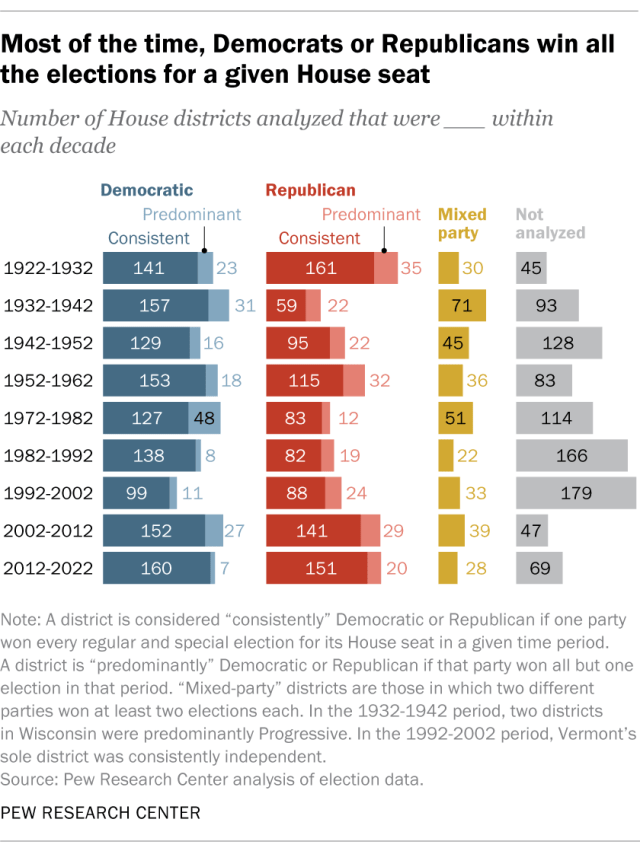
Has it always been this way? Or was there a time when House districts weren’t firmly in the grip of one party or the other, election cycle after election cycle?

To find out, we examined the outcome of every House election – regularly scheduled ones as well as special elections to fill vacancies – from 1922 to 2020.

House districts are redrawn following each decennial census to reflect population changes, so districts aren’t directly comparable from one census period to another. With that in mind, we analyzed election results in 10-year segments. Each segment includes the five regular House elections held between census years, along with any special elections.

We found that in every 10-year segment, after adjusting for redistricting changes, most districts were consistently won by either Republicans or Democrats.


Our analysis begins with the decade following the 1920 census. Between the 1922 general election (for the 68th Congress) and a series of special elections in 1932 for the outgoing 72nd Congress:Republicans won every election in 161 House districts (41% of the districts we analyzed in this period) and all but one race in 35 more districts (9%).
Democrats ran the table in 141 districts (36%) and won all but one election in another 23 (6%).
Only in 30 districts

Friday, August 30, 2024

The Harris-Walz Interview: Pivot!

Our most recent book is Divided We Stand: The 2020 Elections and American Politics. Less than 48 hours after Biden's withdrawal, Kamala Harris became the Democratic Party's presumptive nominee.

In our forthcoming book on the 2024 election, we note that "incumbency" is an ambiguous concept when the challenger was the incumbent just four years earlier and has remained in the public eye ever since.

Mike Allen at Axios:
Vice President Harris said twice during yesterday's interview in Georgia with CNN's Dana Bash that Americans are ready to "turn the page" on the Trump era.Why it matters: It's part of Harris' strategy of portraying herself as the candidate of change, even though she's in the White House — and trying to make former President Trump seem like the exhausting incumbent.

Harris' campaign communications director, Brian Fallon, tweeted while the CNN special was still airing that even after Trump "lost in 2020, he never left the stage — he tried to overturn the election and began running again immediately. America is exhausted with him."

Harris, joined by running mate Tim Walz for her first formal interview since President Biden bowed out, rejected identity politics when asked about Trump's comments about her racial identity."Same old, tired playbook," Harris said. "Next question, please."

Bash followed up: "That's it?"Harris replied: "That's it."

Trump, on his Truth Social platform, called the interview: "BORING!!!"

She need not talk about identity politics. As soon as the camera is on, viewers can see that she is a Black woman. 

Kevin Liptak at CNN:

Pressed by Bash on her reversals on fracking and decriminalizing illegal border crossings, Harris sought to explain why her positions had changed.

“How should voters look at some of the changes that you’ve made?” Bash asked Harris. “Is it because you have more experience now and you’ve learned more about the information? Is it because you were running for president in a Democratic primary? And should they feel comfortable and confident that what you’re saying now is going to be your policy moving forward?”
Harris said despite the shifts in position, her values had not changed.

“I think the most important and most significant aspect of my policy perspective and decisions is my values have not changed,” she said. “You mentioned the Green New Deal. I have always believed – and I have worked on it – that the climate crisis is real, that it is an urgent matter to which we should apply metrics that include holding ourselves to deadlines around time.”
...
And she pointed to her record as California attorney general, when she prosecuted gangs accused of cross border trafficking, as an indication of her values on immigration.

Note that she did not directly answer Bash's question.  Instead of explaining why she changed her position, she pivoted to her underlying values and her record. 

Likewise, Walz pivoted when Bash asked about his inaccurate statements about his military record. Kierra Frazier at Politico:

CNN’s Dana Bash asked Walz about remarks in 2018, when he was running for Congress, and he said he “carried a weapon of war in war” as he discussed his support for restricting assault weapons.

Walz, who served 24 years in the National Guard but was not in combat, says he misspoke — chalking it up to garbling some words.

“My grammar is not always correct,” he said.

The Republican criticism was part of a broader effort to tarnish Walz soon after he emerged as Harris’ running mate. But the effect of the accusation has been muted, in part because former President Donald Trump made well-known efforts to dodge military service, and his running mate, Ohio Sen. JD Vance, served four years in the Marine Corps and was deployed to Iraq but did not have combat experience.

Walz said in the CNN interview that his military record “speaks for itself” as he dismissed the criticism.

“I’m incredibly proud I’ve done 24 years of wearing the uniform of this country, equally proud of my service in a public school classroom, whether it’s Congress or the governor,” he said. “My record speaks for itself. I speak candidly. I wear my emotions on my sleeves, and I speak especially passionately about our children being shot in schools and around guns.”

Thursday, April 4, 2024

Outsiderism 2024

Our latest book is titled Divided We Stand: The 2020 Elections and American Politics.  The 2024 race has begun.

Theodoric Meyer and Leigh Ann Caldwell at WP:
Five Senate Republican challengers have never held public office. In four of those states — Wisconsin, Ohio, Montana and Pennsylvania — the Democratic incumbents have served in public office for more than two decades. (The fifth state is Nevada, but Sen. Jacky Rosen is a relative newcomer to politics who is running for her second Senate term.)

Republicans bet this is an election in which voters will gravitate toward outsider candidates as congressional approval ratings have hovered at 15 percent for the past six months, according to Gallup.
“Voters are sick of do-nothing career politicians. That is going to be a real problem for these Democrat Senators who have been sitting in office for decades,” National Republican Senatorial Committee spokesman Mike Berg said.
...

The career politician attack has been used time and time again with mixed results — because of the strength of candidates and the mood of the electorate.

In 2018, the first election under President Donald Trump, annoyed voters kicked out incumbents. Nine percent of House incumbents lost, all of them Republicans except for two Democrats who lost their primaries, handing Democrats the majority. It was the third-lowest reelection rate of House members since 1994, according to OpenSecrets.

Indiana Republican Mike Braun sensed the mood in 2018. In his primary, the first-time candidate used the political outsider theme, catapulting him from behind to beat his challengers, Reps. Todd Rokita and Luke Messer (remember cardboard cutouts?). He went on to defeat Sen. Joe Donnelly (D) in the red state. (Donnelly voting not to confirm Supreme Court Justice Brett Kavanaugh also played a major role in his loss.)

It was less effective in 2022

But in the last election, in 2022, voters wanted little change despite a sour mood on the economy, Republican lobbyist and political consultant Bruce Mehlman wrote in a memo after the midterms, calling it the “least change-y change election since 2002.” Every Senate incumbent won reelection, and 94.5 percent of House incumbents won.

It’s too early to tell whether this year will be a change election. One big unknown is the how the top of the ticket — the candidates for president — will play into the career politician critique.

Biden was first elected to the Senate nearly 52 years ago. Trump bills himself as an outsider but is a former president. Both men are unpopular.


Sunday, January 7, 2024

1892

Our latest book is titled Divided We Stand: The 2020 Elections and American Politics.  The 2024 race has begun.

In 1912, Theodore Roosevelt ran on the Progressive ticket against his successor, William Howard Taft.  The 1892 election was the most recent election in which both major-party candidates had served as president. Matthew Continetti at The Washington Free Beacon:
The precedent of 1892 is so distant that it hardly seems relevant. Our two-incumbent election is a genuine novelty. It pits a twice-impeached, criminally charged Republican against a deeply unpopular Democrat who faces his own impeachment inquiry and whose adult son is under federal indictment. All set against the backdrop of collapsing public trust, deteriorating world order, resurgent anti-Semitism, the interpenetration of the judicial system with domestic elections, myriad connections between former and current national security personnel and the major media "echo chamber," America's aggressive and cunning strategic adversaries, the legitimation of political violence, and a likelihood of constitutional crisis and domestic unrest. Harrison-Cleveland was placid by comparison. Even boring.

Monday, August 29, 2022

Incumbents Losing

Our most recent book is titled Divided We Stand: The 2020 Elections and American Politics.  Among other things, it discusses state and congressional elections. 

Andrew Solender at Axios:
It's a banner year for insurgent House candidates: 2022 is posting the second-highest number of primary losses for House members since 1948.

Why it matters: Rising populism is weakening the shield of incumbency.

Driving the news: Reps. Mondaire Jones (D-N.Y.) and Carolyn Maloney (D-N.Y.) both lost their primaries on Tuesday.As is often the case in redistricting years, the two Democrats were the victims of shifting district lines that pitted Maloney against a colleague and forced Jones to abandon his district.

By the numbers: To date, in this cycle, 14 House incumbents have failed to secure their party’s nomination.2020 saw the most successful primary challenges in a non-redistricting year since 1974, suggesting this is part of a trend, not a one-off.

Saturday, February 27, 2021

Incumbent Reelection in State Legislative Elections


Our forthcoming book is titled Divided We Stand: The 2020 Elections and American Politics.  Among other things, it discusses state legislative elections.

From Ballotpedia:

Two-hundred and twenty seven incumbent state legislators lost re-election in general elections on Nov. 3, 2020. This represents 4.7% of all state legislative incumbents who ran in general elections

Wednesday, September 2, 2020

MA Primary

In Defying the Odds, we discuss state and congressional elections as well as the presidential race.  Progressives have done fairly well in Democratic primaries.

Russell Berman at The Atlantic:
Overall, the Massachusetts primary results did not fit neatly into a larger national narrative. They represented a vindication for incumbents but a mixed bag for progressives, who succeeded in protecting Markey but failed in their bid to oust long-serving Representative Richard Neal, the chairman of the House Ways and Means Committee. Neal defeated a young progressive challenger, Holyoke Mayor Alex Morse, in his bid for a 17th term.
...'
Kennedy jumped into the race a year ago after a pair of polls showed him well ahead of Markey in a hypothetical matchup; the surveys were a testament to both the Kennedy brand in Massachusetts and the lack of one for Markey, despite his having represented the state in Congress since before Joe Kennedy was born. By a margin of 18 points, Democratic voters in a Boston Globe poll identified Kennedy as the more liberal candidate. The genius of Markey’s campaign was that it took his biggest vulnerability and used it as an opportunity: The senator didn’t have much of a political identity in Massachusetts, so his supporters created one for him.

Markey became “someone who most people in Massachusetts who follow politics would say is unrecognizable,” Mary Anne Marsh, a veteran Democratic strategist in the Bay State, told me.

The identity Markey’s camp created—that of a tenacious progressive fighter who often took lonely stands against his party—closely resembled Sanders’s. They dug up a vintage 1970s TV ad from when Markey first ran for Congress, in which he boasted that party bosses had thrown his desk out into a hallway. The linchpin of the strategy was Representative Alexandria Ocasio-Cortez, who endorsed Markey after he partnered with her to introduce the Green New Deal just weeks after she took office in 2019. Progressive groups such as the Sunrise Movement joined her in backing Markey, rewarding his leadership on climate change while forgiving his votes for the Iraq War, NAFTA, and the 1994 crime bill. (Activists on the left assailed former Vice President Joe Biden for a similar record during the Democratic presidential primary.) A three-minute video hailing Markey as the “Green New Dealmaker” and co-opting a famous Kennedy refrain became a sensation, and an ad featuring Ocasio-Cortez ran on TV in the state more than 1,200 times.

Wednesday, February 26, 2020

A Good Sign for Incumbents

In Defying the Odds, we discuss state and congressional elections as well as the presidential race. The update looks at political and demographic trends through the 2018 midterm.  Our next book will explain 2020.

Justin McCarthy at Gallup:
Most Americans (59%) say the U.S. representative in their local congressional district deserves to be reelected, and 35% say the same for most members of Congress. Both figures are the highest seen since 2012 and are on the high end of what Gallup has recorded over the past decade. Still, fewer Americans support returning members of Congress to Washington today than felt this way in the late 1990s and early 2000s.
...
Democrats have a solid majority in the U.S. House of Representatives, and the elevated 59% of Americans saying their member of Congress deserves reelection augurs well for their bid to maintain their majority next year. This assumes, however, that the 59% holds for the remaining nine months before Election Day. If Americans still feel their member deserves another term at a similar level closer to November, this could mean a favorable environment for Democrats' prospects of maintaining power in at least one chamber of Congress.

Saturday, December 17, 2016

A Good Year for Incumbents

Kyle Kondik and Geoffrey Skelley write at Rasmussen:
With Republican Sen.-elect John Kennedy’s triumph in the Louisiana runoff last weekend, victories by two other Republicans in Louisiana House races, and Gov. Pat McCrory’s (R) concession last week to Gov.-elect Roy Cooper (D) in North Carolina, the winners of 2016’s House, Senate, and gubernatorial races are now set. This allows us to do a little housekeeping. Kennedy’s win confirms that this is the first cycle in the history of popular Senate elections that every state that held a Senate election in a presidential cycle voted for the same party for both president and for Senate (34 for 34 this year). Also, finalizing these results permits us to give a final assessment of our down-ballot Crystal Ball projections for 2016: We picked 32 of 34 Senate races correctly, along with 10 of 12 gubernatorial races and 428/435 House races.
Looking over the down-ballot outcome, there’s one inescapable conclusion in a year that was defined by a political outsider, Donald Trump, winning the presidency: It was still a really good year to run as an incumbent in 2016, all things considered.
This election cycle, 393 of 435 House representatives, 29 of 34 senators, and five of 12 governors sought reelection (several of the governors were prohibited from seeking another term). Of those, 380 of 393 House members (97%), 27 of 29 senators (93%), and four of five governors (80%) won another term. These members of Congress and governors not only won renomination, but also won in November.
See the chart at OpenSecrets 

Monday, September 1, 2014

Beating Senate Incumbents

At the Daily Beast, Lloyd Green writes:
Will the Republican finally wrest control of the Senate from the Democrats? The New York Times fixes the odds of that happening at 2-to-1. But, for the Republicans to make that a reality, they must defeat at least three incumbent senators and take three open seats, while holding on in a hotly contested race in Georgia, and successfully defending Senate Minority Leader Mitch McConnell from a stiff Democratic challenge.
But if history is a guide, Republican triumph won’t come easy. The last time the GOP unseated more than two incumbents in a single cycle was in 1980. Thirty-four years ago, America elected Ronald Reagan as president, and sent a dozen Democratic senators to an early retirement. Since then, Republicans have demonstrated proficiency at winning open seats, but are remedial when it comes to knocking off incumbents.

Monday, November 4, 2013

No Anti-Incumbent Wave

Previous posts have cast doubt on the popular notion of "anti-incumbent" waves. At The Guardian, Harry Enten offers four points:
  • Take a look at this chart from Alan Abramowitz. It maps out House of Representative incumbent losses in a general election by party since 1954. I've added the 2012 election to the chart... The only year in which ten or more incumbents of both parties were defeated in the general election was 2012. Seventeen Republicans and ten Democrats went down. That's what you'd expect when there is a lot of redistricting going on around the country....
  • 29% of respondents to a recent NBC/WSJ poll said they thought their representative deserved to be re-elected. That's not significantly different from 1992. The final poll before the 1992 election had the re-elect percentage at 31%, after it actually cratered to 27% during the summer of 1992. And was there an anti-incumbent wave in 1992? Hardly. In yet another redistricting year, only 24 incumbents lost.
  • A few weeks ago, Gallup reported that a record high 60% of Americans believed a third party is needed. This week, 30% of NBC/WSJ respondents claimed they'd vote for a third-party candidate for Congress over a Democrat and a Republican. Those percentages seem high, until you realize that this polling looks a lot like it has over the past few years.
  • Democracy Corps just surveyed a bunch of swing Democratic and Republican districts. They found that while named Democratic incumbents had a -4 net approval rating, named Republicans had a +5 net approval rating. That would suggest Republicans picking up some Democratic seats, but not too many Democrats snagging Republican seats. Indeed, Republicans are polling better right now than they were in the summer of 2012. 

Wednesday, October 16, 2013

Bad Mood

The Pew Research Center reports:
As the government shutdown drags on and the debt limit deadline approaches, 81% say they are dissatisfied with the way things are going in the United States, while just 14% are satisfied. The percentage saying they are satisfied with the state of the nation has fallen 13 points since July and is now at its lowest level since the financial crisis in late 2008.
The grim public mood is reflected in the record share of voters who want most members of Congress defeated in next year’s midterm elections. Nearly three-quarters (74%) of registered voters would like to see most members of Congress defeated; during the 2010 and 2006 election cycles, which both culminated in shifts in control of the House, no more than 57% in each of these two cycles wanted most members of Congress not to be reelected.
Moreover, the share saying they do not want their own representative reelected – 38% – is as high as it has been in two decades. At this stage in the 2010 and 2006 midterms, fewer wanted to see their own member of Congress defeated (29% in November 2009, 25% in September 2005).
An early read of voter preferences for the 2014 midterm shows that the Democrats have a six-point edge: 49% of registered voters say they would vote for or lean toward voting for the Democratic candidate in their district, while 43% support or lean toward the Republican candidate.
In November 2009, a year before the Republicans won a House majority, Democrats held a five-point edge (47% to 42%). In September 2005, 14 months before the Democrats won a House majority for the first time in more than a decade, Democrats held a 12- point lead (52% to 40%).
The Democratic Party continues to be viewed more favorably than the Republican Party: 47% of adults have a favorable opinion of the Democratic Party while 38% view the GOP favorably. As in the past, the public by wide margins views the GOP as more extreme in its positions than the Democratic Party (55% to 34%) and less willing to work with its political opponents (32% say the Republican Party, 50% the Democrats).
However, as many say the Republican Party (42%) as the Democratic Party (39%) can better manage the federal government. And by 44% to 37%, slightly more say the GOP is better able to handle the nation’s economy. [emphasis added]

Friday, October 11, 2013

Anti-Incumbency?

Throw the bums out.
That’s the message 60 percent of Americans are sending to Washington in a new NBC News/Wall Street Journal poll, saying if they had the chance to vote to defeat and replace every single member of Congress, including their own representative, they would. Just 35 percent say they would not.

According to the latest NBC/WSJ poll, the shutdown has been a political disaster. One in three say the shutdown has directly impacted their lives, and 65 percent say the shutdown is doing quite a bit of harm to the economy. NBC's Chuck Todd reports.
The 60 percent figure is the highest-ever in that question recorded in the poll, registered in the wake of the government shutdown and threat of the U.S. defaulting on its debt for the first time in history. If the nation’s debt limit is not increased one week from now,

“We continue to use this number as a way to sort of understand how much revulsion there is,” said Democratic pollster Peter D. Hart, who conducted the poll with Republican Bill McInturff. “We now have a new high-water mark.”
Read the full poll here (.pdf)
But will an anti-incumbent wave affect both parties?  That prospect seems unlikely.  In 2006, Stuart Rothenberg persuasively argued that the United States does not have anti-incumbent elections: 
Over the past 26 Congressional elections, going back to 1954, there have been only three elections when at least a half-dozen incumbents of both parties were defeated — 1956, 1990 and 1992, according to “Vital Statistics on Congress, 2001-02,” edited by Norman Ornstein, Thomas Mann and Michael Malbin.

By contrast, we have had eight elections in which one party knocked off at least 20 of the opponent’s incumbents and lost fewer than a half-dozen of its own.

Virtually all midterm elections are a referendum on the party of the president, so it isn’t surprising that when a political wave hits, it damages one party much more heavily than it does the other.

The worst bipartisan election since the mid-1950s was in 1992, when a total of 24 sitting House Members — 16 Republicans and eight Democrats — were defeated. While there was a strong anti-Washington, D.C., mood developing in this country at that time, that year also was a redistricting election in which some incumbents didn’t possess the normal advantages of incumbency. That fact undoubtedly explains so many incumbent losses.

Otherwise, over the past 50 years, the closest we’ve come to an anti-incumbent election was in 1990, when six Democrats and nine Republicans lost in the general election, and in 1978, when 14 Democrats and five Republicans were defeated that November.
Here are the incumbent-loss figures for the three House elections since then:


2008 Democrat 06
Republican 17
Total 23
2010 Democrat 54
Republican 04
Total 58


2012 Democrat 10
Republican 17
Total 27


The 2012 election, like that of 1992, was a redistricting election.  Most of the losing incumbents had new territory or were facing other incumbents.

Friday, February 8, 2013

The Senate: The Value of Early Decisions

Kate Hunter reports at Bloomberg that Senate Democrats prefer that their members make up their minds on retirement or reelection for 2014:
Senate Democratic leaders have a message for their members unsure whether to run for re-election in 2014: Making an early decision will help the party keep control of the chamber.
Leaders of both parties don’t want to be caught off guard as Republicans were last year when Maine Senator Olympia Snowe announced her retirement just eight months before the Nov. 6 election. That helped scuttle Republicans’ to gain the Senate majority.
Two Democrats -- Iowa’s Tom Harkin and West Virginia’s Jay Rockefeller -- and one Republican, Saxby Chambliss of Georgia, already have announced they won’t seek re-election in 2014. Political strategists in both parties are watching others, including Democrats Tim Johnson of South Dakota and Frank Lautenberg of New Jersey and Republican Susan Collins of Maine, for signs that they won’t run again.
“Strategists really want these incumbents to make a decision sooner rather than later so they can put the necessary plans in place to account for that,” said Nathan Gonzales, a political analyst for the non-partisan Rothenberg Political Report in Washington.
Early notice of retirements is particularly important for Democrats, who will have 21 seats up in the Senate next year, compared with 14 for Republicans.
Democrats, who control 55 votes in the 100-member chamber, will be defending seats in seven states President Barack Obama lost last year: Alaska, Arkansas, Louisiana, Montana, North Carolina, South Dakota and West Virginia. A loss of the Senate majority to Republicans would mean that party would control both houses of Congress during Obama’s last two years in office.

Sunday, January 27, 2013

2014 Senate Outlook

Tom Harkin (D-IA) has joined Jay Rockefeller (D-WV) at the exit, potentially opening seats for GOP takeover in 2014.  Tim Johnson (D-SD) may be next. James Hohmann and John Bresnahan write at Politico:
“These cycles are long, but clearly it’s been a good couple weeks,” said former National Republican Senatorial Committee executive director Rob Jesmer, who just joined FP1 Strategies. “It’s good for the NRSC especially after a disappointing election. This will help with fundraising and jumpstart some enthusiasm that would have taken more time otherwise.”
“An open seat is an open seat. It’s really hard to beat incumbents, so when you get an open seat it automatically vaults a seat up to a level that’s more competitive than it would have been otherwise,” he added. “Iowa was not on the map 48 hours ago, and now it’s on the map. And that’s a big deal.”
Democratic strategists highlight their incumbents who appear likely to run again in red states where retirements could have proved devastating, including Montana’s Max Baucus, Arkansas’ Mark Pryor, Louisiana’s Mary Landrieu, Alaska’s Mark Begich and North Carolina’s Kay Hagan.
In the last decade, only three Democratic incumbents have lost reelection: South Dakota’s Tom Daschle in 2004, along with as Wisconsin’s Russ Feingold and Arkansas’ Blanche Lincoln in 2010. (emphasis added)
There have been many more GOP incumbent losses:

2006

  • Talent (MO)
  • Burns (MT)
  • DeWine (OH)
  • Santorum (PA)
  • Chafee (RI)
  • Allen (VA)
2008

  • Stevens (AK)
  • Coleman (MN)
  • Sununu (NH)
  • Elizabeth Dole (NC)
  • Gordon Smith (OR)
2010

  • Bennett (UT), lost renomination in party convention
2012
  • Lugar (IN) lost renomination in primary
  • Brown (MA)

Monday, November 12, 2012

Anti-Incumbency? Not in 2012

There was some speculation that 2012 might turn out to be an anti-incumbent year.  After all, approval of Congress was low and some polls indicated that voters were wearying of their own lawmakers.

The anti-incumbent tide never arrived.  Even if the few undecided House races turn against incumbents, the 2012 reelection rate (including primaries and the general election) is about 90 percent in the House and 91 percent in the Senate.

The House figure is a bit below the historical average, but many of the defeats stemmed not from anti-incumbency but from redistricting, which put some members in less favorable territory or pitted them in primaries against incumbents from the same party.