Search This Blog

Showing posts with label Polarization. Show all posts

Thursday, July 2, 2026

The Widening Gyre

Turning and turning in the widening gyre
The falcon cannot hear the falconer;
Things fall apart; the centre cannot hold;
Mere anarchy is loosed upon the world,
The blood-dimmed tide is loosed, and everywhere
The ceremony of innocence is drowned;
The best lack all conviction, while the worst
Are full of passionate intensity.
-- W.B. Yeats


Our most recent book is The Comeback: The 2024 Elections and American Politics. The first year of the second Trump administration was full of ominous developments -- including a tranche of racist and anti-Semitic chats by prominent Young Republicans.  Kevin Roberts, president of the Heritage Foundation, defended Tucker Carlson after his softball interview with Nazi wannabe Nick Fuentes.  Meanwhile, the Democrats grapple with their own extremists, including anti-Semites and hardcore leftists.  Seventy-two years after the fall of Joe McCarthy, some of the new leftists are saying "You're goddamn right we're communists!"

Most of the men I spoke with said that the president is abandoning his “America First” agenda, which is what attracted them to the Republican Party in the first place. Rather than defect to the Democratic Party, they want a more radical GOP—one led not by MAGA insiders such as J. D. Vance but by figures further to the right, who they believe can deliver on the promises that Trump has failed to keep on immigration and foreign policy. Some young activists, though, articulated a political vision that goes far beyond any Trump-campaign pledge. For them, the future of American conservatism should be rooted in a patriarchal version of Christianity and an unapologetic ethnonationalism.

...

For Kai Schwemmer, who is the national political director for the College Republicans of America as well as Utah County’s deputy elections clerk, embracing overtly racial nationalism isn’t just good in itself. It’s shrewd politics. “If we go back to this kind of civic nationalism”—the idea that America is united by shared ideals rather than common ethnicity or culture—“I think the Republican Party will end up losing,” Schwemmer told me. “Nationalism is not a dirty word,” he continued. “We can’t retreat from it, and we can’t retreat from having a more conservative Republican Party.” He said that the party’s future leaders must “appeal to the fears and worries of the majority of Americans, who are white.”
Speaking of potential leaders, Schwemmer identified a “big three” for young conservatives: Nick Fuentes, Tucker Carlson, and Candace Owens. This “dissident” wing, Schwemmer said, has displaced the “old guard”—figures such as Ben Shapiro and Jordan Peterson who first drew many young conservatives into politics.
None of the conservative activists I spoke with endorsed Fuentes unequivocally, and a couple condemned him, distancing themselves from the “groyper” label that his white-nationalist followers embrace. A member of the College Republicans at a private Ohio university estimated that only a minority of his group’s membership considered themselves fans of Fuentes, and most rejected the streamer’s blatant anti-Semitism. But he also conceded that about three-quarters of them “broadly sympathize” with Fuentes’s views. Skepticism of Israel, he told me, is the “dominant narrative” among his peers.

The Turning Point president from the southeastern university, however, has observed something much warmer, and more worrisome, than broad sympathy: the belief that Fuentes is a more genuine representative than Trump of the America First vision, not in spite of his anti-Semitism but because of it. “Almost all of Gen Z hates the Jews,” he told me. In his Turning Point chapter, he said, “Fuentes is the guy."

The DSA, in fact, seems to despise the Democratic Party. Darializa Avila Chevalier has called Joe Biden a “rapist” and wrote “Fuck Kamala Harris” on social media. She proceeded to be nominated for a House race in New York last week by Democratic voters who presumably do not all share those feelings. The DSA now includes a growing caucus of supporters in Congress, has mayoral candidates well positioned to win in several big cities, and has plans to throw its weight behind a yet-to-be-determined presidential candidate in 2028.
The DSA’s feelings about Democrats encompass not only the party’s leadership but also the philosophical commitments that have guided it since the New Deal: a mixed economy undergirded by democratic values. Chevalier, for instance, joined a post–October 7 celebratory rally and portrayed Russia’s invasion of Ukraine as a defensive response to Western “bullying.” She previously called for seizing land and the means of production and has repeatedly praised communism.

...

Militant anti-Zionism became a wedge that the group’s more radical activists used to drive away critics of authoritarianism on the left. In 2025, the group’s convention voted to officially remove its founding language allowing for the expulsion of members who worked for communist cells, and added a provision calling the Palestinian “right to resistance” a central tenet of the DSA. Having dismantled the guardrails that Harrington built to exclude communists, the group established new guardrails to exclude anybody opposed to Israel’s destruction. “Michael Harrington’s DSA is dead,” a dispatch from the proceedings gloated.
The DSA’s Red Star caucus was formed the year after the North Star caucus, in an apparent rebuke. It writes that nearly half of the members of the National Political Committee, the DSA’s highest leadership body, “openly identify as communists.”

These left-wing factions have realigned the organization in firm opposition to liberal democracy. In 2021, the DSA joined the São Paulo Forum, a communist-led international network—a move that would, one DSA member protested at the time, “support authoritarian governments who systematically violate the basic tenets of democratic socialism.” It proclaimed its solidarity with Venezuela under the dictatorship of Nicolás Maduro, and with Cuba under that of the Castro brothers. The DSA now locates its vision of the ideal society in the world’s most despotic regimes.

Sunday, September 14, 2025

Divider

Our new book is The Comeback: The 2024 Elections and American Politics. The second Trump administration  has been full of ominous developments. Last week, a gunman murdered Charlie Kirk.

Peter Baker at NYT:

The first few minutes of President Trump’s Oval Office address after the assassination of Charlie Kirk last week followed the conventional presidential playbook. He praised the victim, asked God to watch over his family and talked mournfully of “a dark moment for America.”

Then he tossed the playbook aside, angrily blaming the murder on the American left and vowing revenge.

That was stark even for some viewers who might normally be sympathetic. When Mr. Trump appeared later on Fox News, a host noted that there were “radicals on the right,” just as there were “radicals on the left,” and asked, “How do we come back together?” The president rejected the premise. Radicals on the right were justified by anger over crime, he said. “The radicals on the left are the problem,” he added. “And they’re vicious. And they’re horrible.”

... 

 “If I take care of the base, everything else will take care of itself,” he once told Anthony Scaramucci, a former ally who briefly served in Mr. Trump’s first-term White House.

While he made few nods toward working across the aisle in his first term, Mr. Trump has all but abandoned any efforts at bipartisanship in his second. He does not invite Democratic leaders to the White House for talks, nor does he brief them on major national security events.

Russell T. Vought, his budget director, complained in July that “the appropriations process has to be less bipartisan.”

...

His critics fear that Mr. Trump will now use the Kirk assassination to go further on liberal organizations and institutions, a view encouraged in ominous social media posts by Stephen Miller, the president’s deputy chief of staff and a leader of the Trump administration’s immigration crackdown.\

“In recent days we have learned just how many Americans in positions of authority — child services, law clerks, hospital nurses, teachers, gov’t workers, even DOD employees — have been deeply and violently radicalized,” Mr. Miller wrote on Saturday, suggesting that their responses to Mr. Kirk’s killing were unacceptable. “The consequence of a vast, organized ecosystem of indoctrination.”

Mr. Trump is certainly right that his opponents have called him a “fascist” and “Nazi.” But his outrage at incendiary rhetoric is situational. In the same Fox News interview last week in which he complained about excesses by the left, he referred to Zohran Mamdani, the democratic socialist and front-runner for mayor of New York, as a “communist.” Even more than in his first term, Mr. Trump lately has referred to political rivals and journalists as “evil.”

Sunday, August 31, 2025

Diploma Divide on the Hill


Volden C, Wai J, Wiseman AE. On the Decline of Elite-Educated Republicans in Congress. Perspectives on Politics. Published online 2025:1-13. doi:10.1017/S1537592725102260
We identify a rise in educational polarization among members of the US Congress mirroring the educational polarization in the American mass public. Over the past half-century, the percentage of Republican representatives who attended elite educational institutions declined from 40% to 15%, and the percentage of similarly educated Republican senators declined from 55% to 35%, while the ranks of elite-educated Democrats rose in both chambers. These changes across the parties have mapped into observable differences in behavior and approaches toward lawmaking. We find that elite-educated legislators are much more liberal in their voting patterns, suggesting a link between the decline in elite-educated Republicans and ideological polarization in Congress. We also demonstrate that, in the House, elite-educated Democrats are especially effective lawmakers, but not so for elite-educated Republicans. In the Senate, we establish a link between the decline of elite-educated Republicans and the rise of partisan warrior “Gingrich Senators.” Overall, these patterns offer initial glimpses into how political elites are being drawn from different educational cohorts, representing an important transition in American governance.


Friday, July 4, 2025

Trump, the Hater

Our new book is The Comeback: The 2024 Elections and American Politics. 

As the nation prepared to celebrate its birthday, Trump turned his prejudice and hatred up to 11.

Michael Luciano at Mediaite:

President Donald Trump turned back the clock and used an old-time slur about Jews before declaring his hatred of congressional Democrats.

Speaking at a rally in Des Moines, Iowa on Thursday night, just hours after the House passed his spending bill, the president took a victory lap.

In a private meeting with congressional Republicans on Wednesday reportedly demonstrated he did not know about nearly $1 trillion in Medicaid cuts in the bill, which also cuts food assistance to millions of people. The legislation also extends the 2017 tax cuts and allocates more money to Immigration and Customs Enforcement than the vast majority of the world’s militaries. According to the Congressional Budget Office, the bill will add $3.3 trillion to the national debt over the next 10 years. Republicans have responded to the estimate by claiming it is wrong.
“No death tax, no estate tax,” Trump told the crowd. “No going to the banks and borrowing from – in some cases – a fine banker, in some cases, shylocks and bad people.”

Trump went on to say the “shylocks and “bad people” managed to “destroy a lot of families.” The president then pivoted to slamming Democrats, who uniformly opposed his bill in the House and Senate.

“Not one Democrat voted for us,” Trump continued. “And I think we use it in the campaign that’s coming up, the midterm, because we’re gotta beat them. But all of the things that we’ve given, and they wouldn’t vote, only because they hate Trump. But I hate them too. You know that? I really do. I hate them. I cannot stand them because I really believe they hate our country.”


Monday, April 7, 2025

Democrats' Generational War

Our forthcoming book is The Comeback: The 2024 Elections and American Politics. It includes a chapter on congressional and state elections.

Democrat Saikat Chakrabarti decided to challenge Rep. Nancy Pelosi for her San Francisco congressional seat when he watched in disbelief last year as his party chose a 74-year-old member she had backed to lead the House Oversight Committee over Rep. Alexandria Ocasio-Cortez, his 35-year-old former boss and one of the party’s most powerful communicators.

For Chakrabarti — a 39-year-old software engineer turned political operative who ran Ocasio-Cortez’s 2018 upset primary campaign in New York — it was another sign that the Democratic Party is dominated by an older generation of leaders who he says have lost touch with Americans’ day-to-day struggles. Though Pelosi, 85, stepped down from leadership in 2022 to elevate the next generation, he argues that nearly four decades in Congress “is enough” and that the party needs younger leaders who can do away with a “culture of caution.”

“People are looking for fighters,” said Chakrabarti, who rankled many House Democrats with his confrontational tactics while briefly serving as Ocasio-Cortez’s chief of staff in 2019. “This old generation of leadership, they’ve been around for so long that they don’t recognize that this Republican Party is a completely different Republican Party. They’re just hoping that the backlash of Trump will build up and we’ll let the pendulum swing back our way.”

Chakrabarti is just one in a growing group of Democratic candidates who are launching 2026 campaigns rooted in those themes — and forcing the party to face an uncomfortable conversation about the role that its gerontocracy has played in its declining popularity.

Monday, March 31, 2025

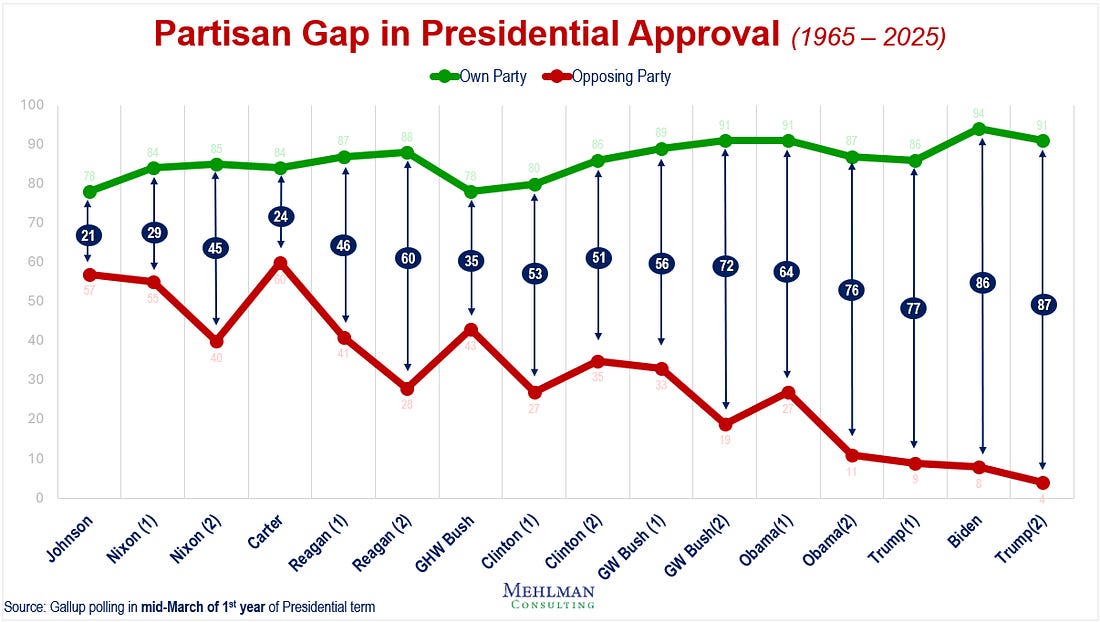
Partisan Gap in Presidential Approval

Our forthcoming book is The Comeback: The 2024 Elections and American Politics. The second Trump administration is off to an ominous start.

 Bruce Mehlman:

The gap between approval of U.S. presidents by their own party vs approval by members of the other party has been growing for decades. New Gallup data this week make clear this trend persists, with 91% of Republicans approving Trump's job performance vs 4% of Democrats.

Friday, March 21, 2025

Public: Raise Taxes on Rich People and Corporations


Andy Cerda at Pew:
More than six-in-ten U.S. adults (63%) say tax rates on large businesses and corporations should be raised. This includes 34% who say they should be raised a lot. Another 19% say large businesses’ tax rates should be lowered, while 17% say they should be kept the same as they are now.

About six-in-ten (58%) say tax rates on household income over $400,000 should be raised, including 23% who say these tax rates should be raised a lot. Much smaller shares say taxes on higher-income households should be lowered (19%) or kept the same (21%).

As has been the case in recent years, views differ substantially by party. Democrats are overwhelmingly supportive of raising taxes on these groups, while Republicans are more divided.
  • 81% of Democrats and Democratic-leaning independents support raising taxes on large businesses and corporations. Nearly as many (74%) say taxes should be raised on household income over $400,000.
  • By contrast, 43% of Republicans and Republican leaners say taxes on each group should be raised, while roughly three-in-ten say taxes for these groups should be lowered.

Tuesday, June 11, 2024

Culture War

In Defying the Odds, we talk about the social and economic divides that enabled Trump to enter the White House. In Divided We Stand, we discuss how these divides played out in 2020.  

From Pew:


Wednesday, May 8, 2024

Polarized Attitudes Toward NATO and Ukraine

  Our latest book is titled Divided We Stand: The 2020 Elections and American Politics.  Among other things, it discusses foreign influence and Trump's attack on democracy.  Russia helped Trump through 2020.  As Russia began its latest invasion of Ukraine, Trump lavished praise on Russian dictator Vladimir Putin. 

As NATO approaches its 75th anniversary, Americans are increasingly divided in their views about the alliance. Most continue to believe the United States benefits from its membership, but partisan differences on ratings of NATO have widened in recent years.

Three-quarters of Democrats and Democratic-leaning independents rate the organization favorably, while only 43% of Republicans and Republican leaners agree – down from 55% in a 2022 survey conducted soon after Russia’s invasion of Ukraine.

Attitudes toward the war in Ukraine have evolved to reflect the partisan polarization found across so many issues in U.S. politics. Democrats and Republicans differ sharply on views about aid to Ukraine, ratings of Ukrainian President Volodymyr Zelenskyy, and whether supporting Ukraine helps or hurts U.S. interests.

The share of Americans who believe the U.S. is not providing enough support to Ukraine has risen slightly in recent months, following setbacks for Ukraine on the battlefield and prolonged congressional debate over sending aid. (The survey was conducted before President Joe Biden signed into law an aid package sending nearly $61 billion to the Ukrainian war effort.)

Roughly one-quarter of Americans (24%) now say the U.S. is not providing enough aid, up from 18% in November 2023, when we last asked this question. Still, more Americans (31%) think the U.S. is providing too much aid, and 25% believe it’s giving the right amount.


However, views on this issue vary considerably by party. While the share of Democrats who believe the U.S. is not doing enough to help Ukraine declined after the initial onset of the war, it has increased more recently. Currently, 36% of Democrats say the U.S. is not providing enough aid.

In contrast, just 13% of Republicans say the U.S. is not giving enough support to Ukraine, while 49% believe it is giving too much. At the beginning of the war, Republican attitudes were essentially the reverse: 49% said the U.S. was not providing enough aid and 9% said it was providing too much. Among Republicans, conservatives are more likely than moderates and liberals to say the U.S. is providing too much aid to Ukraine.


Sunday, April 21, 2024

Deepening Diploma Divide

In Defying the Odds, we talk about the social and economic divides that enabled Trump to enter the White House. In Divided We Stand, we discuss how these divides played out in 2020.  

Nate Moore at The Liberal Patriot:

We are on track for a historically large education divide among white voters. An average of recent polls finds Joe Biden winning white college-educated voters by 18 points and losing white non-college voters by 27 points—a colossal gap of 45 points. 

Compared to 2020 results, Trump’s margin with non-college whites is holding steady, while Biden has significantly improved his standing with degree-holding whites. Such Democratic improvement is certainly welcome for Team Biden, but not unexpected. College-educated white voters have been shifting blue for a decade, driven left by Trump and the GOP’s hardline cultural stances. The flip side of the demographic coin is that nonwhite voters, particularly those without a degree, are moving towards Republicans. Should current trends continue, education polarization—rather than racial—will become the defining feature of American elections. 


Tuesday, April 16, 2024

The End of Election Modeling

Our most recent book is titled Divided We Stand: The 2020 Elections and American Politics.  Among other things, it discusses the politics of economic policy.

At Marketplace, Kimberly Adams says that the economy  is becoming less predictive of political attitudes and behavior.
As a result, according to Alan Abramowitz, a professor emeritus of political science at Emory University, “these sorts of forecasting models that incorporate measures of economic conditions are just not working very well anymore.”

Abramowitz said another reason forecasting is harder these days is that, although models can be quite good at predicting the popular vote, that’s not how presidents are elected in the United States.

“What ultimately matters, of course, is the electoral vote,” Abramowitz said, referring to the Electoral College, “and the electoral vote hinges on the outcomes in a handful of closely contested states. Well, that’s very difficult to predict.”

For the first time in his decadeslong career, Abramowitz said he won’t even bother trying to put together a forecasting model this year.

“I know that enterprise continues, people will continue to do this,” he said. “I am so skeptical about the value of this particular enterprise right now … I’d rather leave it to others to try to figure out how to do this. And I think a lot of us who’ve been in this game for a long time probably feel about the same way.”

Views of the economy used to shape political choices.  Increasingly, it is the other way around. 

Kathy Frankovic at YouGov:

In 2000, a change in presidential administration from Democratic to Republican shifted the way partisanship affects economic views – even without a real change in economic measures. Economic assessments shifted in the opposite direction when Biden succeeded Trump as president. At the beginning of the Trump administration, Republicans and Democrats differed on how they saw the economy moving, with Republicans far more likely than Democrats to say the economy was getting better and Democrats far more likely to say it was getting worse. That difference was even larger in the weeks before the 2020 election. A month after Joe Biden’s victory — which was a month before his inauguration — Democrats remained negative on the direction of the economy, while Republicans were moving in that direction. The responses in the week before and the week after the inauguration show large movements in both parties. By the time Biden took office, Republicans viewed economic trends more negatively and Democrats saw them more positively.

Saturday, April 6, 2024

Resentment, Not Rage, in Rural America

In Defying the Odds, we talk about the social and economic divides that enabled Trump to enter the White House. In Divided We Stand, we discuss how these divides played out in 2020.  

Nicholas Jacobs at Politico:
Academics can and do disagree on what is motivating non-college-educated whites to vote for Donald Trump. I don’t pretend that we have settled on a single answer. I do know that there is something particular about Trump’s appeal in rural America and that demographics alone do not explain it. In rural America, women are more likely to vote for Trump; so are young people; so are poor as well as rich. Place matters.

But ruralness is not reducible to rage. And to say so is to overlook the nuanced ways in which rural Americans engage in politics. They are driven by a sense of place, community and often, a desire for recognition and respect. This, as I have recently argued in a new book, is the defining aspect of the rural-urban divide — a sense of shared fate among rural voters, what academics call a “politics of place,” that is expressed as a belief in self-reliance, rooted in local community and concerned that rural ways of living will soon be forced to disappear.

In recent years, that rural political identity has morphed into resentment — a collective grievance against experts, bureaucrats, intellectuals and the political party that seeks to empower them, Democrats.

Yes, such resentment is a real phenomenon in rural areas. But words matter; rage and resentment are not interchangeable terms. Rage implies irrationality, anger that is unjustified and out of proportion. You can’t talk to someone who is enraged. Resentment is rational, a reaction based on some sort of negative experience. You may not agree that someone has been treated unfairly, but there is room to empathize.

Research both by me and by others has illuminated how resentment is driven by the complex rural identity that, while occasionally intersecting with national political currents, is rooted in the unique context of rural life. Rage, both as a soundbite and as presented in the book, oversimplifies and misrepresents these debates. And so does the assumption that all the holders of these views are white, and that this rage is motivated by racism. Racism exists in all parts of the country and is embedded in American politics. But what the research shows is that while there are deep and persistent racial resentments in rural communities, despite a slight correlation between the two, rural resentment is an attitude distinct from racial prejudice.

...

 Taken as a whole, rural voters are not merely reacting against change — be it demographic or economic. They are actively seeking to preserve a sense of agency over their future and a continuity of their community’s values and social structures. Some might call this conservatism, but I think it is the same thing motivating fears of gentrification in urban areas, or the desire to “keep Portland weird.” Place matters for a whole bunch of people — but especially for rural folks.

Saturday, October 14, 2023

The Mess on the Hill


Mary Ellen McIntire and Aidan Quigley at Roll Call:
House Judiciary Chairman Jim Jordan became Republicans’ nominee for speaker Friday, winning a secret-ballot election against Georgia Rep. Austin Scott, a last-minute entrant into the race.
...

“We’re done here until Monday,” Rep. Kat Cammack, R-Fla., said after the second ballot to gauge how many GOP members would back Jordan on the floor came in at 152-55. One member voted “present” on that second ballot, according to Cammack and Rep. French Hill, R-Ark.
...

The second vote indicated slightly higher margin than the initial 124-81 vote Friday to nominate Jordan, a founder of the House Freedom Caucus who became an ally of former Speaker Kevin McCarthy in recent years. Still, according to Rep. Pete Sessions, R-Texas, the second-round vote total was “enough to not know if we could go to the floor today.”

...

“I don’t know, but the math is not good” for Jordan, Rep. Mario Diaz-Balart, R-Fla., a Scalise backer, said Friday. “I think ultimately, we’re gonna have to find somebody who can truly unify us.”

Another Scalise ally, Florida Rep. Vern Buchanan, said ahead of Friday’s votes that he didn’t believe Jordan could get to 217 votes and that a quick turnaround to considering his bid was unfair to any challengers.

“I like Jim, but I just think that Steve got a raw deal,” Buchanan said. “I think he’s worked hard, he’s earned it and I think if [Jordan] would’ve given him a little bit more support — that really changed my mind a little bit on Jim Jordan.”
Sahil Kapur and Julia Jester:
Democrats are standing firm in their refusal to bail out the House Republican majority as it struggles to elect a new speaker 10 days after after booting Rep. Kevin McCarthy.

They're also dialing up the rhetoric against the GOP’s new nominee for speaker, prominent Donald Trump ally Jim Jordan of Ohio, blasting him as an insurrectionist, election denier and extremist.

“House Republicans have selected as their nominee to be the speaker of the people’s House the chairman of the chaos caucus, a defender in a dangerous way of dysfunction, and an extremist extraordinaire,” House Minority Leader Hakeem Jeffries, D-N.Y., said Friday on the steps of the Capitol, flanked by dozen of Democratic lawmakers. “His focus has been on peddling lies and conspiracy theories and driving division amongst the American people.”


Four of the former Ohio State University wrestlers who have accused Rep. Jim Jordan of failing to protect them from a sexual predator when he was the team’s assistant coach in the 1980s and '90s said Tuesday he has no business being the next speaker of the House.

“Do you really want a guy in that job who chose not to stand up for his guys?” said former OSU wrestler Mike Schyck, one of the hundreds of former athletes and students who say they were sexually abused by school doctor Richard Strauss and have sued the university. “Is that the kind of character trait you want for a House speaker?”


Sunday, August 13, 2023

How Prosecutions Helped Trump Tighten His Grip on the GOP

Our most recent book, Divided We Stand, looks at the 2020 election and Trump's disregard for law.

At NYT, Jonathan Swan, Ruth Igielnik, Shane Goldmacher and Maggie Haberman report that the indictments have helped Trump tighten his grip on the GOP.

Right-wing media went from helping DeSantis to rallying behind Trump.
Mr. DeSantis’s office closely coordinated with Fox producers to create flattering segments, according to emails obtained by The Tampa Bay Times. His achievements in Florida — especially his handling of Covid — were heralded as heroic acts of governance in the face of leftist opposition. Fox programming centered on themes and villains that Mr. DeSantis had built his brand on fighting: transgender athletes, Dr. Anthony Fauci and all things “woke.”

But after Mr. Trump’s first indictment, the priorities of the conservative movement and its media ecosystem shifted

.Influential conservative talk radio hosts rallied behind Mr. Trump. Even commentators who liked Mr. DeSantis, such as Mark Levin, took on the indictments as a personal mission that seemed to override other priorities. Another right-wing personality, Glenn Beck, who used to warn about the dangers of Mr. Trump, went on Tucker Carlson’s now-canceled show on Fox, put on a MAGA hat and declared that “the America that we knew, the fundamental transformation that started in 2008, is finished.”
The party apparatus went from nominal neutrality to support.
But when Mr. Trump announced he was running for president on Nov. 15, top officials at the Republican National Committee knew they needed to stop pumping out the Trump emails. They wanted to avoid giving the appearance that they were playing favorites in the G.O.P. primary and therefore risk compromising their official neutrality. An analysis of the past 10 months of fund-raising emails from an online archive shows that between Mr. Trump’s announcement on Nov. 15 and late March the R.N.C. sent only one email that mentioned Mr. Trump in its subject line.

But on March 29, when rumors were swirling that the former president would soon be indicted in Manhattan, the R.N.C. ended its moratorium.
..The money flowed.
That first indictment poured rocket fuel into Mr. Trump’s online fund-raising machine. Mr. Trump had been averaging $129,000 raised per day in 2023 until that point, according to federal records. In the next three weeks he averaged more than $778,000 per day.

And the grassroots moved.

More than half of Republicans — including 77 percent of self-identified MAGA Republicans — said the indictments and investigations against Mr. Trump were an attack on people like them, according to a CBS News/YouGov poll taken soon after the most recent indictment. And 86 percent of Republicans felt the indictments were an attempt to stop Mr. Trump from campaigning.


Thursday, August 10, 2023

Polarization 2023

In Defying the Odds, we talk about the social and economic divides that enabled Trump to enter the White House. In Divided We Stand, we discuss how these divides played out in 2020.

Frank Newport at Gallup:

Republicans and Democrats are highly polarized on a number of prominent U.S. social and policy issues, but there has been significant variation in the trends associated with these partisan gaps over the past two decades. The gaps have increased significantly on some issues but have changed much less on others, even with broad shifts in Americans’ attitudes that affect both partisan groups.


Thursday, July 13, 2023

GOP's 2022 Turnout Edge

Our more recent book is titled Divided We Stand: The 2020 Elections and American Politics.  Among other things, it discusses voter demographics .

 Hannah Hartig and colleagues at Pew:

A new Pew Research Center analysis of verified voters and nonvoters in 2022, 2020, 2018 and 2016 finds that partisan differences in turnout – rather than vote switching between parties – account for most of the Republican gains in voting for the House last year.

Overall, 68% of those who voted in the 2020 presidential election turned out to vote in the 2022 midterms. Former President Donald Trump’s voters turned out at a higher rate in 2022 (71%) than did President Joe Biden’s voters (67%).

... 

 Other key findings:

  • Voters under 30 continued to strongly support the Democratic Party, voting 68% to 31% for Democratic candidates. But this margin was somewhat narrower than in 2018. Republicans benefitted more from significant drop off in voter turnout among younger age groups between 2018 and 2022, since young voters tend to support Democrats. Voters under 30 accounted for 10% of the electorate in 2022 – similar to their share of all voters in 2018 (11%), but down from 2020 (14%).
  • Ideological polarization by party was nearly complete in 2022: Only 1% of self-described conservative Republicans voted for Democratic House candidates and less than 1% of liberal Democrats voted Republican.
  • Voting in person on Election Day increased sharply in 2022 compared with 2020. More voters reported casting ballots in person on Election Day in both parties, but the share remained much higher among Republican voters (51%) than among Democratic voters (34%).
  • White voters without college degrees made up a majority (54%) of Republican voters in 2022, compared with 27% of Democratic voters. Yet these voters made up a somewhat greater share of GOP voters in 2020 (58%) and 2018 (57%).
  • Voters ages 50 and older were a larger share of the total in 2022 (64%) than in any of the past three elections. 70% of Republican voters were 50 or older, as were 57% of Democratic voters.
  • Hispanic voters continued to support Democrats, but by a much smaller margin than in 2018: Hispanic voters favored Democratic candidates by a 21-point margin in 2022, compared with a 47-point margin in 2018. This change was driven by asymmetric changes in voter turnout among Hispanic adults, rather than changing preferences among individual Hispanic voters.
  • Black voters continued to support Democrats by overwhelming margins: 93% voted for Democrats in the midterms while 5% supported Republicans. This is similar to levels of support in 2020, 2018 and 2016. Black voters made up 9% of the electorate in both 2022 and 2018 and 11% of the electorate in 2020.
  • The Republican advantage among White evangelical Protestants was somewhat larger in 2022 than in the past three elections. 86% supported Republican candidates in 2022 and only 12% voted Democratic.

Saturday, July 8, 2023

MAGA: Rage, Fun, and Community

Our book, Divided We Stand, looks at the 2020 election and the January 6 insurrection.  Some Republican leaders -- and a measurable number of rank-and-file voters -- are open to violent rebellion, coups, and secession.  Trump posted a picture of himself holding a baseball bat, right next to a picture of DA Bragg.

They think it's fun.

David French notes a little-discussed aspect of MAGA fans:
 For them, the MAGA community is kind and welcoming. For them, supporting Trump is fun. Moreover, the MAGA movement is heavily clustered in the South, and Southerners see themselves as the nicest people in America. It feels false to them to be called “mean” or “cruel.” Cruel? No chance. In their minds, they’re the same people they’ve always been — it’s just that they finally understand how bad you are. And by “you,” again, they often mean the caricatures of people they’ve never met.

In fact, they often don’t even know about the excesses of the Trump movement. Many of them will never know that their progressive neighbors have faced threats and intimidation. And even when they do see the movement at its worst, they can’t quite believe it. So Jan. 6 was a false flag. Or it was a “fedsurrection.” It couldn’t have really been a violent attempt to overthrow the elected government, because they know these people, or people like them, and they’re mostly good folks. It had to be a mistake, or an exaggeration, or a trick or a few bad apples. The real crime was the stolen election.

It’s the combination of anger and joy that makes the MAGA enthusiasm so hard to break but also limits its breadth. If you’re part of the movement’s ever-widening circle of enemies, Trump holds no appeal for you. You experience his movement as an attack on your life, your choices, your home and even your identity. If you’re part of the core MAGA community, however, not even the ruthlessly efficient Ron DeSantis can come close to replicating the true Trump experience. Again, the boat parade is a perfect example. It’s one part Battle for the Future of Civilization and one part booze cruise.

The battle and the booze cruise both give MAGA devotees a sense of belonging. They see a country that’s changing around them and they are uncertain about their place in it. But they know they have a place at a Trump rally, surrounded by others — overwhelmingly white, many evangelical — who feel the same way they do.

Evangelicals are a particularly illustrative case. About half of self-identified evangelicals now attend church monthly or less often. They have religious zeal, but they lack religious community. So they find their band of brothers and sisters in the Trump movement. Even among actual churchgoing evangelicals, political alignment is often so important that it’s hard to feel a true sense of belonging unless you’re ideologically united with the people in the pews around you.

Monday, July 3, 2023

Polarized Views of Election Legitimacy

In Defying the Odds, we discuss Trump's record of disregarding the rule of law.  Our next book, Divided We Stand, looks at the 2020 election and the January 6 insurrection.   Trump and his minions falsely claimed that he won the election, and have kept repeating the Big Lie.

Daniel A. Cox and Ruy Teixeira at the Survey Center on American Life:
There are stark political divisions in views about the legitimacy of the 2020 presidential election. Ninety-six percent of Democrats and 68 percent of independents say the 2020 election was fair. In contrast, over one in three (36 percent) Republicans believe the 2020 election was legitimate. Notably, 63 percent of Republicans believe the 2020 election was illegitimate.

Views about the integrity of the last presidential election differ significantly across the educational divide. Nearly eight in 10 (78 percent) Americans with a college degree believe Biden was the legitimate victor of the 2020 presidential election, compared to only 58 percent of Americans without a college degree. The education gap is evident among Republicans as well. Nearly half (48 percent) of college-educated Republicans believe Biden’s victory was legitimate, compared to 28 percent of Republicans with a high school education or less. Regardless of education, Democrats overwhelmingly believe the 2020 election was legitimate. Ninety-nine percent of college-educated Democrats and 93 percent of Democrats with a high school education or less express confidence in the legitimacy Biden’s victory.

Saturday, June 24, 2023

Abortion Politics One Year After Dobbs


The boost Democrats received from the abortion issue from last year’s midterm elections through downballot races so far in 2023 has been well documented. And the latest round of polling shows that momentum continues.

In addition to holding the majority, supporters of abortion rights are more motivated by the issue than opponents — a major shift from before Dobbs. According to Gallup, 33 percent of voters who identify as “pro-choice” say they would only support a candidate for office who agreed with their position, while just 23 percent of “pro-life” voters say the same thing.

And because there are more “pro-choice” voters than “pro-life” ones, the numbers break out like this: 17 percent of the total electorate is composed of “pro-choice” voters who would only support candidates who favor abortion rights, while 10 percent of all voters are “pro-life” and would only vote for abortion-rights opponents.

Dating back to 1996, abortion-centric “pro-life” voters outnumbered “pro-choice” ones in every Gallup poll until 2022, and there’s been no change since that first flipped last May.

A new Monmouth poll out this week underscores how fundamental abortion rights have become for Democrats. Among all Americans, abortion and women’s rights (19 percent) ranked third behind freedom of speech (26 percent) and gun rights (21 percent) when asked about the specific types of rights they worry about losing. But for Democrats, abortion and women’s rights (36 percent) was far and away the rights they see as most under threat, easily ahead of freedom of speech (14 percent) and voting rights (12 percent).

Jeremy White et al. at Politico:
Through it all, few have been more aggressive than Newsom in forcing the issue and inserting California into state-level standoffs. In the months after decrying national Democrats’ anemic response, he bought billboards in red states advertising California as an abortion haven, moved to cut off Walgreens for succumbing to Republican pressure on abortion medication (The outcome was more complicated.) and responded to a Texas law authorizing payouts to people who sue abortion providers by pushing a California version for guns, hoping to force a legal reckoning.

Abortion access may be settled law in the state Newsom leads, but he always has an eye on the bigger picture. The governor has raised money for President Joe Biden and his own PAC by lambasting Republicans like Florida Gov. Ron DeSantis on abortion restrictions. When a Texas judge blocked approval of an abortion drug, Newsom let his donors know California was stockpiling pills — and asked for $20 to “fight back everywhere rights are under attack.”

Rachel Bade at Politico:

Former President Donald Trump avoids talking about the matter almost entirely. Florida Gov. Ron DeSantis signed a six-week abortion ban in the middle of the night in April, and has barely spoken about it since. Sen. Tim Scott (R-S.C.) originally waffled on whether he’d support a nationwide abortion ban. And former South Carolina Gov. Nikki Haley has been vague about how she’d handle the issue as president.

Then there’s former Vice President Mike Pence.

More than any other Republican candidate, the former vice president has staked his pitch to voters on his unabashed “pro-life” stance.

While some Republicans — including Trump and former New Jersey Gov. Chris Christie — say that in a post-Roe America, abortion policy should be left up to the states, Pence has endorsed a nationwide ban on the medical procedure at 15 weeks of gestation.

While some Republicans say the party shouldn’t weigh in on banning widely used abortion drugs, Pence’s 501(c)(4) group Advancing American Freedom has filed an amicus brief supporting a challenge to the FDA’s approval of mifepristone, the most widely used abortion pill in the country.

Sunday, June 18, 2023

Documents, Schmocuments

 Our most recent book, Divided We Stand, looks at the 2020 election and Trump's disregard for law.  According to a federal indictment, he jeopardized national security by illegally retaining government documents, and then obstructed efforts to get them back. 

Aaron Blake at WP:

But despite it being readily apparent that Trump didn’t do what the government asked, a new YouGov poll shows Republicans, by and large, maintain that he did. It shows 53 percent say Trump “cooperated in returning documents,” with just 15 percent saying he didn’t.

Perhaps as stunningly, YouGov back in January asked the same question about President Biden and former vice president Mike Pence, both of whom had a smaller number of classified documents. Despite there being no evidence either of them declined to turn over the documents, significantly more Republicans said Biden didn’t cooperate (38 percent) than said the same of Trump (17 percent). Just 22 percent of Republicans said Biden had cooperated.

And in case you think this just boils down to partisanship, it doesn’t. In contrast to Republicans’ views of Biden’s supposed lack of cooperation, Democrats recognized Pence’s cooperation by a 50-12 margin.

Related to the above are views of intentionality. There is no public evidence that Biden knew he had classified documents and held on to them, and plenty that Trump did. That evidence long predates last week’s indictment. But a February Quinnipiac poll showed just 48 percent of Republicans believed Trump intentionally held on to the documents, compared to 71 percent who said the same of Biden.