Search This Blog

Sunday, June 5, 2016

Why Trump Would Have to Object to a Catholic Judge

Maggie Haberman reports at The New York Times:
Donald J. Trump said Sunday that a Muslim judge might have trouble remaining neutral in a lawsuit against him, extending his race-based criticism of the jurist overseeing the case to include religion and opening another path for Democrats who have criticized him sharply for his remarks.
The comments, in an interview with John Dickerson, the host of CBS’s “Face the Nation,” come amid growing disapproval from fellow Republicans over his attacks on Judge Gonzalo P. Curiel, a federal judge in California overseeing a suit against the defunct Trump University, whose impartiality Mr. Trump questioned based on the judge’s Mexican heritage.
...

Mr. Dickerson asked Mr. Trump if, in his view, a Muslim judge would be similarly biased because of the Republican presumptive nominee’s call for a ban on Muslim immigrants. “It’s possible, yes,” Mr. Trump said. “Yeah. That would be possible. Absolutely.”
By this logic, Trump would also have to object to a Roman Catholic judge.

On January 24, the Catholic League for Religious and Civil Rights issued this release:
Bill Donohue comments on a remark made by Donald Trump’s national spokeswoman, Katrina Pierson:
On December 18, 2011, Katrina Pierson sent the following tweet:
“Just saw a commercial from Catholic Church stating that Catholic Church was started by Jesus. I bet they believe that too.”
No one makes a comment like this without harboring an animus against Catholicism. It would be instructive to learn more about Pierson’s thoughts on the subject. Perhaps she can share them with us.
In the meantime, Pierson needs to apologize to Catholics for making such a snide remark. We would also like to hear assurances from Donald Trump that he will not tolerate anti-Catholicism in his campaign.
On February 18, the New York Times reported:
Donald J. Trump said it was “disgraceful” that Pope Francis questioned his faith on Thursday and suggested that his presidency would be the answer to the Vatican’s prayers because he would protect it from terrorists if elected.
As he returned to Rome after his six-day visit to Mexico, Francis said, “A person who thinks only about building walls, wherever they may be, and not building bridges, is not Christian,” in response to a question about Mr. Trump aboard the papal airliner.
At The Washington Post on February 29, Philip Bump reported that Trump's father apparently joined in anti-Catholic Klan activity:
On Memorial Day 1927, brawls erupted in New York led by sympathizers of the Italian fascist movement and the Ku Klux Klan. In the fascist brawl, which took place in the Bronx, two Italian men were killed by anti-fascists. In Queens, 1,000 white-robed Klansmen marched through the Jamaica neighborhood, eventually spurring an all-out brawl in which seven men were arrested.
One of those arrested was Fred Trump of 175-24 Devonshire Rd. in Jamaica.
This is Donald Trump's father. Trump had a brother named Fred, but he wasn't born until more than a decade later. The Fred Trump at Devonshire Road was the Fred C. Trump who lived there with his mother, according to the 1930 Census.

The predication for the Klan to march, according to a flier passed around Jamaica beforehand, was that "Native-born Protestant Americans" were being "assaulted by Roman Catholic police of New York City." "Liberty and Democracy have been trampled upon," it continued, "when native-born Protestant Americans dare to organize to protect one flag, the American flag; one school, the public school; and one language, the English language."
Of course, objecting to a Roman Catholic jurist would be a bit of a problem if a Trump case ever reached the Supreme Court.  Five of the eight current justices are Catholic, including the four Republican appointees: Roberts, Alito, Thomas, and Kennedy.  Democratic appointee Sonia Sotomayor is also Catholic.

Trump: Bringing UsTogether

Kyle Cheney reports at Politico:
Donald Trump expanded his argument against a Mexican judge [sic:  the judge is an Indiana-born American] on Sunday, suggesting that a Muslim judge may not be able to rule impartially in a Trump lawsuit either because of his call for a temporary ban on Muslim immigration.
It’s the extension of an argument that has rattled even many Republicans who have called the argument racist for suggesting a judge couldn’t rule fairly based on his ethnicity. But Trump, showing no signs of backing off the suggestion, indicated that he’d include other groups as well.

Quizzed by CBS’ John Dickerson in an interview that aired Sunday on “Face the Nation,” Trump said he’d have similar concerns about a Muslim judge.
“It's possible, yes. Yeah. That would be possible, absolutely,” he said.
CNN reports:
Donald Trump sought to tout his support among African-Americans on Friday by pointing out a black man in the crowd and calling him "my African-American."

"Oh, look at my African-American over here. Look at him," Trump said. "Are you the greatest?"
Trump's remark came as he recalled an incident in March when a black supporter of his assaulted a protester at a rally in Arizona as he was being escorted out of the building by police. The comment didn't generate a noticeable response from Trump's audience.
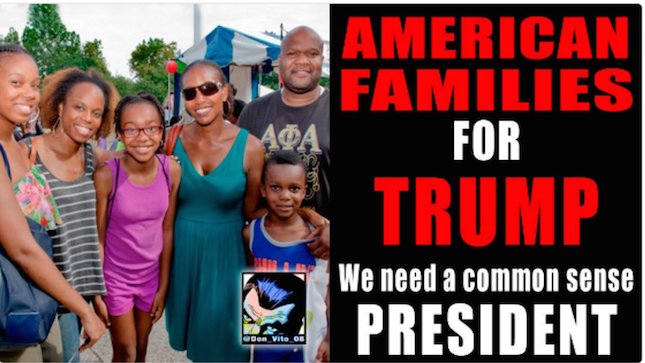
On Saturday, Trump shared a tweet from "@Don_Vito_08"  that purported to show an African American family on the “Trump Train.”  But the family in question does not support Trump.  @Don_Vito_08 had merely copied it from an article by Cincinnati station WCPO on the Midwest Black Family Reunion.  In March, Trump retweeted an unflattering image of Heidi Cruz compared with his wife, Melania. That tweet and image also came from @Don_Vito_08.

Saturday, June 4, 2016

Important Background on the Trump Cases

Matt Ford writes at The Atlantic:
We’ll start at the beginning. Curiel is presiding over two separate class-action lawsuits about Trump University. One of them, Low v. Trump University, was filed in April 2010 under the name Markaeff v. Trump University. The other, Cohen v. Trump, was filed in October 2013. (A third case brought by New York Attorney General Eric Schneiderman in 2013 is also under way in that state.) Trump is named as a defendant in both cases.
The plaintiffs in Low and Cohen portray Trump University as a basically fraudulent endeavor, one that promised Trump’s secrets to real-estate success but instead dispensed generic advice for tens of thousands of dollars. They’veamassed a collection of evidence and testimony that seems to support their claims. Trump strongly denies the allegations and often cities numerous positive testimonials the seminars received from former customers of Trump University.
In his public remarks, Trump appears to make no distinction between Low andCohen. But there are crucial differences between the two civil class-action lawsuits. The Low plaintiffs sued Trump University and Trump himself under various consumer-protection laws in California, Florida, and New York—a relatively standard class-action lawsuit.
Cohen, on the other hand, targets Trump through a provision of the federal Racketeer Influenced and Corrupt Organizations Act, more commonly known as the RICO Act—the same statute federal prosecutors use to bring down mob bosses. In essence, Low accuses Trump University of engaging in fraudulent business practices, while Cohen frames Trump University itself as a criminal enterprise with Trump as the orchestrator of a racketeering scheme.

Trump v. the Rule of Law

 At The New York Times, Adam Liptak writes that Trump's attacks on Judge Curiel have prompted conservative and libertarians scholars to worry about the 
Mr. Trump accused the judge of bias, falsely said he was Mexican and seemed to issue a threat.
“They ought to look into Judge Curiel, because what Judge Curiel is doing is a total disgrace,” Mr. Trump said. “O.K.? But we will come back in November. Wouldn’t that be wild if I am president and come back and do a civil case?”

David Post, a retired law professor who now writes for the Volokh Conspiracy, a conservative-leaning law blog, said those comments had crossed a line.
“This is how authoritarianism starts, with a president who does not respect the judiciary,” Mr. Post said. “You can criticize the judicial system, you can criticize individual cases, you can criticize individual judges. But the president has to be clear that the law is the law and that he enforces the law. That is his constitutional obligation.”
“If he is signaling that that is not his position, that’s a very serious constitutional problem,” Mr. Post said.
Beyond the attack on judicial independence is a broader question of Mr. Trump’s commitment to the separation of powers and to the principles of federalism enshrined in the Constitution. Randy E. Barnett, a law professor at Georgetown and an architect of the first major challenge to President Obama’s health care law, said he had grave doubts on both fronts.
“You would like a president with some idea about constitutional limits on presidential powers, on congressional powers, on federal powers,” Professor Barnett said, “and I doubt he has any awareness of such limits.”
At The Washington Post, Callum Borchers reports that CNN's Jake Tapper asked Trump about his repeated attacks.
Actually, Tapper didn't quite get to form a question. Trump interjected to talk about Clinton's emails. So Tapper tried to steer the conversation back to whether Trump's complaint about U.S. District Judge Gonzalo Curiel was racist. Trump deflected again. Tapper tried again. And again.

In all, Tapper made an astounding 23 follow-up attempts. This moment right here — with this look on Tapper's face — perfectly encapsulates the exchange.
Tapper's relentlessness ultimately paid off. He finally got a straight answer out of the presumptive Republican presidential nominee.
TAPPER: If you are saying he cannot do his job because of his race, is that not the definition of racism?
TRUMP: No, I don't think so at all.
Tapper presumably had other subjects he would have liked to get to. Trump likely figured as much and assumed he could stall long enough for his interviewer to move on. That's usually how it goes.
But Tapper refused to drop the subject until Trump offered a yes-or-no answer. It was clearly an exhausting effort. But it showed that even Donald J. Trump can be worn down by a journalist who never gives up.

Friday, June 3, 2016

Ceaser on the 2016 Election and the Nominating System

Comments from James Ceaser in an Atlantic interview with Emma Green:
This is the danger of this fully popular system. There’s a higher probability that you could get a demagogic result—it’s ripe for that. And lo and behold, that’s what we have. It’s the realization of the fear people had about this system.

There are disadvantages to a limited system, too—no system is perfect. It can become stale; it can protect too much of the status quo; it can fail to hear messages that are surging up. This is a point that has been made in both the Sanders and Trump phenomena—there is something the political class is missing that became clear in this primary process. So it’s not as if one has all the benefits and none of the disadvantages—it’s a mix.
...
You also have two candidates who weren’t members of their party. That’s another extraordinary thing: The party used to say hey, we control this, we’re going to pick the one that we want. Now, a party at the national level is kind of like a public utility. They don’t have a basis even of limiting who the candidates are to their own party. Bernie Sanders is not a Democratic. He was a socialist. And Trump was really not a Republican. But they came in and rented a party because that’s the way the rules are set up.
...
By “public utility,” in a way, I mean [they’re] running an election by some neutral rule—they’re just sort of running the election for the candidates. Anyone can walk in, and the party can’t really shape this very much. Parties decided to do this on their own. Usually it works out—most of the time, you’ve gotten good candidates out of it—but now it’s come to the point that they haven’t been able to say, “Well, we don’t want this person because he hasn’t been a member of the party.” You would think a party would be able to do that.

Thursday, June 2, 2016

Trump v. Hispanics

Jonathan Martin and Alexander Burns report at The New York Times:
The head of Hispanic media relations at the Republican National Committee is resigning this month in what appears to be another indication of the lingering discomfort some party officials have about working to elect Donald J. Trump president.
Ruth Guerra, who is of Mexican descent and was in charge of carrying the party’s message to Hispanic voters, is joining the American Action Network, a Republican-aligned “super PAC,” she confirmed in a brief interview on Wednesday.
The American Action Network is expected to spend millions on congressional races, and the new job is in essence a promotion, one co-worker said.
But Ms. Guerra told colleagues this year that she was uncomfortable working for Mr. Trump, according two R.N.C. aides who requested anonymity to speak candidly about the difficulties surrounding the party’s presumptive standard-bearer.
Ed O'Keefe reports at The Washington Post:
The RNC announced Wednesday night that Guerra will be replaced by Helen Aguirre Ferre, a GOP operative and former Spanish-language conservative radio talk show host with deep roots in the Miami area. (Her father-in-law is Maurice Ferre, the first Hispanic mayor of Miami.)
...
Aguirre Ferre is a former aide and close friend of Bush and his family. She prepped the former Florida governor for major speeches and presidential debates and served as his top Spanish-language surrogate. The former host of a radio program for Univision's national network of talk stations, she also was a top Hispanic affairs adviser to Mitt Romney's 2012 presidential campaign.
In a statement issued by the RNC, Aguirre Ferre said she's "eager to make the case to the Hispanic community why Republican ideas and values are the way forward for our country after eight years of an Obama agenda which has failed all Americans."
Despite that eagerness, she frequently expressed doubts about Trump in public during appearances on Spanish-language television programs and on Twitter — as recently as last month.
Appearing May 8 on Univision's "Al Punto," a Sunday public affairs program hosted by the network's popular anchor Jorge Ramos, she agreed with other panelists who said that a segment of the Republican Party would not unite around Trump.
"I think you're going to see a segment, Jorge, who won't be able to do it. Because they don't consider Trump to be a real conservative," she said in Spanish.
Seema Mehta reports at The Los Angeles Times: 
“I am concerned, and I’m saddened, and I’m bewildered,” said Luis Alvarado, a GOP media strategist who, like many other Latino officials in California, said he will not vote for Trump. “We had fought for every inch in changing the minds and hearts of not just fellow Latinos, but also fellow Republicans in understanding how we need to work together. And Trump comes along and everything just gets pushed aside.”
The Republican Party’s problem with Latino voters predate Trump because of the party’s stance on immigration. GOP strategists often say that Latinos may agree with the party on social and economic issues but won’t listen to their pitch if they believe Republicans want to deport their family members.

In California, there are 4.1 million registered Latino voters, with 55% registered as Democrats, 16% Republican and 25% having no party preference.

Trump insists that Latinos “love” him, but polling does not bear that out. A Fox News poll in May found Latino voters favored Democratic front-runner Hillary Clinton over Trump 62% to 23%.

Many have had a visceral reaction to Trump's proposals that include deporting 11 million people and building an enormous border wall. Protests greet Trump whenever he holds rallies in California.

When former Downey Mayor Mario Guerra was wrongly listed as a Trump delegate, the Republican received many angry emails and phone calls from his constituents, accusing him of being disloyal to his ethnicity.
“People said, ‘You're betraying your people. What are you thinking?’’’ said Guerra, who is treasurer of the California Republican Party.
Javier Panzar reports at The Los Angeles Times:
Democratic operatives are using Trump as a sort of all-purpose boogeyman in a diverse range of down-ticket races all over the state.

Even in districts where there is no meaningful Republican opposition in sight, Democratic campaigns are milking Trump's rhetoric to raise money and bring out voters.

"It is the best political gift a Democrat running in California could get," said political consultant Dave Jacobson of the political firm Shallman Communications.
Compton City Councilman Isaac Galvan, running for an open state Senate seat in a safe Democratic district, sent out a mailer in English and Spanish quoting Trump's now infamous comment that Mexico sends "rapists" and drug dealers across the border to the United States.
The mailer screams: "PUT AN END TO DONALD TRUMP'S RACISM AND SEXISM!!! VOTE TUESDAY JUNE 7, 2016 FOR ISAAC GALVAN."
 

Wednesday, June 1, 2016

Trump Notes

Michael Barbaro and Steve Eder report at The New York Times:
In blunt testimony revealed on Tuesday, former managers of Trump University, the for-profit school started by Donald J. Trump, portray it as an unscrupulous business that relied on high-pressure sales tactics, employed unqualified instructors, made deceptive claims and exploited vulnerable students willing to pay tens of thousands for Mr. Trump’s insights.
One sales manager for Trump University, Ronald Schnackenberg, recounted how he was reprimanded for not pushing a financially struggling couple hard enough to sign up for a $35,000 real estate class, despite his conclusion that it would endanger their economic future. He watched with disgust, he said, as a fellow Trump University salesman persuaded the couple to purchase the class anyway.
“I believe that Trump University was a fraudulent scheme,” Mr. Schnackenberg wrote in his testimony, “and that it preyed upon the elderly and uneducated to separate them from their money.”
Josh Marshall at TPM:
Some events are important to take note of. One of them happened on Friday when the Republican nominee for President of the United States, Donald J. Trump, again used a campaign rally to launch into a racist tirade against the federal judge presiding over two of the three fraud lawsuits against Trump's now defunct "Trump University." Federal Judge Gonzalo P. Curiel was born in 1953 in East Chicago, Indiana. He was a federal prosecutor from 1989 to 2006, primarily working in narcotics enforcement. He was a state judge from 2006 until 2012 when President Obama nominated him to serve as a Federal District Court Judge in the Southern District of California. While serving as US Attorney in 1997, Curiel was reportedly the targeted for assassination by members of the Arellano Felix drug cartel during his ultimatelysuccessful prosecution of the cartel.
Also from Marshall:
With all the ranting and noise, I want to catch us up on what we actually learned yesterday with Trump's big Vets' charities show. The big takeaway is that nothing Trump revealed changed what we knew last week: four-plus months after holding his debate-skedaddle fundraiser and announcing $6 million raised, Trump was caught in a series of lies about the money, most notably that he'd apparently tried to get away without contributing any of the $1 million he pledged after repeatedly saying he already had. (Here's a helpful timeline through May 24th, the date Trump was finally shamed into coughing up the money.)
Tina Nguyen writes at Politico:
Nobody is doubting that the presumptive Republican nominee is exceptionally well-off. Several tax experts and fellow rich people told Politico that, even in the absence of seeing his tax returns, they were willing to bet that Trump was technically a low-grade billionaire. But it’s possible, many say, that Trump pockets far less profit than his business revenues suggest. The fact that he’s sold several of his assets—including up to $7 million in fund assets and $9 million in individual securities—to cover his campaign debt suggests that he probably doesn’t have enough cash on hand to easily cover the costs of his campaign outright. That’s not something one would expect from a man who claims he is worth “in excess of TEN BILLION DOLLARS”(the capitalization is Trump’s). In addition, the real estate mogul has added over $50 million in debt to his ledger, Politico reports, putting his total debt somewhere between $315 million and $500 million, and possibly more.