Search This Blog

Saturday, June 13, 2026

Schumer Redux

Our most recent book is The Comeback: The 2024 Elections and American Politics. It includes a chapter on congressional and state elections.

Jordain Carney at POLITICO:

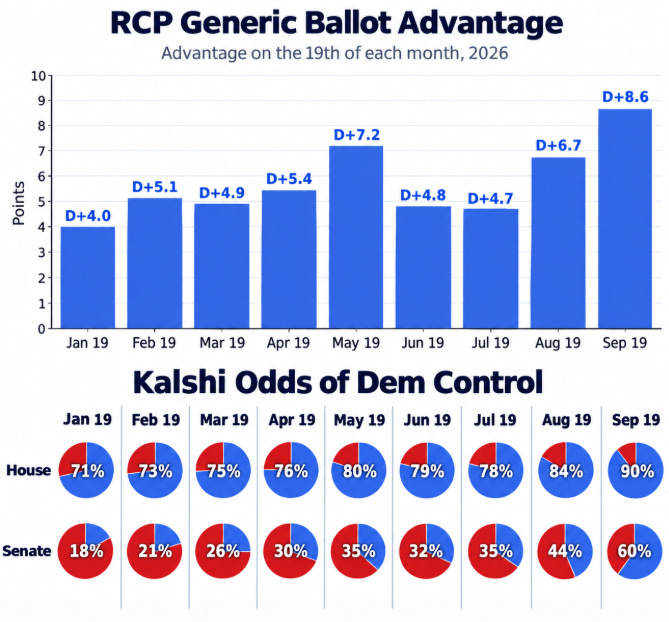
Chuck Schumer has served as a punching bag for angry Democrats for more than a year — taking flak on everything from his 2026 recruiting to his handling of government funding talks.

But with about five months until the midterm elections, the Senate minority leader is gently starting to punch back — pointing out how some of his bets are paying off as his party
moves within striking distance of taking back the majority in November.

“There’s no victory lap to take in June,” he said in an interview in his Capitol office suite.


But he ticked through moves he oversaw in the past year — from leading opposition to GOP safety-net cuts to picking shutdown fights over health care and immigration enforcement funding and orchestrating national intervention in several Senate primaries — that he argued have strengthened Democrats’ hand for the midterms and beyond.

“We made a lot of strategic decisions that got us to this place — it didn’t happen by accident,” Schumer said. “I knew from the beginning that if we recruited strong candidates, found paths to victory, focused on the issues the American people cared about, and forced … the Republicans, to carry Trump’s water, we’d be in much better shape, and that has happened.”

Thursday, June 11, 2026

Trump Loves Inflation, and There's a Lot to Love

Our new book is The Comeback: The 2024 Elections and American Politics. The first year of the second Trump administration has been full of ominous developments

War and economic woes will hurt the GOP in November.  The only question is how much.


Raquel Coronell Uribe at NBC:
President Donald Trump embraced an unlikely foe Wednesday: inflation.

Asked by reporters whether he was concerned about new economic data that showed inflation last month surged to the highest rate since early 2023, Trump praised the government figures.

“The numbers were great. You know what I really love? I love the inflation. You know why? Because as soon as this war is over ... when the war is over, it’s coming down, it’s going to come down like a rock,” he said, referring to U.S. efforts to secretly get oil ships through the Strait of Hormuz.

Democrats pounced on Trump’s remarks, with Senate Minority Leader Chuck Schumer, D-N.Y., and Sen. Elizabeth Warren, D-Mass., accusing him of not caring about the rising cost of living for Americans.

Trump later argued that his words were taken out of context, telling the New York Post what he loved was how inflation wasn’t higher. Trump said that “the numbers are much lower than anticipated” and predicted prices would plunge once the war is over.

He also predicted that the current inflation rate would be the peak in the Iran war, which began Feb. 28.

One day later... Aimee Picchi at CBS News:
Inflation facing U.S. businesses surged in May to its highest level since November 2022 amid higher energy prices stemming from the Iran war.

The Producer Price Index, which registers inflation before it reaches consumers, soared 6.5% in May from a year ago, the Labor Department reported on Thursday. On a monthly basis, the PPI rose 1.1% from April, a faster pace than the 0.6% increase forecast by economists polled by financial data firm FactSet.

The hotter-than-expected reading comes a day after the Consumer Price Index surged in May to an annual rate of 4.2%, its fastest pace in more than three years. Although the PPI doesn't directly signal changes in consumer prices, it can feed into broader inflation if businesses pass those costs on to customers.

Wednesday, June 10, 2026

Inflation and Iran Mid-2026

Our new book is The Comeback: The 2024 Elections and American Politics. The first year of the second Trump administration has been full of ominous developments

War and economic woes will hurt the GOP in November.  The only question is how much.

Madison Hoff at Business Insider:

US annual inflation accelerated to 4.2% last month, new consumer price index data showed, as expected. That adds to the recent trend of inflation speeding up, reaching the highest rate since April 2023.

Inflation outpaced wage growth for the second straight time. Average hourly earnings increased 3.4% in May from a year ago. Real earnings fell 0.7% over the year and 0.1% over the month.

Mark Hamrick, senior economic analyst at Bankrate, expects inflation to remain elevated in the near term because of supply chain disruptions in the Middle East, which could mean the trend of inflation surpassing wage growth persists.

"The dividing line between the haves and the have nots is dictating whether consumers are able to keep with rising price levels," Hamrick said in an email to Business Insider. He pointed to the Fed's May Beige Book, which said consumer spending is "increasingly bifurcated across income groups amid affordability pressures," with higher-income households less affected.

Nicole Bachaud, an economist at ZipRecruiter, said wage growth falling short of inflation is putting financial strain on middle-income households. The Federal Reserve Bank of Kansas City echoed that sentiment in the May Beige Book, noting one firm said that "middle-income households are squeezing more life out of every dollar before deciding to spend it."

Amy Sherman at PolitiFact:

March 1: Trump said in a speech that "combat operations continue at this time in full force, and they will continue until all of our objectives are achieved." When The New York Times asked him how long the United States and Israel would continue the attacks, Trump said: "Well, we intended four to five weeks."

March 2: Trump said at a White House ceremony: "We're already substantially ahead of our time projections. But whatever the time is, it's OK." He repeated that the initial projection was "four to five weeks, but we have capability to go far longer than that."

In a press conference, Hegseth said, "This is not Iraq. This is not endless. ... This is the opposite. This operation (has) a clear, devastating, decisive mission: destroy the missile threat, destroy the navy, no nukes."

Hegseth added: "Trump has all the latitude in the world to talk about how long it may or may not take. Four weeks, two weeks, six weeks. It could move up, it could move back.

March 5: Trump said at an event to celebrate soccer champions Inter Miami CF: "The United States military, together with the wonderful Israeli partners, continues to totally demolish the enemy far ahead of schedule and at levels that people have never seen before."

Hegseth said, "Our munitions are full up, and our will is ironclad, which means our timeline is ours and ours alone to control as long as it takes to ensure the United States of America achieves these objectives."
March 7: Trump told reporters on Air Force One, "We're winning the war by a lot. We've decimated their whole evil empire. It'll continue, I'm sure, for a little while."

He called it "a short excursion."

When asked how long he expected the attacks to continue, Trump didn’t directly answer the question. "Well, I think we've accomplished more in one week than anyone thought possible."

On Truth Social he said victory already occurred. "We don’t need people that join Wars after we’ve already won!"

The list goes on, but you get the idea. 


Tuesday, June 9, 2026

More on the Welker Interview

Our books have discussed Trump's low character, which was on display this weekend.   An interview with Kristen Welker went sideways.

 Sofia Kinzinger:

After the interview was taped but before it aired, Welker mentioned on Sunday’s broadcast that the president had reached out. They spoke. He agreed to do a second interview.

Read that again slowly.

You do not call a reporter after a taped interview to say everything went great. You call because you know there’s a need for damage control. You do not offer a second sit-down out of generosity — you offer one because you are hoping for a redo. The second interview is not a goodwill gesture. It is a damage control overture. It is the White House’s way of saying: we know what’s coming, and we do not want it to air.

The fact that Welker disclosed this publicly, on air, is itself a signal. The damage control attempt became part of the damage.

Step back even further and look at why Wisconsin in the first place.

This was the president’s first trip to the state since being reelected in 2024. He chose a farm. He brought the Secretary of Agriculture. He hosted a roundtable titled “American Agriculture.” The symbolism is loud, and it is loud because the silence underneath it is deafening.

Farmers, and specifically Midwestern farmers, have been among the most quietly devastated constituencies of the current administration’s trade policies. Tariffs that were supposed to open foreign markets have instead raised input costs. Fertilizer prices tied to the Iran war have climbed. Fuel costs have followed. Deal after deal, announced with fanfare and followed by complexity, has left farmers absorbing losses that were never part of the pitch they were sold.

Tariffs, cuts to USDA programs, and immigration policy that has frightened away farm laborers have combined to create a compounding pressure on small and medium farms across Wisconsin. These are not abstract policy debates for the families running those operations. These are balance sheets. These are decisions about whether to plant next season.

Share

And when Welker asked Trump directly about gas and fertilizer prices climbing because of the war, he snapped: “Are you ready? Am I allowed to talk?” Then: “I love the farmers and the farmers love me.”

That line — “the farmers love me”— was the whole point of the trip. And the fact that it had to be said out loud, with visible frustration, on a farm in the rain, in front of a journalist who wouldn’t let it stand unchallenged, tells you more about where things actually stand than any poll number could.

Farmers are not a monolith, but they are a constituency that carries symbolic and electoral weight far beyond their numbers. They represent something in the American political imagination — self-reliance, resilience, the backbone of the country. When that group begins to peel away, it does not just change vote counts. It changes the story.

The support has been quietly diminishing for months. Not loudly. Not with protests or rallies. Just with the slow, grinding reality of costs that don’t come down, promises that don’t deliver, and a White House that showed up to Wisconsin with a camera crew and a curated barn and a message that felt, even to its intended audience, like it was meant for television rather than for them.

That gap — between the image and the reality, between the invitation and the exit, between the staged farm backdrop and the president walking off the set — is the story.


Monday, June 8, 2026

BS About LA

Our most recent book is The Comeback: The 2024 Elections and American Politics. It includes a chapter on congressional and state elections.

California sends mail ballots to every registered voter and allows the counting of ballots postmarked by election day even if they arrive a week later.  This process helps explain why the state's vote count is slow.  Despite the total lack of evidence for significant cheating,  the slow count gives Trumpists an occasion to spread lies about election fraud.

MELANIE MASON, DUSTIN GARDINER and BLAKE JONES at POLITICO:
Rob Quan, the indefatigable Los Angeles politics watchdog, made a prediction on X five days before the primary: “Spencer Pratt will finish election night in first place but he will consistently slide over the next week or two, as later votes are counted, and this website will reach peak dumpster fire status.”

He wasn’t totally right about the first results in the Los Angeles mayor’s race. Pratt’s weaker-than-expected showing put him behind Karen Bass from the start. But the dumpster fire? That forecast was spot on.

Social media sites, particularly X, were awash with conspiracy theories about Nithya Raman’s surge since Election Day. By Sunday, Raman had pulled ahead of Pratt by roughly 3,000 votes, making her the heavy favorite to take on Bass in the November runoff — and Pratt’s online fans handled the development much like Quan anticipated.

By now, certain corners of the social media ecosystem have settled, baselessly, on an ironclad consensus: The election was rigged. One widely-circulated claim alleged that a suspicious ballot drop included, improbably, zero votes for Pratt. In fact, the charge stemmed from a misreading of election data that had a one-minute lag in updates, the Los Angeles Times reported. Still skeptics were unconvinced when Bill Essayli, the Donald Trump-picked first assistant U.S. attorney for the Central District of California who said he’s launched “multiple” unspecified election fraud investigations, debunked the claim on X.

Also circling online was incredulity that Raman could possibly be neck-and-neck with Pratt, noting his strong polling in the lead-up to the race. But the last major poll before the election — by UC Berkeley’s Institute of Governmental Studies — showed Raman edging out Pratt, even with fellow Democratic Socialist candidate Rae Huang pulling 9 percent of the vote. Huang’s showing has hovered under 3 percent, indicating that progressive voters rallied around Raman in the closing days.

Much of the argument for a rigged election is based mostly on vibes. Non-Californians who couldn’t fathom why a plurality of Angelenos would back a deeply unpopular incumbent or self-described locals insisting they knew nobody who voted for Raman. The confusion says more about the online echo chamber that Pratt dominated. When Pratt, a Republican, insisted before the election that he’d win 50 percent plus one and win the mayorship outright, his fans believed him — never mind how implausible that would be for a city where 55 percent of voters are registered Democrats and just 14 percent are registered Republicans.

For the last few days, reporters — notably, The New York Times’ Ken Bensinger and CNN’s Elex Michaelson — have been trying, often in vain, to refute falsehoods and explain the precedent of progressive candidates getting a boost off of late votes. (One such example is the roughly 20-point swing that vaulted progressive challenger Eunisses Hernandez over Democratic incumbent city councilmember Gil Cedillo in 2022.) Roxanne Hoge, the chair of the Los Angeles County GOP, has also used social media to provide clear information about the voting process.

But the cheating fixation persists, in no small part because it’s amplified by the most powerful man in the world. Trump said during an interview on Meet the Press on Sunday the California elections were rigged — as well as repeating his baseless claims about the 2020 presidential election being fraudulent — before he abruptly ended his interview with Kristen Welker and walked out. Newsom’s press office declared the outburst “the most severe case of California Derangement Syndrome we’ve ever seen.”

Pratt’s post-election posts have taken a conspiratorial turn. On Friday, he urged his supporters to be patient; by Sunday, he was intimating the late votes for Raman were entirely due to homeless people voting for her.

Sunday, June 7, 2026

Snowflake in June

Our books have discussed Trump's low character, which was on display this weekend


Saturday, June 6, 2026

CA Vote Count and Bogus Conspiracy Theories

Our most recent book is The Comeback: The 2024 Elections and American Politics. It includes a chapter on congressional and state elections.

California sends mail ballots to every registered voter and allows the counting of ballots postmarked by election day even if they arrive a week later.  This process helps explain why the state's vote count is slow.  Despite the total lack of evidence for significant cheating,  the slow count gives Trumpists an occasion to spread lies about election fraud.

 Kevin Rector at LAT:

Since election night in California, a single theory of election fraud has taken root like no other — not just among online conspiracy theorists or bot accounts, but among major conservative influencers and people close to President Trump.

Late on election night, an update of vote counts in the Los Angeles mayor’s race appeared on election results pages of various media outlets including the Los Angeles Times.

It showed leading Democrats Mayor Karen Bass and Councilmember Nithya Raman receiving tens of thousands of new votes, and leading Republican former reality TV star Spencer Pratt receiving no new votes.

Close observers of the vote tally immediately took screenshots, with some shouting fraud. Others ran statistical analyses that showed it would be impossible for a candidate such as Pratt — running second in the race — to receive zero votes in such a large batch of ballots.

“They’re not even trying to hide the fraud anymore,” wrote Elon Musk, the world’s richest man and onetime member of Trump’s inner circle.

The claim fit into the broader narrative being pushed relentlessly by Trump and other Republicans in recent days, that California Democrats were cheating.

But the discrepancy in the Tuesday vote count in the mayor’s race was not fraud.

What attracted far less attention than the update with zero Pratt votes was another update one minute later that showed tens of thousands of votes for Pratt, and none for Bass or Raman.

There was no batch of votes that included zero votes for any candidate, as Los Angeles County’s own data show plainly.

But voting data pushed out by the Associated Press came as two separate updates one minute apart, with Bass’ and Raman’s votes in the first and Pratt’s in the second.

“The AP vote count receives updates as provided by election officials and adds them to our vote count. What happened in this case is that there was a lag in an automated update such that some candidates’ votes were added in one update and the other candidates followed about a minute later,” the Associated Press said in a statement to The Times.

Thursday, June 4, 2026

CA Election Problems: Slow Count and Top Two

Our most recent book is The Comeback: The 2024 Elections and American Politics. It includes a chapter on congressional and state elections.

California sends mail ballots to every registered voter and allows the counting of ballots postmarked by election day even if they arrive a week later.  This process helps explain why the state's vote count is slow.  Despite the total lack of evidence for significant cheating,  the slow count gives Trump an occasion to spread lies about election fraud.


Seth Masket:

As of this writing, the California governor’s race appears to be going to a November runoff between Democrat Xavier Becerra and Republican Steve Hilton. As in the 2020 presidential race, Democratic billionaire Tom Steyer ran a spirited campaign but came up short, and will likely Back Dat Azz Up into obscurity once again. As such, this looks like a “normal” primary, producing a nominee for each major party that the electorate can weigh in on. But California’s top-two system is still problematic here, and very easily could have produced a perverse and chaotic outcome for the state.

Definitely check out Jonathan Bernstein’s piece roasting the top-two system — I largely agree with what he says. But I want to stress a bit on party coordination, something notably lacking on the Democratic side in this contest.

Top-two primary elections are not “primaries” in any sense except that they come first. In common usage, a primary is a way for a party to decide on a nominee by turning to the party’s voters. California’s system does not do that. Rather, it is a June election among all the candidates, with the two top vote-getters going to a runoff election in November, even if they’re from the same party.

Usually, this looks similar to what you’d get in a more conventional primary election system, with a Democrat and a Republican going to the runoff. But once in a while, you get a Democrat-Democrat or a Republican-Republican runoff. Eric McGhee and Mark Baldassare at the Public Policy Institute of California ran the numbers and found that at least 18 state legislative or congressional contests have ended up in a same-party runoff each election cycle since the top-two system was adopted. (Such races have helped to modestly reduce polarization in the state legislature.) Usually that doesn’t matter much for representation purposes; it’s the same-party runoff in a district dominated by that party.

However, as McGhee and Baldassare note, there have been eight same-party runoffs in districts that lean toward the other party, and seven of those were two Republicans facing off in a Democratic-leaning district. That is, the top-two system created multiple situations where a Republican ended up representing a Democratic-majority district. (That doesn’t have an enormous impact in a state where Democrats have such large majorities, but imagine that happening in a statewide office like governor.)


Tuesday, June 2, 2026

Bag of Tricks

Our most recent book is The Comeback: The 2024 Elections and American Politics. It includes a chapter on congressional and state elections.

Monday, June 1, 2026

Feds Losing Legal Talent

Our new book is The Comeback: The 2024 Elections and American Politics. The first year of the second Trump administration has been full of ominous developments

Eileen Sullivan and Andrea Fuller at NYT:

President Trump’s upheaval of the federal government has led to an exodus of more than 10,000 lawyers since the beginning of 2025, a striking loss of legal talent that has left some agencies pushing to find attorneys to carry out his agenda.

Roughly one in five lawyers who worked in the government at the end of 2024 had left by March of this year, according to a New York Times analysis of federal employment data.

Along with the usual retirements and turnover in the federal work force, the last year saw deep staffing cuts and the resignations of some staff members who objected to Mr. Trump’s policies. Their departures show how rapidly the president has eroded the image of the federal government as the gold standard for lawyers seeking public service roles.

Instead, many of those looking for such work are flocking to the offices of Democratic state attorneys general and nonprofits that are challenging administration policies in the courts, boosting Mr. Trump’s opponents with seasoned lawyers.


Sunday, May 31, 2026

The Wounded Bear Caucus

Our most recent book is The Comeback: The 2024 Elections and American Politics. It includes a chapter on congressional and state elections.  For the rest of the 119th Congress, Trump's victories in Senate primaries will lead to defeats in Senate roll call votes.

The group of senators willing to break with Trump in his second term started with moderates Susan Collins of Maine and Lisa Murkowski of Alaska, as well as former party leader Mitch McConnell and libertarian Rand Paul, both of Kentucky. It has expanded to what some senators call the “wounded bear caucus” of colleagues forced into retirement by the president: Cornyn and Cassidy, plus Thom Tillis of North Carolina, who decided to step aside after Trump made clear he wouldn’t support him.

Cornyn is the newest member. Trump endorsed Cornyn’s primary runoff opponent, scandal-plagued state Attorney General Ken Paxton, stunning colleagues and helping fuel a rout in the contest on Tuesday—the incumbent lost by more than 25 percentage points. Cornyn said he would back the nominee, and party leaders fell in line, saying they would support Paxton to preserve the party’s 53-47 majority in the Senate. But the ill will isn’t going away.

In a post on social media Friday, Cornyn related the tale of the frog and the scorpion, calling it an “old, but apt fable” and presumably a jab at Trump. (Cornyn’s office declined to comment.) The scorpion asks the frog to carry it across the river, then stings the frog and they both drown—despite the scorpion knowing that would happen. “I am sorry, but I couldn’t help myself. It’s my character,” Cornyn recounts the scorpion saying.

Cassidy, in the interview, had his own thoughts on the Texas race. Paxton, he said, “is someone who Trump probably relates to in terms of all those ethical challenges—Cornyn is not.”

Thursday, May 28, 2026

Bad Economic News

Our new book is The Comeback: The 2024 Elections and American Politics. The first year of the second Trump administration has been full of ominous developments

IndexBox:

The U.S. Bureau of Economic Analysis reported on May 28, 2026, that personal income edged down by less than $0.1 billion in April, a decline of less than 0.1 percent on a monthly basis. Disposable personal income, which subtracts personal current taxes from total income, fell by $19.9 billion, or 0.1 percent. Meanwhile, personal consumption expenditures rose by $111.1 billion, a 0.5 percent monthly gain. 

Wednesday, May 27, 2026

Texas Day

Our most recent book is The Comeback: The 2024 Elections and American Politics. It includes a chapter on congressional and state elections.

Trump endorsed Ken Paxton for the Senate.

Andrew Howard at Politico:
Paxton officially ousted Sen. John Cornyn in the GOP runoff by a hefty margin, after top Republicans in Washington lit $100 million on fire burning the man they now have to embrace for the incumbent they thought would be the better bet in the general election.

That rescue mission for Cornyn officially failed on Tuesday, but Trump had already sealed his fate when he endorsed Paxton last week. Now, those same Republicans who have spent months attacking the scandal-plagued Paxton are coming around. Grudgingly.

The NRSC, which backed Cornyn, scrubbed its social media and website of anti-Paxton posts.

In a statement on Tuesday, the committee led by Sen. Tim Scott (R-S.C.) said the state “isn’t going to elect James Talarico,” the Democratic nominee, while attacking his record. Missing from the statement, notably, was any mention of Paxton by name, as well as any formal commitment to spending on his behalf. The Sen. John Thune-aligned super PAC Senate Leadership Fund, whose affiliated nonprofit poured millions into ads for Cornyn and attacking Paxton, had made no public comments as of 12:30 a.m. Eastern, hours after the race was called.

Texas GOP Gov. Greg Abbott, who has had an occasionally rocky relationship with the attorney general, congratulated Paxton on X, but his public statement on Instagram focused on the broader GOP ticket, calling for Republicans to “crush socialist Democrats’ dream of turning Texas blue” and promising that a “united Republican Party will drive victory.”

Other GOP-aligned groups are jumping right in for their nominee. The powerful Club for Growth Action immediately lent its endorsement, and one of its aligned-PACs quickly dropped an ad that repeatedly mocks Talarico as a “woke weirdo.”

And the Akin ploy is alive and well.

Ben Kamisar at NBC:

Democrat Johnny Garcia has won his party’s primary in Texas’ 35th Congressional District, NBC News projects, defeating a rival whom party leaders had condemned for antisemitic comments as Democrats look to compete in a district Republicans redrew to their benefit.

The district stretches from Austin to San Antonio, the result of Republican efforts to combine two Democratic seats into one and create a new district leaning their way. Donald Trump carried the district by about 10.5 points in 2024.

Despite that result, there are signs the district could be competitive in the general election, including $1 million in spending from an opaque outside group aimed at boosting Garcia’s opponent, sex therapist Maureen Galindo, despite the controversies dogging her. Punchbowl News reported that the super PAC, Lead Left PAC, had links to a GOP fundraising platform.

Tuesday, May 26, 2026

Malevolence Tempered by Incompetence: DOJ Edition

 Our new book is The Comeback: The 2024 Elections and American Politics. The second Trump administration is off to an ominous start. Its incompetence sometimes compounds the harm it does, but it sometimes tempers it.

 Alan Feuer at NYT:

In the past several months, prosecutors have repeatedly failed to persuade grand juries that the cases they have brought warrant criminal charges. And if it were not unusual enough, they have also been admonished at least three times since last November by federal judges who have accused them of misconduct.

The latest setback came in Chicago, where a judge cited a remarkable list of grand jury errors in a case that was dismissed against four Democratic activists about to face trial for impeding the police during a protest last fall at a suburban immigration detention facility.

...

The government’s missteps were bad enough to necessitate tossing out the case against the critics of the president’s immigration plan just days before it was supposed to go to trial.

But the mistakes also pointed to a more important problem: As Mr. Trump has demanded more and more charges against those he perceives as his opponents, prosecutors have felt pressure to push weak cases through grand juries. And that, in turn, has led to an erosion in faith in the Justice Department by both the grand jurors themselves and the judges considering the cases.

...

Part of the problem, legal experts say, is that Mr. Trump has hired inexperienced loyalists to fill senior roles in the Justice Department even as hundreds of career prosecutors have departed — either by their own choice or because they were forced out for having worked on cases that ran afoul of the president.

Junior prosecutors typically attend a weeklong course on the ins and outs of working with grand juries, and often trail more seasoned colleagues before they take the lead in presenting cases. But leaders in politically appointed posts do not get the same kind or amount of training.

...

All of these examples of grand jury malfeasance come on top of the many cases in which Justice Department prosecutors have failed to get grand jurors to return indictments. Such failures — known as no true bills — used to be essentially unheard-of, given the amount of sway that prosecutors have in the grand jury room and the department’s adherence to a tradition of seeking charges only in cases with strong evidence.

But over the past year or so, there has been a flurry of no true bills in federal courts across the country. Most have occurred in cities like Los Angeles and Washington, where grand jurors have rejected several cases involving people accused of protesting the administration’s immigration crackdowns and surges in federal law enforcement.

Sunday, May 24, 2026

Epstein and the Midterm

Our new book is The Comeback: The 2024 Elections and American Politics. The second Trump administration has been full of ominous developments. Scandals persist.  Especially Epstein.

Holly Otterbein at Axios:

Several top Democratic candidates in the midterms are airing scathing ads linking their Republican foes to the Jeffrey Epstein scandal — betting that the Trump administration's reluctance to release the Epstein files still resonates with voters.

Why it matters: Democrats are mostly focusing on high prices, health care and Trump's war against Iran, but some also are trying to tie Republicans to the late sex offender as part of a broader message accusing the GOP of protecting the corrupt elite.

Zoom in: In the hotly contested Ohio Senate race, Democrat Sherrod Brown has spent nearly $1.5 million on TV ads slamming his GOP rival, freshman Sen. Jon Husted, for previously taking donations from Epstein financial client Leslie Wexner, according to the ad-tracking firm AdImpact.
...

Graham Platner, the presumptive Democratic nominee in the Maine Senate race — a must-win contest for the party's hopes of gaining a majority in the Senate — also is making anti-Epstein messaging part of his strategy to unseat Republican Sen. Susan Collins.In a six-figure TV ad, Platner accuses Collins of selling out voters to "the president and to the Epstein class," as an old video of Epstein and Donald Trump flashes across the screen.

In Georgia's Senate race — one of the GOP's best opportunities to flip a seat this year — Sen. Jon Ossoff (D) likewise has argued in speeches and media interviews that Trump's administration is made up of "the Epstein class."


Saturday, May 23, 2026

Perceptions of the Economy May 2026

 Our new book is The Comeback: The 2024 Elections and American Politics. The first year of the second Trump administration has been full of ominous developments

Megan Brenan at Gallup:

Americans have continued to grow more negative about the economy in May, pushing Gallup's Economic Confidence Index to -45, down from -38 in April and the lowest reading since October 2022, when it was identical to now. Still, the current index score is above the recent low of -58 in June 2022 during a period, like now, marked by high inflation and soaring gas prices.
A release from the University of Michigan:

Consumer sentiment fell for the third straight month as supply disruptions in the Strait of Hormuz continue to lift gasoline prices, according to the University of Michigan Surveys of Consumers.

Sentiment is now just below the previous historical trough seen in June 2022. The cost of living continues to be a first-order concern, with 57% of consumers spontaneously mentioning that high prices were eroding their personal finances, up from 50% last month.

Independents and Republicans saw decreases in sentiment, with both groups reaching their lowest readings of the current presidential administration. Meanwhile, sentiment of Democrats was little changed from last month.

“Earlier this year consumers may have reserved judgment about how long the Iran conflict would last,” said U-M economist Joanne Hsu, director of the surveys. “Three months into the conflict, consumers appear to be worried that supply disruptions are unlikely to be resolved quickly. Moreover, consumers are clearly concerned that increases in gas prices will spread to other prices in the economy and that consequences may persist into the long run.”


Friday, May 22, 2026

Democratic Autopsy


Lisa Kashinsky and Andrew Howard at Politico:
Democrats’ long-awaited autopsy of the 2024 election backfired almost immediately after it was released on Thursday.

The Democratic National Committee’s biting and gloomy portrait of the party immediately kicked off a fresh round of infighting, with strategists and party officials lambasting chair Ken Martin for releasing a haphazard, typo-ridden report that failed to fully capture why, exactly, the party was crushed by President Donald Trump.

...

 The 192-page document — which the DNC only made public after it had been published by CNN — made no mention of Israel or Gaza and included sparse references to former President Joe Biden’s decision to run for reelection, two key elements that contributed to Trump’s 2024 win.

“We should take this autopsy with a massive grain of salt. Clearly, the people who put it together ran a highly ineffective, ill-researched process. Therefore it’s difficult to draw constructive conclusions,” said Adrienne Elrod, a senior adviser on the Biden and then Harris campaigns.

 Click here for a downloadable version of the "autopsy."  It is mostly inside baseball, with scant attention to inflation, the border crisis, the disastrous withdrawal from Afghanistan, Biden's cognitive decline, and other fundamental reasons for Harris's defeat.

Thursday, May 21, 2026

Corrupt Bargains

 Our new book is The Comeback: The 2024 Elections and American Politics. The first year of the second Trump administration has been full of ominous developments. Scandals proliferate.

Andrew Duehren at NYT:

Lawyers at the Internal Revenue Service sought to contest President Trump’s lawsuit against the agency, recommending several potential defenses in a case that the Justice Department nevertheless decided to resolve by creating an extraordinary $1.8 billion fund that could soon be used to pay Mr. Trump’s political allies.

I.R.S. officials prepared a 25-page memorandum outlining what they saw as flaws in Mr. Trump’s suit and advising the Justice Department to move to dismiss it, according to two people familiar with the memo. That memo was provided to Treasury officials in April, and it is unclear if they passed it along to its intended recipients at the Justice Department, according to the people, who spoke anonymously to discuss internal government deliberations.

No lawyers from the Justice Department ever appeared in court to respond to the suit or disputed any of Mr. Trump’s claims, which demanded at least $10 billion from the I.R.S. for not doing enough to prevent the leak of his tax information. The Justice Department instead made a highly unusual deal in the case. In exchange for Mr. Trump’s dropping the suit, the Trump administration created the $1.776 billion “anti-weaponization” fund for people who say they were wrongly targeted by the federal government.

The existence of the internal memo, which has not been previously reported, shows that the Trump administration disregarded readily available defenses to a lawsuit filed by the president against an agency he controls. While the Justice Department has said that Mr. Trump will not receive money from the new fund, critics have slammed the arrangement as a corrupt attempt at paying Mr. Trump’s political supporters, including, potentially, those who were convicted and later pardoned for storming the Capitol on Jan. 6, 2021.

Judd Legum at Popular Information:

On Monday, Popular Information broke the news that President Trump publicly praised two companies, Thermo Fisher Scientific and Apple, the same day he bought their stock. Trump took a tour of a Thermo Fisher facility and called on large pharmaceutical firms to partner with the company on the same day he bought between $15,000 and $50,000 of Thermo Fisher stock.

In a third example from Popular Information’s report, Trump bought between $50,000 and $100,000 in Micron stock and, the next day, touted Micron as “one of the hottest companies” in an interview on Fox News. Trump also encouraged people to “go out and buy a Dell computer” nine days after buying between $1 million and $5 million worth of Dell stock.

Popular Information’s investigation was based on Trump’s 113-page financial disclosure that was belatedly disclosed on May 14. The filing revealed that Trump had engaged in thousands of stock trades in the first three months of 2026. The hyperactive trading was an egregious violation of the presidential norm to avoid real or perceived conflicts of interest. In June 2016, in recognition that a president could not ethically trade individual stocks, Trump liquidated his stock portfolio.

Wednesday, May 20, 2026

It's His Party. It's Not His Senate

Our most recent book is The Comeback: The 2024 Elections and American Politics. It includes a chapter on congressional and state elections.

Trump endorsed Ken Paxton for the Senate in Texas and secured the defeat of Rep. Thomas Massie in a KY primary.  Adam Wren and Samuel Benson at POLITICO:

“Those so-called victories over the last couple weeks are just a mirage. They are self-owns,” said one senior Senate Republican operative, granted anonymity to speak candidly about frustration with the White House. “We’re not actually beating Democrats, and we’re not actually advancing legislation. Instead, gas is up 45% due to our actions and the President’s decision to go to war with Iran. He’s focused on the ballroom. He’s announced a $1.8 billion restitution fund with zero details or congressional authority to do so. It just is crazy.”

In just one day, a conquered — and, consequently, unbridled — Sen. Bill Cassidy joined Democrats to become the 50th yes vote on a war powers resolution, opposed Trump’s ballroom funding in reconciliation and called Trump’s freshly picked Paxton a “felon.” And that was just day three of Cassidy unchained.

Cassidy is not alone. Trump’s ballroom funding is stalled, the SAVE America Act is mired in the Senate and Majority Leader John Thune is pushing back on his desire to fire the parliamentarian. That’s not to mention the pushback even from the likes of the friendlier senator from Louisiana, John Kennedy, who expressed doubt about the Justice Department’s $1.8 billion Anti-Weaponization Fund.

“There are still many, many months to go before the election, and this president is going to have to continue to deal and work with, and partner with, or battle with this group of lawmakers,” Sen. Lisa Murkowski of Alaska told reporters Tuesday. “Even though Bill Cassidy lost his primary, he is still a voting member of the Senate until January. … So the president may have just opened some opportunities for people.”
Now Cornyn could join their ranks. After Trump endorsed Paxton, the senior Texas senator faces increasingly slim chances of surviving next week’s runoff election. Should he lose, Cornyn will be liberated to vote his conscience — unmoved by threats of further political vengeance from Trump — for the final months of his term.

Paxon could still win, but only if Republicans divert millions of dollars from North Carolina, Georgia, Ohio, and other competitive races.

Tuesday, May 19, 2026

Gerrymanders and Waves

Our most recent book is The Comeback: The 2024 Elections and American Politics. It includes a chapter on congressional and state elections.

Bill Scher at The Washington Monthly:

While it’s likely that Democrats will maintain a healthy generic congressional ballot lead heading into Election Day, the math linking the national House popular vote to House seats is murkier than ever. In 2006, a Democratic 7.9-point popular vote advantage translated to 233 House seats, a net gain of 30. In 2010, the Republicans leveraged a 6.8-point vote edge into 257 seats, a net gain of 63. Eight years later, an 8.4-point margin gave Democrats 40 more seats, bringing their total to 241.

Today, thanks to increased political polarization, geographic sorting, and aerobic gerrymandering, political handicappers envision fewer competitive House districts, which means big popular vote swings may not translate into big numbers of seat flips. That’s why political handicappers such as The Cook Political Report with Amy Walter classify relatively few House districts, just 18, as toss-ups with another 17 as leaning towards one party (12 Democrat, five Republican). The other 400 are considered likely or solidly with a party.

Still, a strong political wind typically blows most toss-up districts towards the popular vote winner. In 2018, Democrats won 21 of the 30 toss-ups, or 70 percent, according to Cook. Moreover, Cook’s race ratings shifted in the Democrats’ favor over the course of the year, as often happens when political analysts receive more district-level poll data. Twelve districts considered toss-ups on May 18 were moved to the “Lean Democratic” or “Likely Democratic” columns by November, and Democrats swept those races. Plus, they picked up three seats from the “Lean Republican” and “Likely Republican” columns.

This November, based on today’s Cook ratings, if Democrats sweep their Lean and Likely races and pick up 70 percent of the toss-ups, they will win 219 seats, just one more seat sufficient for a majority. And that would only mean a net gain of four seats, well below the post-war 25-seat average. A big reason is the explosion of Republican gerrymandering greenlighted by the U.S. Supreme Court’s rollback of the Voting Rights Act, coupled with the Democrats’ loss at the Virginia Supreme Court, scotching their voter-approved gerrymander. As Amy Walter explained to the New York Times, before the judicial rulings, Cook classified 217 House seats as at least leaning Democratic; now that number is down to 207.


Monday, May 18, 2026

Polling Floors and Midterm Waves


Nate Cohn at NYT:
In this morning’s latest New York Times/Siena poll, whether Mr. Trump really has a high floor is starting to be put to the test.

Just 37 percent of Americans approve of his performance as president, a drop of four percentage points from the last Times/Siena poll in January and his lowest approval rating in any Times/Siena survey in either term.

A four-point decline isn’t necessarily huge, but it puts Mr. Trump’s ratings in new political territory. While recent presidencies have often been unpopular and polarizing, no president’s approval rating has been under 38 percent for more than a few days in the last 17 years, according to our average. If there has been a floor during this partisan era of politics, Mr. Trump’s ratings today have fallen to it.

...

The most immediate political consequence is that Democrats appear increasingly well positioned for the midterm elections in November. The poll shows Democrats have a double-digit lead, 50 percent to 39 percent, when registered voters are asked which party’s candidate they’ll support for Congress. That’s a notable shift from Times/Siena polls earlier this cycle — which showed Democrats up two to five points.

Anything like it would easily overcome the Republicans’ redistricting advantage in the House and suggest that Democrats could be highly competitive in the Senate. And although there’s still a long time until the election, Democrats held an even larger 14-point lead among those who said they were “almost certain” or “very likely” to vote.

...

The case of George W. Bush is instructive. At almost the exact same stage of Mr. Bush’s second term, the combination of the war in Iraq and high gas prices dragged his approval rating to about where Mr. Trump’s ratings are today. His ratings ultimately fell into the 20s, but it didn’t happen overnight. On average, Mr. Bush’s approval rating fell by less than one point per month for the rest of his term — which so happens to be the rate that Mr. Trump has been losing support over the last few months. For his approval rating to keep falling, Mr. Bush had to lose the support of longtime fans and Republicans. It can take a while.

If the conflict lasts long enough for Mr. Trump to keep bleeding support, Republicans might face something a lot worse than a bad midterm. A midterm defeat was likely even before the war began — it’s the usual fate of parties in power, after all — but the president’s party usually rebounds relative to that for the next presidential election. If Mr. Trump’s approval rating stays in the 30s, it won’t be so easy to assume Republicans will rebound. In the polling era, there are no examples of the president’s party retaining the White House when the president’s approval rating is under 40 percent. More often, the election is a rout.

Sunday, May 17, 2026

Cassidy Loses

Our most recent book is The Comeback: The 2024 Elections and American Politics. It includes a chapter on congressional and state elections.  Sen. Bill Cassidy voted to convict Trump in the second impeachment.  He tried to regain Trump's favor by casting the deciding vote to confirm Robert F. Kennedy, Jr. as HHS secretary.  It did not work.

 Michael Gold at NYT:
Senator Bill Cassidy of Louisiana on Saturday lost his Republican primary and the chance to seek a third term, after President Trump targeted him for defeat in retaliation for voting to convict him in his impeachment trial five years ago.

In a result that underscored the durability of Mr. Trump’s grip on his party, Representative Julia Letlow, the president’s chosen candidate, finished well ahead, drawing about 45 percent of the vote. John Fleming, the state treasurer and a former Trump administration official, edged out Mr. Cassidy to finish second, with about 28 percent of the vote.

Both Ms. Letlow and Mr. Fleming will advance to a runoff on June 27, according to The Associated Press.

Neither secured a majority of votes. But Mr. Cassidy, who voted to remove Mr. Trump in 2021 for inciting insurrection and has clashed with the Make America Healthy Again movement over vaccines, could not even secure enough support in his state to stay in the race, finishing with around 25 percent of the vote.