Search This Blog

Tuesday, February 19, 2019

Klobuchar and Free College

In Defying the Odds, we discuss the early stages of the 2016 campaign, when many candidates were unknowns.  In our forthcoming update, we bring the story through the 2018 midterm. We are now in the early stages of the 2020 race.

"I am not for free four-year college for all, no," she said. "And I wish -- if I was a magic genie and could give that to everyone and we could afford it, I would," she said.
Realizing her answer might not be popular among some of the college students in the crowd -- many of whom are likely burdened with debt of their own -- she explained why:
"I've got to tell the truth. We have this mounting debt that the Trump administration keeps getting worse and worse. I also don't want to leave that on the shoulders of all these we've got to do a balance. Some of it is major tax reform in terms of reversing some of the things this administration has done. Some of it making sure that students are getting degrees and being led to jobs where we actually have jobs."
Klobuchar invoking the national debt is a significant break with numerous top Democrats, who often dismiss the debt in face of pressing issues like climate change, health care and education.
She said she wants to find a mix of incentives for students, and talked about expanding Pell grants for students and refinancing student loans as some examples.

America as International Threat

In Defying the Odds, we discuss foreign policy issues in the 2016 campaign. Our forthcoming update takes the story through the 2018 election.

John Gramlich and Kat Devlin at Pew:
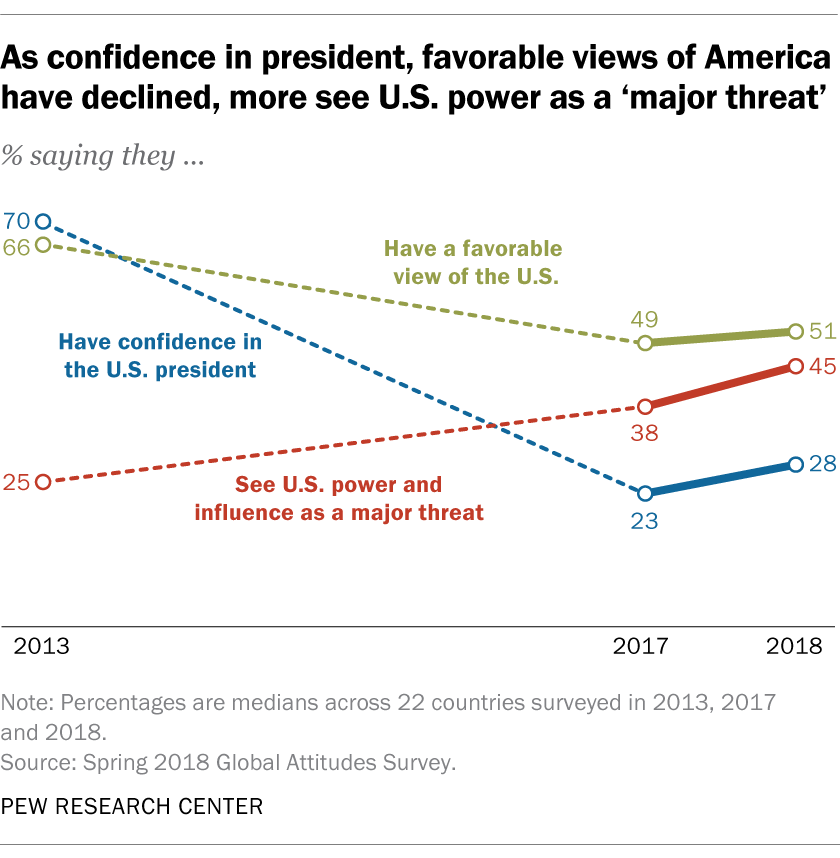
A growing share of people around the world see U.S. power and influence as a “major threat” to their country, and these views are linked with attitudes toward President Donald Trump and the United States as a whole, according to Pew Research Center surveysconducted in 22 nations since 2013.

A median of 45% across the surveyed nations see U.S. power and influence as a major threat, up from 38% in the same countries during Trump’s first year as president in 2017 and 25% in 2013, during the administration of Barack Obama. The long-term increase in the share of people who see American power as a threat has occurred alongside declines in the shares of people who say they have confidence in the U.S. president to do the right thing regarding world affairs and who have a favorable view of the United States. (For more about global views toward the U.S. president and the country he leads, see “Trump’s International Ratings Remain Low, Especially Among Key Allies.”)

Monday, February 18, 2019

Retribution, Trump, and Nixon

In Defying the Odds, we discuss Trump's approach to the media -- which is Nixonian.

In a July 2, 1971 taped conversation, Nixon spoke with Chuck Colson about using antitrust action against media companies: "If the threat of screwing them is going to help us more with their programming than doing it, then keep the threat. Don't screw them now. [Otherwise] they'll figure that we're done."

We license only individual broadcast stations. We do not license TV or radio networks (such as CBS, NBC, ABC or Fox) or other organizations with which stations have relationships (such as PBS or NPR), except to the extent that those entities may also be station licensees. We also do not regulate information provided over the Internet, nor do we intervene in private disputes involving broadcast stations or their licensees. Instead, we usually defer to the parties, courts, or other agencies to resolve such disputes.
But even if FCC does not license networks themselves, it can cause trouble for media companies.  On September 15, 1972, Nixon talked about using it to punish The Washington Post.
PRESIDENT: The Post has asked -- it's going to have its problems.

HALDEMAN: (Unintelligible)

DEAN: The networks, the networks are good with Maury [Maurice Stans]coming back three days in a row and --

PRESIDENT: That's right. Right. The main thing is the Post is going to have damnable, damnable problems out of this one. They have a television station.

DEAN: That's right, they do.
PRESIDENT: And they're going to have to get it renewed.

HALDEMAN: They've got a radio station, too.

PRESIDENT: Does that come up too? The point is, when does it come up?

DEAN: I don't know. But the practice of nonlicensees filing on top of licensees has certainly gotten more,...

PRESIDENT: That's right.
DEAN: more active in the, in the area.

PRESIDENT: And it's going to be God damn active here.

DEAN: (Laughs)

PRESIDENT: Well, the game has to be played awfully rough.

Sunday, February 17, 2019

Retribution

In Defying the Odds, we discuss Trump's dishonesty and his record of disregarding the rule of law.  In our forthcoming update, we bring the story up through the 2018 election.

 
In his 2019 State of the Union, he said:  "But we must reject the politics of revenge, resistance, and retribution, and embrace the boundless potential of cooperation, compromise, and the common good."

But seriously ... Trump is into retribution.

Hail Caesar

In Defying the Odds, we discuss Trump's place in the American constitutional system

Lloyd Green at The Guardian:
A shutdown averted, a constitutional crisis born. On Friday, Donald Trump declared a national emergency to gain additional funds for his much promised border wall, bypassing Congress and raiding the Pentagon for $3.6bn, already a legally dubious proposition in the eyes of the justice department. So much for Mexico paying.
Once upon a time, Trump and his legal minions brayed against unilateral executive actions, calling them tyrannical. Not any more. Barack Obama is out of the White House.
Hail Caesar, hello his praetorian.
Take Jay Sekulow, Trump’s personal lawyer. In April 2016, in a brief to the supreme court attacking Obama’s unilateral expansion of the Deferred Action for Childhood Arrivals (Daca) program, Sekulow painted Obama as a despot.
Echoing James Madison, founding father and fourth president, Sekulow thundered that the “accumulation of all powers, legislative, executive and judiciary, in the same hands … may justly be pronounced the very definition of tyranny”. He also compared Obama and his executive order to Harry Truman’s unconstitutional seizure of America’s steel mills during the Korean war.

According to Sekulow, Truman “violated controlling precedent and abdicated [his] constitutional duty to faithfully execute the law”.
In other words, by expanding Daca without a congressional green light, Obama had committed an impeachable offense.
 Justice Robert Jackson Concurring opinion, Youngstown v. Sawyer, 343 U.S. 579 (June 2, 1952)"
When the President takes measures incompatible with the expressed or implied will of Congress, his power is at its lowest ebb, for then he can rely only upon his own constitutional powers minus any constitutional powers of Congress over the matter. Courts can sustain exclusive presidential control in such a case only by disabling the Congress from acting upon the subject. [Footnote 4/4] Presidential claim to a power at once so conclusive and preclusive must be scrutinized with caution, for what is at stake is the equilibrium established by our constitutional system.

Saturday, February 16, 2019

Trump Lies About Border Data, Praises Dictator Justice

In Defying the Odds, we discuss Trump's dishonesty and his record of disregarding the rule of law

Katie Bo Williams and Marcus Weisgerber at Defense One:
He rejected the claims by Democrats — and data from his own U.S. Customs and Border Protection — that most drugs seized at the border are being caught at ports of entry, not on unguarded frontiers.
“It’s wrong, it’s wrong. It’s a lie. It’s all a lie,” he said.
According to U.S. Customs and Border Protection statistics, 90 percent of heroin, 88 percent of cocaine, 87 percent of meth and 80 percent of fentanyl seized along the border in the first 11 months of 2018 was intercepted at legal crossing points.
Asked where he gets his statistics, the president said, “I get many stats.”
But there remains little evidence of any crisis the wall could solve. Illegal border crossings haven’t been as low since 1971; most illegal drugs are smuggled through ports of entry, not hauled across the open border; and there’s no evidence that undocumented immigrants commit more crime than native-born Americans. Meanwhile, the nation’s intelligence chiefs didn’t mention border crossings among the major threats to national security in their January congressional testimony.
Trump also appeared to suggest that he believed the perceived problem of drug smuggling into the United States could be resolved by more liberal use of the death penalty.
“When I asked [Chinese president Xi Jinping], I said you have a drug problem? ‘No, no, no.’ I said you have 1.4 billion, what do you mean you have no drug problem? ‘No, we don’t have a drug problem.’ I said why? ‘Death penalty. We give death penalty to people that sell drugs.’ End of problem.”
A 2016 report from Brookings Institution found that despite more than 500 Chinese laws regarding illegal drugs, these “’relentless and draconian countermeasures’ have been relatively ineffective against the country’s drug problems.
Last year, Trump said of the Chinese president: "He's now president for life. President for life. No, he's great. And look, he was able to do that. I think it's great. Maybe we'll have to give that a shot some day."

Trump Emergency

In Defying the Odds, we discuss Trump's place in the American constitutional system

David French at National Review:
One thing that is abundantly clear from reading the full text of President Trump’s declaration of a national emergency on the southern border — he’s barely even deigning to explain why there is a particular crisis today, or why that crisis is so grave that it requires the military to combat it. At its heart it’s a contemptuous document. It’s the proclamation of a monarch, not an argument by a president. And it should fail in court.
...
Before today, legal writers were guessing at the statutes the president would use to justify defying the will of Congress and using the military to build his border wall. Now we know. In his declaration, he’s exclusively using 10 U.S.C. 2808 to reallocate up to $3.6 billion from Department of Defense construction projects — more than double the amount that Congress allocated for wall construction in its border compromise. (He intends to use other funds as well for wall construction, but those aren’t applicable to the emergency declaration.)
...
The intent is clear — to grant the military the power to build out military installations, and a “military installation” is a “base, camp, post, station, yard, center, or other activity under the jurisdiction of the Secretary of a military department or . . . without regard to the duration of operational control.” Each of the precisely described forms of installation represents facilities that support the troops. Under basic rules of statutory construction, the “other activity” must also fulfill that same purpose. As the Supreme Court held in Circuit City Stores v. Adams, when “general words follow specific words in a statutory enumeration, the general words are construed to embrace only objects similar in nature to those objects enumerated by the preceding specific words.”

A border wall, by contrast, is a civilian structure to be manned by civilian authorities to perform a civilian mission. The troops would not be creating a military fortification for military use. Not only is it not “military construction,” it’s also not “necessary” in order to support the use of the armed forces — unless one wants to make the fantastical argument that the wall somehow “protects” the troops who are building the wall. They are not defending the border from actual invasion as defined by the law of armed conflict or relevant American law. They are assisting in a law-enforcement mission that is mainly designed to prevent the commission of federal misdemeanors, not to stop an army that intends to take and hold American territory

At Lawfare  Scott R. Anderson abd Margaret Taylor acknowledge that a president has discretion to call a national emergency, but:
Can § 284’s authorization to build a “fence” to “block drug smuggling corridors” really be used to build a wall across the entire southern border? Is the wall really a “military construction project” of the sort authorized by § 2808? Does the president’s declaration of national emergency really “require[] the use of the armed forces” as required by § 2808? The patchwork of legal authorities on which the Trump administration is relying exposes the administration to a wide array of these challenges. One possible outcome may be a partial victory and partial defeat, in which the Trump administration is able to rely on some authorities and associated funding but not others. Regardless, plaintiffs are likely to seek—and federal courts seem likely to grant—injunctions that stop the federal government from taking any irrevocable steps towards building the wall while these legal challenges are resolved. In this sense, the primary function of these challenges may be to buy time until Congress is able to impose new limitations on the use of these funds and authorities, or even until a new Congress or a president is elected in 2020 who no longer wishes to pursue this agenda.