Colby Itkowitz and John Wagner at WP:
President Trump said Friday he does not believe white nationalism is a rising global danger after a suspected gunman who authorities say espoused that ideology killed 49 Muslims in New Zealand.
When asked at the White House whether white nationalists were a growing threat around the world, Trump replied: “I don’t really. I think it’s a small group of people that have very, very serious problems. It’s certainly a terrible thing.”
Trump also said he had not seen a manifesto, purportedly from an attacker, that named him as an inspiration for white identity ideology.
Alex Ward at Vox:
President Donald Trump just used similar language to describe immigrants coming into the United States that the alleged mass shooter did to justify killing nearly 50 Muslims in Christchurch, New Zealand.
On Friday, Trump issued the first veto of his presidency to override a congressional blockade of the national emergency he declared at America’s southern border. During the veto signing ceremony, Trump explained why he felt a national emergency was warranted to stop migrants from entering the US.
“People hate the word ‘invasion,’ but that’s what it is,” he said, according to the White House pool report.
That is chillingly similar to the language the main suspect in Friday’s Christchurch terrorist attack used to explain why he chose to gun down at least 49 Muslims. In the rambling 74-page manifesto the 28-year-old suspected shooter posted online shortly before the attack, he writes that he was committing the killings “to show the invaders that our lands will never be their lands.”
It’s also the same language the man who killed 11 people at a synagogue in Pittsburgh last October used: In that case, the perpetrator blamed Jews for helping what he called “invaders”in the Central American migrant caravans who were trying to enter the US.
However, public cynicism about America’s moral standards is high, as evidenced in the annual Values and Morals poll conducted by Gallup since 2002. In the latest poll, released last June, a record high 49 percent of respondents rated moral values in the U.S. as poor, and only 14 percent rated them excellent or good.
The perception that unethical behavior is increasingly commonplace could have a snowball effect, says Andrew Cullison, a philosophy professor who heads DePauw University’s Prindle Institute for Ethics.
“People think that if moral standards have eroded, why should they play by the rules,” he said. “If they’ve lost trust in some entity or institution, then that organization has lost the right to their compliance with the rules.”
Cullison said President Trump and his administration may be contributing to those perceptions with their departure from some longstanding ethical norms. Trump, for example, has refused to release his tax returns, as other recent presidents did, and has neither divested his business holdings or placed them in a blind trust.
“It’s the objective truth that norms of conduct are being violated,” Cullison said. “Where people differ is how outraged they are. If you’re getting what you want (in terms of policy), you’ll be more willing to look the other way.”
Last year, Tom Scheck reported at APM:
A growing chorus of ethics officials, including the acting director of the U.S. Office of Government Ethics, warns that President Trump's conduct related to his business interests is causing a dangerously negative public perception of the nation's ethics system.
"These are perilous times," said David Apol, acting director of the Office of Government Ethics. His comments came in a rare interview earlier this month that happened to be the same day President Trump nominated someone to replace him.
Apol worries that the president's decision to not divest from his sprawling business holdings and the scandals involving Trump's Cabinet are causing public distrust in the federal government.
"When the head of your organization, the head of your government says these rules aren't important enough for me to comply with, that makes the program challenging. And that changes the relationship, the way people view the ethics program," he said.
....
In a recent poll by Transparency International, 44 percent of respondents said they believe that most or all of the officials in the Office of the President are corrupt — an 8 percent increase from 2016. The poll also found that 58 percent of Americans polled believe corruption is getting worse.
...
Other polling finds that public trust in government remains near historic lows under President Trump. Only 18 percent of Americans say they can trust the government in Washington to do what is right, according to polling by the Pew Research Center
In Defying the Odds, we discuss Russian involvement in the 2016 campaign. The update -- just published --includes a chapter on the 2018 midterms.
At WP, Aaron Blake reports on Judge Amy Berman Jackson's sentencing of Paul Manafort:
Manafort’s legal team had suggested repeatedly in its sentencing memo that the fact that he hadn’t been found to have colluded with Russia should be a mitigating factor when it came to how much time he would serve in prison. But Jackson not only rejected that argument in sentencing him to 43 additional months in prison, she also rejected the entire argument behind it.
“The ‘no collusion’ refrain that runs through the entire defense memorandum is unrelated to matters at hand,” she said. “The ‘no collusion’ mantra is simply a non sequitur.”
Then she added: “The ‘no collusion’ mantra is also not accurate, because the investigation is still ongoing.”
Claiming something like there was “no collusion” as a defense is within any defendant’s right. It’s basically saying, “There was no crime.” The problem with Trump and his allies — and Manafort’s legal team, in this case — was that they have tried to stretch it much further. They have argued that the lack of proof of collusion thus far is somehow dispositive. They are suggesting that, because it hasn’t been proved, it never happened.
Trump has tried this trick repeatedly for months, misrepresenting statements by key players in the Russia probe. When Deputy Attorney General Rod J. Rosenstein last year announced indictments of Russians suspected of influencing the 2016 election, he emphasized that those specific indictments included no allegations of collusion. The president and the White House suggested that Rosenstein had essentially just exonerated the Trump campaign, when, in fact, the case simply wasn’t about collusion.
Dan Friedman at Mother Jones:
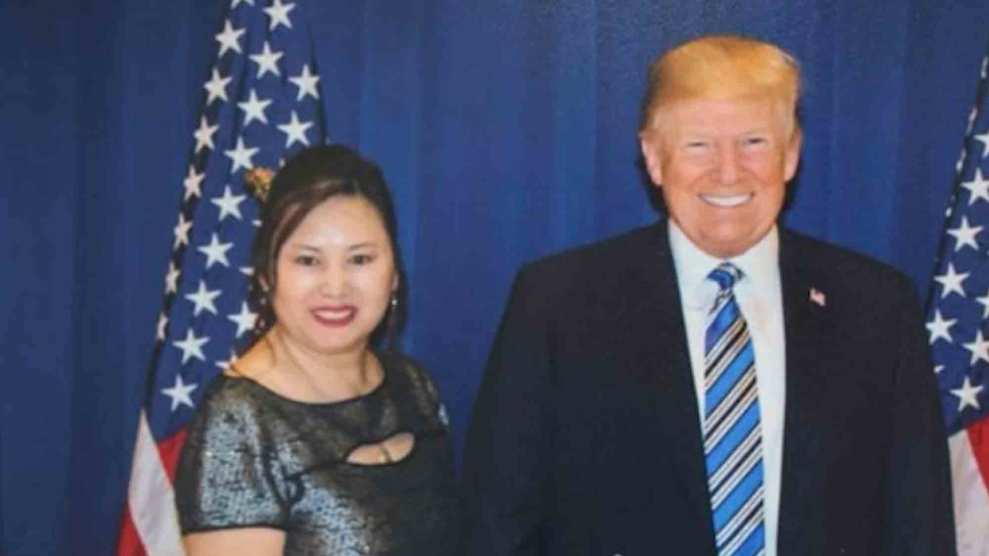
After four days of silence, the White House has finally addressed questions about Cindy Yang, the massage parlor owner who sold Chinese business executives access to President Donald Trump and his family at Mar-a-Lago.
“The President doesn’t know this woman,” Judd Deere, a White House spokesman, told Mother Jones on Tuesday.
Josh Kovensky at TPM:
The founder of a chain of massage and spa parlors that snagged Patriots owner Robert Kraft was apparently also hawking a different line of business: investment immigration.
Li “Cindy” Yang, a 45-year old Florida woman, has found herself in the headlines this past week for hobnobbing with some of the country’s most powerful politicians (including Trump) at Mar-a-Lago, and reportedly charging top Chinese execs for access to elected officials at the Palm Beach club.
TPM found that Yang, through a Florida-based company called GY US Investments LLC, was also using proximity to Trump and his properties to peddle so-called investor visas. Under the EB-5 visa program, foreign citizens can get a conditional two-year U.S. green card in exchange for making certain investments. Mother Jones first reported the existence of GY US Investments.
David Gelles et al. at NYT:
With more countries grounding Boeing jets and with lawmakers, aviation workers and consumers calling on the United States to do the same, the head of the aerospace giant on Tuesday made a personal appeal to President Trump.
Boeing’s chief executive, Dennis A. Muilenburg, called from Chicago and expressed to Mr. Trump his confidence in the safety of the 737 Max 8 jets, according to two people briefed on the conversation. Two of the planes flown by overseas carriers have crashed in recent months in similar accidents.
The brief call had been in the works since Monday, but it came shortly after Mr. Trump raised concerns that the increasing use of technology in airplanes was compromising passenger safety. “Airplanes are becoming far too complex to fly,” he wrote on Twitter. “Pilots are no longer needed, but rather computer scientists from MIT.”
...
Boeing’s relationship with Mr. Trump has not always been smooth, however. Shortly after becoming president-elect, Mr. Trump assailed Boeing for the estimated cost of its program to build new Air Force One planes, which provide mobile command centers for the president.
The “costs are out of control, more than $4 billion. Cancel order!” Mr. Trump wrote on Twitter a month after winning the election, but before taking office. A couple of weeks later, Mr. Muilenburg visited Mr. Trump at his Mar-a-Lago club in Palm Beach, Fla., to try to smooth things over.
“It was a terrific conversation,” Mr. Muilenburg told reporters after the meeting, explaining that he had given Mr. Trump “my personal commitment” that Boeing would build new Air Force One planes for less than the $4 billion estimate. Weeks after the conversation, Boeing donated $1 million to Mr. Trump’s inaugural committee. The company had donated the same amount to help finance President Barack Obama’s inauguration in 2013.
Dan Diamond at Politico:
The White House's proposed budget includes funding for a small children's health program sought by one of President Donald Trump's golfing buddies: Jack Nicklaus.
Under the administration's fiscal 2020 funding plan released Monday, HHS would steer $20 million toward a mobile children's hospital project at Miami's Nicklaus Children's Hospital, named for the legendary golfer.
Nicklaus had lobbied Trump on the golf course in Florida, and he met with HHS Secretary Alex Azar and then-OMB Director Mick Mulvaney in Washington, D.C., to request funds, say two individuals with knowledge. Trump personally directed HHS to earmark the funds to help Nicklaus develop mobile children's hospitals, one individual said.
In Defying the Odds, we discuss Trump's character, involvement in scandal, and approach to the media -- which all suggests parallels to Nixon. The update -- just published --includes a chapter on the 2018 midterms.
From CNN:
Programming note: CNN Original Series “Tricky Dick” explores Richard Nixon’s political rise and fall, with never-before-seen footage, starting Sunday, March 17, at 9p ET/PT.
Washington (CNN) -- President Donald Trump’s rhetoric about the Russia investigation might seem unprecedented, including his blistering attacks on investigators and pushback against the press. But history presents another strong example. More than 40 years ago, President Richard Nixon grappled with Watergate and hit many of the same points as the scandal unfolded.
In both cases, the President and his White House were enveloped by a sprawling Justice Departmentinvestigation. Both times, this led to the departure of senior officials, a slew of criminal charges against people close to the President, and allegations of a cover-up. Nixon and Trump both relished opportunities to proclaim their innocence and go after their opponents.
There are parallels, but there are also some differences. Watergate forced Nixon from office in August 1974 after Republicans in Congress withdrew their support. Trump has maintained the backing of GOP lawmakers and voters alike. Indeed, many Trump supporters have embraced his narrative that he is the victim of a “witch hunt” and the investigation itself is the problem.
As special counsel Robert Mueller nears the end of his investigation and Democrats on Capitol Hill ramp up their own probes, here are a dozen ways Nixon and Trump struck similar tones.
Toluse Olorunnipa and Sean Sullivan at WP:
A new proposal by President Trump to slash Medicare spending puts Republicans in a political bind ahead of the 2020 election as Democrats are pitching an expansion of the popular health-care program for all Americans.
Trump’s 10-year budget unveiled Monday calls for more than $845 billion in reductions for Medicare, aiming to cut “waste, fraud and abuse” in the federal program that gives insurance to older Americans. It’s part of a broader proposed belt-tightening effort after deficits soared during the president’s first two years in office in part due to massive tax cuts for the wealthy.
The move immediately tees up a potential messaging battle between Democratic proposals for Medicare-for-all — castigated by Republicans as a socialist boondoggle — and a kind of Medicare-for-less approach. focused on cutting back on spending, from the GOP.
Democrats, including some seeking to challenge Trump in 2020, seized on the proposed Medicare cuts Monday as an example of the GOP seeking to balance the budget on the backs of the elderly and the poor after giving broad tax breaks to the wealthy.
“Make no mistake about it: Trump’s budget is a massive transfer of wealth from the working class to the wealthiest people and most profitable corporations in America,” Sen. Bernie Sanders (I-Vt.), a Democratic presidential candidate, said in a Monday tweet that highlighted Medicare cuts.
During his 2016 campaign, Trump broke from Republican orthodoxy by promising not to cut Medicare, Medicaid or Social Security. His budget, by contrast, calls for scaling back all three programs.
Li Yang, the Florida massage parlor entrepreneur who created and operated a business that sold Chinese business executives access to President Donald Trump and his family at Mar-a-Lago, has yet another intriguing line of work. She is an officer of two groups with ties to China’s Communist government. And she founded a Miami-based nonprofit that promotes “economic and cultural exchange” between China and the West in coordination with “senior…Chinese leaders” in the United States, according to a profile of Yang posted on a Chinese social media platform.
Donald Trump’s inauguration received tens of thousands of dollars from shell companies that masked the involvement of a foreign contributor or others with foreign ties.
The Guardian has identified the creators of three obscure firms that contributed money to Trump’s inaugural committee, which collected a record $107m as he entered the White House in 2017.
The three companies each gave $25,000 to Trump’s inaugural fund. At least one of the contributions was made for a foreign national who appears ineligible to make political donations in the US.
...
One of the $25,000 donations to Trump’s inauguration was made through a Delaware shell company for a wealthy Indian financier based in London, who appears to not hold US citizenship or residency.
Another was made by a company formed in Georgia by a lobbyist with connections to the Taiwanese government. His wife said the firm was funded by Chinese investors. One of their daughters was later given an internship in Trump’s White House, which they said was unrelated to the donation.
A third $25,000 contribution was made through a company formed anonymously in New York by an Israeli real estate developer who has helped other foreign developers with legal issues in the US. The Israeli developer said he held US residency, commonly known as a “green card”, which permitted him to contribute legally.