Search This Blog

Showing posts with label ethics. Show all posts

Tuesday, February 11, 2025

Trump Administration and Ethics

Our forthcoming book is The Comeback: The 2024 Elections and American Politics. The second Trump administration is off to an ominous start.  Just a few weeks in, it is not only unethical, it is waging war on ethics.

 Jack Blanchard at Politico Playbook:

  • The president signed a new executive order halting enforcement of the 1977 Foreign Corrupt Practices Act, which blocks American companies from offering bribes to foreign governments, per FT’s Steff Chávez. (“It’s going to mean a lot more business for America,” he said.)
  • The Justice Department moved to end the federal bribery case against NYC Mayor Eric Adams, Fox News’ Brooke Singman and colleagues scooped. Acting Deputy AG Emil Bove’s directive to the Manhattan U.S. Attorney’s Office “raises urgent questions about the administration of justice during Mr. Trump’s second term and the independence of federal prosecutors,” NYT’s William Rashbaum and colleagues report.
  • Trump pardoned former Illinois Gov. Rod Blagojevich, who went to prison for eight years for trying to sell off a Senate seat, as Axios’ Alex Isenstadt scooped.
  • Trump dismissed David Huitema as head of the Office of Government Ethics, even though he’d only recently begun his five-year term, CNN’s Fredreka Schouten reports. VA Secretary Doug Collins was tapped as interim head of the office — another instance of replacing an independent watchdog with a loyalist.
  • Trump fired Hampton Dellinger, head of the whistleblower-protecting Office of Special Counsel — but a federal judge ordered Dellinger (who quickly filed suit) temporarily reinstated, per the AP.

Monday, December 23, 2024

The Gaetz Report

Our next book will examine Trump's return to power.  He actually wanted to make this guy attorney general.

Sarah Ferris and Jeremy Herb, CNN:
The House Ethics Committee found evidence that former Rep. Matt Gaetz paid tens of thousands of dollars to women for sex or drugs on at least 20 occasions, including paying a 17-year-old girl for sex in 2017, according to a final draft of the panel’s report on the Florida Republican, obtained by CNN.

The committee concluded in its bombshell document that Gaetz violated Florida state laws, including the state’s statutory rape law, as the GOP-led panel chose to take the rare step of releasing a report about a former member who resigned from Congress.

“The Committee determined there is substantial evidence that Representative Gaetz violated House Rules and other standards of conduct prohibiting prostitution, statutory rape, illicit drug use, impermissible gifts, special favors or privileges, and obstruction of Congress,” panel investigators wrote.

The panel investigated transactions Gaetz personally made, often using PayPal or Venmo, to more than a dozen women during his time in Congress, according to the report. Investigators also focused on a 2018 trip to the Bahamas – which they said “violated the House gift rule” – during which he “engaged in sexual activity” with multiple women, including one who described the trip itself as “the payment” for sex on the trip. On the same trip, he also took ecstasy, one woman on the trip told the committee.

Earlier this month, the House Ethics Committee secretly voted to release its report after initially voting against doing so. The vote to put out the report – which was opposed by panel Chairman Michael Guest, a Mississippi Republican – was the culmination of a years-long probe into allegations surrounding Gaetz. He was President-elect Donald Trump’s first pick to be attorney general but dropped out amid opposition from GOP senators and after CNN reported key details of this same ethics report.

FULL TEXT OF THE REPORT HERE.


Saturday, December 2, 2023

House Republicans Are Unhappy (with One Another)


Our recent book is titled Divided We Stand: The 2020 Elections and American Politics.  Among other things, it discusses the state of the partiesThe state of the GOP is not good.  George Santos was an embarrassment and source of discord for House Republicans.

Andrew Solender and Juliegrace Brufke at Axios:

House Republican leadership is facing some internal backlash over their last-minute opposition to expelling former Rep. George Santos (R-N.Y.) from Congress.

Why it matters: The historic vote to expel Santos was prompted by a report from the bipartisan House Ethics Committee which alleged a "complex web" of wrongdoing by the embattled Long Islander.Beyond the Ethics Committee, Santos has also been twice criminally indicted. He pleaded not guilty and maintains that he is innocent.

Driving the news: The House voted 311-114 on Friday to pass a resolution expelling Santos from Congress. Republicans split almost evenly, with 105 voting for expulsion and 112 voting against – compared to just two Democrats who voted against expulsion and another two who voted "present."
The push to rescue Santos gained 11th hour momentum when Speaker Mike Johnson (R-La.) and other members of leadership came out against expulsion the morning of the vote.
Santos' removal winnows the House GOP majority to a three-vote margin, while also giving Democrats an opportunity to pick up Santos' seat.

What we're hearing: Ethics Committee members Andrew Garbarino (R-N.Y.) and John Rutherford (R-Fla.) both floated to colleagues the idea of resigning from the panel if the vote failed, according to two lawmakers and an aide familiar with the discussions.


And it is not just the Santos vote.  Olivia Beavers at Politico reports that Speaker Johnson's honeymoon is over:
“He continues to play games,” a livid Rep. Max Miller (R-Ohio) said in an interview. “We are talking about a man [who] 30 days ago said that he was an anti-CR guy. We are talking about a man 30 days ago that was anti-Ukraine funding. ... It shows me he was never really morally convicted in his positions to begin with.

“He just did a 180 on everything he believed in,” Miller added, “and that to me is disgusting.”

Miller, an ally of McCarthy and former President Donald Trump, called Johnson a “joke,” describing the speaker’s decision to attach IRS cuts to Israel aid as “a slap in the face to every Jew” and a “fucking dumb” choice that set a precedent of tying domestic policy to foreign aid. He made clear that his complaints stemmed from the speaker’s decision to not take up funding bills this week, as a shutdown deadline looms.

Thursday, November 16, 2023

Santos: Ethics Committee and the Full Vulnerability Study

 Our most recent book is titled Divided We Stand: The 2020 Elections and American Politics.  Among other things, it discusses state and congressional elections.

From the House Committee on Ethics:

On November 14, 2023, the Committee unanimously voted to adopt the Report of the Investigative Subcommittee (ISC), which is enclosed as Appendix A.  The Committee also unanimously voted, pursuant to Committee Rule 28, to refer to the Department of Justice (DOJ) substantial evidence that Representative Santos: knowingly caused his campaign committee to file false or incomplete reports with the Federal Election Commission; used campaign funds for personal purposes; engaged in fraudulent conduct in connection with RedStone Strategies LLC; and engaged in knowing and willful violations of the Ethics in Government Act as it relates to his Financial Disclosure (FD) Statements filed with the House.    Amid a deferral request from DOJ and Representative Santos’ obfuscation and delay, the ISC expeditiously compiled a voluminous record consisting of over 170,000 pages of documents and testimony from dozens of witnesses, including financial statements, contemporaneous communications, and other materials.  That record demonstrated the breadth of Representative Santos’ misconduct.  As discussed in the ISC’s Report: 

  • Representative Santos sought to fraudulently exploit every aspect of his House candidacy for his own personal financial profit.    
  • He blatantly stole from his campaign.   
  • He deceived donors into providing what they thought were contributions to his campaign but were in fact payments for his personal benefit.    
  • He reported fictitious loans to his political committees to induce donors and party committees to make further contributions to his campaign – and then diverted more campaign money to himself as purported “repayments” of those fictitious loans.  
  • He used his connections to high value donors and other political campaigns to obtain additional funds for himself through fraudulent or otherwise questionable business dealings.  
  • And he sustained all of this through a constant series of lies to his constituents, donors, and staff about his background and experience.
 Despite his protestations, many of the public revelations following Representative Santos’ election could not have surprised him.  Members of his own campaign team presented him with a 141-page Vulnerability Report on December 1, 2021, which raised a number of issues regarding his background as well as his personal and campaign disclosures including, among other things:   

  • No evidence to support Representative Santos’ claims to have graduated with an MBA from New York University and Bachelor of Economics and Finance from Baruch College;  
  • Questions regarding how he loaned his 2020 campaign over $80,000 when his personal financial disclosure did not show any assets and only a $55,000 salary; 
  • Questions regarding his claims to have an extensive background in money management and growth, but no reported personal investments or assets; 
  • Questions regarding his failure to report salary from Harbor City Capital Management (which was under investigation by the Securities and Exchange Commission (SEC)); and 
  • His failure to file a 2021 FD Statement.2

As a result of the report, Representative Santos was encouraged by his campaign staff to drop out of the race and, when he refused, three staffers quit his campaign altogether.22  This was a key moment wherein Representative Santos could have put an end to all the lies he told, or at a minimum, taken steps to correct the record about his background and personal and campaign finances.  Instead, he downplayed the significance of the report, telling new staff who were brought on to replace those who had left, and those who stayed, that the report was inaccurate.23  Following the turnover in his campaign staff, he continued to lie about his background,24 and found more ways to defraud his campaign supporters.
FULL TEXT OF THE VULNERABILITY STUDY HERE:

Saturday, May 27, 2023

DeSantis Squeezes Money from Lobbyists

Our most recent book is titled Divided We Stand: The 2020 Elections and American Politics.  Among other things, it discusses campaign finance.

Matt Dixon and Jonathan Allen at NBC:
Officials who work for Gov. Ron DeSantis' administration — not his campaign — have been sending text messages to Florida lobbyists soliciting political contributions for DeSantis' presidential bid, a breach of traditional norms that has raised ethical and legal questions and left many here in the state capital shocked.

NBC News reviewed text messages from four DeSantis administration officials, including those directly in the governor's office and with leadership positions in state agencies. They requested the recipient of the message contribute to the governor’s campaign through a specific link that appeared to track who is giving as part of a “bundle” program.

“The bottom line is that the administration appears to be keeping tabs on who is giving, and are doing it using state staff,” a longtime Florida lobbyist said. “You are in a prisoner’s dilemma. They are going to remain in power. We all understand that.”

In 2011, Rich Galen explained how Texas Governor Rick Perry raised so much in-state money for his doomed presidential campaign:

  • We do know that more than half Perry's money came from the donors in the State of Texas. As a very wise Texan told me when Perry first announced:
We are a Texas business. Perry is either going to be President of the United States or he's going to be Governor of Texas for the next three years. In either case, our name is going to be on that first finance report.
  • We also know that about $13.5 million of Perry's money (nearly 80 percent) has come from donors who gave $2,500 which is the maximum amount. They can't give again in this primary season so we can assume the Perry campaign has been ramping up its small-donor program - the folks who give more modest amounts, but can be hit up again and again.


Monday, June 24, 2019

The Vetting Docs

In  Defying the Oddswe discuss the people surrounding Trump (The update  -- recently published --includes a chapter on the 2018 midterms.)
The choice of servants is of no little importance to a prince, and they are good or not according to the discrimination of the prince. And the first opinion which one forms of a prince, and of his understanding, is by observing the men he has around him; and when they are capable and faithful he may always be considered wise, because he has known how to recognize the capable and to keep them faithful. But when they are otherwise one cannot form a good opinion of him, for the prime error which he made was in choosing them.
-- Machiavelli
Some highlights:
  • Scott Pruitt, who ultimately lost his job as EPA Administrator because of serial ethical abuses and clubbiness with lobbyists, had a section in his vetting form titled "allegations of coziness with big energy companies."
  • Tom Price, who ultimately resigned as Health and Human Services Secretary after Trump lost confidence in him in part for stories about his use of chartered flights, had sections in his dossier flagging "criticisms of management ability" and "Dysfunction And Division Has Haunted Price's Leadership Of The House Budget Committee."
  • Mick Mulvaney, who became Trump's Budget Director and is now his acting chief of staff, has a striking assortment of "red flags," including his assessment that Trump "is not a very good person."
  • The Trump transition team was so worried about Rudy Giuliani, in line for Secretary of State, that they created a separate 25-page document titled "Rudy Giuliani Business Ties Research Dossier" with copious accounting of his "foreign entanglements."
...
Behind the scenes: In the chaotic weeks after Trump's surprise election victory, Trump fired Chris Christie as the head of his transition. The team that took over — which V.P. Mike Pence helmed — outsourced the political vetting of would-be top officials to the Republican National Committee.
...
Traditionally, any would-be top official faces three types of vetting: an FBI background check, a scrub for financial conflicts of interest from the Office of Government Ethics, and a deep dive from the president-elect's political team, which veteran Washington lawyers often handle.
We obtained many of the political vetting forms. According to sources on the RNC vetting team, senior Trump officials asked them to do an initial "scrub" of the public record before Trump met the contenders. But in many cases — for example the misguided choice of Andrew Puzder as Labor Secretary — this RNC "scrub" of public sources was the only substantial vetting in Trump's possession when he announced his picks.
The full list here.


Friday, June 14, 2019

Fire Kellyanne

In  Defying the Oddswe discuss the people surrounding Trump (The update  -- recently published --includes a chapter on the 2018 midterms.)
The choice of servants is of no little importance to a prince, and they are good or not according to the discrimination of the prince. And the first opinion which one forms of a prince, and of his understanding, is by observing the men he has around him; and when they are capable and faithful he may always be considered wise, because he has known how to recognize the capable and to keep them faithful. But when they are otherwise one cannot form a good opinion of him, for the prime error which he made was in choosing them.
-- Machiavelli

A release from the U.S. Office of Special Counsel (OSC)
The U.S. Office of Special Counsel (OSC) today sent a report to President Donald J. Trump finding that Counselor to the President Kellyanne Conway violated the Hatch Act on numerous occasions by disparaging Democratic presidential candidates while speaking in her official capacity during television interviews and on social media.
Although the President and Vice President are exempt from the Hatch Act, employees of the White House are not. OSC’s letter to the President accompanying the report refers to Ms. Conway as a “repeat offender” and states: “Ms. Conway’s violations, if left unpunished, would send a message to all federal employees that they need not abide by the Hatch Act’s restrictions. Her actions thus erode the principal foundation of our democratic system—the rule of law.”
Today’s report follows a March 2018 OSC report finding that Ms. Conway violated the Hatch Act during two separate television interviews in which she advocated for and against candidates in the 2017 Alabama special election for U.S. Senate.
Moreover, during a media interview on May 29, 2019, Ms. Conway downplayed the significance of the law as applied to her. When asked about the Hatch Act, she stated, “If you’re trying to silence me through the Hatch Act, it’s not going to work,” and “Let me know when the jail sentence starts.”
Like with other presidential appointees, the President has the authority to discipline Ms. Conway for violating the Hatch Act. Given that Ms. Conway is a repeat offender and has shown disregard for the law, OSC recommends that she be removed from federal service.
OSC’s full report is available here

Friday, March 15, 2019

Blowing Out the Moral Lights Around Us

 In  Defying the Oddswe discuss  Trump's record of scandal The update  -- just published --includes a chapter on the 2018 midterms.

However, public cynicism about America’s moral standards is high, as evidenced in the annual Values and Morals poll conducted by Gallup since 2002. In the latest poll, released last June, a record high 49 percent of respondents rated moral values in the U.S. as poor, and only 14 percent rated them excellent or good.
The perception that unethical behavior is increasingly commonplace could have a snowball effect, says Andrew Cullison, a philosophy professor who heads DePauw University’s Prindle Institute for Ethics.
“People think that if moral standards have eroded, why should they play by the rules,” he said. “If they’ve lost trust in some entity or institution, then that organization has lost the right to their compliance with the rules.”
Cullison said President Trump and his administration may be contributing to those perceptions with their departure from some longstanding ethical norms. Trump, for example, has refused to release his tax returns, as other recent presidents did, and has neither divested his business holdings or placed them in a blind trust.
“It’s the objective truth that norms of conduct are being violated,” Cullison said. “Where people differ is how outraged they are. If you’re getting what you want (in terms of policy), you’ll be more willing to look the other way.”
Last year, Tom Scheck reported at APM:
A growing chorus of ethics officials, including the acting director of the U.S. Office of Government Ethics, warns that President Trump's conduct related to his business interests is causing a dangerously negative public perception of the nation's ethics system.
"These are perilous times," said David Apol, acting director of the Office of Government Ethics. His comments came in a rare interview earlier this month that happened to be the same day President Trump nominated someone to replace him.
Apol worries that the president's decision to not divest from his sprawling business holdings and the scandals involving Trump's Cabinet are causing public distrust in the federal government.
"When the head of your organization, the head of your government says these rules aren't important enough for me to comply with, that makes the program challenging. And that changes the relationship, the way people view the ethics program," he said.
....
In a recent poll by Transparency International, 44 percent of respondents said they believe that most or all of the officials in the Office of the President are corrupt — an 8 percent increase from 2016. The poll also found that 58 percent of Americans polled believe corruption is getting worse.
...
Other polling finds that public trust in government remains near historic lows under President Trump. Only 18 percent of Americans say they can trust the government in Washington to do what is right, according to polling by the Pew Research Center

Thursday, May 18, 2017

Flynn Facts

In Defying the Odds, we describe Trump's penchant for getting in trouble.

Michael Isikoff reports at Yahoo that Trump has been in touch with Flynn:
“I just got a message from the president to stay strong,” [disgraced former national security advisor Michael] Flynn said after the meal was over, according to two sources who are close to Flynn and are familiar with the conversation, which took place on April 25.
The comment came at the end of an especially difficult day for Flynn, during which his legal woes appeared to grow: Two congressmen — House Oversight Committee Chairman Jason Chaffetz, R-Utah, and ranking Democrat Elijah Cummings, D-Md. — after reviewing classified Pentagon documents, had just accused Flynn of failing to disclose foreign income from Russia and Turkey when he sought to renew his security clearance.
The sources who spoke to Yahoo News say Flynn did not indicate how Trump had sent the message —whether it was a written note, a text message, a phone call or some other method. (The White House did not respond to a request for comment.) But the fact that the two men have stayed in contact could raise additional questions about the president’s reported request to former FBI Director James Comey to shut down a federal investigation of the retired Army general.
Ned Parker, Jonathan Landay and Warren Strobel report at Reuters:
Michael Flynn and other advisers to Donald Trump’s campaign were in contact with Russian officials and others with Kremlin ties in at least 18 calls and emails during the last seven months of the 2016 presidential race, current and former U.S. officials familiar with the exchanges told Reuters.
The previously undisclosed interactions form part of the record now being reviewed by FBI and congressional investigators probing Russian interference in the U.S. presidential election and contacts between Trump’s campaign and Russia.
Six of the previously undisclosed contacts described to Reuters were phone calls between Sergei Kislyak, Russia's ambassador to the United States, and Trump advisers, including Flynn, Trump’s first national security adviser, three current and former officials said.
Conversations between Flynn and Kislyak accelerated after the Nov. 8 vote as the two discussed establishing a back channel for communication between Trump and Russian President Vladimir Putin that could bypass the U.S. national security bureaucracy, which both sides considered hostile to improved relations, four current U.S. officials said.
Matthew Rosenberg and Mark Mazzetti report at The New York Times:
Michael T. Flynn told President Trump’s transition team weeks before the inauguration that he was under federal investigation for secretly working as a paid lobbyist for Turkey during the campaign, according to two people familiar with the case.
Despite this warning, which came about a month after the Justice Department notified Mr. Flynn of the inquiry, Mr. Trump made Mr. Flynn his national security adviser. The job gave Mr. Flynn access to the president and nearly every secret held by American intelligence agencies.
Mr. Flynn’s disclosure, on Jan. 4, was first made to the transition team’s chief lawyer, Donald F. McGahn II, who is now the White House counsel. That conversation, and another one two days later between Mr. Flynn’s lawyer and transition lawyers, shows that the Trump team knew about the investigation of Mr. Flynn far earlier than has been previously reported.
Vera Bergengruen reports at McClatchy:
One of the Trump administration’s first decisions about the fight against the Islamic State was made by Michael Flynn weeks before he was fired – and it conformed to the wishes of Turkey, whose interests, unbeknownst to anyone in Washington, he’d been paid more than $500,000 to represent.
The decision came 10 days before Donald Trump had been sworn in as president, in a conversation with President Barack Obama’s national security adviser, Susan Rice, who had explained the Pentagon’s plan to retake the Islamic State’s de facto capital of Raqqa with Syrian Kurdish forces whom the Pentagon considered the U.S.’s most effective military partners. Obama’s national security team had decided to ask for Trump’s sign-off, since the plan would all but certainly be executed after Trump had become president.
Flynn didn’t hesitate. According to timelines distributed by members of Congress in the weeks since, Flynn told Rice to hold off, a move that would delay the military operation for months.

Sunday, May 7, 2017

Trump and Democracy

In Defying the Odds, we discuss Trump's role in American political history.

Tom Nichols at USA Today:
There is a serious danger to American democracy in all this. When voters choose ill-informed grudges and diffuse resentment over the public good, a republic becomes unsustainable. The temperance and prudent reasoning required of representative government gets pushed aside in favor of whatever ignorant idea has seized the public at that moment. The Washington Post recently changed its motto to “democracy dies in darkness,” a phrase that is not only pretentious but inaccurate. More likely, American democracy will die in dumbness.
Those of us who criticized Trump voters for their angry populism were often told during and after the election not to condescend to our fellow citizens, and to respect their choices. This is fair. In a democracy, every vote counts equally and the president won an impressive and legitimate electoral victory.
Even so, the unwillingness of so many of his supporters to hold him to even a minimal standard of accountability means that a certain amount of condescension from the rest of us is unavoidable.
In every election, we must respect the value of each vote. We are never required, however, to assume that each vote was cast with equal probity or intelligence.
Michael Gerson at The Washington Post:
Ultimately, Trump is failing because he has little knowledge of the world and no guiding star of moral principle. The best of our leaders — think Abraham Lincoln — have been sure about the truth and uncertain about themselves. Trump is the opposite. His mind is uncluttered by creeds. He knows what he wants at any given moment, but it can bear little relation to the moment following. Who really believes that he would be sleepless if the wall were not built or if NAFTA ultimately survived? Who believes he would not be sleepless because of a nasty joke at his expense during a dinner party?
Without deep and thoughtful beliefs, persuasion is impossible. It is public reasoning that allows others to follow a leader’s footsteps in the snow. What has Trump done to rationally and respectfully persuade his critics?
Without deep and thoughtful beliefs, the prevailing advice is often the latest advice. For a rootless leader, in Oscar Wilde’s phrase, “passions are quotations.”
Trump clearly wants to be judged by a frenetic level of activity. But the issue at hand is direction, not momentum. It is useful to undo some past liberal excesses, as Trump has done. But negation can’t be confused with inspiration. There can be no measure of political progress without a measuring stick of political conviction. Instead, we are treated to hysterical self-praise. Appalling — but, hey, what did we expect?
Annie Applebaum at The Washington Post:
the real problem with [Ivanka] Trump is not what she and her husband, Jared Kushner, contribute to the president’s “image,” but what their presence says about the culture of this White House. One of the things that distinguishes rule-of-law democracies from personalized dictatorships is their reliance on procedures, not individual whims, and on officials — experienced people, subject to public scrutiny and ethics laws — not the unsackable relatives of the leader. That distinction is now fading.
No ordinary public official would be allowed to dine with the leader of China, as Trump did, on the same day that China granted valuable trademarks to her company. No civil servant would be able to profit from the jewelry she advertises by wearing on public occasions. Only in kleptocracies are sons-in-law with broad international business interests allowed to make foreign policy.

Sunday, April 16, 2017

The Swamp Lives in Darkness

At The New York Times, Eric Lipton, Ben Protess and Andrew W. Lehren report:


President Trump is populating the White House and federal agencies with former lobbyists, lawyers and consultants who in many cases are helping to craft new policies for the same industries in which they recently earned a paycheck.


The potential conflicts are arising across the executive branch, according to an analysis of recently released financial disclosures, lobbying records and interviews with current and former ethics officials by The New York Times in collaboration with ProPublica.


In at least two cases, the appointments may have already led to violations of the administration’s own ethics rules. But evaluating if and when such violations have occurred has become almost impossible because the Trump administration is secretly issuing waivers to the rules.


Both parties use the revolving door...

But the Trump administration is more vulnerable to conflicts than the prior administration, particularly after the president eliminated an ethics provision that prohibits lobbyists from joining agencies they lobbied in the prior two years. The White House also announced on Friday that it would keep its visitors’ logs secret, discontinuing the release of information on corporate executives, lobbyists and others who enter the complex, often to try to influence federal policy. The changes have drawn intense criticism from government ethics advocates across the city.

Thursday, April 6, 2017

Kleptocrat-in-Chief

Derek Kravitz and Al Shaw report at ProPublica:
In an interview with ProPublica, Trump Organization attorney Alan Garten confirmed that President Trump can withdraw profits and underlying assets from his trust at any time.
He also said the president has been able to withdraw money since Trump took office on Jan. 20. That language was not included in a Jan. 26 summary of the trust — what’s known as a trust certification — but was included in a Feb. 10version of the document.
Asked about the change, Garten said the Trump Organization prepares different versions of the summaries to “highlight different things for different people.”

The full details of the trust are in what’s known as a trust agreement, which Garten said the Trump Organization will not release. He referred further questions about release of the trust agreement to the law firm of Morgan Lewis, which did not respond to a ProPublica request for comment. We have updated the story’s headline to reflect Garten’s comments.
Jonathan Chait writes at New York:
In December Trump promised, “No new deals will be done during my term(s) in office.” In January, that pledge was scaled back to simply mean no new foreign deals. Accordingly, Trump’s company announced a massive expansion of its domestic hotel business. “There are 26 major metropolitan areas in the U.S., and we’re in five,” Trump Hotel chief executive Eric Danziger said in January. “I don’t see any reason that we couldn’t be in all of them eventually.”
Trump promised in January he would donate any profits at his hotels that came from foreign governments. When reporters found two months later that he had failed to do so, his organization promised the donations would happen at the end of the calendar year.
The main problem with Trump’s “separation,” of course, is that it operates on his say-so.
Without access to his tax returns, the extent of his business conflicts is a matter of guesswork to the public. And, with the president enjoying an idiosyncratic exemption from the strict conflict-of-interest requirements that bind other federal employees, the only enforcement mechanisms lie in Congress’s hands. Congress could require Trump to release his tax returns, but the Republican majority has voted down even these halting steps.

Saturday, January 28, 2017

Conflict of Interest: Trump and the Ban

Chris Sommerfeldt reports at The New York Daily News:
President Trump’s most recent executive order effectively bans citizens of seven Muslim-majority countries from entering the U.S. for at least 90 days — but some Muslim countries were spared from the order's blacklist, even though they have deep-seated ties to terrorism.
Conspicuously, records show Trump holds major business interests in several of the countries excluded from the list, while he doesn’t hold any stakes in the countries on it.
Friday’s executive order, signed at the Pentagon, suspends the issuing of U.S. visas or travel permits to people from Iran, Iraq, Libya, Somalia, Sudan and Yemen.

Not a single American was killed by citizens from any of those countries between 1975 and 2015, according to statistics tallied by the conservative-leaning CATO Institute.
However, the same set of statistics show that nearly 3,000 Americans were killed by citizens from Saudi Arabia, the United Arab Emirates, Egypt and Turkey in the same time period — with the bulk of those killed being victims of the 9/11 attacks. Yet, people from those four countries are still welcome to apply for U.S. visas and travel permits.

Thursday, January 12, 2017

Russia Law Firm of the Year Concocts Bogus Plan for Trump

We can’t risk creating the perception that government leaders would use their official positions for profit. That’s why I was glad in November when the President-elect tweeted that he wanted to, as he put it, “in no way have a conflict of interest” with his businesses. Unfortunately, his current plan cannot achieve that goal.
It’s easy to see that the current plan does not achieve anything like the clean break Rex Tillerson is making from Exxon. Stepping back from running his business is meaningless from a conflict of interest perspective. The Presidency is a full-time job and he would’ve had to step back anyway. The idea of setting up a trust to hold his operating businesses adds nothing to the equation. This is not a blind trust—it’s not even close.
I think Politico called this a “half-blind” trust, but it’s not even halfway blind. The only thing this has in common with a blind trust is the label, “trust.” His sons are still running the businesses, and, of course, he knows what he owns. His own attorney said today that he can’t “un-know” that he owns Trump tower. The same is true of his other holdings. The idea of limiting direct communication about the business is wholly inadequate. That’s not how a blind trust works. There’s not supposed to be any information at all. 
...
This isn’t the way the Presidency has worked since Congress passed the Ethics in Government Act in 1978 in the immediate aftermath of the Watergate scandal. Since then, Presidents Jimmy Carter, Ronald Reagan, George H.W. Bush, Bill Clinton, George W. Bush, and Barack Obama all either established blind trusts or limited their investments to non-conflicting assets like diversified mutual funds, which are exempt under the conflict of interest law.
Sophie Tatum reports at CNN:
Morgan Lewis, a law firm representing President-elect Donald Trump, was named the "Russia Law Firm of the Year" last year by a group that ranks legal organizations.
Facing the press Wednesday for the first time since being elected president, Trump yielded a significant part of his news conference to an attorney from the law firm, which is helping separate him from his various business ties.
In highlighting its receipt of the Russia award, Morgan Lewis' website cites Chambers and Partners.
"This active Moscow office of an American firm offers top-level advice in regards to the energy sector and also houses very strong banking and M&A teams," Chambers and Partners writes about the award.

Tuesday, January 3, 2017

A Bad Start

At Buzzfeed, Alexis Levinson and Sarah Mimms report:
The 115th congress had not yet been sworn in when House Republicans had their first screw up.
In a hastily called meeting Tuesday morning, House Republicans opted to get rid of a rule that would have effectively defanged the Office of Congressional Ethics.
The rule was passed in another closed-door meeting on Monday night and quickly devolved into a giant messaging problem for House Republicans. Just three weeks before swearing in a Republican president who had campaigned on “draining the swamp,” House Republicans appeared to have done exactly the opposite.
The move left House Republicans flailing even as their party prepares to take control of all the levers of power in Washington. Majority Leader Kevin McCarthy was peppered with questions about the rule during a meeting with reporters Tuesday morning, and at times seemed to express uncertainty over the exact details of what the rule would do. The majority leader even found himself fending off questions about whether or not House leadership was “weak,” as the rule had passed over the objections of both him and Speaker Paul Ryan.
...
“Offices were getting flooded with calls” from constituents angry about the rule, according to one House Republican staffer. President-elect Donald Trump tweeted criticizing Republicans for making the move “their number one act and priority,” over other much-hyped GOP agenda items. Many members leaving the meeting said that Trump’s tweets had little to do with the move to kill the provision. McCarthy said he had spoken against the rule for exactly the reason Trump mentioned, telling reporters Tuesday morning, “I didn’t think this was the best timing.”

Sunday, September 11, 2016

Trump's Questionable Charity

David Farenthold reports at The Washington Post:
The Donald J. Trump Foundation is not like other charities. An investigation of the foundation — including examinations of 17 years of tax filings and interviews with more than 200 individuals or groups listed as donors or beneficiaries — found that it collects and spends money in a very unusual manner.
For one thing, nearly all of its money comes from people other than Trump. In tax records, the last gift from Trump was in 2008. Since then, all of the donations have been other people’s money — an arrangement that experts say is almost unheard of for a family foundation.
Trump then takes that money and generally does with it as he pleases. In many cases, he passes it on to other charities, which often are under the impression that it is Trump’s own money.

In two cases, he has used money from his charity to buy himself a gift. In one of those cases — not previously reported — Trump spent $20,000 of money earmarked for charitable purposes to buy a six-foot-tall painting of himself.
Money from the Trump Foundation has also been used for political purposes, which is against the law. The Washington Post reported this month that Trump paid a penalty this year to the Internal Revenue Service for a 2013 donation in which the foundation gave $25,000 to a campaign group affiliated with Florida Attorney General Pamela Bondi (R).

Monday, July 4, 2016

Trump and the Alt-Right

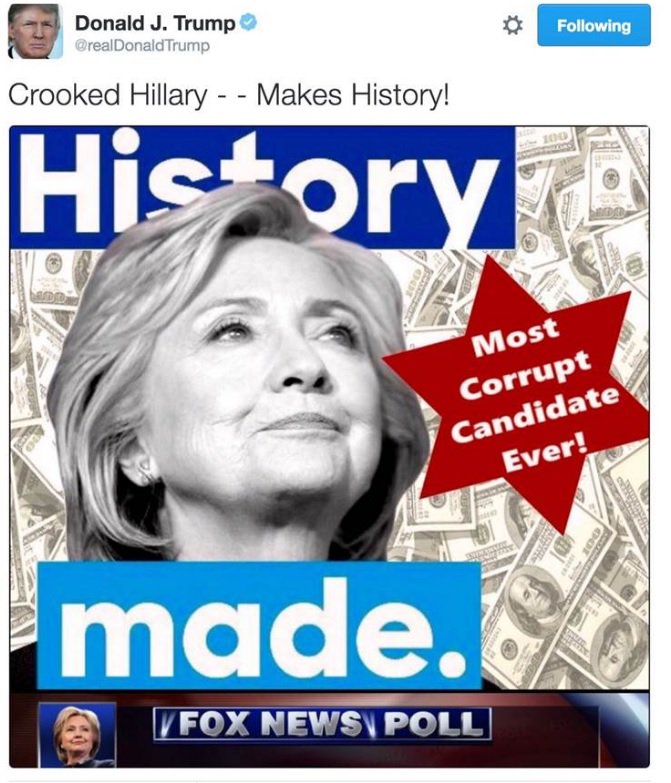
Clinton's meeting with the FBI could have been on occasion to focus on ethics issues.  Instead, Trump made his own bigotry the story of the weekend.  David Weigel writes:
It was so close to the message that Republicans say they want from Donald Trump: a tweet describing Hillary Clinton as “crooked” and the “most corrupt candidate ever,” on the morning that the likely Democratic presidential nominee met with the FBI.
But the image that Trump chose to illustrate his point, which portrayed a red Star of David shape slapped onto a bed of $100 bills, had origins in the online white-supremacist movement. For at least the fifth time, Trump’s Twitter account had shared a meme from the racist “alt-right” and offered no explanation why.
... 
The offending image first appeared in a June 15 tweet by @FishBoneHead1, an account with fewer than 1,000 followers and a penchant for memes that mock Muslims, black Democrats and “cucks” — an alt-right term derived from the word “cuckold,” for people they deem insufficiently conservative. According to Anthony Smith, a reporter for the news site Mic, it was shared June 22 on a racist section of the 8Chan Web forum.


More detail from Anthony Smith:
Though the thread where the meme was featured no longer exists, you can find it by searching the URL in Archive.is, a "time capsule of the internet" that saves unalterable text and graphic of webpages. Doing so allows you to see the thread on /pol/ as it originally existed.
Of note is the file name of the photo, HillHistory.jpg, potentially a nod to the Neo-Nazi code for "HH," or "Heil Hitler," which the alt-right is fond of hiding in plain sight. 
Back to Weigel:
“The evangelicals will listen to his pro-Israel statements, while we will listen to his signals,” Andrew Anglin wrote in the Daily Stormer, a racist site named after Nazi propagandist Julius Streicher’s notorious tabloid.

Friday, May 23, 2014

A Caution to Young Political Operatives

At The Week, Matt Lewis writes:
Last weekend, a conservative blogger in Mississippi named Clayton Kelly was arrested for allegedly sneaking into a nursing home to photograph the wife of Sen. Thad Cochran (R), who suffers from progressive dementia. Two other Mississippi men — one of them a local tea party leader — have since been arrested on conspiracy charges for allegedly taking part in the plot.
Anyone interested in the unseemly details regarding why this might make sense strategically as the hotly contested June 3 primary approaches can read what I've written and said. (It centers around rumors that Cochran has long had a relationship with a woman and staffer who is not his wife.) But let's go bigger. Why do people to do such mean-spirited things in the name of politics in the first place?
...

Politics and the media are both full of young and ambitious people who don't get paid terribly well, but want to do something big and bold — to make a name for themselves. Both businesses tend to glamorize rule-breakers who not only get away with their risky maneuvers, but earn plaudits for them (Lee Atwater for operatives; Hunter S. Thompson for would-be gonzo journalists), and both exist in a sort of "wild west" where pushing the boundaries of what is acceptable is deemed necessary for success. Both are fueled by caffeine, alcohol, and too much testosterone. This is a business where people are heralded for their ability to "spin," where attacking opponents is an acceptable and expected part of the game.
...
The incident in Mississippi represents the culmination of many things. We have the convergence of media activism (with the rise of alternative media and blogs), the ever-present problem of campaigns and journalism being stacked full of ambitious young people, and the trend of political campaigns being viewed as tantamount to military battle, meaning that every election is viewed as an existential threat to one's side.
The big lesson is that young political and media operatives ought to be careful. Being virtuous isn't just a touchy-feely thing; in politics, it's a survival strategy.

Saturday, March 23, 2013

OFA Controls @BarackObama Twitter Account

Organizing for Action is in the news again, Aaron Blake reports at The Washington Post:
[In] another example of the often-blurry lines between politicians and independent outside groups, Obama has effectively begun sharing his eponymous @BarackObama Twitter account with the group, and he will continue to tweet on it, according to an Organizing for Action spokeswoman.
Organizing for Action says it now controls the account, which has nearly 29 million followers and previously served as Obama’s personal and campaign account. The bio for @BarackObama says “This account is run by Organizing for Action staff. Tweets from the President are signed -bo.”
Organizing for Action spokeswoman Katie Hogan confirmed that the feed will continue to feature Obama’s tweets, as it did when it was run by his campaign.
...
“The fact that President Obama’s Twitter account is being managed by Organizing for Action is one more example that shows that OFA is functioning as an unprecedented, privately funded arm of the presidency that accepts unlimited contributions from wealthy donors,” said Fred Wertheimer, head of the Democracy 21 watchdog group. “OFA represents bad public policy and a terrible precedent for the future, as other federal officeholders can be expected to go down this dangerous path.”
Melanie Sloan, the head of another watchdog group called Citizens for Responsibility and Ethics in Washington, said Obama might even be breaking the law.
“By outsourcing President Obama’s tweets, the White House might well be violating the Presidential Records Act, which requires preservation of presidential records,” Sloan said.

Thursday, February 7, 2013

Menendez Is in Trouble

Open Secrets reports on New Jersey Senator Robert Menendez's ethics trouble:
The Washington Post reports that Sen. Robert Menendez (D-N.J.) tried two different times to dispute top federal health officials' findings that one of his major donors had overbilled Medicare by nearly $9 million. As we reported last week, the donor, Florida eye doctor Salomon Melgen -- who's now under investigation by the FBI -- and his family have given more than $426,000 to federal candidates since 1992. The list of recipients includes Republicans and many Florida politicians, though Menendez is clearly the favorite.

But all of those donations are just the tip of the iceberg -- Melgen's business, Vitero-Retinal Consultants also gave $700,000 to Majority PAC in 2012, the super PAC set up to support Senate Democrats. Majority PAC spent about $600,000 to back Menendez in his reelection race last fall.

And Center for Responsive Politics research has also found that Salomon and his wife, Flor, each donated $20,000 to the Fund to Uphold the Constitution, a legal defense fund that Menendez set up. The organization reported spending about $109,000 to pay law firm Perkins Coie for "campaign expenses" during the 2012 election cycle.

Menendez has been under attack for his relationship to Melgen since late October, when a conservative blog said the senator visited with prostitutes but didn't pay them during trips to the Dominican Republic that he took with Melgen. Menendez has denied the prostitution-related allegations but recently reimbursed the Florida doctor for flights on his private jet during those trips. Following the initial allegations, Menendez's legal defense fund reported paying more than $26,000 to Genova Burns, a New Jersey law firm that previously represented him in 2010 when a recall effort to unseat him was launched.
American Crossroads has set up a Menendez "resignation watch."

The Weekly Standard reports that Chris Christie would name an interim replacement if he should resign:
“If a vacancy shall happen in the representation of this State in the United States senate, it shall be filled at the general election next succeeding the happening thereof, unless such vacancy shall happen within 70 days next preceding such election, in which case it shall be filled by election at the second succeeding general election, unless the governor of this State shall deem it advisable to call a special election therefor, which he is authorized hereby to do,” New Jersey law reads. “The governor of this State may make a temporary appointment of a senator of the United States from this State whenever a vacancy shall occur by reason of any cause other than the expiration of the term; and such appointee shall serve as such senator until a special election or general election shall have been held pursuant to law and the Board of State Canvassers can deliver to his successor a certificate of election.”