Search This Blog

Thursday, March 19, 2020

"That's Been the Story of Life"

In Defying the Odds, we discuss the 2016 campaign. The 2019 update includes a chapter on the 2018 midterms. The 2020 race, the subject of our next book, is well under  way.  

Coronavirus presents unprecedented challenges to public policy and the electoral process.

Q Okay. Why do you keep calling this the “Chinese virus”? There are reports of dozens of incidents of bias against Chinese Americans in this country. Your own aide, Secretary Azar, says he does not use this term. He says, “Ethnicity does not cause the virus.” Why do you keep using this? A lot of —
THE PRESIDENT: Because it comes from China.
Q — people say it’s racist.
THE PRESIDENT: It’s not racist at all. No. Not at all. It comes from China. That’s why. It comes from China. I want to be accurate.
Q And no concerns about Chinese Americans —
THE PRESIDENT: Yeah, please, John.
Q — in this country?
THE PRESIDENT: No.
Q And to the aides behind you, are you comfortable with this term?
THE PRESIDENT: No, I have a great — I have great love for all of the people from our country. But, as you know, China tried to say at one point — maybe they stopped now — that it was caused by American soldiers. That can’t happen. It’s not going to happen — not as long as I’m President. It comes from China.
...

Q Mr. President, perhaps I could second follow up. How are non-symptomatic professional athletes getting tests while others are waiting in line and can’t get them? Do the well-connected go to the front of the line?
THE PRESIDENT: Well, that — you’d have to ask them that question. I mean, they — I — I’ve read —
Q Should that happen?
THE PRESIDENT: No, I wouldn’t say so, but perhaps that’s been the story of life. That does happen on occasion. And I’ve noticed where some people have been tested fairly quickly. Look, we inherited a very--
Q Would you encourage them to defer their test to others?
THE PRESIDENT: Excuse me. Excuse me. We inherited a very obsolete system. This was a system that was out of date, obsolete, or it was a system that was never meant to take care of the kind of quantity, the number of people that we’re talking about — millions and millions of people.
...
Q Yeah. Mr. President, your credibility ratings are very low. There was a recent NPR poll --
THE PRESIDENT: Who are you asking with that question?
Q I’m asking —
THE PRESIDENT: Because I see that they’re very high. You know, if you look, I’m 95
percent in the Republican Party.
Q Credibility, sir —
THE PRESIDENT: We just had a poll that was done by a very reputable group. We’re — I’m beating Sleepy Joe Biden by a lot in Florida — in the state of Florida and in other states. You know, so I don’t really know who you’re talking about.
...
Q: There’s federal — there’s reporting that the federal government has a plan that shows that this coronavirus outbreak might last as much — as long as 18 months. Are you seeing those numbers? Could this actually last —
THE PRESIDENT: No, we’re not seeing that at all.
Q And then the — my second question is, there are some — at least one White House official who used the term “Kung flu,” referring to the fact that this virus started in China. Is that acceptable? Is it wrong? Are you worried that that having this virus be talked about as a “Chinese virus,” that that might help —
THE PRESIDENT: I wonder who said that.
Q That might (inaudible) —
THE PRESIDENT: Do you know who said that?
Q That — I’m not sure the person’s name, but would you condemn the fact —
THE PRESIDENT: He used —
Q — the “Kung flu” —
THE PRESIDENT: Say the term again.
Q The — a person at the White House used the —
THE PRESIDENT: No, just the term.
Q — term “Kung flu.” My question is —
THE PRESIDENT: “Kung flu”?
Q — do you think that’s wrong? “Kung flu.” And do you think using the term “Chinese virus” — that puts Asian Americans at risk, that people might target them?
THE PRESIDENT: No, not at all. No, not at all. I think they probably would agree with it 100 percent. It comes from China. There’s nothing not to agree on.

Wednesday, March 18, 2020

Trump Does Not Put Politics Aside

In Defying the Odds, we discuss Trump's approach to governingThe 2019 update includes a chapter on the 2018 midterms.

In his Oval Office address last week, he said:  We must put politics aside, stop the partisanship and unify together as one nation and one family."


As for West Virginia...


From the Lincoln Project:


St.Patrick's Primaries

In Defying the Odds, we discuss the 2016 campaign. The 2019 update includes a chapter on the 2018 midterms. The 2020 race, the subject of our next book, is well under way. Coronavirus presents unprecedented challenges to the electoral process.

At The Guardian, Lloyd Green sums up:
On Tuesday, Joe Biden delivered a crushing blow to Bernie Sanders’ already dimming chances. The former vice-president scored imposing wins in Arizona, Florida and Illinois.
Pro tip: turning a race into a referendum on Fidel Castro as Sanders did is a bad idea. In the Sunshine state, Biden’s margin was nearly 40 points. Looking back, the Vermont senator’s 2016 performance was more a function of disdain for Hillary Clinton than his call to revolution.
Biden has built a rainbow coalition that cuts across class. Indeed, the Delaware Democrat captured the votes of white people without college degrees, a prize that eluded Clinton and a bloc Donald Trump calls his own. A global pandemic and a market crash will sorely test the president’s hold.
As for Sanders, his quest has morphed into the quixotic, an exercise in rule or ruin, or all of the above. Reportedly, he will continue to tilt at windmills into late April, waging war in Pennsylvania and New York. But he lost both states four years ago and there is no reason to assume this time will be different.
Biden has now amassed more than 1,000 delegates, more than half way to clinching the nomination. The primary battle is over in all but name.
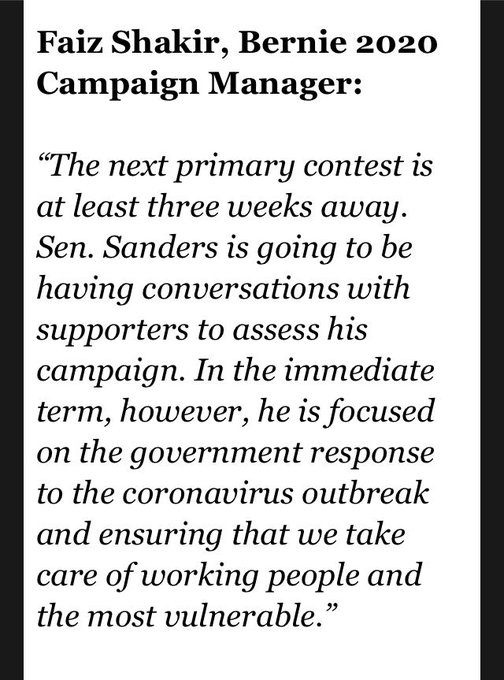
INBOX: Statement from Bernie Sanders’ campaign manager Faiz Shakir after last night’s primary losses to Joe Biden
View image on Twitter
See Laura Litvan's other Tweets
There was some good news for Democatic progressives.  Cameron Joseph reports at Vice:
One of the last — and loudest — pro-life Democrats left in Congress lost his primary Tuesday night.

Rep. Dan Lipinski (D-Ill.) lost to former advertising executive Marie Newman, trailing by 48%-44% with 90% of precincts reporting.
Newman came just short of beating Lipinski two years ago, with the backing of a broad coalition of progressive groups. This time, she jumped into the election early, and they lined up to boost her past Lipinski, outspending him by a wide margin. EMILY’s List, which backs pro-choice Democratic women, backed Newman early on, as did a plethora of other groups including NARAL Pro-Choice America, Planned Parenthood Action Fund, MoveOn, Indivisible, The Sierra Club, Service Employees International Union and Our Revolution.
And note Cam's observations on the decline of traditional machine politics:
[Lipinski had] largely avoided tough primaries in the solidly Democratic district because of strong support from the Chicago Democratic machine. Lipinski was handed his seat in Congress by his father, former Rep. Bill Lipinski (D-Ill.), and has a close relationship with Illinois House Speaker Mike Madigan (D), who runs the state party and the city’s machine.
But that machine has weakened in recent years — and Lipinski’s district has continued to grow more liberal and more heavily Hispanic. After barely surviving in 2018, it was too much for him this time around.

Tuesday, March 17, 2020

Delay in Ohio Primary

In Defying the Odds, we discuss the 2016 campaign. The 2019 update includes a chapter on the 2018 midterms. The 2020 race, the subject of our next book, is well under way Coronavirus presents unprecedented challenges to the electoral process.

Zach Montellaro and Alice Miranda Ollstein at Politico:
Polls will not open for Ohio's primary election Tuesday after a late-night decision from Gov. Mike DeWine, effectively upheld by the state Supreme Court, to delay in-person voting until June in an effort to protect voters and poll workers from the coronavirus outbreak.
"During this time when we face an unprecedented public health crisis, to conduct an election tomorrow would force poll workers and voters to place themselves at an unacceptable health risk of contracting coronavirus," DeWine said in a statement.

The election was in limbo for several hours Monday night after a state judge in Columbus denied a last-minute attempt by the state to postpone the primary election. But DeWine responded with an unprecedented order closing physical polling places as the legal battle moved up to the Ohio Supreme Court. Early Tuesday morning, four judges on that court issued a unanimous, unsigned ruling declining to stop the state from shuttering polls. Three other judges on the court recused — two because they're currently running for reelection and the other because he is DeWine's son.

The ruling effectively overturns the Monday ruling from Franklin County Judge Richard Frye that the primary had to continue as scheduled. Frye said it was too late to move back the primary and that doing so would confuse and suppress voters.

Monday, March 16, 2020

Biden and Sanders

In Defying the Odds, we discuss the 2016 campaign. The 2019 update includes a chapter on the 2018 midterms. The 2020 race, the subject of our next book, is well under way.

Lloyd Green at The Guardian:
On Sunday, America caught a glimpse of the coming campaign: two septuagenarians battling each other without a live audience applauding and goading. The debate changed nothing, but at the end of the evening Joe Biden was sitting on the cusp of the Democratic nomination. Come Tuesday, the former vice-president is poised for lopsided wins in Arizona, Florida, Illinois and Ohio.

Without Hillary Clinton as a foil and target, Sanders’ luster appears gone. It is no longer his time, if it ever was. As Biden put it: “We have problems we have to solve now. What’s a revolution going to do? Disrupt everything in the meantime?”
Faced with a pestilential presidency, the Democrats are ready to rally to around the Delaware Democrat. Even better for Biden, so too may be the rest of the country. Nationally, the latest polls give Biden a nine-point lead over Donald Trump. Whether Biden can sustain that edge remains to be seen.
Amid a pandemic, a battered stock market and zero-interest rates, a president disclaiming his own responsibility is more than America can afford or bear. Unalloyed self-absolution and the Oval Office are a toxic brew. A Biden presidency would not be flashy but it would definitely be engaged.

John F. Harris at Politico:
The assumption that there is no practical way the Democratic Party can put forward a presidential ticket with two white men has become so widely accepted in journalistic and political circles that a major development at last night’s debate was greeted in some quarters with something of a shrug.
But Joseph Biden’s firm public commitment that he would select a woman as his running mate in the event he stays atop the Democratic race and is the party’s 2020 nominee is historically unprecedented: No major candidate has ever made such a pledge based on demographic characteristics, nor has one narrowed the field of potential vice presidential nominees this early in the year, several months before the decision is usually made.

Sunday, March 15, 2020

Breaking the Rules of Crisis Communication

In Defying the Odds, we discuss Trump's approach to governingThe 2019 update includes a chapter on the 2018 midterms.


At WP, Carolyn Y. Johnson and William Wan write that Trump is breaking the rules.
Spokespersons allow the public to put a face to the act of responding to, investigating, and resolving a crisis. How a spokesperson handles public and media inquiries, in addition to what he or she says, helps establish credibility for an organization. It also contributes to the public’s transition from the crisis stage to resolution and recovery stages. An organization should carefully choose the personnel who will represent it. The selection should be based on two factors: 
  • The individual’s familiarity with the subject matter 
  • His or her ability to talk about it clearly and with confidence
Dr. Anthony Fauci, the director of the National Institute of Allergy and Infectious Diseases, has provided sound information. But he is just one of multiple voices in the executive branch. Trump is the loudest.  Vice President Pence nominally heads the task force, he he has no expertise in the subject. Other administration voices have been just plain wrong.  On March 6, Steve Benen reported:
At a surface level, there's nothing wrong with a prominent White House official discouraging panic and trying to reassure the public that an ongoing problem is being addressed. But just below the surface, [Lawrence] Kudlow -- who has a notorious track record for being wrong -- went a bit further this morning that he should have.

According to CNBC's report, for example, the National Economic Council director said the economy "looks sound," which was vaguely reminiscent of John McCain insisting in 2008 that the "fundamentals of the economy are strong," even as the system crashed around him.
But more importantly, Kudlow added this morning, "[R]egarding the containment issue, I will still argue to you that this is contained." CNBC's report went on to quote Kudlow saying, "We don't actually know what the magnitude of the virus is going to be. Although, frankly, so far it looks relatively contained."
As the virus spreads, and the death toll rises, there just isn't any reason to look at the public-health emergency and see a virus that's "relatively contained." And yet, Kudlow's odd comments come on the heels of his recent assertion, in reference to the coronavirus, "We have contained this. I won't say airtight, but it's pretty close to airtight."

Saturday, March 14, 2020

Changing Elections During the Year of Coronavirus

In Defying the Odds, we discuss state and congressional elections as well as the presidential race. The update looks at political and demographic trends through the 2018 midterm.  Our next book will explain 2020.  Coronavirus has suddenly become a major part of the story.  The government's response to the virus and its economic impact will be at the heart of campaign debates.  And there is talk that it may have an effect on the election process itself.

A president cannot unilaterally postpone or cancel a presidential election.  Article II, section 1 of the Constitution gives Congress the power to set the date for choosing electors: " The Congress may determine the time of choosing the electors, and the day on which they shall give their votes; which day shall be the same throughout the United States."  Similarly, Article I, section 4 says of congressional elections: "The Times, Places and Manner of holding Elections for Senators and Representatives, shall be prescribed in each State by the Legislature thereof; but the Congress may at any time by Law make or alter such Regulations, except as to the Places of chusing Senators." Any shift in date would be limited to a matter of weeks.  No executive order or statute could extend the terms of the president or members of Congress.  The Constitution sets the terms (four years for president, two years for House members, six years for senators).  And change in terms would require a constitutional amendment.

But there is a loophole.

The individual citizen has no federal constitutional right to vote for electors for the President of the United States unless and until the state legislature chooses a statewide election as the means to implement its power to appoint members of the electoral college. U. S. Const., Art. II, § 1. This is the source for the statement in McPherson v. Blacker, 146 U. S. 1, 35 (1892), that the state legislature's power to select the manner for appointing electors is plenary; it may, if it so chooses, select the electors itself, which indeed was the manner used by state legislatures in several States for many years after the framing of our Constitution. Id., at 28-33. History has now favored the voter, and in each of the several States the citizens themselves vote for Presidential electors. When the state legislature vests the right to vote for President in its people, the right to vote as the legislature has prescribed is fundamental; and one source of its fundamental nature lies in the equal weight accorded to each vote and the equal dignity owed to each voter. The State, of course, after granting the franchise in the special context of Article II, can take back the power to appoint electors. See id., at 35 (" '[T]here is no doubt of the right of the legislature to resume the power at any time, for it can neither be taken away nor abdicated''')
Mark Joseph Stern at Slate:
Due in part to partisan gerrymandering, Republicans control the legislatures of 28 states. Collectively, these states have 294 electoral votes. Trump himself could not cancel the entire presidential election. But he could ask these GOP-dominated legislatures to cancel their statewide presidential elections and assign their electors to him. It’s doubtful that we will face this situation in November. But imagine a worst-case scenario: The election is approaching, and the coronavirus remains rampant in our communities. States are unsure whether they have the personnel and resources to hold an election. Congress has failed to mandate no-excuse absentee balloting, and many states have declined to implement it. Or the postal service is so hard hit that it cannot reliably carry ballots to and from voters’ residences. It’s not difficult to envision Trump’s allies in state legislatures assigning their states’ electoral votes to the president, insisting that these dire circumstances justify pulling a constitutional fire alarm.

There is one catch. This scenario presumes that state legislature have the power not only to pick electors, but also to direct them to vote for a specific candidate. States have long exercised this control over electors’ votes. But the Supreme Court will soon hear two cases brought by electors who assert that they have a constitutional right to vote for whomever they wish. They assert that state legislatures can appoint electors—the human beings themselves—but cannot then require them to vote for a particular candidate, or punish them if they do not. It seems unlikely that the court will grant “faithless electors” the ability to buck state legislatures and cast rogue votes. If the court does give electors this right, however, the entire system will be thrown into chaos. Statewide votes would become largely meaningless, because the 538 electors could “vote their conscience” no matter what the state legislature demands.
Let’s assume, though, that SCOTUS will not burn down the current system, and the court allows states to exercise their traditional authority to assign electors to candidates. This system permits legislatures to cancel or ignore the statewide presidential election and effectively decide the election. That shortcut to reelection would be profoundly anti-democratic. But so is the Electoral College itself, and we are still living with its consequences. Until both Republicans and Democrats agree to amend this Rube Goldberg machine out of the Constitution, it will remain a tool for autocrats to wield when they fear the majority has turned against them.