Search This Blog

Showing posts with label congressional districts. Show all posts

Wednesday, April 22, 2026

Virginia Redistricting

 Our most recent book is The Comeback: The 2024 Elections and American PoliticsIt includes a chapter on congressional and state elections

Erin Doherty and Aaron Pellish at POLITICO:

After a narrow loss in Virginia, Republicans are pointing fingers as President Donald Trump’s national gerrymandering fight slips into a stalemate.

Multiple Republicans say the party should’ve spent much more, much earlier to have a better shot at blocking Democrats’ Virginia map, which could give the party as many as four more House seats. And pressure is now growing on Florida Gov. Ron DeSantis to make up for Democrats’ gains with a GOP-led redistricting effort in his state, as soon as next week.

...

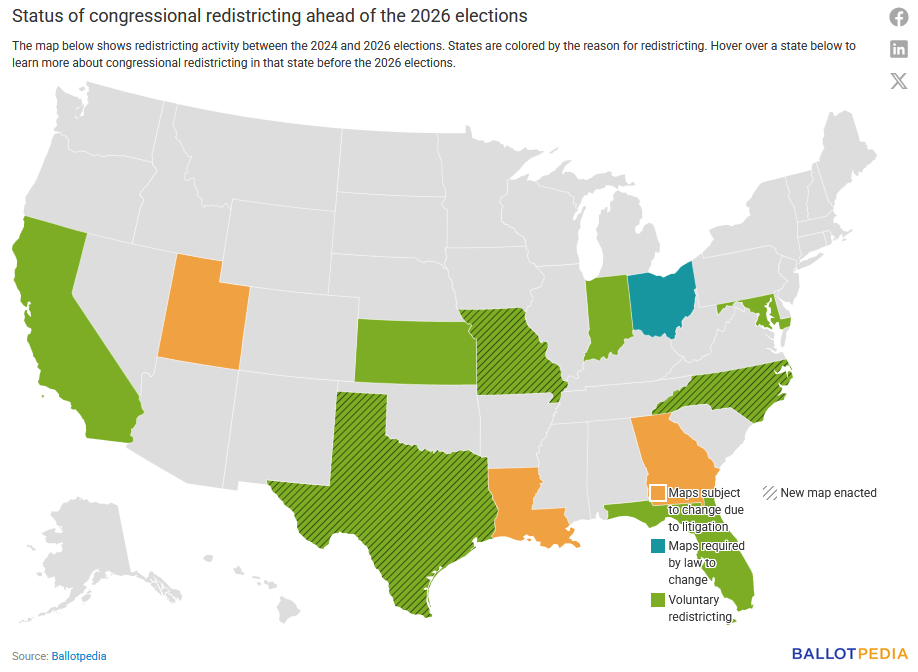
Tuesday’s results in Virginia, combined with gains in California and a new court-drawn seat in Utah, have effectively erased the advantage Republicans built off new maps in Texas, North Carolina, Ohio and Missouri. It’s a stark reversal nearly nine months after Trump first urged Republicans in the Lone Star State to redraw maps, upending the midterm battlefield.


Sunday, February 15, 2026

Immigration Issues and the Texas Gerrymander

 Our most recent book is The Comeback: The 2024 Elections and American PoliticsIt includes a chapter on congressional and state elections.  

Myah Ward and Megan Messerly at Politico:

Home builders are warning President Donald Trump that his aggressive immigration enforcement efforts are hurting their industry. They’re cautioning that Republican candidates could soon be hurt, too.

Construction executives have held multiple meetings over the last month with the White House and Congress to discuss how immigration busts on job sites and in communities are scaring away employees, making it more expensive to build homes in a market desperate for new supply. Beyond the affordability issue, the executives made an electability argument, raising concerns to GOP leaders that support among Hispanic voters is eroding, particularly in regions that swung to Trump in 2024.

Hill Republicans have held separate meetings with White House officials to share their own electoral concerns.

This story is based on eight interviews with home builders, lawmakers and others familiar with the meetings.

“I told [lawmakers] straight up: South Texas will never be red again,” said Mario Guerrero, the CEO of the South Texas Builders Association, a Trump voter who traveled to Washington last week.

...

The meetings this month came after Democrats crushed a Republican in a special runoff election for a state senate seat in a Trump-friendly district in Tarrant County, which includes most of Fort Worth, rattling Republicans nationally. New research from the American Business Immigration Coalition and Comité de 100, first obtained by POLITICO, shows how slipping support among Latino voters could affect Republican-leaning districts in Texas, Pennsylvania, Florida and California.

Monday, February 9, 2026

The House Map and the Aggregate Vote

 Our new book is The Comeback: The 2024 Elections and American PoliticsIt includes a chapter on congressional and state elections.  

Hans Nichols and Kavya Beheraj at Axios:

House Democrats will need to overperform Vice President Harris by roughly three percentage points in swing districts to capture the majority in 2026, according to an Axios analysis of presidential margins in congressional districts.

Why it matters: In special elections over the last year, Democrats have been surpassing Harris' 2024 margins by double digits, putting the majority clearly in reach.

But the universe of competitive House seats is historically small, meaning that even an unambiguous national move toward the Democrats will result in a relatively narrow Democratic majority.

Flashback: The 2018 midterms saw a 6.5 percentage point swing in Democrats' favor compared to President Trump's 2016 margins, giving them 41 new seats for a 235 -199 majority, according to the Cook Political Report. A similar shift in 2026 would translate into 12 additional Democratic seats, giving them a 227-208 majority, according to the data, which includes redistricted maps, according to The Downballot and Sabato's Crystal Ball.

The other side: If GOP candidates fare just 1% better than Trump did last cycle, House Speaker Mike Johnson (R-La.) could add another 12 seats to his majority, putting him at a comfortable 232-204 margin.

Zoom out: Democrats are banking that the electorate will look a lot less Trumpy when the president's name is not on the ballot. Their voters, Democrats argue, are highly motivated and engaged when Trump is in office.

...

Zoom in: Presidential performance in a congressional district doesn't guarantee a predetermined outcome, but in the Trump era, the number of crossover districts is at a historic low.Thirteen House Democrats prevailed in seats that Trump carried in 2024. A total of three Republicans held on in Harris districts.
n 2008, after President Obama's first election, there were 83 crossover districts.Two of the best lawmakers at convincing voters to split their ticket — Rep. Don Bacon (R-Neb.), who won in a Harris +4.6 district, and Rep. Jared Golden (D-Maine), who won in a Trump +9 district — are both retiring.

What we're watching: After tit-for-tat redistricting in six states, Republicans appear to have drawn themselves another three seats.Democrats on Thursday proposed adding another four in Virginia (pending judicial review), but Republicans are plotting to equalize in Florida.

Wednesday, January 7, 2026

Vacancies and Margins

Our new book is The Comeback: The 2024 Elections and American PoliticsIt includes a chapter on congressional and state elections

MIA MCCARTHY, CALEN RAZOR and BENJAMIN GUGGENHEIM at POLITICO:

First, the GOP Conference’s long-planned, day-long policy retreat Tuesday at the Kennedy Center — intended to build unity around a legislative agenda in a midterm election year — was shaken by news of Rep. Doug LaMalfa’s unexpected death and Rep. Jim Baird’s hospitalization from a car accident.

It brought into stark relief the major math challenges House Republicans now face. LaMalfa’s passing brings the balance of the House to 218-213. And as long as Baird is out recovering, Speaker Mike Johnson can only afford to lose a single GOP vote on party-line legislative business on the chamber floor.

“We keep saying we are one breath away from the minority — that’s more true today than ever,” one House Republican told Meredith Lee Hill.

Lindsey Holden at Politico:

Newsom has 14 days to schedule a special election, which would take place by mid-May unless the governor holds off until the June 2 primary.

The new congressional boundaries California voters approved in November don’t kick in until that primary. This creates a scenario in which a short-timer elected by LaMalfa’s current constituents could serve out the end of his term, followed by a representative running in the newly drawn, more Democratic, district.

Or, one candidate could thread the needle of both districts and serve the two terms back to back. However, that situation is fairly unlikely, considering the sharp red-to-blue swing Prop 50 will initiate.

California elections expert Paul Mitchell, who was involved in drawing the new maps, predicted in an X post that Newsom will schedule the special election in March, with a June runoff, or align it with the midterm primary with an August runoff.

Monday, January 5, 2026

The Shrinking House Battlefield


 Yasmeen Abutaleb at WP:
Of the 39 seats Democrats are competing for, 28 are in districts that Trump won by five or more percentage points.

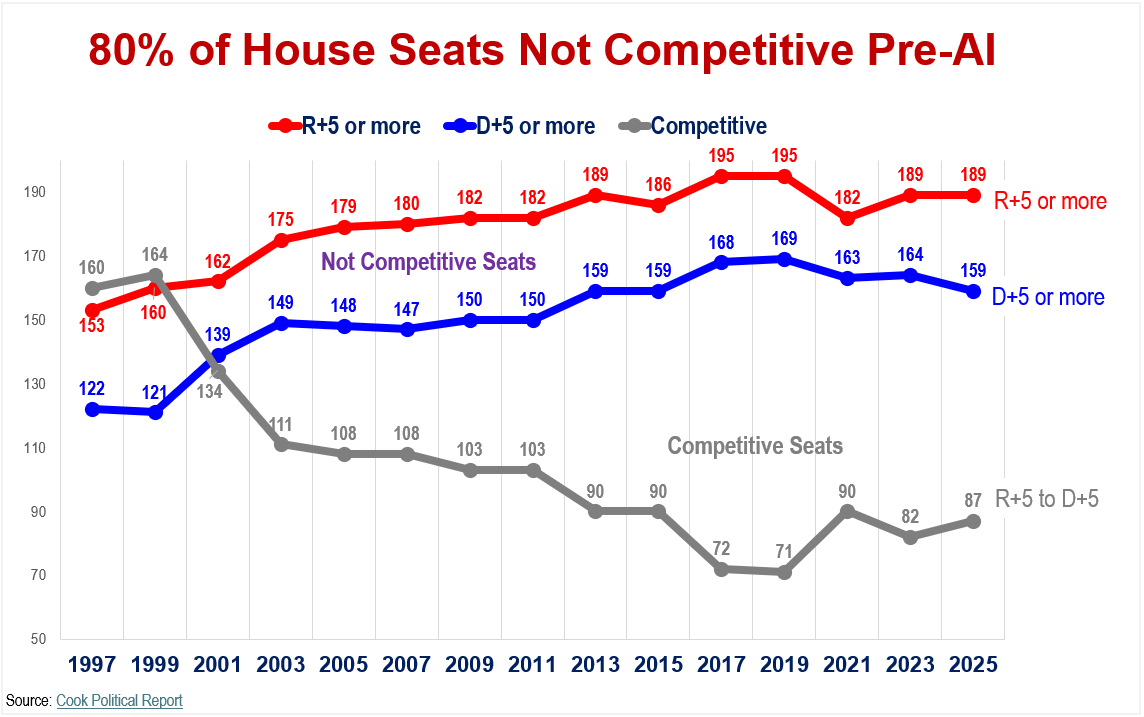
A gerrymandering spree instigated by Trump has narrowed the number of truly competitive seats, furthering a trend that was already underway in recent elections as the nation has become more polarized. That has not affected the race for the Senate, which Republicans are favored to hold.

Just 36 races in this year’s election are rated competitive by the Cook Political Report, compared with 49 races at the same point in the 2018 cycle. Half of the seats rated competitive by Cook this year are already held by Democrats, leaving the party even less room to gain ground.

“Democrats will have a very narrow but viable path to the majority. That’s a different scenario than 2006 or 2018, when Democrats put a ton of Republican-held seats in play,” said David Wasserman, senior editor and elections analyst at the Cook Political Report. “There’s so little elasticity in U.S. House elections these days compared to prior eras.”

...

Democrats believe they have effectively neutralized Republican efforts to pick up additional seats through gerrymandering in Texas, Ohio and North Carolina by gaining seats of their own in California and Utah. The Indiana Senate rejected a partisan gerrymander last month, and Democrats are still exploring whether they could pick up seats in Virginia, Illinois and Maryland. Wasserman said the post-gerrymandering landscape remains “pretty equitable to both parties.”


Friday, December 12, 2025

World War G: Trump Loses the Indiana Battle

Our new book is The Comeback: The 2024 Elections and American PoliticsIt includes a chapter on congressional and state elections.  The passage of Prop 50 in CA will offset the Texas gerrymander.  The D victory in VA will partly offset GOP gerrymanders elsewhere.

Mitch Smith at NYT:

Republican members of the Indiana Senate bucked President Trump on Thursday and joined Democrats in voting down a new congressional map that would have positioned Republicans to sweep the state’s U.S. House seats.

The 19 to 31 vote was a highly public defeat for Mr. Trump, who has spent significant political capital pushing for redrawn maps in Republican-led states and who repeatedly threatened political consequences for Indiana Republicans who did not fall in line. The defiance of Mr. Trump comes as he faces other signs of rifts within his own party.

Speaking to reporters in the Oval Office after the vote, Mr. Trump downplayed the result in Indiana, saying that “we won every other state.” He also said that he hoped the president pro tem of the Indiana Senate, who voted against the map, loses his next primary.

The rejection of the map in the State Senate, where Republicans hold 40 of the 50 seats, followed months of presidential lobbying that turned increasingly pointed in recent weeks as it became clear that some holdouts were not budging. Mr. Trump had called some of them out by name on social media, openly questioning their loyalty to the party and pledging to back primary challengers against them.

Sunday, October 26, 2025

World War G: The Battlefield Expands

Our new book is The Comeback: The 2024 Elections and American PoliticsIt includes a chapter on congressional and state elections.

The California Legislature has approved a special election to redraw congressional district lines. Democrats stand to pick up five seats to offset a recent Texas gerrymander.  The war is spreading.

Reid Epstein at NYT:

The next front in the nation’s pitched battle over mid-decade congressional redistricting is opening in Virginia, where Democrats are planning the first step toward redrawing congressional maps, a move that could give their party two or three more seats.

The surprise development, which was announced by legislators on Thursday, would make Virginia the second state, after California, in which Democrats try to counter a wave of Republican moves demanded by President Trump to redistrict states to their advantage before the 2026 midterm elections. No other Democratic state has begun redistricting proceedings, while several Republican states have drawn new maps or are deliberating doing so.

Bruce Mehlman:

Traditionally redistricting is usually done once per decade, though this is not dictated by the Constitution or a specific law. President Trump is pushing Republican states to redraw maps in 2025 to maximize GOP advantage for 2026, and three have already done so (TX, NC, MO) with two more coming (OH, UT). Many Democratic governors such as California’s Gavin Newsom are moving to “fight fire with fire” with hyper-partisan gerrrymanders of their own. Up to 15 states in total (so far) are considering or acting: the 5 above plus CA, FL, IL, IN, KS, LA, MD, NE, SC, VA & WI.
...


Democrats could be in danger of losing around a dozen districts across the South if the court strikes down Section 2 of the 1965 Voting Rights Act in Louisiana v. Callais, a case the court heard two weeks ago. “Without Section 2, which has been interpreted to require the creation of majority-minority districts, Republicans could eliminate upward of a dozen Democratic-held districts across the South.” (NYT)


Saturday, October 11, 2025

Obamacare Politics

Our new book is The Comeback: The 2024 Elections and American PoliticsIt includes a chapter on congressional and state elections.

Elena Shao and Margot Sanger-Katz at NYT:

More than 23 million Americans are currently enrolled in Obamacare plans, and nearly all of them will face higher health care costs next year if extra federal funding for subsidies expires, as scheduled, on Dec. 31.

Democrats in Congress are withholding their votes on a government spending bill to demand that Republicans extend these subsidies, which lower the cost of insurance for people who buy their own health care coverage in marketplaces established by the Affordable Care Act. Since Congress introduced the extra funding in 2021, enrollment has doubled.

These Americans live nearly everywhere in the country, but their numbers are especially concentrated in a handful of red states whose governments have declined to expand Medicaid programs to cover poor, childless adults.

Fifty-seven percent of people with this type of insurance live in Republican congressional districts.

Saturday, September 13, 2025

World War G: Cleaving Cleaver

Our new book is The Comeback: The 2024 Elections and American PoliticsIt includes a chapter on congressional and state elections.

The California Legislature has approved a special election to redraw congressional district lines. Democrats stand to pick up five seats to offset a recent Texas gerrymander.

 Fredreka Schouten at CNN:

Missouri’s Republican-controlled Senate on Friday passed a new congressional map, taking final legislative action to target one of the state’s Democratic seats in the US House and boost the GOP’s chances of retaining its fragile majority in the chamber.

The 21-11 vote came just two weeks after the state’s GOP Gov. Mike Kehoe first unveiled the map and ordered a special legislative session to approve it. It targets longtime Democratic Rep. Emanuel Cleaver by carving up his Kansas City-area district and stretching its boundaries into rural, Republican-friendly areas of central Missouri.

...

Missouri is the latest state to undertake a mid-decade redistricting as part of an extraordinary, multi-state campaign by President Donald Trump and his allies to preserve the balance of power in the House by changing district lines.

Republicans hope to win seven of Missouri’s eight congressional seats under the new map in next year’s midterm elections. The GOP currently controls six seats, and Democrats hold two.

Tuesday, September 2, 2025

Bad News, Good News for GOP

Our new book is The Comeback: The 2024 Elections and American PoliticsIt includes a chapter on congressional and state elections.

 For Republican prospects in 2026, the economy is a problem:

Alex Isenstadt:

Republican operatives and lawmakers are increasingly anxious about how inflation could affect the GOP in the 2026 midterms, and want President Trump to take more aggressive steps to address rising prices.

Why it matters: GOP insiders and lawmakers believe the cost of drugs and consumer items — and how the White House deals with Trump's tariffs potentially turbocharging prices and creating shortages — will be key to whether the GOP keeps control of Congress next year.

Zoom in: Republicans on Capitol Hill and beyond praise Trump's recent focus on crime, but many are alarmed by internal polls and focus groups showing persistent — and increasing — concerns about prices.

Katherine Hamilton and Alison Sider:

For the American middle class, it has been a summer of cooling confidence.

Consumer sentiment dropped nearly 6% in August, after trending up in June and July, according to a closely watched index from the University of Michigan. Pessimism about the job market increased, with more people surveyed saying they expect their income to decline, according to polling done by think tank the Conference Board.

The middle class—generally considered to include households making roughly $53,000 to $161,000 a year—is playing an outsize role in that waning optimism. After months of tracking high-income earners’ increasing confidence about the economy, households making between $50,000 and $100,000 made an abrupt about-face in June. They now more closely resemble low-income earners’ gloomier views, according to surveys done by Morning Consult, a data-intelligence firm.

“There was a period of time, briefly, where the middle-income consumer looked like they were being dragged up by all that was going well in the world,” said John Leer, chief economist at Morning Consult. “Then things fell off a cliff.”


But....

At Politico, Lisa Kashinsky, Elena Schneider and Nicholas Wu write that Democrats are "hamstrung by constitutional restrictions or independent commissions in some states, while Republicans are generally free of those legal barriers and have leadership trifectas in Indiana, Florida, Missouri and Ohio, promising state lawmakers fewer restrictions to draw Democratic rivals out of their seats. Florida’s constitution has language restricting partisan gerrymandering, though its conservative-majority state Supreme Court recently upheld a GOP redraw."


Nate Cohn at NYT: "[If] the new maps are enacted in all of these states, Democrats will need to win the national popular vote by two or three percentage points to be favored to retake the House, according to projections based on recent congressional and presidential election results."

Sunday, August 24, 2025

World War G Is Spreading

Our new book is The Comeback: The 2024 Elections and American PoliticsIt includes a chapter on congressional and state elections.

The California Legislature has approved a special election to redraw coingressional district lines. Democrats stand to pick up five seats.

Liz Crampton, Dustin Gardiner and Nick Reisman at Politico:

Texas Republicans on Saturday passed a new map
that will help the GOP flip as many as five House seats — a partisan play at the hand of President Donald Trump. On Thursday, California Democratic lawmakers and Gov. Gavin Newsom preemptively agreed to send a retaliatory ballot measure to voters — the first step in potentially offsetting Texas’ maneuver by creating new Democratic-leaning seats.


The nation’s two largest states had fired the opening salvo in what is likely to become an intense and protracted redistricting campaign by both parties to grasp power in Washington. Now other red and blue state governors face pressure to follow their lead and aggressively gerrymander their congressional maps.

Republicans hold a clear advantage in the arms race: The GOP is poised to move forward with redistricting in Florida, Ohio, Missouri and Indiana, which could yield at least half a dozen more seats. Democrats, meanwhile, have struggled to get gerrymandering efforts moving in blue states beyond California, though leaders in New York, Illinois and Maryland say they are weighing options.
...
Efforts are underway to carve out more GOP seats in Indiana, Ohio, Missouri and Florida — and Trump’s political operation is pressuring individual state lawmakers to act. On Thursday, Trump declared on X that Republicans in Missouri — where the GOP could pick up one more seat by splitting a district in Kansas City — are “IN!” to call a special session to redistrict.

The legal hurdles for Democrats in other deep-blue states could prove more formidable, hampering their party’s quest to retake the House in the 2026 midterms.

In New York, Gov. Kathy Hochul wants to disband a quasi-independent commission in charge of drawing House map. But the panel, created by a voter-approved constitutional amendment, cannot be erased until 2027 at the earliest.

Friday, August 22, 2025

California Pulls the Trigger

Our new book is The Comeback: The 2024 Elections and American PoliticsIt includes a chapter on congressional and state elections.

The California Legislature has approved a special election to redraw coingressional district lines. Democrats stand to pick up five seats.

 Laura J. Nelson, Seema Mehta and Melody Gutierrez at LAT:

Newsom initially said that new electoral districts in California would only take effect if another state redrew its lines before 2031. But after Texas moved toward approving its own maps this week that could give the GOP five more House seats, Democrats stripped the so-called “trigger” language from the amendment — meaning that if voters approve the measure, the new lines would take effect no matter what.

“They fired the first shot, Texas,” Newsom said before signing the bills Thursday. “We wouldn’t be here if Texas had not done what they just did, if Donald Trump didn’t do what he just did.”

The ballot measure language, which asks California voters to override the power of the independent redistricting commission, was approved by most Democrats in the Assembly and the Senate, where they hold supermajorities.

Lawmakers have the power to place constitutional amendments on the statewide ballot without the approval of the governor. Newsom later signed two bills that fund the special election and spell out the lines for the new congressional districts.

Tuesday, August 12, 2025

Town Halls 2025

Our new book is The Comeback: The 2024 Elections and American PoliticsIt includes a chapter on congressional and state elections.

Maya C. Miller at CalMatters:

Rep. Doug LaMalfa, the Republican who represents much of California’s rural north, had barely begun his prepared remarks at a town hall in Chico early Monday when a chorus of boos and jeers overpowered him.

The raucous interjections didn’t relent for nearly 90 minutes.

The crowd of more than 650 people at the local Elks Lodge peppered him with obscenity-laden comments and slammed him for his vote for President Donald Trump’s budget bill, which cuts more than $1.1 trillion in federal spending for Medicaid, Medicare and plans under the Affordable Care Act over the next decade. The crowd excoriated LaMalfa for supporting legislation they said will “devastate” rural hospitals and hurt vulnerable people with disabilities and poor families.

But LaMalfa claimed the legislation makes “no cuts to the people themselves” in California’s Medicaid program, known as Medi-Cal, and instead only targets “waste, fraud and abuse” – a common and misleading line that House Republicans across the country have employed to defend the legislation.

...

The in-person, open mic town hall has gradually become a relic in the age of social media, as fewer elected officials are willing to prostrate themselves in today’s hyperpartisan era. House Republicans even discouraged their members from hosting face-to-face forums after a wave of negative headlines out of viral town hall confrontations – including with their own GOP supporters – earlier this year.


Nicholas Wu, Cassandra Dumay and Mia McCarthy at Politico:

Such scenes of angry constituents confronting lawmakers are nothing new. They were commonplace in 2009 as Democrats pressed forward with a health care overhaul and in 2017 when Republicans sought to undo it.


This time around, there is a fierce debate underway about whether the town hall explosions are part of a genuine backlash to GOP governance in Washington — one that could presage another wave election as seen in 2010 and 2018 — or just another reflection of America’s political polarization.

Many Republicans are dismissing the outbursts, concluding they have been choreographed by Democrats and groups aligned with them and do not reflect genuine voter sentiment. Some — including Trump — have claimed without evidence that paid protesters are responsible.

I think Democrats have been organized to actually act out in town halls, and I think if you’re going to have a town hall where you’re inviting people to come in with the intent of protesting, that’s what you’re going to get,” Sen. Mike Rounds (R-S.D.) said Tuesday.

But left-of-center activists say the GOP dismisses voters’ outrage at their peril. Groups might be helping to publicize and organize protests around lawmakers’ events, they say, but that is merely harnessing a real grass-roots backlash to what Republicans are pursuing in Washington.

Monday, August 11, 2025

Robo-Gerrymander

Our new book is The Comeback: The 2024 Elections and American PoliticsIt includes a chapter on congressional and state elections.

Bruce Mehlman:
Researchers were using high-performance computing and big data to discover new materials and analyze proteins before AI… but AI massively accelerated & improved such data-intensive efforts. Gerrymandering dates to 1812 in the U.S. Party strategists have been leveraging voter data and computing to draw advantageous maps for decades. AI promises gerrymandering on steroids — weapons of mass division in the 2025 redistricting wars — with powerful AI models able to (1) precisely-sift unprecedented amounts and unprecedentedly-personal data, (2) compare unlimited potential maps to optimize outcomes. But while AI-enabled cramming could reduce the paltry 20% of seats that are currently competitive, AI-drawn maps might also create more competitive seats by shifting voters out of safer seats (where risk-averse incumbent politicians often prefer them).

Saturday, August 9, 2025

World War G

Our new book is The Comeback: The 2024 Elections and American PoliticsIt includes a chapter on congressional and state elections. The gerrymander war is the big news of 2025.

 Jake Sherman at Punchbowl News:

Republicans are hoping to net a minimum of three House seats in Florida, as we scooped Thursday. Add that to the five seats in Texas, one each in Missouri and Indiana, plus two or three in Ohio, where state law mandates a redraw ahead of 2026.

The Supreme Court also has yet to rule in a high-profile Louisiana redistricting case on the 1965 Voting Rights Act that could further alter next year’s congressional landscape.

The Sunshine State effort, officially announced by Florida House Speaker Daniel Perez on Thursday, is only the most recent Republican initiative to cushion the blow from what’s expected to be a difficult midterms for the GOP. Republicans are hoping to redraw three districts in their favor, likely those of Democratic Reps. Debbie Wasserman Schultz and Jared Moskowitz in Trump-tending South Florida, as well as Darren Soto in the Orlando area.

...

California Democratic Gov. Gavin Newsom — a 2028 hopeful — is doing everything he can to sidestep his commission, but he’ll need Golden State voters to back his efforts in a special election. This will be extremely expensive and may not work. If it does, the prize could be five new blue seats, which could negate the proposed Texas map.

Where else can Democrats find more seats? Maryland could offer one. But Democrats tried to pass such a map in the 2022 cycle and a court shot it down as an illegal partisan gerrymander.

Oregon is another possibility, although Democratic Gov. Tina Kotek didn’t sound particularly enthusiastic. It’s possible that Democrats could gain a seat out of Illinois, although the Land of Lincoln is already heavily gerrymandered in their favor.

Democrats in other blue states would have to amend their own constitutions in order to get into the redistricting fight. The deadline has passed to do this before the 2026 elections in New Jersey and Colorado. Democrats don’t have the votes in Washington State. New York would require court intervention, and state judges haven’t favored Democrats in redistricting there in recent years.


Thursday, August 7, 2025

Gerrymandering Is a Zero-Sum Game

Lindsey Holden at Politico:
Two of California’s safest House Democrats say they’re preparing to take one for the team — accepting slightly more competitive districts as part of the state’s quest to find five new blue seats.

Gov. Gavin Newsom wants to counter President Donald Trump’s effort to increase the number of GOP seats in Texas with a midcycle gerrymandering of his own. State lawmakers could vote soon after they return from recess on Aug. 18 to hold a November special election asking Californians for the power to redraw congressional districts ahead of the midterms.

But decreasing the number of Republican seats means some deep-blue California districts will take on a slightly more purple tinge.

San Diego Reps. Scott Peters and Sara Jacobs — both of whom represent overwhelmingly Democratic areas — are among the members who would likely see an increase in Republican voters if lines are redrawn. Both told Playbook they would prefer to avoid the sudden redistricting, but that Trump’s Texas push warrants it.

“This is bigger than me and my seat,” Jacobs said. “This is about the survival of democracy and our country. I don't think any of us want to go forward with this, but it's the only way to respond to what they're doing in Texas.”

Peters said he actually agrees with Northern California Republican Rep. Kevin Kiley’s crusade to outlaw redistricting outside the typical 10-year time span. But, he added, “We’re not the ones who picked this fight.”

Jonathan Martin at Politico:

Which gets to the cold reality for GOP lawmakers in California and New York: The very Republicans who helped deliver their party’s congressional majority by winning in the two mega-states in 2020 and 2022 could be collateral damage to Trump’s gambit.

That includes House veterans such as Reps. Darrell Issa and Ken Calvert, both of California, but also younger, promising Republican lawmakers such as [Kevin] Kiley, 40, and Rep. Mike Lawler (N.Y.), 38.

“This creates a situation where you’re going to lose blue state members, which over the long haul are critical to keeping the majority,” Lawler told me.

It’s all, Lawler said, “mutually assured destruction once people go full throttle.”

The redistricting threat is especially cruel to Lawler, who was already eager to avoid yet another tough race in his Hudson Valley district by running for governor next year. But Trump made clear he preferred Rep. Elise Stefanik, a born-again MAGA disciple, as the standard-bearer even though running a Trump acolyte statewide may only ensure Stefanik ends next year where she started this year: hoping for a Trump cabinet appointment.

For Kiley, the Newsom reprisal to Trump may extinguish a congressional career that just began in 2023.


Tuesday, August 5, 2025

Duel in the Sun: Texas v California

Our new book is The Comeback: The 2024 Elections and American PoliticsIt includes a chapter on congressional and state elections.

Eleanor Klibanoff at Texas Tribune:

The Texas House voted Monday afternoon to track down and arrest more than 50 Democratic lawmakers who were not present when the chamber gaveled in. After the 85-6 vote, House Speaker Dustin Burrows said he would immediately sign civil warrants for each of the legislators, empowering the chamber’s sergeant-at-arms and state troopers to arrest and bring them to the Capitol.

They will not face civil or criminal charges from the arrests. The warrants apply only within state lines, making them largely symbolic as most of the legislators in question decamped to Illinois, New York and Massachusetts to forestall passage of the GOP’s proposed redraw of Texas’ congressional map.

The House used the same tactic to try to force Democrats back to work in 2021, when a majority of them left for Washington, D.C., to protest GOP voting restrictions. Some of the lawmakers challenged the warrants in court, obtaining an injunction against arrests that was later struck down by the Texas Supreme Court.

While the Texas Constitution “enables ‘quorum-breaking’ by a minority faction of the legislature, it likewise authorizes ‘quorum-forcing’ by the remaining members,” the court ruled.

...

Democrats left the state Sunday afternoon to deny the House a quorum — the number of people necessary for the chamber to advance legislation — and delay passage of a new congressional map.

The current congressional map, drawn by a Republican-dominated Legislature in 2021, has netted 25 GOP seats in the last two elections. But after pressure from President Donald Trump’s team, Abbott directed lawmakers to redraw the map during the special legislative session, which started July 21. Last week, the House proposed new congressional lines dividing up existing districts in Austin, Houston and Dallas with the aim of netting five more Republican seats.

Michael Wilner, Laura J. Nelson, Seema Mehta and Taryn Luna at LAT:

A last-ditch effort by California Democrats to redraw the state’s congressional map for the 2026 election, countering a similar push by Texas Republicans, is now up against the clock.

Gov. Gavin Newsom said Monday that Democrats are moving forward with a plan to put a rare mid-decade redistricting plan before voters on Nov. 4. But state lawmakers will craft a “trigger,” he said, meaning California voters would only vote on the measure if Texas moved forward with its own plans to redraw Congressional boundaries to add five more Republican seats.

“It’s cause and effect, triggered on the basis of what occurs or doesn’t occur in Texas,” Newsom said. “I hope they do the right thing, and if they do, then there’ll be no cause for us to have to move forward.”