Search This Blog

Showing posts with label Texas. Show all posts

Wednesday, March 4, 2026

Texas Primary 2026

Our most recent book is The Comeback: The 2024 Elections and American PoliticsIt includes a chapter on congressional and state elections

Mia McCarthy at POLITICO:
While the outcome wasn’t shocking, the confirmation of a May 26 runoff between Sen. John Cornyn (R-Texas) and state Attorney General Ken Paxton confirmed the fears of many Republicans who now face a likely scorched-earth campaign that could seriously hobble the victor in November’s general election and drain resources from tough races in places like North Carolina and Maine.


Democrats, meanwhile, are seeing their dream scenario play out: State Rep. James Talarico has defeated Rep. Jasmine Crockett outright in the Democratic primary, giving the candidate many strategists see as the party’s best chance to finally turn the Lone Star State blue a clear path to November.

Tuesday’s results showed some surprising strength for Cornyn after he trailed Paxton, a MAGA firebrand, in most polls. The veteran senator is about a point ahead of the AG in the latest returns.

But for national Republicans, keeping Cornyn afloat will be expensive and will risk damaging Paxton if he ends up being their nominee. In the absence of a Trump endorsement for any candidate, Cornyn and his allies have already spent more than $100 million to take out Paxton.

The Akin Ploy does not always work: Republicans tried to boost Crockett but failed.

Megan Lebowitz and Ben Kamisar at NBC:

Texas state Rep. Steve Toth defeated Rep. Dan Crenshaw in a Republican primary in Texas, NBC News projects, unseating Crenshaw after a race that centered on which candidate more closely aligned with President Donald Trump.

Crenshaw becomes the first member of Congress to lose renomination in the 2026 midterm election cycle.

Toth challenged Crenshaw — the lone GOP House member running for re-election in Tuesday’s primaries who didn’t have Trump’s endorsement — from the right, arguing that his foreign policy and immigration views did not sufficiently align with those of the MAGA movement. Toth, an ordained pastor, also secured a late endorsement from Sen. Ted Cruz, R-Texas.
Crenshaw, who is in his fourth term, has at times bucked his party by backing aid for Ukraine and criticizing Trump allies for their claims that the 2020 election was stolen. But he sought to tie himself closely to Trump throughout the campaign in the solidly Republican 2nd District


Sunday, March 1, 2026

Non-Coordination Coordination in Texas


Shane Dolmacher at NYT:
“Running out of money,” read the post on the social media platform X, “less than $400 remains in my pocket.” It landed on Nov. 13, from an obscure account called @pie0myWesley with just three followers. Anyone else stumbling upon it might have assumed it was a random musing from someone who had seen better days.

The account instead appears to be connected to the Republican Senate campaign of Representative Wesley Hunt of Texas. And one of its followers is @TxGopFighter, with seeming connections to an outside group helping Mr. Hunt’s candidacy. The two anonymous accounts have spent months sharing strategic information, private polling, messaging advice and media-buying data in what may be an effort to skirt federal law.

That law prohibits candidates from coordinating in private with independent groups such as super PACs. The Hunt campaign and those allies, however, are doing so with a pair of social media accounts in plain sight for those who know where to look.

...

Dozens of candidates use so-called red boxes on their websites to make suggestions for how super PACs should spend money to support them. They include both top Democratic candidates in the Texas Senate race: James Talarico, a state legislator, and Representative Jasmine Crockett.

“Spanish speaking voters need to hear radio ads in the RGV, San Antonio and El Paso that there is no Democrat who Donald Trump fears more than Jasmine Crockett,” read the instructions on Ms. Crockett’s website.


The 2022 Senate campaign of JD Vance in Ohio pushed past a previous boundary, when an allied super PAC with more cash than the campaign committee posted reams of private data to a Medium account. In 2023, a super PAC supporting Gov. Ron DeSantis of Florida in his presidential bid posted research, polling and messaging advice.

Usually, such communication goes in one direction. The Hunt accounts are distinctive in that they appear to include communications by people on both sides of the supposed firewall. At least two times, the accounts replied to each other on X.

Friday, February 27, 2026

The Akin Ploy in the Texas Senate Race

 Our most recent book is The Comeback: The 2024 Elections and American PoliticsIt includes a chapter on congressional and state elections.  

In the 2012 Missouri  Senate race, incumbent Democrat Claire McCaskill ran ads during the GOP primary campaign saying that Todd Akin was "too conservative."  The idea of the "attack ad" was to drive GOP voters to Akin, her weakest potential foe.  It worked.  Other campaigns have tried variations of the "pick your opponent" ploy.

Republicans are doing it in Texas.

Dan Merica and Matthew Choi at WP:

Republicans in Texas, and nationwide, are looking to boost Rep. Jasmine Crockett (D-Texas) in the closing days of the state’s Democratic Senate primary.

GOP spending on the race, which includes television ads and text messaging mobilization, underscores Republicans’ hope that Crockett, a congresswoman from Dallas, defeats Texas state Rep. James Talarico in the primary Tuesday. Some Republican operatives and leaders believe Crockett would be easier to defeat in November.

“I think Talarico is dangerous,” Sen. John Cornyn (R-Texas), who is locked in a high-stakes Senate primary of his own against Texas Attorney General Ken Paxton, said last month. “He’ll probably beat Jasmine Crockett, and he’s capable of raising a lot of money. And if you look at the head-to-head with Paxton, it’s tied.”

A group with ties to longtime Republican operatives has been sending text messages to voters in recent days that tout Crockett’s opposition to Immigration and Customs Enforcement, an issue that polling shows motivates the Democratic base. One Texan who regularly votes in Democratic primaries received the text messages, according to operatives working on the Texas races.

Sunday, February 22, 2026

The Electoral Fate of Senior Senators

Our most recent book is The Comeback: The 2024 Elections and American Politics. It includes a chapter on congressional and state elections.


Erratum:  McKellar was from Tennessee.  h/t Jim Pinkerton.

This table updates and confirms a 1983 article: Tuckel, Peter. “Length of Incumbency and the Reelection Chances of U. S. Senators.” Legislative Studies Quarterly 8, no. 2 (1983): 283–88. https://doi.org/10.2307/439434 . Abstract:

This note examines the relationship between the number of terms U.S. senators had served and their reelection chances during two time periods—1920-1958 and 1960-1980. The results of the study show strikingly different patterns of winning reelection during these two time periods. During the years 1920-1958, senators who had served one or two terms were more vulnerable to defeat than were those who had served three or more terms. In the years 1960-1980, the opposite pattern holds: first- and second-term senators did considerably better at the polls than their more senior colleagues. It is hypothesized that two factors explain why the electoral position of junior senators has improved in the modern period: the greater diffusion of power within the post-1950s Senate and the entry of television into the domain of electoral politics. This second factor, coupled with the greater age of more senior senators, is also used to explain why the electoral position of senators who had served three or more terms declined during the last two decades.

Tuckel concluded the article: In the television era, age might be a greater political liability than hitherto. Because it is a visual medium and highlights the physical appearance of candidates, television may decrease the reelection chances of veteran senators."

Wednesday, February 18, 2026

Colbert, Talarico, Carr, and Streisand


Sometimes their efforts to silence debate can backfire, big time.

Sophie Brams at The Hill:
“Late Show” host Stephen Colbert on Tuesday dismissed CBS’s denial that it blocked his interview with Texas Senate candidate James Talarico (D) from airing as “crap.”

“They know damn well that every word of my script last night was approved by CBS lawyers, who, for the record, approve every script that goes on the air,” Colbert said during his show Tuesday evening.
“In fact, between the monologue I did last night, and before I did the second act talking about this issue, I had to go backstage,” he continued. “I got called backstage to get more notes from these lawyers. Something that had never, ever happened before.”

Colbert told viewers on Monday that CBS, which is owned by Paramount, said he could not have Talarico on the broadcast over concerns about the Federal Communications Commission‘s (FCC) “equal time” rule.

The “equal time” rule requires broadcast stations to provide equal opportunities to opposing political candidates but has historically exempted talk shows.
FCC Chair Brendan Carr appears to be eyeing a change to those exemptions, suggesting in new guidance that programs “motivated by partisan purposes” should have to adhere to equal time protections.

“We looked, and we can’t find one example of this rule being enforced for any talk show interview, not only for my entire late-night career, but for anyone’s late-night career, going back to the 1960s,” Colbert said Tuesday.

In January, the FCC raised questions about such exemptions but has not issued a formal ruling. 

Muskaan Arshad at The Daily Beast:

Carr singling out Talarico has drawn more attention to him, creating something of a Streisand Effect for the 36-year-old. The Streisand Effect was coined after legendary singer Barbra Streisand sued a photographer in 2003 for $50 million after he took an aerial photo of her Malibu mansion, causing the image to go viral.

According to Google Trends statistics, nationally in the past 24 hours, James Talarico’s name has been searched 5x more than that of Democratic Representative Jasmine Crockett, his competitor for Texas Senator John Cornyn’s seat, and the attention could fundamentally shift the competitive election.

According to Texas Public Opinion Research, at the end of January, Crockett and Talarico were nearly tied among Democratic Primary Voters, with Crockett’s 38 percent to Talarico’s 37 percent.

One of the largest issues holding Talarico back in polling was his lower name recognition than Crockett’s, with pollsters identifying a serious “visibility gap” between the two candidates.

Ted Johnson at Deadline:

The attention surrounding James Talarico‘s Late Show with Stephen Colbert interview has been very good for the Texas Democrat’s campaign for U.S. Senate.

He raised $2.5 million in the 24 hours after the segment was shifted from CBS broadcast to YouTube, his largest single fundraising period for the campaign.

On Monday, Colbert said that he was prohibited from featuring Talarico on his late-night show, as the FCC has issued new guidance about the appearance of political candidates on talk shows.

Instead, Colbert said that the interview would be posted on YouTube. There, the interview has drawn almost 5.2 million views, greatly exceeding the show’s average broadcast audience.


Sunday, February 15, 2026

Immigration Issues and the Texas Gerrymander

 Our most recent book is The Comeback: The 2024 Elections and American PoliticsIt includes a chapter on congressional and state elections.  

Myah Ward and Megan Messerly at Politico:

Home builders are warning President Donald Trump that his aggressive immigration enforcement efforts are hurting their industry. They’re cautioning that Republican candidates could soon be hurt, too.

Construction executives have held multiple meetings over the last month with the White House and Congress to discuss how immigration busts on job sites and in communities are scaring away employees, making it more expensive to build homes in a market desperate for new supply. Beyond the affordability issue, the executives made an electability argument, raising concerns to GOP leaders that support among Hispanic voters is eroding, particularly in regions that swung to Trump in 2024.

Hill Republicans have held separate meetings with White House officials to share their own electoral concerns.

This story is based on eight interviews with home builders, lawmakers and others familiar with the meetings.

“I told [lawmakers] straight up: South Texas will never be red again,” said Mario Guerrero, the CEO of the South Texas Builders Association, a Trump voter who traveled to Washington last week.

...

The meetings this month came after Democrats crushed a Republican in a special runoff election for a state senate seat in a Trump-friendly district in Tarrant County, which includes most of Fort Worth, rattling Republicans nationally. New research from the American Business Immigration Coalition and Comité de 100, first obtained by POLITICO, shows how slipping support among Latino voters could affect Republican-leaning districts in Texas, Pennsylvania, Florida and California.

Sunday, February 8, 2026

The Senate Is In Play


Alex Isenstadt at Axios:
Top Republicans are increasingly worried about private polling that paints a dire picture of the midterms — and it's not just the House they're afraid of losing, it's also the Senate.

...
Here's what's setting off GOP bells about the Senate:

1. The map's expanding

Senate Minority Leader Chuck Schumer (D-N.Y.) is taking a lot of darts from his own party these days. But Republicans privately concede he's done a good job of recruiting Senate candidates in conservative states once seen as out of reach for Democrats.Schumer got former Sen. Sherrod Brown to run again in Ohio, and former Rep. Mary Peltola to run in Alaska. Ohio Sen. Jon Husted and Alaska Sen. Dan Sullivan are the GOP incumbents.
Even if Democrats fail to win either race, Republicans now will need to spend potentially tens of millions to defend those seats.

2. The Texas problem

If incumbent Texas Sen. John Cornyn loses the upcoming GOP primary to state Attorney General Ken Paxton, polls suggest it could open the door to a Democrat winning Cornyn's seat in November.The NRSC penned a memo this week arguing that Cornyn is "the only Republican candidate" who can "reliably win a general election matchup" against either Democratic state Rep. James Talarico or U.S. Rep Jasmine Crockett (D). (Republicans might get some help — the Democratic primary has gone harshly negative recently.)
Even if Paxton wins in November, many Republicans warn, the party will have to unexpectedly spend tens of millions of dollars more than if Cornyn is the nominee.

Democrats haven't won a statewide race in Texas in more than three decades. But Republicans aren't dismissing the possibility this year. Last weekend the party suffered a lopsided special election defeat for a state Senate seat.Particularly glaring: Trump, who had endorsed the GOP candidate, won the district by 17 points in 2024.

3. The Georgia problem

The GOP's failure to recruit popular Gov. Brian Kemp for a Senate run has been a major setback in the party's efforts to pick off the most vulnerable Senate Democrat up for reelection, Georgia's Jon Ossoff.Kemp's decision not to run has left three lesser-known Republicans to fight for the GOP nomination — none with Kemp's fundraising chops.
Ossoff's has raised far more money than any GOP challenger and has over $25 million on hand. Whoever wins the bruising GOP primary will have to burn through cash before facing him.

Sunday, February 1, 2026

Texas Special Elections


Brianna Tucker at WP:
Democrats narrowed Republicans’ U.S. House majority and flipped a state Senate seat on conservative terrain in a pair of Saturday special election runoffs with national implications.

Democrat Christian Menefee won the special election runoff Saturday for Texas’s 18th Congressional District, paring House Republicans’ slim advantage by securing a long-vacant seat in a heavily Democratic area. In a second election runoff in Tarrant County, which includes Fort Worth, Democrats won a notable upset, with Taylor Rehmet defeating Republican Leigh Wambsganss in a district where President Donald Trump won by 17 points in 2024.
In special elections and other local races over the past year, Democrats have largely outperformed Republicans. National Democratic leaders have pointed to the results, including Rehmet’s win, along with sweeping victories in last fall’s elections, as reasons for optimism headed into this fall’s midterms. Democrats are hoping in November to capitalize on anger at Trump’s agenda. Republicans will try to defy recent political trends and hold on to their control of Congress.

J. David Goodman at NYT:

Republican leaders, concerned that a defeat could bring an influx of Democratic investment into Texas races in 2026, tried to rally support for Ms. Wambsganss. She received an endorsement from President Trump and the backing of prominent conservative leaders in Texas, including Gov. Greg Abbott and Lt. Gov. Dan Patrick. The chairman of the Republican National Committee met with Ms. Wambsganss last week.

The unusually timed election attracted low turnout in a district of Tarrant County that includes portions of Fort Worth and its northern suburbs. Mr. Patrick, in the run up to the race, pleaded with Republicans to vote in the special election, which fell on a Saturday. Mr. Trump also urged voters to vote in a social media post on Friday.

“You can win this election for Leigh, who has my complete and total endorsement,” Mr. Trump wrote. 

Sometimes it's easy to dismiss upsets in state legislative elections because the constituencies are tiny.  Not so here: with 940k residents apiece, Texas State Senate districts are more populous than US House districts and even some states. About 94k people voted in this one, a decent turnout for a special in January. 

See Ballotpedia on 2025 and 2026 specials. 

Wednesday, December 10, 2025

Pick Your Opponent, 2025

Our new book is The Comeback: The 2024 Elections and American PoliticsIt includes a chapter on congressional and state elections

In the 2012 Missouri  Senate race, incumbent Democrat Claire McCaskill ran ads during the GOP primary campaign saying that Todd Akin was "too conservative."  The idea of the "attack ad" was to drive GOP voters to Akin, her weakest potential foe.  It worked.  Other campaigns have tried variations of the "pick your opponent" ploy.

Reese Gorman at NOTUS:
Republicans’ Senate campaign arm has actively worked behind the scenes to encourage Rep. Jasmine Crockett to jump into the Senate Democratic primary in Texas, believing she will be the easiest opponent to beat.

Just a month ago, there was grave concern among Republicans about the Senate race, where incumbent Sen. John Cornyn is running for reelection. Democrats were running two formidable candidates, and Cornyn was caught in the middle of a bruising three-way primary that Republicans were concerned would weaken the eventual nominee.

The National Republican Senatorial Committee put out a poll in July with Crockett’s name included, which showed her as the leading Democrat in a hypothetical matchup.

“When we saw the results, we were like, ‘OK, we got to disseminate this far and wide,’” a source familiar with the process told NOTUS.

The fact that Crockett was included in the poll was no accident.

In June news broke that Texas Democrats Colin Allred, James Talarico, former Rep. Beto O’Rourke and Rep. Joaquin Castro met to discuss the 2026 election. Operatives at the NRSC realized that Crockett — whose political stock had been rising — wasn’t included in that meeting and also hadn’t been included in any credible poll. So they decided to change that.

Following the NRSC’s polls, other surveys began to include Crockett and showed similar results: She was surging in the primary.

The NRSC then worked to amplify those polls and is taking credit for helping “orchestrate the pile on of these polling numbers to really drive that news cycle and that narrative that Jasmine Crockett was surging in Texas,” the source said.

Tuesday, December 9, 2025

Democratic Tea?

Our new book is The Comeback: The 2024 Elections and American PoliticsIt includes a chapter on congressional and state elections

Holly Otterbein and Stephen Neukam at  Axios:

Hours after former NFL star Colin Allred quit the Texas Senate race Monday, rabble-rousing Rep. Jasmine Crockett jumped in — the latest sign that Democrats are facing a Tea Party-style revolt by progressives.

Why it matters: Senate Democratic leaders this year have tried to tip the scales in favor of their favorite 2026 candidates in several states — but they've lost some power as much of the party's base has turned on them in President Trump's second term.
...

Zoom out: In Ohio and North Carolina, Schumer helped clear the 2026 Democratic primary fields for former Sen. Sherrod Brown and former Gov. Roy Cooper. But in several other states, Democratic leaders have failed to head off contested primaries — and party-approved candidates are struggling to stake out leads. It's all unfolding amid an intraparty rebellion that's drawn some comparisons to how the conservative Tea Party movement reshaped the GOP nearly two decades ago.
  • In Maine, polls show oyster farmer Graham Platner, a progressive Democrat, as still competitive against Schumer-endorsed Maine Gov. Janet Mills — even after reports Platner made controversial comments online and had a Nazi-linked tattoo (which he's covered up).
  • In the Michigan Senate primary, mainstream Democrats have complained that Rep. Haley Stevens, the favorite of party officials, has run a lackluster campaign against liberal state Sen. Mallory McMorrow and Bernie-Sanders backed Abdul El-Sayed, a doctor.
  • In Iowa, the establishment favorite, Josh Turek, faces a large primary field.

Sunday, October 26, 2025

World War G: The Battlefield Expands

Our new book is The Comeback: The 2024 Elections and American PoliticsIt includes a chapter on congressional and state elections.

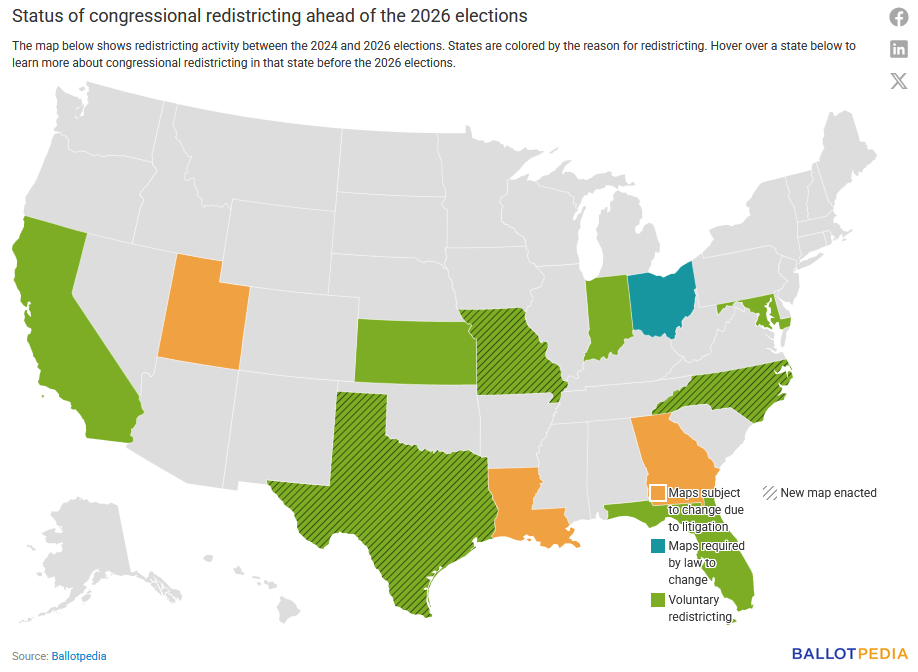
The California Legislature has approved a special election to redraw congressional district lines. Democrats stand to pick up five seats to offset a recent Texas gerrymander.  The war is spreading.

Reid Epstein at NYT:

The next front in the nation’s pitched battle over mid-decade congressional redistricting is opening in Virginia, where Democrats are planning the first step toward redrawing congressional maps, a move that could give their party two or three more seats.

The surprise development, which was announced by legislators on Thursday, would make Virginia the second state, after California, in which Democrats try to counter a wave of Republican moves demanded by President Trump to redistrict states to their advantage before the 2026 midterm elections. No other Democratic state has begun redistricting proceedings, while several Republican states have drawn new maps or are deliberating doing so.

Bruce Mehlman:

Traditionally redistricting is usually done once per decade, though this is not dictated by the Constitution or a specific law. President Trump is pushing Republican states to redraw maps in 2025 to maximize GOP advantage for 2026, and three have already done so (TX, NC, MO) with two more coming (OH, UT). Many Democratic governors such as California’s Gavin Newsom are moving to “fight fire with fire” with hyper-partisan gerrrymanders of their own. Up to 15 states in total (so far) are considering or acting: the 5 above plus CA, FL, IL, IN, KS, LA, MD, NE, SC, VA & WI.
...


Democrats could be in danger of losing around a dozen districts across the South if the court strikes down Section 2 of the 1965 Voting Rights Act in Louisiana v. Callais, a case the court heard two weeks ago. “Without Section 2, which has been interpreted to require the creation of majority-minority districts, Republicans could eliminate upward of a dozen Democratic-held districts across the South.” (NYT)


Sunday, August 24, 2025

World War G Is Spreading

Our new book is The Comeback: The 2024 Elections and American PoliticsIt includes a chapter on congressional and state elections.

The California Legislature has approved a special election to redraw coingressional district lines. Democrats stand to pick up five seats.

Liz Crampton, Dustin Gardiner and Nick Reisman at Politico:

Texas Republicans on Saturday passed a new map
that will help the GOP flip as many as five House seats — a partisan play at the hand of President Donald Trump. On Thursday, California Democratic lawmakers and Gov. Gavin Newsom preemptively agreed to send a retaliatory ballot measure to voters — the first step in potentially offsetting Texas’ maneuver by creating new Democratic-leaning seats.


The nation’s two largest states had fired the opening salvo in what is likely to become an intense and protracted redistricting campaign by both parties to grasp power in Washington. Now other red and blue state governors face pressure to follow their lead and aggressively gerrymander their congressional maps.

Republicans hold a clear advantage in the arms race: The GOP is poised to move forward with redistricting in Florida, Ohio, Missouri and Indiana, which could yield at least half a dozen more seats. Democrats, meanwhile, have struggled to get gerrymandering efforts moving in blue states beyond California, though leaders in New York, Illinois and Maryland say they are weighing options.
...
Efforts are underway to carve out more GOP seats in Indiana, Ohio, Missouri and Florida — and Trump’s political operation is pressuring individual state lawmakers to act. On Thursday, Trump declared on X that Republicans in Missouri — where the GOP could pick up one more seat by splitting a district in Kansas City — are “IN!” to call a special session to redistrict.

The legal hurdles for Democrats in other deep-blue states could prove more formidable, hampering their party’s quest to retake the House in the 2026 midterms.

In New York, Gov. Kathy Hochul wants to disband a quasi-independent commission in charge of drawing House map. But the panel, created by a voter-approved constitutional amendment, cannot be erased until 2027 at the earliest.

Friday, August 22, 2025

California Pulls the Trigger

Our new book is The Comeback: The 2024 Elections and American PoliticsIt includes a chapter on congressional and state elections.

The California Legislature has approved a special election to redraw coingressional district lines. Democrats stand to pick up five seats.

 Laura J. Nelson, Seema Mehta and Melody Gutierrez at LAT:

Newsom initially said that new electoral districts in California would only take effect if another state redrew its lines before 2031. But after Texas moved toward approving its own maps this week that could give the GOP five more House seats, Democrats stripped the so-called “trigger” language from the amendment — meaning that if voters approve the measure, the new lines would take effect no matter what.

“They fired the first shot, Texas,” Newsom said before signing the bills Thursday. “We wouldn’t be here if Texas had not done what they just did, if Donald Trump didn’t do what he just did.”

The ballot measure language, which asks California voters to override the power of the independent redistricting commission, was approved by most Democrats in the Assembly and the Senate, where they hold supermajorities.

Lawmakers have the power to place constitutional amendments on the statewide ballot without the approval of the governor. Newsom later signed two bills that fund the special election and spell out the lines for the new congressional districts.

Sunday, August 10, 2025

Cornyn, Paxton, and the Attention Economy

Our new book is The Comeback: The 2024 Elections and American PoliticsIt includes a chapter on congressional and state elections.

At Politico, Adam Wren notes that Democratic Senate candidates are mismatched in the attention economy.
ON THE REPUBLICAN SIDE: A similar gap exists on the right, as Cornyn faces a primary challenge from Texas AG Ken Paxton. Senate Republicans would much prefer Cornyn, worrying that Paxton could lose to a Democrat in the general under the right conditions.

But Paxton has adapted to our new, disruptive attention-based political era. He has run to where MAGA eyeballs are. Yes, that means doing hits on Fox News, but it also means going into less-mainstream media appearances, including as a guest on Steve Bannon’s “War Room” podcast. “We had you really early on this — before it got kicked off,” Bannon told Paxton in a gerrymandering-centric appearance earlier this week, effectively vouching for his MAGA bona fides.

Cornyn has taken a more institutionalist approach. Perhaps his most prominent foray into the redistricting fight came in the form of a sternly worded letter to the FBI asking for their help in tracking down the absconding Texas Dems. To be fair, that move was successful in generating its own earned media and resulted in the FBI approving a request to locate the contingent of quorum-breaking Democrats, though it remains unclear what that means in practicality and the FBI is declining to comment, as POLITICO’s Gigi Ewing writes.

Cornyn is also using tactics that have failed against Paxton in the past, POLITICO’s Andrew Howard sharply observes. In May, Cornyn’s campaign launched a website attacking Paxton titled CrookedKen.com, highlighting a number of Paxton’s flaws. The site’s content is almost identical to a website rolled out by George P. Bush during his primary race against Paxton in May 2022, called KenTheCrook.com. Bush’s political team had a lot of overlap with Cornyn’s, and Paxton won that primary by more than 30 points.
Cornyn declined an interview with Playbook.

“Every campaign I was ever on, including in 1980, our objective was to get in the local paper when we visited it, and get on the local radio station, and get on TV as much as possible,” Dave Carney, the Abbott strategist, told Playbook. “The difference between that — which is the exact same strategy, get as much attention as you can earn — now is: There’s 600,000 … places to get noticed.”


Saturday, August 9, 2025

World War G

Our new book is The Comeback: The 2024 Elections and American PoliticsIt includes a chapter on congressional and state elections. The gerrymander war is the big news of 2025.

 Jake Sherman at Punchbowl News:

Republicans are hoping to net a minimum of three House seats in Florida, as we scooped Thursday. Add that to the five seats in Texas, one each in Missouri and Indiana, plus two or three in Ohio, where state law mandates a redraw ahead of 2026.

The Supreme Court also has yet to rule in a high-profile Louisiana redistricting case on the 1965 Voting Rights Act that could further alter next year’s congressional landscape.

The Sunshine State effort, officially announced by Florida House Speaker Daniel Perez on Thursday, is only the most recent Republican initiative to cushion the blow from what’s expected to be a difficult midterms for the GOP. Republicans are hoping to redraw three districts in their favor, likely those of Democratic Reps. Debbie Wasserman Schultz and Jared Moskowitz in Trump-tending South Florida, as well as Darren Soto in the Orlando area.

...

California Democratic Gov. Gavin Newsom — a 2028 hopeful — is doing everything he can to sidestep his commission, but he’ll need Golden State voters to back his efforts in a special election. This will be extremely expensive and may not work. If it does, the prize could be five new blue seats, which could negate the proposed Texas map.

Where else can Democrats find more seats? Maryland could offer one. But Democrats tried to pass such a map in the 2022 cycle and a court shot it down as an illegal partisan gerrymander.

Oregon is another possibility, although Democratic Gov. Tina Kotek didn’t sound particularly enthusiastic. It’s possible that Democrats could gain a seat out of Illinois, although the Land of Lincoln is already heavily gerrymandered in their favor.

Democrats in other blue states would have to amend their own constitutions in order to get into the redistricting fight. The deadline has passed to do this before the 2026 elections in New Jersey and Colorado. Democrats don’t have the votes in Washington State. New York would require court intervention, and state judges haven’t favored Democrats in redistricting there in recent years.


Friday, August 8, 2025

Immigration Policy Threatens GOP Gains

Our new book is The Comeback: The 2024 Elections and American PoliticsIt includes a chapter on congressional and state elections.


Marianna Sotomayor at WP:
Hispanic Republicans in the U.S. House say they are increasingly concerned that President Donald Trump’s mass deportation campaign could backfire with Latino voters, as they look for ways to protect some undocumented immigrants from deportation.

These Republicans expressed fear that the inroads Trump and the GOP made with Latino voters in 2024 could erode because of what they see as a haphazard approach to mass deportations, which are starting to disrupt their communities and threaten local businesses. They are growing especially anxious about the push to arrest and deport migrants whose only crime is crossing the border illegally.

“We’re all against criminals and gang members and those with deportation orders. But as this is starting to touch some folks who have known somebody who’s been here 20 years, more and more [people] are starting to see it, and there’s more and more response in the districts,” Rep. Carlos A. Gimenez (R), who represents a predominantly Hispanic district in South Florida, said in an interview.

The concern from Latino Republicans — along with some of their conservative colleagues — comes as the Trump administration, through White House Deputy Chief of Staff Stephen Miller, has directed immigration officials to make a minimum of 3,000 arrests daily.

And the leakage of Hispanic support could cause the looming Texas gerrymander to backfire.   Pooja Salhotra at NYT:

Texas Republicans are hoping that the surge of Hispanic support for President Trump in 2024, which was especially sharp in South Texas, will last through the 2026 midterm elections. They also hope that voters, Hispanic or not, in districts like the currently Democratic one around Laredo will not be overly angry about the Republicans’ aggressive mid-decade redistricting push, a hardball tactic to retain power in Washington that is being pressed by Mr. Trump.

More than a dozen conversations with voters in South Texas over the weekend showed that neither hope is a sure thing.
“The Republican Party is going to lose a lot of votes around here,” said Ricardo Sandoval, 35, a trucking and warehousing businessman in Laredo who supported Mr. Trump in November.

Mr. Sandoval said he agreed with Mr. Trump’s campaign promises for tax cuts, tariffs on China and an immigration crackdown along the border. But now, he said, he feels he was misled. The roller coaster of on-again-off-again tariffs has depressed cross-border trade and upended his business, pushed prices up and forced him to lay off more than a dozen employees. Mr. Trump’s aggressive immigration enforcement actions have been disrespectful to the thousands of Hispanics who supported him, Mr. Sandoval said. And he said the Republicans’ redistricting effort in Texas was an unethical way to try to hold onto power.

“There’s a sense of betrayal,” he said.

Recent polling has suggested that misgivings like Mr. Sandoval’s might be spreading among Hispanic voters, especially those who say they are feeling the impact of rising prices for groceries and imported goods, as well as a slowdown in the labor market.


Thursday, August 7, 2025

Gerrymandering Is a Zero-Sum Game

Lindsey Holden at Politico:
Two of California’s safest House Democrats say they’re preparing to take one for the team — accepting slightly more competitive districts as part of the state’s quest to find five new blue seats.

Gov. Gavin Newsom wants to counter President Donald Trump’s effort to increase the number of GOP seats in Texas with a midcycle gerrymandering of his own. State lawmakers could vote soon after they return from recess on Aug. 18 to hold a November special election asking Californians for the power to redraw congressional districts ahead of the midterms.

But decreasing the number of Republican seats means some deep-blue California districts will take on a slightly more purple tinge.

San Diego Reps. Scott Peters and Sara Jacobs — both of whom represent overwhelmingly Democratic areas — are among the members who would likely see an increase in Republican voters if lines are redrawn. Both told Playbook they would prefer to avoid the sudden redistricting, but that Trump’s Texas push warrants it.

“This is bigger than me and my seat,” Jacobs said. “This is about the survival of democracy and our country. I don't think any of us want to go forward with this, but it's the only way to respond to what they're doing in Texas.”

Peters said he actually agrees with Northern California Republican Rep. Kevin Kiley’s crusade to outlaw redistricting outside the typical 10-year time span. But, he added, “We’re not the ones who picked this fight.”

Jonathan Martin at Politico:

Which gets to the cold reality for GOP lawmakers in California and New York: The very Republicans who helped deliver their party’s congressional majority by winning in the two mega-states in 2020 and 2022 could be collateral damage to Trump’s gambit.

That includes House veterans such as Reps. Darrell Issa and Ken Calvert, both of California, but also younger, promising Republican lawmakers such as [Kevin] Kiley, 40, and Rep. Mike Lawler (N.Y.), 38.

“This creates a situation where you’re going to lose blue state members, which over the long haul are critical to keeping the majority,” Lawler told me.

It’s all, Lawler said, “mutually assured destruction once people go full throttle.”

The redistricting threat is especially cruel to Lawler, who was already eager to avoid yet another tough race in his Hudson Valley district by running for governor next year. But Trump made clear he preferred Rep. Elise Stefanik, a born-again MAGA disciple, as the standard-bearer even though running a Trump acolyte statewide may only ensure Stefanik ends next year where she started this year: hoping for a Trump cabinet appointment.

For Kiley, the Newsom reprisal to Trump may extinguish a congressional career that just began in 2023.


Tuesday, August 5, 2025

Duel in the Sun: Texas v California

Our new book is The Comeback: The 2024 Elections and American PoliticsIt includes a chapter on congressional and state elections.

Eleanor Klibanoff at Texas Tribune:

The Texas House voted Monday afternoon to track down and arrest more than 50 Democratic lawmakers who were not present when the chamber gaveled in. After the 85-6 vote, House Speaker Dustin Burrows said he would immediately sign civil warrants for each of the legislators, empowering the chamber’s sergeant-at-arms and state troopers to arrest and bring them to the Capitol.

They will not face civil or criminal charges from the arrests. The warrants apply only within state lines, making them largely symbolic as most of the legislators in question decamped to Illinois, New York and Massachusetts to forestall passage of the GOP’s proposed redraw of Texas’ congressional map.

The House used the same tactic to try to force Democrats back to work in 2021, when a majority of them left for Washington, D.C., to protest GOP voting restrictions. Some of the lawmakers challenged the warrants in court, obtaining an injunction against arrests that was later struck down by the Texas Supreme Court.

While the Texas Constitution “enables ‘quorum-breaking’ by a minority faction of the legislature, it likewise authorizes ‘quorum-forcing’ by the remaining members,” the court ruled.

...

Democrats left the state Sunday afternoon to deny the House a quorum — the number of people necessary for the chamber to advance legislation — and delay passage of a new congressional map.

The current congressional map, drawn by a Republican-dominated Legislature in 2021, has netted 25 GOP seats in the last two elections. But after pressure from President Donald Trump’s team, Abbott directed lawmakers to redraw the map during the special legislative session, which started July 21. Last week, the House proposed new congressional lines dividing up existing districts in Austin, Houston and Dallas with the aim of netting five more Republican seats.

Michael Wilner, Laura J. Nelson, Seema Mehta and Taryn Luna at LAT:

A last-ditch effort by California Democrats to redraw the state’s congressional map for the 2026 election, countering a similar push by Texas Republicans, is now up against the clock.

Gov. Gavin Newsom said Monday that Democrats are moving forward with a plan to put a rare mid-decade redistricting plan before voters on Nov. 4. But state lawmakers will craft a “trigger,” he said, meaning California voters would only vote on the measure if Texas moved forward with its own plans to redraw Congressional boundaries to add five more Republican seats.

“It’s cause and effect, triggered on the basis of what occurs or doesn’t occur in Texas,” Newsom said. “I hope they do the right thing, and if they do, then there’ll be no cause for us to have to move forward.”