Search This Blog

Showing posts with label transparency. Show all posts

Friday, June 12, 2020

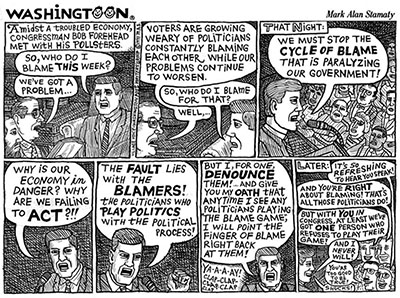
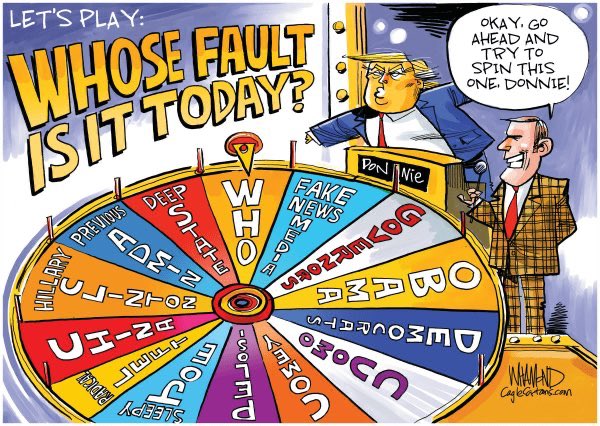
The Blame Game


In public policy, tradeoffs are inevitable. 

Health care is a vivid example. Autism Policy and Politics: In Autism Intervention, Cheap Does Not ...

Negativity bias: losses may get more attention than gains.

Overpromising:  "If you like your current plan..."

Agency strategies (Hood, ch. 4):  "the mess we inherited"

Blame acceptance (Hood p. 54).  After the Bay of Pigs disaster, JFK said, "There's an old saying that victory has 100 fathers and defeat is an orphan ... I have said as much as I feel can be usefully said by me in regard to the events of the past few days. Further statements, detailed discussions, are not to conceal responsibility because I'm the responsible officer of the Government."


Paul Krugman a Twitter: "We've been heading for the Trump moment ...

Yemen: early sign that Trump would avoid blame acceptance.

The messes he inherited:


Coronavirus?

May 14
We inherited a broken, terrible system. And I always say it: Our cupboards were bare. We had very little in our stockpile.
March 13
Q    Dr. Fauci said earlier this week that the lag in testing was, in fact, “a failing.”  Do you take responsibility for that?
...
THE PRESIDENT:  Yeah, no, I don’t take responsibility at all, because we were given a — a set of circumstances and we were given rules, regulations, and specifications from a different time. 
Villains

John McCain (died August 28, 2018)


The Fed


The Deep State


Antifa


Elderly Catholic Peace Activists!


Transparency and Accountability

Jefferson: "the whole art of government consists in the art of being honest."


Saturday, May 9, 2020

Concealing Information

In Defying the Odds, we discuss the 2016 campaign. The 2019 update includes a chapter on the 2018 midterms. The 2020 race, the subject of our next book, is well under  way.  

Coronavirus presents unprecedented challenges to public policy and the electoral process.


Toluse Olorunnipa at The Washington Post:
President Trump in recent weeks has sought to block or downplay information about the severity of the coronavirus pandemic as he urges a return to normalcy and the rekindling of an economy that has been devastated by public health restrictions aimed at mitigating the outbreak.

His administration has sidelined or replaced officials not seen as loyal, rebuffed congressional requests for testimony, dismissed jarring statistics and models, praised states for reopening without meeting White House guidelines and, briefly, pushed to disband a task force created to combat the virus and communicate about the public health crisis.

Several Republican governors are following Trump’s lead as an effort takes shape to control the narrative about a pandemic that has continued to rage throughout a quickly reopening country. With polls showing most consumers still afraid to venture out of their homes, the Trump administration has intensified its efforts to soothe some of those fears through a messaging campaign that relies on tightly controlling information about a virus that has proven stubbornly difficult to contain.
Jason Dearen at AP:
The decision to shelve detailed advice from the nation’s top disease control experts for reopening communities during the coronavirus pandemic came from the highest levels of the White House, according to internal government emails obtained by The Associated Press.
The files also show that after the AP reported Thursday that the guidance document had been buried, the Trump administration ordered key parts of it to be fast-tracked for approval.
The trove of emails show the nation’s top public health experts at the Centers for Disease Control and Prevention spending weeks working on guidance to help the country deal with a public health emergency, only to see their work quashed by political appointees with little explanation.
The document, titled “Guidance for Implementing the Opening Up America Again Framework,” was researched and written to help faith leaders, business owners, educators and state and local officials as they begin to reopen. It included detailed “decision trees,” or flow charts aimed at helping local leaders navigate the difficult decision of whether to reopen or remain closed.

Sunday, April 16, 2017

The Swamp Lives in Darkness

At The New York Times, Eric Lipton, Ben Protess and Andrew W. Lehren report:


President Trump is populating the White House and federal agencies with former lobbyists, lawyers and consultants who in many cases are helping to craft new policies for the same industries in which they recently earned a paycheck.


The potential conflicts are arising across the executive branch, according to an analysis of recently released financial disclosures, lobbying records and interviews with current and former ethics officials by The New York Times in collaboration with ProPublica.


In at least two cases, the appointments may have already led to violations of the administration’s own ethics rules. But evaluating if and when such violations have occurred has become almost impossible because the Trump administration is secretly issuing waivers to the rules.


Both parties use the revolving door...

But the Trump administration is more vulnerable to conflicts than the prior administration, particularly after the president eliminated an ethics provision that prohibits lobbyists from joining agencies they lobbied in the prior two years. The White House also announced on Friday that it would keep its visitors’ logs secret, discontinuing the release of information on corporate executives, lobbyists and others who enter the complex, often to try to influence federal policy. The changes have drawn intense criticism from government ethics advocates across the city.

Friday, March 3, 2017

Ryan on Transparency

This new Washington Way isn't open debate broadcast on C-SPAN; it's closed-door, backroom deals. The Washington Way doesn't seek input from both sides of the issue; it muscles through bills on strict one-party votes. And the Washington Way isn't interested in honest up-or-down votes on transformational programs. It rigs the process to produce the outcome it desires through any means necessary. The ends justify the means. Bend the Constitution to keep up with the change.
...
The initial goal was to pass the bill before the August recess. But when that deadline wasn't met, tens of thousands of Americans got the opportunity to express their opposition to the bill when members went back to their districts for town hall meetings. Suddenly, news reports and YouTube were full of videos of angry citizens confronting often dazed the defensive members of Congress.  Immediately after that, the president and a small number of advisers and Democratic leaders retreated behind closed doors to write their health-care bill.  They didn't like what they were hearing from Americans, so they told us, in no uncertain terms to shut up and sit down. 
Robert Pear reports at The New York Times:
It was “find the Affordable Care Act replacement” day on Thursday as publicity-seeking Democrats — and one frustrated Republican — scampered through Capitol corridors, hunting for an elusive copy of a bill that Republican leaders have withheld from the public as they search for party unity.

Just a week before two powerful House committees plan to vote on the measure, opponents spent hours making the point that almost no one has actually seen legislation that would affect the lives and pocketbooks of millions of Americans.

“The Republicans have played hide-and-seek with us,” said Representative Lloyd Doggett, Democrat of Texas.

Speaker Paul D. Ryan of Wisconsin said party leaders were determined to plow ahead with repeal legislation, despite lingering disagreements among Republicans and outright opposition from Democrats.

Tuesday, March 10, 2015

Clinton Email, Continued

Hillary Clinton held a press conference to quell controversy over her emails.  She failed, as Dustin Volz explains at National Journal:
"Important questions remain about security," said Daniel Castro, vice president of the Information Technology & Innovation Foundation, shortly after Clinton's presser began. "The State Department sets the policy of what is acceptable security procedure. Connecting a State Department device to an unknown server should have raised flags internally. This gets to basic perimeter security."
"Overall, I don't see this briefing putting the matter to rest," Castro added.
Clinton's now infamous email domain, clintonemail.com, was hosted on an independently run and privately held server, an unusual move that potentially left her account exposed to hackers who would have a keen interest in reading the correspondence of the nation's top diplomat.
Part of the reason Clinton could do little Tuesday to reassure her critics is due to a series of unknowns presented by her private account that simply can't be explained away. Computer experts contend that no overtures of transparency now can erase the doubt that she may have surreptitiously destroyed emails that would be irretrievable even for the most independent and scrupulous of investigators.
"The hardest thing to do with forensics is to prove a negative," Jason Straight, chief privacy officer and senior vice president of cybersecurity at UnitedLex, a global firm that provides legal services on electronic-data discovery, told National Journal last week. "Absence of evidence is not the evidence of absence."

Monday, March 9, 2015

Clinton, But...

Anne Gearan writes at The Washington Post that HRC was supposed to be the candidate of experience.
But over the past two weeks, with back-to-back revelations that she was working with foreign countries that gave millions of dollars to her family’s charitable foundation and that she set up and exclusively used a private e-mail system, that argument has been put in peril.
Instead of a fresh chapter in which Clinton came into her own, her time as the country’s top diplomat now threatens to remind voters of what some people dislike about her — a tendency toward secrecy and defensiveness, along with the whiff of scandal that clouded the presidency of her husband, Bill Clinton.
That side of Hillary Clinton also plays directly into the main Republican argument against her, that she is a candidate of “yesterday” — as Sen. Marco Rubio of Florida recently put it — who comes with decades of baggage the country no longer need carry.
“Part of the reason the story is gaining traction is that it reminds people of what the Clinton White House was like,” said American University political science professor Jennifer Lawless. “It reminds people of the scandals, the secrecy and the lack of transparency that were often associated with Bill Clinton’s eight years in Washington.”
Amy Chozick writes at The New York Times that HRC was supposed to be the champion of women.
But the Bill, Hillary & Chelsea Clinton Foundation has accepted tens of millions of dollars in donations from Saudi Arabia, the United Arab Emirates, Kuwait, Oman, Qatar, Algeria and Brunei — all of which the State Department has faulted over their records on sex discrimination and other human-rights issues.
The department’s 2011 human rights report on Saudi Arabia, the last such yearly review prepared during Mrs. Clinton’s tenure, tersely faulted the kingdom for “a lack of equal rights for women and children,” and said violence against women, human trafficking and gender discrimination, among other abuses, were all “common” there.
Continue reading the main story
Saudi Arabia has been a particularly generous benefactor to the Clinton Foundation, giving at least $10 million since 2001, according to foundation disclosures. At least $1 million more was donated by Friends of Saudi Arabia, co-founded by a Saudi prince.
Republicans quickly zeroed in on the apparent contradiction. Carly Fiorina, the former Hewlett-Packard chief, told a crowd at the Conservative Political Action Conference last month that Mrs. Clinton “tweets about women’s rights in this country and takes money from governments that deny women the most basic human rights.”
Maureen Dowd writes:
Everyone is looking for signs in how Hillary approaches 2016 to see if she’s learned lessons from past trouble. But the minute this story broke, she went back to the bunker, even though she had known for months that the Republicans knew about the account. The usual hatchets — Philippe Reines, David Brock, Lanny Davis and Sidney Blumenthal — got busy.
The Clintons don’t sparkle with honesty and openness. Between his lordly appetites and her queenly prerogatives, you always feel as if there’s something afoot.
Everything needs to be a secret, from the Rose Law Firm records that popped up in a White House closet two years after they were subpoenaed to the formulation of her health care plan.
Yet the Clintons always act as though it’s bad form when you bring up their rule-bending. They want us to compartmentalize, just as they do, to connect the dots that form a pretty picture and leave the other dots alone.
If you’re aspiring to be the second president in the family, why is it so hard to be straight and direct and stand for something? Why can’t you just be upright and steady and good?
Given all the mistakes they’ve made, why do they keep making them? Why do they somehow never do anything that doesn’t involve shadows?

Sunday, March 8, 2015

SNL on HRC

Mediaite reports:
SNL wasted no time tonight, getting right to the controversy over Hillary Clinton‘s emails in its cold open. And this Hillary––”a relatable woman on a couch”––won’t let a little thing like email get in the way of ascending to the presidency.
Clinton looked slightly possessed as she insisted that “there will be no mistakes in my rise to the top” and dared the media to go through not just her emails, but her Netflix and Instagram accounts.
Clinton declared, “I will ascend to the high office of president and claim my rightful place in history!!!… if I choose to run!”
Video here

On his own show, SNL alum Jimmy Fallon also mentioned HRC:


Thursday, March 5, 2015

Walker's Email Problem

It is not just Hillary ClintonAt The Daily Beast, Lloyd Green reminds us of Scott Walker's email problem and other gum on his shoe:
Before Walker was elected governor, when he was Milwaukee County Executive, Walker’s staff kept a secret email system and set up a secret wireless router in Walker’s government office that commingled government and campaign business on private Gmail and Yahoo email accounts.
On top of that, county employees were doing campaign work on government time and, by extension, on the taxpayers’ dime—in violation of state law. As the story goes, one of Walker’s aides, Darlene Wink, copped to a misdemeanor guilty plea, and got off with probation for doing campaign work during office hours. Kelly Rindfleisch, Walker’s deputy chief of staff when he was county executive, pleaded guilty to a single felony count for spending “significant time” working as a fund-raiser on government time for Brett Davis, Walker’s running mate.
But it didn’t end there. Brian Pierick, one of the secret website’s webmasters, was convicted of enticing a minor. Another Walker webmaster, Timothy Russell, was sentenced to two years in prison and five years’ probation for stealing from a veterans group, using the money for trips to Hawaii and the Caribbean, and for meeting with Herman Cain’s presidential campaign on the veterans’ tab.
Walker will face questions about these things.  Will he be ready to answer?  Jonah Goldberg casts doubt:
It’s a bigger problem than it might seem. Walker planned on defining himself to the country on his timetable. With that plan in ashes, he’s facing a liberal news corps and a Republican field of competitors hell-bent on defining Walker if he won’t. From the media, that means lots of questions about President Obama’s religion, Walker’s views on evolution and other ridiculous gaffe hunts.
Walker has been “punting” — his word — on such questions, but also on more serious topics. That is a fine tactic when few are paying attention. Other candidates have been punting on various issues too, but no one knows or cares because they aren’t the front-runner. When you’re in the spotlight, punting stops being a way to avoid giving an answer and instead it becomes the answer.
Walker is in danger of being the guy known for not having a good — or any — answer to tough questions. That’s particularly poisonous for him, given that he is running on leadership and truth-telling.
Governor, welcome to the NFL.

Wednesday, March 4, 2015

Clinton's Server Error

Jack Gillum and Ted Bridis report at AP:
The computer server that transmitted and received Hillary Rodham Clinton's emails - on a private account she used exclusively for official business when she was secretary of state - traced back to an Internet service registered to her family's home in Chappaqua, New York, according to Internet records reviewed by The Associated Press.

The highly unusual practice of a Cabinet-level official physically running her own email would have given Clinton, the presumptive Democratic presidential candidate, impressive control over limiting access to her message archives. It also would distinguish Clinton's secretive email practices as far more sophisticated than some politicians, including Mitt Romney and Sarah Palin, who were caught conducting official business using free email services operated by Microsoft Corp. and Yahoo Inc.

...

Operating her own server would have afforded Clinton additional legal opportunities to block government or private subpoenas in criminal, administrative or civil cases because her lawyers could object in court before being forced to turn over any emails. And since the Secret Service was guarding Clinton's home, an email server there would have been well protected from theft or a physical hacking.

But homemade email servers are generally not as reliable, secure from hackers or protected from fires or floods as those in commercial data centers. Those professional facilities provide monitoring for viruses or hacking attempts, regulated temperatures, off-site backups, generators in case of power outages, fire-suppression systems and redundant communications lines.
Gabriel Debenedetti reports at Politico:
Within hours of a report that Clinton had relied heavily on her personal email address while serving as secretary of state, former Florida Gov. Jeb Bush, a Republican eyeing 2016, tweeted to demand that she release all her emails. By Tuesday morning, the GOP opposition group America Rising filed a Freedom of Information Act request to the State Department, requesting copies of emails sent to Clinton.
In a sense, the situation bears some resemblance to the case of Romney and his tax returns. Repeated demands from Democrats — and some Republicans — that the former private equity executive disclose his returns hindered the GOP nominee’s campaign in 2012. It took him until September 2012 to release his 2011 documents, by which point Democrats had successfully painted him as an out-of-touch plutocrat.

Tuesday, March 3, 2015

"A Serious Breach"

Michael S. Schmidt reports at The New York Times:
Hillary Rodham Clinton exclusively used a personal email account to conduct government business as secretary of state, State Department officials said, and may have violated federal requirements that officials’ correspondence be retained as part of the agency’s record.
Mrs. Clinton did not have a government email address during her four-year tenure at the State Department. Her aides took no actions to have her personal emails preserved on department servers at the time, as required by the Federal Records Act.
It was only two months ago, in response to a new State Department effort to comply with federal record-keeping practices, that Mrs. Clinton’s advisers reviewed tens of thousands of pages of her personal emails and decided which ones to turn over to the State Department. All told, 55,000 pages of emails were given to the department. Mrs. Clinton stepped down from the secretary’s post in early 2013.
Her expansive use of the private account was alarming to current and former National Archives and Records Administration officials and government watchdogs, who called it a serious breach.
“It is very difficult to conceive of a scenario — short of nuclear winter — where an agency would be justified in allowing its cabinet-level head officer to solely use a private email communications channel for the conduct of government business,” said Jason R. Baron, a lawyer at Drinker Biddle & Reath who is a former director of litigation at the National Archives and Records Administration.
...
[Nick] Merrill, the spokesman for Mrs. Clinton, declined to detail why she had chosen to conduct State Department business from her personal account. He said that because Mrs. Clinton had been sending emails to other State Department officials at their government accounts, she had “every expectation they would be retained.” He did not address emails that Mrs. Clinton may have sent to foreign leaders, people in the private sector or government officials outside the State Department.
Ken Westin writes at Tripwire:
Not only would such an activity circumvent record retainment requirements, but also security requirements. For someone as high up as Hillary Clinton to be using a private email address for official government business, it raises a number of security concerns. This is shadow IT at a grand scale. With no visibility into how the Clinton’s emails were being secured it would be impossible for the government to ensure the communications were not compromised by espionage.
According to the Washington Post that the worst scenario may have come true when hacker “Guccifer” reportedly released several emails pertaining to Benghazi which appear to be between Sidney Blumenthal and Hillary Clinton at the “clintonemail.com” domain. The domain was registered January 2009 through Network Solutions.

Thursday, May 19, 2011

Crossroads Groups Remain Active

A new ad from Crossroads GPS:


American Crossroads is on the air in a New York special House election:


Sean Higgins writes at Investor's Business Daily:
Most people on the right looked at Julian Assange and his WikiLeaks project and wanted him arrested. Stephen Law, president of American Crossroads, had a different approach: copy Assange's idea.

"All of us are of the view that the way WikiLeaks operates is questionable at best ... but there was obviously some genius behind it as well, which is to create a repository for inside documents that tell a story most people aren't aware of," Law told IBD.

So he decided to make his own.

Law is leading an effort to create a conservative version called "Wikicountability.org." The goal is to pool efforts of center-right groups that have obtained insider documents about the Obama administration that show "how it is executing its policies and activities," Law said.

We wish we were shocked, but the plan is merely the latest play by Democrats to crack down on donors who support their opponents. In 2010 they tried and failed to pass the Disclose Act, which would have forced disclosure on business donations but left unions alone.

This year they've turned to harassment by regulation, first asking the Federal Communications Commission to require groups that run political ads to disclose their high-dollar donors. The Obama Administration is also working up an executive order to require anyone bidding for a federal contract to disclose if the company or its executives donated more then $5,000 to independent groups.

Now comes the 501(c)(4) net, which may catch the likes of liberal uber-donor George Soros, though we'd bet he's happy to lend his name to the project to create an appearance of nonpartisanship. The real targets of the disclosure project are conservative groups like Crossroads GPS and Americans for Prosperity, which have seen their fundraising and influence grow in recent years.

All this is done in the name of "transparency," which is a nice way of saying, we know where you live. The real goal is to intimidate business and big donors from giving money to Republicans. The draft executive order aiming to wrest disclosure from federal contractors appears to make no such demands on federal labor unions, which had their free speech rights restored alongside business in Citizens United.

Friday, March 25, 2011

Crossroads, CREW, and Crowdsourcing

At Slate, David Weigel writes:

Michael Warren called up CREW to ask if it would follow up Melanie Sloan's criticism of American Crossroads GPS by going the extra mile and disclosing their own donors.

"CREW does not discuss its donors," said communications director Garrett Russo. I asked him why not, since Sloan said Crossroads GPS was guilty of hypocrisy for not doing the same thing.

"CREW does not discuss its donors," Russo repeated. "That's about all I can tell you."

Helpful! American Crossroads GPS, loving it, sends over a statement from spokesman Jonathan Collegio:

Democrats generally miss the difference between private and government entities, which explains why they are the party of high taxes, suffocating anti-business regulations and everlasting recessions. While Crossroads GPS fully follows the disclosure laws that govern private nonprofits, the Obama administration is breaking laws that govern the free flow of information from federal bureaucracies to taxpaying citizens.

None of this is meant to equate CREW and ACGPS. CREW does name liberal targets and file ethics complaints against Democrats; ACGPS is not in the business of attacking Republicans. But the very idea that ACGPS or any other group is hypocritical for crowdsourcing research on government transparency is ridiculous.


Wednesday, March 17, 2010

Filling Gaps in the White House Website, Part 38

From the president's interview with Bret Baier of Fox News:

BAIER: Let me insert this. We asked our viewers to e-mail in suggested questions. More than 18,000 people took time to e-mail us questions. These are regular people from all over the country. Lee Johnson, from Spring Valley, California: "If the bill is so good for all of us, why all the intimidation, arm twisting, seedy deals, and parliamentary trickery necessary to pass a bill, when you have an overwhelming majority in both houses and the presidency?"

Sandy Moody in Chesterfield, Missouri: "If the health care bill is so wonderful, why do you have to bribe Congress to pass it?"

OBAMA: Bret, I get 40,000 letters or e-mails a day.

BAIER: I know.

OBAMA: I could read the exact same e-mail —

BAIER: These are people. It's not just Washington punditry.

OBAMA: I've got the exact same e-mails, that I could show you, that talk about why haven't we done something to make sure that I, a small business person, am getting as good a deal as members of Congress are getting, and don't have my insurance rates jacked up 40 percent? Why is it that I, a mother with a child with a preexisting condition, still can't get insurance?

So the issue that I'm concerned about is whether not we're fixing a broken system.

BAIER: OK, back to the original question.

OBAMA: The key is to make sure that we vote — we have a vote on whether or not we're going to maintain the status quo, or whether we're going to reform the system.

BAIER: So you support the deem and pass rule?

OBAMA: I am not —

BAIER: You're saying that's that vote.

OBAMA: What I'm saying is whatever they end up voting on — and I hope it's going to be sometime this week — that it is going to be a vote for or against my health care proposal. That's what matters. That's what ultimately people are going to judge this on.

If people don't believe in health care reform — and I think there are definitely a lot of people who are worried about whether or not these changes are, in some fashion, going to affect them adversely. And I think those are legitimate concerns on the substance — then somebody who votes for this bill, they're going to be judged at the polls. And the same is going to be true if they vote against it.

Yesterday, the president issued a statement celebrating "Sunshine Week." That statement was on the White House website. Like dozens of other interviews, the Fox exchange was not.

Monday, February 8, 2010

Filling Gaps in the White House Website, Part 35

From Katie Couric's interview:
KATIE COURIC: A lot of people, including Democrats, wrote to me saying, "You campaigned on a slogan of change you can believe in. But their lives and the ways of Washington," they wrote, "haven't changed at all. What would you say to them?"

PRESIDENT OBAMA: Well, it's not true that they haven't changed at all. Let's just take, we're sitting in the White House here. Every single person who comes into the White House now is posted on a website, so you know every visitor to the White House. That's never happened in the history of the Republic. We are eliminating lobbyists from boards and commissions that have significant power throughout Washington. That hasn't happened in a previous Administration.

There's more transparency on something like the Recovery Act and how taxpayer dollars are being spent than there's ever been on a project of this size and scale. So, here in the White House, actually, we have instituted a whole range of changes that give people a lot more confidence in what we're doing. We haven't done as much as needs to be done. So, for example, on earmarks -- what people consider to be pork projects.
What we've said is, "Member of Congress, if you're gonna introduce a project that benefits your district, you should post it on the internet so people can see it, before you vote on it. And we'll put it on a centralized website." But all these things take time. I mean, you know, you're not gonna transform a culture in Washington or anywhere else over the course of a year. You just gotta keep on chipping away at it, and that's what we've tried to do
No transcript of the interview is available on the White House website.

Tuesday, January 26, 2010

Filling Gaps in the White House Website, Part 34

In an interview with Diane Sawyer, the president addresses the lack of transparency in health care negotiations:

SAWYER: Health care -- going forward, should all the conversations, all the meetings be on C-SPAN?

OBAMA: You know, I think your question points out to a legitimate mistake that I made during the course of the year, and that is that we had to make so many decisions quickly in a very difficult set of circumstances that after awhile, we started worrying more about getting the policy right than getting the process right. But I had campaigned on process. Part of what I had campaigned on was changing how Washington works, opening up transparency and I think it is -- I think the health care debate as it unfolded legitimately raised concerns not just among my opponents, but also amongst supporters that we just don't know what's going on. And it's an ugly process and it looks like there are a bunch of back room deals.

Now I think it's my responsibility and I'll be speaking to this at the State of the Union, to own up to the fact that the process didn't run the way I ideally would like it to and that we have to move forward in a way that recaptures that sense of opening things up more.

The White House website does not have a transcript of this interview.