Search This Blog

Thursday, July 7, 2016

Trump Met Congressional Republicans. He Did Not Display Genius.

Trump’s most tense exchange was with Sen. Jeff Flake (R-Ariz.), who has been vocal in his concerns about the business mogul’s candidacy, especially his rhetoric and policies on immigration that the senator argues alienate many Latino voters and others in Arizona.

When Flake stood up and introduced himself, Trump told him, “You’ve been very critical of me.”

“Yes, I’m the other senator from Arizona — the one who didn’t get captured — and I want to talk to you about statements like that,” Flake responded, according to two Republican officials.

Flake was referencing Trump’s comments last summer about the military service of Sen. John McCain (R-Ariz.), who was a prisoner of war during the Vietnam conflict. Trump questioned whether McCain was a war hero because he was captured.

Flake told Trump that he wants to be able to support him — “I’m not part of the Never Trump movement,” the senator said — but that he remains uncomfortable backing his candidacy, the officials said.
Trump said at the meeting that he has yet to attack Flake hard but threatened to begin doing so. Flake stood up to Trump by urging him to stop attacking Mexicans. Trump predicted that Flake would lose his reelection, at which point Flake informed Trump that he was not on the ballot this year, the sources said.
...
Rep. Mark Sanford (R-S.C.) left the meeting worried about Trump’s grasp on the basics of the Constitution. At a lunch with reporters afterward, he recalled that the candidate did not seem to know what he was promising to defend.

“I wasn’t particularly impressed,” said Sanford. “It was the normal stream of consciousness that’s long on hyperbole and short on facts. At one point, somebody asked about Article I powers: What will you do to protect them? I think his response was, ‘I want to protect Article I, Article II, Article XII,’ going down the list. There is no Article XII.”
And the lede in this morning's New York Times story speaks for itself:
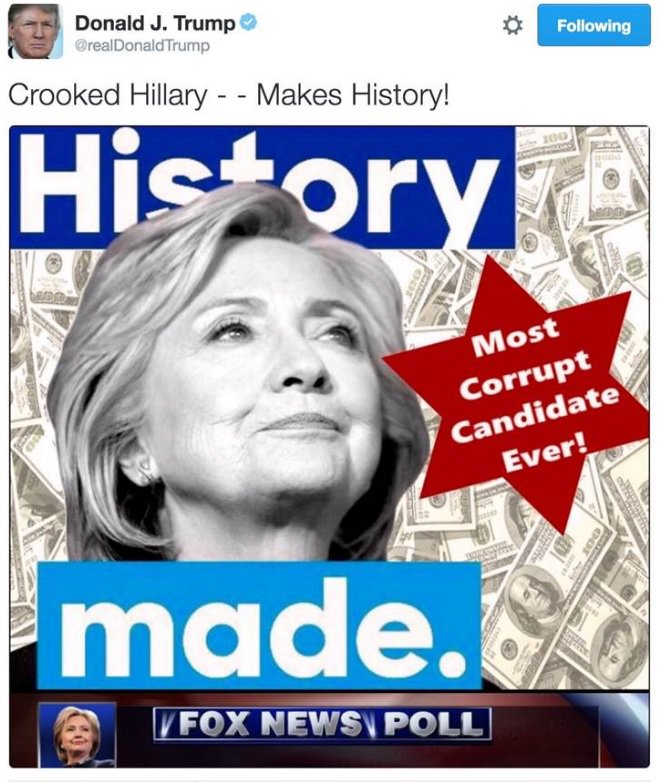
Donald J. Trump on Wednesday offered a defiant defense of his campaign’s decision to publish an image widely viewed as anti-Semitic — saying he regretted deleting it — and vigorously reaffirmed his praise of Saddam Hussein, the murderous Iraqi dictator.
In the span of 30 minutes, an often-shouting Mr. Trump breathed new life into a controversy that was sparked on Saturday by his posting of an image on his Twitter account of a six-pointed star next to a picture of Hillary Clinton, with money seeming to rain down in the background. The image was quickly, and broadly, criticized for invoking stereotypes of Jews. Mr. Trump deleted it two hours later, and replaced the star image with a circle.
“ ‘You shouldn’t have taken it down,’ ” Mr. Trump recalled telling one of his campaign workers. “I said, ‘Too bad, you should have left it up.’ I would have rather defended it.”
“That’s just a star,” Mr. Trump said repeatedly.
It was a striking display of self-sabotage from a presumptive presidential nominee and underscored the limitations of Mr. Trump’s scattershot approach during the Republican primaries — not to mention how difficult he often makes it for his campaign team to control him.

Wednesday, July 6, 2016

Trump and Rape

Attorney Lisa Bloom writes at The Huffington Post:
An anonymous “Jane Doe” filed a federal lawsuit against GOP presumptive nominee Donald Trump last week, accusing him of raping her in 1994 when she was thirteen years old. The mainstream media ignored the filing.

...

Two prior women have accused Mr. Trump, in court documents, of actual or attempted sexual assault. (Mr. Trump denies all the allegations.)

Under oath, Ivana Trump accused Mr. Trump of a violent rape.
...

A few years later, after their divorce was settled, Ms. Trump claimed that she did not mean the word “rape” in a “literal or criminal” sense.

Note: virtually every settlement of a case involving a high profile person paying money to a former spouse - or anyone - requires the person receiving the money to agree in writing to ironclad nondisparagement and confidentiality. In plain English: you promise to be quiet and not say anything bad about the party paying you money. This has been the case in hundreds of settlement agreements I have worked on over the years. Ms. Trump was almost certainly contractually prohibited after she signed from saying anything negative about Mr. Trump. And it is also common to attempt to “cure” prior negative statements with new agreed-to language - like, I didn’t mean it literally. (You didn’t mean forcible penetration literally?)


A business acquaintance accused Mr. Trump of sexual harassment and “attempted rape”.

A second woman accused Donald Trump of sexual assault, in 1997. According toThe Guardian, then thirty-four year old Jill Harth alleged in a federal lawsuit that Trump violated her “physical and mental integrity” when he touched her intimately without consent after her husband went into business with him, leaving her “emotionally devastated [and] distraught.” The lawsuit called the multiple acts “attempted rape.” Shortly thereafter she voluntarily withdrew the case when a parallel suit against Mr. Trump brought by her husband was settled. When The Guardian reached the woman in 2016 to ask whether she stood by her sexual assault allegations, she responded, “yes.”

Tuesday, July 5, 2016

Scandalabra: No Clinton Indictment, But No Rousing Endorsement, Either

FBI Director James Comey said that the bureau would not recommend indicting Hillary Clinton.  But his statement was not exactly a vote of confidence:
Although we did not find clear evidence that Secretary Clinton or her colleagues intended to violate laws governing the handling of classified information, there is evidence that they were extremely careless in their handling of very sensitive, highly classified information.

For example, seven e-mail chains concern matters that were classified at the Top Secret/Special Access Program level when they were sent and received. These chains involved Secretary Clinton both sending e-mails about those matters and receiving e-mails from others about the same matters. There is evidence to support a conclusion that any reasonable person in Secretary Clinton’s position, or in the position of those government employees with whom she was corresponding about these matters, should have known that an unclassified system was no place for that conversation. In addition to this highly sensitive information, we also found information that was properly classified as Secret by the U.S. Intelligence Community at the time it was discussed on e-mail (that is, excluding the later “up-classified” e-mails).

None of these e-mails should have been on any kind of unclassified system, but their presence is especially concerning because all of these e-mails were housed on unclassified personal servers not even supported by full-time security staff, like those found at Departments and Agencies of the U.S. Government—or even with a commercial service like Gmail.

Separately, it is important to say something about the marking of classified information. Only a very small number of the e-mails containing classified information bore markings indicating the presence of classified information. But even if information is not marked “classified” in an e-mail, participants who know or should know that the subject matter is classified are still obligated to protect it.

While not the focus of our investigation, we also developed evidence that the security culture of the State Department in general, and with respect to use of unclassified e-mail systems in particular, was generally lacking in the kind of care for classified information found elsewhere in the government.

With respect to potential computer intrusion by hostile actors, we did not find direct evidence that Secretary Clinton’s personal e-mail domain, in its various configurations since 2009, was successfully hacked. But, given the nature of the system and of the actors potentially involved, we assess that we would be unlikely to see such direct evidence. We do assess that hostile actors gained access to the private commercial e-mail accounts of people with whom Secretary Clinton was in regular contact from her personal account. We also assess that Secretary Clinton’s use of a personal e-mail domain was both known by a large number of people and readily apparent. She also used her personal e-mail extensively while outside the United States, including sending and receiving work-related e-mails in the territory of sophisticated adversaries. Given that combination of factors, we assess it is possible that hostile actors gained access to Secretary Clinton’s personal e-mail account.

Monday, July 4, 2016

Trump and the Alt-Right

Clinton's meeting with the FBI could have been on occasion to focus on ethics issues.  Instead, Trump made his own bigotry the story of the weekend.  David Weigel writes:
It was so close to the message that Republicans say they want from Donald Trump: a tweet describing Hillary Clinton as “crooked” and the “most corrupt candidate ever,” on the morning that the likely Democratic presidential nominee met with the FBI.
But the image that Trump chose to illustrate his point, which portrayed a red Star of David shape slapped onto a bed of $100 bills, had origins in the online white-supremacist movement. For at least the fifth time, Trump’s Twitter account had shared a meme from the racist “alt-right” and offered no explanation why.
... 
The offending image first appeared in a June 15 tweet by @FishBoneHead1, an account with fewer than 1,000 followers and a penchant for memes that mock Muslims, black Democrats and “cucks” — an alt-right term derived from the word “cuckold,” for people they deem insufficiently conservative. According to Anthony Smith, a reporter for the news site Mic, it was shared June 22 on a racist section of the 8Chan Web forum.


More detail from Anthony Smith:
Though the thread where the meme was featured no longer exists, you can find it by searching the URL in Archive.is, a "time capsule of the internet" that saves unalterable text and graphic of webpages. Doing so allows you to see the thread on /pol/ as it originally existed.
Of note is the file name of the photo, HillHistory.jpg, potentially a nod to the Neo-Nazi code for "HH," or "Heil Hitler," which the alt-right is fond of hiding in plain sight. 
Back to Weigel:
“The evangelicals will listen to his pro-Israel statements, while we will listen to his signals,” Andrew Anglin wrote in the Daily Stormer, a racist site named after Nazi propagandist Julius Streicher’s notorious tabloid.

Sunday, July 3, 2016

International Views of Clinton and Trump

Pew reports on a new international poll:
Overall, people in most of the countries surveyed across Europe and Asia have confidence in Hillary Clinton and her ability to handle international affairs.Donald Trump, however, gets negative ratings in nearly every country surveyed.
The most confidence in Clinton comes from many of the same places where Obama and the U.S. are broadly popular, such as Sweden, Germany and the Netherlands. Much smaller shares in Greece, India and China have confidence in her, although in many places where her confidence ratings are low it is because many people do not offer a response.
Trump, on the other hand, is broadly unpopular in every country surveyed. His highest ratings are in China and Italy, yet even there they do not reach a quarter. Furthermore, in Sweden, fully 82% have no confidence at all in Trump. And in the UK, which Trump visited this past week after the momentous Brexit vote, 71% of the public have no confidence in him at all. (The survey was conducted from April to May and includes interviews conducted before Trump and Clinton became their respective parties’ presumptive nominees.)

Saturday, July 2, 2016

Negative Partisanship

Pew reports:
Our study of polarization in 2014 found that a major element of partisan polarization “has been the growing contempt that many Republicans and Democrats have for the opposing party.” Since then, levels of mutual contempt have grown, and “many” has become “most,” according to a separate survey of 2,008 adults, conducted on landlines and cellphones from April 12-19, 2016.
Today, 58% of Republicans have a very unfavorable impression of the Democratic Party, up from 46% in 2014 and just 32% during the 2008 election year. Among Democrats, highly negative views of the GOP have followed a similar trajectory – from 37% in 2008 to 43% in 2014 and 55% currently.
To gauge the depth of partisan dislike, the 2014 survey asked those who expressed very unfavorable opinions of the opposing party if they would go so far as to say “the party’s policies are so misguided that they threaten the nation’s well-being.”
Over the past two years, as the numbers of Republicans and Democrats with very unfavorable views of the opposing party have grown, so too have the shares saying the other party threatens the nation’s well-being: 45% of Republicans now view Democratic policies as a threat, up from 37% in 2014. And 41% of Democrats say the same about the Republican Party’s policies, an increase of 10 percentage points from two years ago.

The power of negative feeling toward the opposition is reflected in the reasons people give for identifying with their own party. Majorities in both parties point to the positive impact of their own party’s policies as a major reason for their choice of parties – but nearly as many cite the harm caused by the opposing party’s policies.

Friday, July 1, 2016

Chaos Syndrome

Jonathan Rauch writes at The Atlantic:
Chaos syndrome is a chronic decline in the political system’s capacity for self-organization. It begins with the weakening of the institutions and brokers—political parties, career politicians, and congressional leaders and committees—that have historically held politicians accountable to one another and prevented everyone in the system from pursuing naked self-interest all the time. As these intermediaries’ influence fades, politicians, activists, and voters all become more individualistic and unaccountable. The system atomizes. Chaos becomes the new normal—both in campaigns and in the government itself.

Our intricate, informal system of political intermediation, which took many decades to build, did not commit suicide or die of old age; we reformed it to death. For decades, well-meaning political reformers have attacked intermediaries as corrupt, undemocratic, unnecessary, or (usually) all of the above. Americans have been busy demonizing and disempowering political professionals and parties, which is like spending decades abusing and attacking your own immune system. Eventually, you will get sick.