This blog continues the discussion we began with Epic Journey: The 2008 Elections and American Politics (Rowman and Littlefield, 2009).The next book in this series is The Comeback: the 2024 Elections and American Politics (Bloomsbury, 2025).
Search This Blog
Showing posts with label Democratic Party. Show all posts
Showing posts with label Democratic Party. Show all posts
Democrats are adopting a drastically more negative tone toward their own party in the 2026 midterm elections, swapping promises of bipartisan collaboration with vows to "take on corruption in both parties."
Sam Forstag, a House candidate in Montana, told Axios in an interview that "a whole lot of my coworkers got a sour look on their face" when he revealed he was running as a Democrat.
"We have heard pretty loud and clear, whether it's at our town halls or on parade routes, that ... there's just a growing frustration with both political parties," said Jake Johnson, a Democratic candidate in Minnesota.
By the numbers: An Axios analysis of more than 350 ads in federal and statewide elections since 2018 found a huge uptick in Democratic ads mentioning either the Democratic Party or both parties in a negative context.The analysis looked at ads run between Aug. 24 and Sept. 22 of each election year that used phrases such as "my own party," "both parties," and "party leaders."
Candidates often try to appeal to swing voters by pitching themselves as bipartisan problem solvers, pointing out past instances of collaboration or making pledges to work across the aisle if elected.
But Democrats have leaned hard into more populist, anti-establishment rhetoric this year, with ads denouncing a broken political system or citing past instances in which they defied their party.
"I didn't care that he was a Democrat or the pressure that I got to make it go away," Virginia Democrat Shannon Taylor says in one ad about the prosecution of former state Sen. Joe Morrissey.
Data: AdImpact; Note: Party totals include independents running as the de facto nominee; Chart: Andrew Solender/Axios
These candidates of the activist left often seem to fare much worse than mainstream progressives, even though they may not be very different on the issues. The members of Justice Democrats, which includes the Squad and many of their congressional allies, fare about five points worse than other Democrats. Elizabeth Warren, who might count as part of that broader group of activist-backed progressives who aren’t democratic socialist, has underperformed the Democratic baseline in Massachusetts by as much as 10 points on net.
When relatively moderate analysts say that progressives badly underperform, it’s usually with this narrower group of activist-backed progressives in mind.
...
If there’s any good news for Dr. El-Sayed, it’s that he ought to have a lot of room to underperform and still win. With Democrats ahead by an average of seven points on the generic ballot nationwide — in which people are asked which party they’ll support for Congress in November — Democrats ought to be favored to win an open Senate race in Michigan by a similar margin. Most of the candidates of the progressive left haven’t underperformed by so much. To lose, he would need to be one of the worst electoral performers in the party. But if the early polls are any indication, it’s possible he will be.
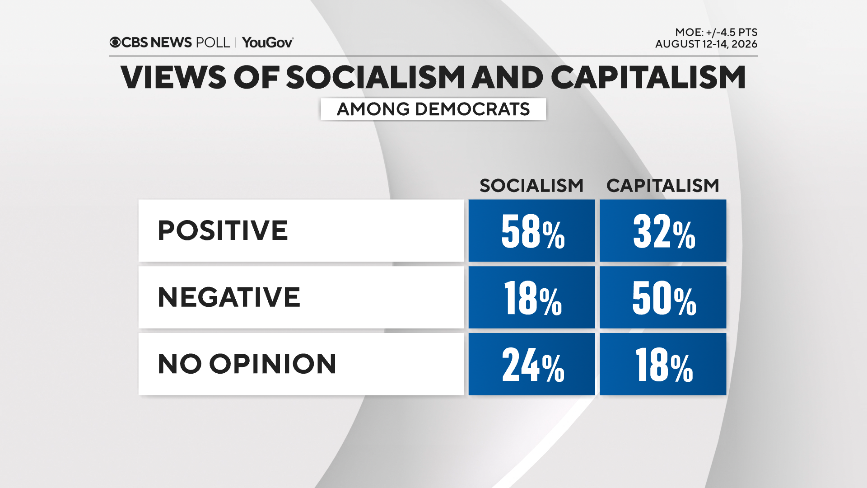
Unlike the public overall, Democrats are mostly positive on socialism and have a more favorable impression of it than of capitalism.
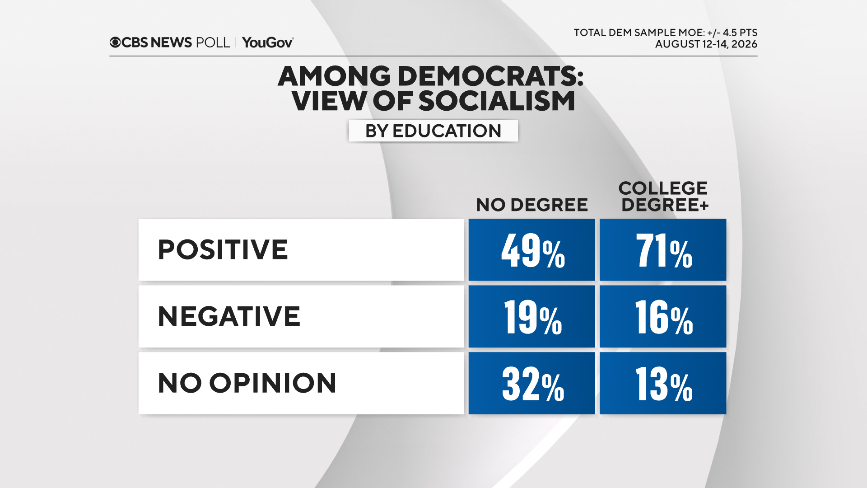
Socialism finds more positive views among Democrats with college degrees than those without. They're even more likely to perceive a gap between the richest and the middle class. And less likely to say the Democratic Party is "effective."
Younger Democrats more than older ones, and White Democrats more than other racial groups tend to have more favorable views of socialism.
In 2000 and 2016, Democrats won the popular vote but lost the electoral vote. Not a coincidence. The GOP has a structural advantage in Senate elections, and not just because of equal representation in the chamber.
Last month, Pew released a study looking at the national political landscape 100 days before the midterm election. President Trump’s approval rating among 3,554 adults interviewed showed 34 percent approving his job in office and 64 percent disapproving. Forty-three percent of the 2,628 registered voters indicated a preference for Democrats for the U.S. House, to 37 percent for Republicans.
The terrific political research team at Pew was kind enough to break out their results, detailing the 1,477 adults (1,039 voters) in 24 red states, the 1,465 adults (1,122 voters) in 19 blue states, and the 606 adults (462 voters) in seven purple states.
Looking at these data, two points jumped off the page. The first was that Republicans were surprisingly weak within their 24 base red states, leading by only 4 points, 39 to 35 percent, and leaving 26 percent up for grabs. Those interviewed in 19 blue states favored Democrats by a whopping 16 points, 50 to 34 percent, with 16 points on the table. The two parties were tied at 42 percent in purple states.
Many would focus on how much stronger Democrats are in blue areas than Republicans are in red areas. But this means that Democrats are “wasting” a lot of support. In effect, they’re running up the score in blue states, where there are few GOP seats to flip, and inflating their national showing. In purple states, where Democrats want an edge in a politically favorable environment, the support levels are even.
That leads to a second and closely related finding. Across several questions, voters in purple states are more closely aligned with red staters than with blue staters.
Their number has swelled more than twentyfold in the past decade, but still totals only around 120,000. The prime target is the downwardly mobile millennial. Michael Lange, a political analyst and DSA member, says the question to identify prospective joiners is: “Are you under 50 and do you rent?” At its latest survey, in 2021, four-fifths of DSA members over the age of 25 had a college degree—twice the share of American adults. A third had a postgraduate degree and a third were gay or queer. Ashik Siddique, a co-chair of the DSA, says it is the largest queer membership organisation in the country. Members found to be working as cops can be expelled.
Therein lies the paradox: a group that claims to represent the working class looks and speaks nothing like it. On all manner of social issues, from trans rights to policing to immigration to abortion, college graduates are far to the left of blue-collar workers. Take protections for trans people, a plank of the DSA platform. Only half of working-class people tell pollsters that it should be illegal to fire or evict a trans person, compared with 82% of left-leaning college grads.
On economics, too, working-class and older voters tend to be more sceptical of the sweeping changes promised by the young new left, says Adam Carlson, a pollster. Mr Siddique, sounding a bit like Lenin, says the DSA’s task is to cultivate a working-class consciousness. The wrinkle is that working-class voters believe strongly in merit and hard work, notes Nicholas Jacobs, a political scientist at Colby College. They tend to be less enthusiastic about expanding government services while distrusting pointy-headed types who use words like “systemic”. Tellingly, in polling, only white left-leaning college grads count “tax the rich” as a top-ten priority.
A Washington Post-Ipsos poll released last Thursday illustrated the problems posed by the rise of the D.S.A.
A solid 75 percent of Democratic voters said they would consider voting for “a candidate for president who identifies as a democratic socialist.” Among all registered voters, however, a majority (54-42) said that they would not consider supporting a democratic socialist presidential candidate, driven by Republicans (88 percent no, 10 percent yes) and independents and other voters (54 to 36).
Even more decisive were the responses when the Post-Ipsos poll asked, “How much do you like or dislike political leaders who identify as democratic socialists?” A third (33 percent) of Democrats said they like democratic socialist political leaders and 10 percent said they dislike them. Among all voters, in contrast, 42 percent said they disliked democratic socialist political leaders and 17 percent said they liked such politicians — Republicans 70 dislike to 3 like and independents and other voters 30 to 12.
In other words, when it comes to socialism, Democratic voters are the outliers, in opposition to the views of voters overall and especially to the views of independents and Republicans.
In terms of actual politics, the outlier status of democratic socialism reflects the concentration of socialist candidates’ success in deep-blue urban areas where Republicans have little or no chance of winning. At the same time, Republicans are relishing the prospect of capitalizing on voters’ distrust of socialism in purple districts and states, even going so far as to financially support the further-left candidate in Democratic primaries.
...
Michael Kistner, a political scientist at Texas A&M’s Bush School of Government and Public Service and an author of research on these issues with Canes-Wrone, wrote that his view “is that the increasing prominence of D.S.A. and Justice Democrats likely hurts Democratic candidates’ standing with moderate and independent voters on the margin. The reason is not performance in these candidates’ own races, should they win the nomination. Typically these candidates win in solidly Democratic districts. The more salient concern is how these candidates affect the party brand of Democrats nationally.”
There is “goodevidence,” Kistner argued, “that party brands — the general reputation and perceived positioning of the party, as seen by the general public — are real and affect election outcomes.”
...
In perhaps the sharpest critique of D.S.A. and other groups on the Democratic left, Jim Kessler, executive vice president for policy at the centrist think tank the Third Way, wrote by email responding to my query: “Since 2018, the moderate New Democrat Coalition Action Fund has managed to flip 50 House seats from red to blue. The D.S.A., Justice Democrats, Our Revolution and the Sunrise Movement can claim zero red-to-blue flipped seats in that time.”
Mayor Zohran Mamdani and his allies swept a series of congressional primaries in New York City on Tuesday in a remarkable show of strength for the insurgent left that sent shock waves through the Democratic Party.
Mr. Mamdani’s candidates toppled a pair of incumbents backed by the city’s political establishment, including major labor unions and the House Democratic leader. Another candidate backed by the mayor won an open House seat, and a handful of democratic socialist challengers he supported were winning down the ballot.
For months, Mr. Mamdani threw himself and his energized political organization into the three marquee congressional contests, campaigning late into the night in the race’s final days and calling the election a referendum on the direction of the party.
...
Brad Lander, 56, a close ally whom Mr. Mamdani urged to run for Congress, ran up a staggering 30-point margin in the affluent 10th District in Brooklyn and Lower Manhattan. He defeated Representative Daniel Goldman, a wealthy Levi Strauss heir who had opposed the mayor in last year’s elections and had close ties to the American Israel Public Affairs Committee, the pro-Israel lobby.
Claire Valdez, 36, a little-known state assemblywoman also recruited by Mr. Mamdani to run, ran up larger than expected margins for the open seat in the Seventh District in a gentrifying swath of Brooklyn and Queens so far left it has been nicknamed the “Commie Corridor.”
She defeated Antonio Reynoso, the Brooklyn borough president, who had far deeper roots in the district and the support of the popular congresswoman, Representative Nydia Velázquez, who is retiring; the left-leaning Working Families Party; and nearly every major labor union in the city.
And Mr. Mamdani’s allies even won in the predominantly Black and Dominican 13th District in Upper Manhattan and the Bronx. In perhaps the night’s most surprising victory, Darializa Avila Chevalier, 32, another democratic socialist who entered the race as a political unknown, narrowly knocked off Representative Adriano Espaillat, the influential chairman of the Congressional Hispanic Caucus.
Chuck Schumer has served as a punching bag for angry Democrats for more than a year — taking flak on everything from his 2026 recruiting to his handling of government funding talks.
But with about five months until the midterm elections, the Senate minority leader is gently starting to punch back — pointing out how some of his bets are paying off as his party moves within striking distance of taking back the majority in November.
“There’s no victory lap to take in June,” he said in an interview in his Capitol office suite.
But he ticked through moves he oversaw in the past year — from leading opposition to GOP safety-net cuts to picking shutdown fights over health care and immigration enforcement funding and orchestrating national intervention in several Senate primaries — that he argued have strengthened Democrats’ hand for the midterms and beyond.
“We made a lot of strategic decisions that got us to this place — it didn’t happen by accident,” Schumer said. “I knew from the beginning that if we recruited strong candidates, found paths to victory, focused on the issues the American people cared about, and forced … the Republicans, to carry Trump’s water, we’d be in much better shape, and that has happened.”
A Washington Post-ABC News-Ipsos poll released Sunday found Trump’s approval rating is 25 percentage-points underwater among Americans overall, including a 21-point disapproval margin among registered voters. The same poll found Democrats’ advantage in overall support for Congress grew from two points in February to five points in the latest poll.
While Trump’s popularity is clearly flagging, the large gap between Trump’s disapproval ratings and Democrats’ smaller advantage in support for Congress has raised questions about whether the Democratic Party’s unpopularity will hamper its chances in this fall’s midterm election. In the last week, Lakshya Jain at the Argument posited that Democrats’ trust deficit on crime is keeping them from winning voters who don’t like Trump, while G. Elliot Morris argued most of the gap is due to “closeted Republicans” who Democrats shouldn’t expect to persuade anyway.
The Post-ABC-Ipsos poll sheds some new light on these issues. It confirms the overall pattern: 93 percent of registered voters who approve of Trump support Republicans for Congress, compared with 79 percent of voters who disapprove of Trump supporting Democrats. But the poll also asked whether each party’s views are “too liberal,” “too conservative,” or “about right,” finding 53 percent of Americans said the Democratic Party is too liberal, up from 46 percent who said this in 2013 (A slightly smaller 49 percent said the Republican Party is too conservative, up from 43 percent in 2013)
Focusing on Trump disapprovers, 61 percent of voters who think the Democratic Party is “too liberal” support Democrats for Congress, compared with 90 percent among voters who don’t think the party is too liberal. When filtering out Republicans, 73 percent of Trump disapprovers who say Democrats are too liberal support Democrats for Congress, compared with 91 percent of those who don’t think the party is too liberal.
How much does that matter? Not much. A simple statistical model controlling for partisanship and 2024 vote finds that viewing the Democratic Party as too liberal is associated with a 5-to-7 point shift in which party voters support in the midterms. But that is on a 0-to-100 scale. If the share of voters saying Democrats are too liberal dropped by 10 points, Democrats would only expect to gain a half a percentage point in support.
The early stage of the campaign is likely a bigger reason for Democrats’ underperformance on the generic ballot. A 2010 political science paper describes a “balance” theory “where the midterm campaign motivates some to vote against the party of the president in order to achieve policy moderation.” As the campaign progresses, vote preferences almost always move toward the out party.”
Zoom in: Every Senate Democrat who's eyeing a 2028 presidential run voted against arms sales to Israel in votes earlier this week.40 Senate Dems voted on a resolution to block arms sales to Israel, up from just 15 on a similar vote last April. Netanyahu is "destroying the bipartisan nature in terms of support for Israel," Sen. Ruben Gallego (D-Ariz.) told Punchbowl News.
Over in the House, some Democrats are turning against defensive support, including funding for Israel's Iron Dome missile defense system.That was "seen as insanely fringe four years ago," Rep. Maxwell Frost (D-Fla.) told Axios. But multiple Democrats who voted for Iron Dome in 2021 told Axios they're done providing financial aid.The big picture: Older Republicans and white Evangelicals are the last groups to hold majority favorable views of Israel, according to recent Pew polling. For every other group, Israel's favorability has collapsed since 2022.
⬇️ Down 31 percentage points among older Democrats (ages 50+). ⬇️ Down 22 percentage points among both younger Republicans/GOP leaners and younger Dems/Dem leaners. ⬇️ Down 14 percentage points among Protestants, 23 among Catholics and 20 among the religiously unaffiliated. ⬇️ Even white Evangelical support, which was at 80% in 2022, has slid by 15 points.
Four studies conducted in the second half of 2025 reveal the depth of the predicament Democrats face. Even as support for Trump deteriorated, each analysis found that the public, including many Democratic voters, had a dismal view of the Democratic Party.
“Many Democrats see their political party as ‘weak’ or ‘ineffective,’” The Associated Press reported based on a July poll by the Associated Press-NORC Center for Public Affairs Research, which it said also found “considerable pessimism within Democratic ranks.” Sign up for the Opinion Today newsletter Get expert analysis of the news and a guide to the big ideas shaping the world every weekday morning. Get it sent to your inbox.
The A.P. quoted Cathia Krehbiel, a 48-year-old Democrat from Indianola, Iowa, who called her party “spineless,” adding that “they speak up a little bit and they roll right over.”
A Pew Research survey showed that in late September “67 percent of Democrats say their own party makes them feel frustrated.” Asked why, “the dominant pre-shutdown response of frustrated Democrats (41 percent) is that the party has not pushed back hard enough against the Trump administration.”
In October, the group behind the centrist Democratic WelcomePAC issued “Deciding to Win,” an analysis of “election results, hundreds of public polls and academic papers, dozens of case studies, and surveys of more than 500,000 voters” that found that “since 2012, highly educated staffers, donors, advocacy groups, pundits and elected officials have reshaped the Democratic Party’s agenda, decreasing our party’s focus on the economic issues that are the top concerns of the American people.”
The authors tracked key word usage in Democratic platforms from 2012 to 2024 and found the frequency of the word “hate” increasing by 1,323 percent; “white/Black/Latino/Latina” by 1,137 percent; “L.G.B.T./L.G.B.T.Q.I.+” by 1,044 percent; and “equity” by 766 percent.
Over the same period, usage of “father/fathers” fell 100 percent; “crime/criminal” by 30 percent; “responsibility” by 83 percent; “middle class” by 79 percent; and “veteran” by 31 percent.
Finally, in November, Politico’s Elena Schneider reported the findings of a 21-state research project funded by Democracy Matters involving polling, dozens of focus groups and message testing.
“Working-class voters see Democrats as ‘woke, weak and out of touch’ and six in 10 have a negative view of the party,” she wrote, later adding:
The initial feedback is grim: Working-class voters don’t see Democrats as strong or patriotic, while Republicans represent safety and strength for them. These voters “can’t name what Democrats stand for, other than being against [Donald] Trump,” according to the report.
Public opinion on nearly every aspect of President Donald Trump’s first year back in the White House is negative, a new CNN poll conducted by SSRS finds, with a majority of Americans saying Trump is focused on the wrong priorities and doing too little to address cost of living.
A majority, 58%, calls the first year of Trump’s term a failure.
There’s hardly any good news in the poll for Trump or the Republican Party entering a critical midterm year, with the president’s handling of the economy looming as the defining issue in key House and Senate races.
Asked to choose the country’s top issue, Americans pick the economy by a nearly two-to-one margin over any other topic. The poll suggests Trump is struggling to prove that he’s addressing it. And it finds broad concerns over Trump’s use of presidential power and his efforts to put his stamp on American culture.
Democrats are accustomed to losing in rural America — especially to Donald Trump. Now they’re hoping the president’s own policies might prove to be the leverage they need going into next year’s midterms.
The party is trying to replace wishful thinking with a new shoe-leather strategy in rural communities where it has long lacked a presence and is deploying unhappy farmers in media campaigns. If Democrats mean to retake Congress in the midterms or have a shot at the White House in 2028, their candidates don’t necessarily need to sweep rural counties — they just need to eat intothe margins Trump was getting, which were frequently north of 80 percent of the vote.
...
Democrats have previously dedicated relatively modest amounts of money, staff and advertising to rural counties and districts outside of swing states. But after a string of off-year victories last month, House Democrats have launched their first-ever rural outreach program, an eight-figure campaign that will fund efforts to hire staffers for candidates, mobilize voters and run ads focusing on the cost of living.
And then there's the One Big Beautiful Bill:
Rural health care centers across the country have already shuttered in response to the law’s Medicaid cuts, which will disproportionately hit communities where hospitals are few and often primary employers. Low-income Americans are quickly learning they may no longer qualify for federal food aid — even as most of the tax breaks the GOP has touted will benefit the wealthy.
Kentucky Gov. Andy Beshear, who chairs the Democratic Governors Association and represents a ruby red state, recently called the law “a slap in the face to rural America.”
Hours after former NFL star Colin Allred quit the Texas Senate race Monday, rabble-rousing Rep. Jasmine Crockettjumped in — the latest sign that Democrats are facing a Tea Party-style revolt by progressives.
Why it matters: Senate Democratic leaders this year have tried to tip the scales in favor of their favorite 2026 candidates in several states — but they've lost some power as much of the party's base has turned on them in President Trump's second term.
...
Zoom out: In Ohio and North Carolina, Schumer helped clear the 2026 Democratic primary fields for former Sen. Sherrod Brown and former Gov. Roy Cooper. But in several other states, Democratic leaders have failed to head off contested primaries — and party-approved candidates are struggling to stake out leads. It's all unfolding amid an intraparty rebellion that's drawn some comparisons to how the conservative Tea Party movement reshaped the GOP nearly two decades ago.
In Maine, polls show oyster farmer Graham Platner, a progressive Democrat, as still competitive against Schumer-endorsed Maine Gov. Janet Mills — even after reports Platner made controversial comments online and had a Nazi-linked tattoo (which he's covered up).
In the Michigan Senate primary, mainstream Democrats have complained that Rep. Haley Stevens, the favorite of party officials, has run a lackluster campaign against liberal state Sen. Mallory McMorrow and Bernie-Sanders backed Abdul El-Sayed, a doctor.
In Iowa, the establishment favorite, Josh Turek, faces a large primary field.
The Democratic Party is hemorrhaging voters long before they even go to the polls.
Of the 30 states that track voter registration by political party, Democrats lost ground to Republicans in every single one between the 2020 and 2024 elections — and often by a lot.
That four-year swing toward the Republicans adds up to 4.5 million voters, a deep political hole that could take years for Democrats to climb out from.
The stampede away from the Democratic Party is occurring in battleground states, the bluest states and the reddest states, too, according to a new analysis of voter registration data by The New York Times. The analysis used voter registration data compiled by L2, a nonpartisan data firm.
Cuts to Medicaid and the Affordable Care Act are expected to make the "big, beautiful bill" even more unpopular.
Prices are still high despite Trump promising to bring them down. Economic approval had long been one of Trump's consistent political strengths. Now it's not.
Trump's deportations are getting blowback after going well beyond violent criminals and gang members. Pollsshow Republicans losing an advantage on one of their key issues in the 2024 election.
Democratic enthusiasm. A recent CNN poll found 72% Democrats and Democratic-aligned voters are extremely motivated to vote in the midterm elections, compared to just 50% of Republicans and Republican-aligned voters.
How closely are Americans following news about government files from the federal investigation of Jeffrey Epstein, and what do they think about President Donald Trump’s handling of the issue? The Washington Post texted 1,089 people Monday to ask.
The Post’s poll found that most Americans are paying at least some attention to news about the Epstein files. Americans largely disapprove of how Trump is handling the issue, with most Democrats and independents disapproving and Republicans expressing a mix of approval and uncertainty. Most Americans strongly support releasing all files in the Epstein case and suspect the documents contain embarrassing information about Trump, Democrats and billionaires.
The Democratic Party’s image has eroded to its lowest point in more than three decades, according to a new Wall Street Journal poll, with voters seeing Republicans as better at handling most issues that decide elections.
The new survey finds that 63% of voters hold an unfavorable view of the Democratic Party—the highest share in Journal polls dating to 1990 and 30 percentage points higher than the 33% who hold a favorable view.
That is a far weaker assessment than voters give to either President Trump or the Republican Party, who are viewed more unfavorably than favorably by 7 points and 11 points, respectively. A mere 8% of voters view the Democrats “very favorably,” compared with 19% who show that level of enthusiasm for the GOP.
.It may be “the economy stupid” for Presidential elections, but no economic indicator (consumer confidence, inflation, stock market returns) correlates consistently to midterm outcomes. What does correlate (high R2)? Presidential Approval. Midterms are referendums on the party in power, usually narrowing the mandate given at the last election. And absent >60% approval, the President’s party loses seats. Trump is currently at 44.6% approval. Advantage Democrats.