Search This Blog

Showing posts with label tea party. Show all posts

Tuesday, December 9, 2025

Democratic Tea?

Our new book is The Comeback: The 2024 Elections and American PoliticsIt includes a chapter on congressional and state elections

Holly Otterbein and Stephen Neukam at  Axios:

Hours after former NFL star Colin Allred quit the Texas Senate race Monday, rabble-rousing Rep. Jasmine Crockett jumped in — the latest sign that Democrats are facing a Tea Party-style revolt by progressives.

Why it matters: Senate Democratic leaders this year have tried to tip the scales in favor of their favorite 2026 candidates in several states — but they've lost some power as much of the party's base has turned on them in President Trump's second term.
...

Zoom out: In Ohio and North Carolina, Schumer helped clear the 2026 Democratic primary fields for former Sen. Sherrod Brown and former Gov. Roy Cooper. But in several other states, Democratic leaders have failed to head off contested primaries — and party-approved candidates are struggling to stake out leads. It's all unfolding amid an intraparty rebellion that's drawn some comparisons to how the conservative Tea Party movement reshaped the GOP nearly two decades ago.
  • In Maine, polls show oyster farmer Graham Platner, a progressive Democrat, as still competitive against Schumer-endorsed Maine Gov. Janet Mills — even after reports Platner made controversial comments online and had a Nazi-linked tattoo (which he's covered up).
  • In the Michigan Senate primary, mainstream Democrats have complained that Rep. Haley Stevens, the favorite of party officials, has run a lackluster campaign against liberal state Sen. Mallory McMorrow and Bernie-Sanders backed Abdul El-Sayed, a doctor.
  • In Iowa, the establishment favorite, Josh Turek, faces a large primary field.

Friday, October 31, 2025

Goodbye Libertarian Tea Party, Hello Authoritarian MAGA

 Our new book is The Comeback: The 2024 Elections and American Politics. The first year of the second Trump administration  has been full of ominous developments .


At WP, Naftali Bendavid reflects on how MAGA supplanted the Tea Party.
The current spending fight reflects the dizzying shift. The tea party’s core demand was fiscal responsibility, but Trump’s signature spending bill adds $3.4 trillion to the deficit, according to the Congressional Budget Office, and passed with overwhelming GOP support. In the current dispute over the government shutdown, Republicans are pushing not for cuts but for an extension of Biden-era spending levels.
Sen. Rand Paul of Kentucky, a rare Republican who opposes his party’s spending measures, said the tea party spirit has evaporated. “I think it’s largely been supplanted by something else,” Paul said in an interview. “We aren’t organized around ideas anymore. We’re organized around a person.”
...

[M]any Trump policies appear to contradict tea party ideals. The tea party abhorred taxes; Trump has imposed high taxes on imports with his tariffs. The tea party revered the Constitution; Trump routinely tests its limits, for example by seizing power over spending and tariffs. The tea party championed the rule of law; Trump openly targets his opponents using the legal system.

More fundamentally, the tea party — driven by anger at President Barack Obama — called for a modest presidency to allow homegrown democracy to flourish. Trump is a dominant, attention-seizing leader who brooks no opposition and regularly pushes to expand his power.

...

 The tea party and MAGA movements are linked by at least one striking quality — a fury at liberal elites who, they contend, have coddled unworthy groups at the expense of ordinary, hardworking Americans. That is evident from the two seminal moments that launched these political tidal waves. [The Santelli rant and the Trump announcement.]

A similarity:

Liberal critics charged that the tea party was motivated at least in part by racial animus, especially as a backlash against the first Black president. Others challenged its claims of grassroots credibility, noting that billionaire brothers Charles and David Koch contributed substantial funds to build up the movement.

Similar criticism has been leveled at MAGAthat it is driven by racism and funded by billionaires.


Saturday, July 23, 2022

The Tea Party Road to Trump

 Our book is titled Divided We Stand: The 2020 Elections and American Politics.  Among other things, it discusses the state of the partiesThe state of the GOP is not good. Trump and his minions falsely claimed that he won the election, and have kept repeating the Big Lie

Charles Homans at NYT Magazine:
The echoes from the earliest days of the Tea Party are instructive. The movement’s advent in early 2009 quickly piqued the interest of Theda Skocpol, a Harvard political scientist who has studied grass-roots organizing for decades, and Vanessa Williamson, her graduate student. In its profusion of local groups, its library public-room conclaves, the Tea Party harked back to a kind of civic activism that had gone largely dormant in American politics. Skocpol and Williamson began attending Tea Party meetings in several states and interviewing dozens of participants. 

The movement arrived at a moment of crisis for the Republican Party. Its elites, and many of their foreign and domestic policies, had been battered by the unpopularity of the George W. Bush administration; voters had broadly turned against the party at the national level, and even its own base seemed demoralized. The Tea Party, arising in the first days of Obama’s presidency, offered the promise of reinvigoration, and almost immediately an array of well-funded conservative and libertarian organizations — Americans for Prosperity, FreedomWorks — backed by major donors and staffed by Beltway Republican lifers jumped on its bandwagon. With their own priorities in mind, they tried to cast it as a people’s uprising on behalf of well-established conservative fiscal objectives: austerity in budgeting, the rollback of entitlement programs and the reduction of taxes.

But in their 2012 book, “The Tea Party and the Remaking of Republican Conservatism,” Skocpol and Williamson argued that most of these views were not what drove the grass-roots activists. These activists represented the Tea Party’s novel contribution to politics — what distinguished it from the professional, top-down organizing that had dominated liberal and conservative activism for half a century, and its real source of political strength. They were overwhelmingly white baby boomers and retirees who were relatively well educated, disproportionately evangelical and only occasionally direct casualties of the financial crisis that had, in the popular understanding of the Tea Party, prompted the movement. Though they made common cause with the political professionals’ tax-cutting agenda, their concerns were otherwise less economic than social and cultural.

“As a general rule, the participants in the Tea Party seemed like sweet grandmotherly and grandfatherly types who had watched an awful lot of Fox News,” Williamson, now a senior fellow at the Brookings Institution, told me. Their specific preoccupations varied, but they boiled down to a profound pessimism about the future of the country, a sense that it was imperiled by the left, the young and the nonwhite. Local organizers and activists were often quick to distance themselves from the most baldly racist derisions of Obama. Far more common, and openly sanctioned, were anti-immigrant sentiments and Islamophobia, which informed not only the conspiracy theories about Obama but also the panic about the supposed threat of Shariah law being imposed across the country and the plans to construct an Islamic cultural center near ground zero in Manhattan.

Two particular themes of the Tea Party’s politics struck Williamson at the time and loomed larger to her after the 2020 election. One was the conspiracism that characterized the views of many grass-roots Tea Partyers, despite the best efforts of the more mainstream-oriented leaders. It drew from a wide range of sources: vintage ones like the John Birch Society and Barry Goldwater’s 1964 presidential campaign — alumni of both often turned up in Tea Party meetings — and newer strains like Alex Jones’s Infowars media empire and the wild-eyed quest for Obama’s “long-form” birth certificate. Where those sources met was in a narrative of dispossession in which true Americans were losing their country to actors from outside the proper bounds of public life. This was the other big theme: “the idea,” Williamson told me, “that a substantial part of the American public were not legitimate actors in American politics.”

This idea reached its purest expression in the conspiracy theories about Obama, whose presidency was so unsquarable with what the Tea Partyers believed to be the true nature of America that to some it seemed, ipso facto, to represent a crime. Even those who in interviews did not espouse conspiracy theories like the birth-certificate claim confided to Skocpol and Williamson an uneasiness about the new president that went beyond normal partisanship. “I think that he’s actually not what he seems to be,” one Virginia Tea Partyer told them. Several interviewees told them that Obama planned to give amnesty to illegal immigrants in order to secure 10 million extra votes for his re-election — enough to allow him to “continue to ignore the interests of real Americans,” Skocpol and Williamson wrote.

Monday, May 30, 2022

Network of Election Deniers

 Our book is titled Divided We Stand: The 2020 Elections and American Politics.  Among other things, it discusses the state of the partiesThe state of the GOP is not good. Trump and his minions falsely claimed that he won the election, and have kept repeating the Big Lie And we now know how close he came to subverting the Constitution.  

Alexandra Berzon at NYT:
An extensive review of Ms. [Cleta] Mitchell’s effort, including documents and social media posts, interviews and attendance at the Harrisburg seminar, reveals a loose network of influential groups and fringe figures. They include election deniers as well as mainstream organizations such as the Heritage Foundation’s political affiliate, Tea Party Patriots and the R.N.C., which has participated in Ms. Mitchell’s seminars. The effort, called the Election Integrity Network, is a project of the Conservative Partnership Institute, a right-wing think tank with close ties and financial backing from Mr. Trump’s political operation.

Ms. Mitchell says she is creating “a volunteer army of citizens” who can counter what she describes as Democratic bias in election offices.
...

Ms. Mitchell’s trainings promote particularly aggressive methods — with a focus on surveillance — that appear intended to feed on activists’ distrust and create pressure on local officials, rather than ensure voters’ access to the ballot, they say. A test drive of the strategy in the Virginia governor’s race last year highlighted how quickly the work — when conducted by people convinced of falsehoods about fraud — can disrupt the process and spiral into bogus claims, even in a race Republicans won.

...

 The Republican National Committee’s involvement is part of a return to widespread election-work organizing. For nearly 30 years, the committee was limited in some operations by a consent decree after Democrats accused party officials in New Jersey of hiring off-duty police officers and posting signs intended to scare Black and Latino people away from voting. The committee was freed of restrictions in 2018.

This year, its multimillion-dollar investment includes hiring 18 state “election integrity” directors and 19 state “election integrity” lawyers. The party has so far recruited more than 5,000 poll watchers and nearly 12,000 poll workers, according to the committee. These efforts are separate from the Election Integrity Network, said Emma Vaughn, an R.N.C. spokeswoman.

But in multiple states, the R.N.C. election integrity directors have been involved in Ms. Mitchell’s events. Ms. Vaughn acknowledged that party officials participate in events hosted by other groups to recruit poll workers and poll watchers. She noted that in many states poll monitors must be authorized by the party. The R.N.C. is training its monitors to comply with laws protecting voting rights, she said.

Friday, February 4, 2022

The New GOP

Our new book is titled Divided We Stand: The 2020 Elections and American Politics.  Among other things, it discusses the state of the partiesThe state of the GOP is not good. Trump and his minions falsely claimed that he won the election, and have kept repeating the Big Lie

 At Axios, Jonathan Swan and Lachlan Markay write that Trump changed the GOP power structure.  He revealed that old organizations had little sway with primary voters.  New organizations do.

Who had the power:

Who has power now:
  • Donald Trump
  • Tucker Carlson
  • Family and former aides to Trump
  • Fox News
  • Club for Growth
  • Daily Wire
  • Breitbart News
  • Online influencers including Candace Owens, Ben Shapiro, Dan Bongino, Joe Rogan, Jack Posobiec, Charlie Kirk and Marjorie Taylor-Greene.
  • Steve Bannon
  • Susan B. Anthony List

Monday, February 1, 2021

The Tea Party Connections to the Insurrection

In Defying the Odds, we discuss Trump's dishonesty and his record of disregarding the rule of law.  Our next book, Divided We Stand, looks at the 2020 election and the January 6 insurrection.

Jim Rutenberg, Jo Becker, Eric Lipton, Maggie Haberman, Jonathan Martin, Matthew Rosenberg and Michael S. Schmidt at NYT:
The rally had been planned by Women for America First, which was quietly becoming the closest thing Mr. Trump had to a political organizing force, gathering his aggrieved supporters behind the lie of a stolen election.

The group’s founder, Amy Kremer, had been one of the original Tea Party organizers, building the movement through cross-country bus tours. She had been among the earliest Trump supporters, forming a group called Women Vote Trump along with Ann Stone, ex-wife of the longtime Trump adviser Roger Stone.

With donors including the Trump-affiliated America First Policies, Women for America First had rallied support for the Supreme Court nomination of Amy Coney Barrett and defended Mr. Trump during his first impeachment.

The group’s executive director was Ms. Kremer’s daughter, Kylie Jane Kremer, who recently worked on Sean Hannity’s radio show. Two organizers helping the effort, Jennifer Lawrence and Dustin Stockton, were close to Mr. Bannon, having worked at Breitbart and then at his nonprofit seeking private financing to help complete Mr. Trump’s border wall. (In August, federal prosecutors accused Mr. Bannon of defrauding the nonprofit’s donors, after an investigation that included a raid of Ms. Lawrence and Mr. Stockton’s motor home; they were not implicated, and Mr. Bannon, who pleaded not guilty, was later pardoned by the president.)
...
For the Kremers, Ms. Lawrence and Mr. Stockton, the instrument of that fight would be a reprise of the Tea Party Express, a bus tour to enlist state and federal lawmakers in Mr. Trump’s effort to keep states from certifying results ahead of the Electoral College vote. Equally important, it would be a megaphone to rally the dejected faithful.
...
The emcee of the Louisiana stop, the Tea Party activist James Lyle, announced that the next day’s event in Missouri was now going to be a thank-you — Senator Josh Hawley had just become the first senator to announce that he would object. “You’ve got to thank them when they do the right thing,” Mr. Lyle said.
...
And Mr. Stockton recently announced a new plan on his Facebook page: a “MAGA Sellout Tour.”“What we do now is we take note of the people who betrayed President Trump in Congress and we ge them out of Congress,” he said. “We’re going to make the Tea Party look tiny in comparison.

Monday, August 5, 2019

The Right Grift

In Defying the Odds, we discuss the conservative movementThe update -- recently published --includes a chapter on the 2018 midterms.

Eric Hoffer wrote: "What starts out here as a mass movement ends up as a racket, a cult or a corporation."  The conservative movement is a case in point.

Maggie Severns and Derek Willis in Politico:
After recruiting thousands of donors for the American Conservative Union — the powerful organization behind the annual CPAC conference — a Republican political operative pushed the same contributors to give millions to a PAC that promised to go after then-President Barack Obama, but then steered much of their donations to himself and his partners.
The PAC, called the Conservative Majority Fund, has raised nearly $10 million since mid-2012 and continues to solicit funds to this day, primarily from thousands of steadfast contributors to conservative causes, many of them senior citizens. But it has made just $48,400 in political contributions to candidates and committees. Public records indicate its main beneficiaries are the operative Kelley Rogers, who has a history of disputes over allegedly unethical fundraising, and one of the largest conservative fundraising companies, InfoCision Management Corp., which charged millions of dollars in fundraising fees.
A July 24 press release from CA attorney general Xavier Becerra:
California Attorney General Xavier Becerra today filed a lawsuit against Move America Forward, a nonprofit that sends care packages to combat troops. The lawsuit alleges that Move America Forward’s marketing practices misled donors about the nonprofit’s affiliations and charitable outreach. Further, the lawsuit alleges that the charity used pictures and quotes of veterans without permission in order to seek donations. The lawsuit also claims Move America Forward violated Internal Revenue Service rules by supporting a political action committee and using charitable donations to support at least two political campaigns.
“Our troops and their commitment to our country should never be used for deceitful gimmicks,” said Attorney General Becerra. “Preying on donors’ support for military service members and veterans with deceptive marketing not only hurts generous donors, but also hurts military families. These actions taint the good work done by the many honest charities in California that support our troops and veterans. Our troops deserve respect and Californians deserve transparency. My office is committed to holding fraudulent charities accountable.”
In the lawsuit, Attorney General Becerra argues that charity directors Salvatore Russo and Shawn Callahan operated separate for-profit entities that charged fees for services provided to Move America Forward and did not comply with California’s Corporations Code guidelines for self-dealing transactions. Russo’s companies were paid an estimated $1,818,000 as a result of these transactions. The complaint further alleges that the nonprofit also invaded the privacy of injured veterans by using their names and stories to solicit donations without their permission. Move America Forward also plagiarized images, quotes, and information from other organizations to mislead donors and falsely inflate its effectiveness in executing its mission. Additionally, Move America Forward improperly shared its resources by providing free office space for the political action committees Move America Forward PAC and the Tea Party Express. The charity also used its charitable assets to support two political campaigns endorsed by those political action committees. Under United States Treasury rules, charities are prohibited from candidate electioneering, and their lobbying capabilities are strictly limited.
The lawsuit seeks the removal of defendants Russo and Callahan as directors of Move America Forward for abusing their authority. It also seeks to ban the defendants from operating charities and from soliciting charitable donations in California. The Attorney General’s Office will pursue further penalties.
A copy of the complaint can be found here.

Wednesday, February 22, 2017

Anti-Trump Manual Sounds Like Tea Party Guidelines

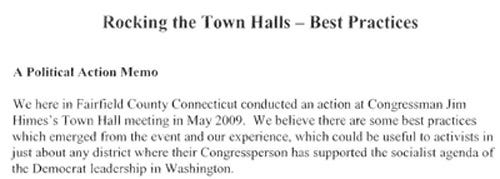
The Iron Law of Emulation is at work.  In 2009, liberals complained about astroturf protests at Democratic town halls, pointing out that the protesters had written guidelines.

The lobbyist-run groups Americans for Prosperity and FreedomWorks, which orchestrated the anti-Obama tea parties earlier this year, are now pursuing an aggressive strategy to create an image of mass public opposition to health care and clean energy reform. A leaked memo from Bob MacGuffie, a volunteer with the FreedomWorks website Tea Party Patriots, details how members should be infiltrating town halls and harassing Democratic members of Congress:


— Artificially Inflate Your Numbers: “Spread out in the hall and try to be in the front half. The objective is to put the Rep on the defensive with your questions and follow-up. The Rep should be made to feel that a majority, and if not, a significant portion of at least the audience, opposes the socialist agenda of Washington.”
— Be Disruptive Early And Often: “You need to rock-the-boat early in the Rep’s presentation, Watch for an opportunity to yell out and challenge the Rep’s statements early.”
— Try To “Rattle Him,” Not Have An Intelligent Debate: “The goal is to rattle him, get him off his prepared script and agenda. If he says something outrageous, stand up and shout out and sit right back down. Look for these opportunities before he even takes questions.”
Paul Sperry reports at The New York Post:
Organizing for Action, a group founded by former President Barack Obama and featured prominently on his new post-presidency website, is distributing a training manual to anti-Trump activists that advises them to bully GOP lawmakers into backing off support for repealing ObamaCare, curbing immigration from high-risk Islamic nations and building a border wall.
In a new Facebook post, OFA calls on activists to mobilize against Republicans from now until Feb. 26, when “representatives are going to be in their home districts.”
The protesters disrupted town halls earlier this month, including one held in Utah by House Oversight Committee Chairman Jason Chaffetz, who was confronted by hundreds of angry demonstrators claiming to be his constituents.
The manual, published with OFA partner “Indivisible,” advises protesters to go into halls quietly so as not to raise alarms, and “grab seats at the front of the room but do not all sit together.” Rather, spread out in pairs to make it seem like the whole room opposes the Republican host’s positions. “This will help reinforce the impression of broad consensus.” It also urges them to ask “hostile” questions — while keeping “a firm hold on the mic” — and loudly boo the GOP politician if he isn’t “giving you real answers.”

Thursday, November 24, 2016

Trump Voters

It’s common to view their concerns through a purely economic lens and call them protectionist. That is largely true as far as it goes: These people have been buffeted by globalization more than most Americans and see restrictions on trade and immigration as ways to boost the number of good-paying jobs open to American workers. But that’s far from all that they want, nor does a purely economic lens capture the way they view their votes.

They are best viewed through the lens of active citizenship. They take national identity seriously and imbue Americanism with an implicit bargain that flies in the face of liberal or libertarian cosmopolitanism. They believe that being American means more than voting and paying taxes. To them it means that if you work hard and play by the rules, the people who run the country owe it to you that you will live with dignity and respect.
...

I’m sure many people reading this are thinking, “Adding these voters to the conservative coalition can’t be done.” But in fact it can be done, as Wisconsin governor Scott Walker showed. Walker cut taxes and reduced the rate of spending growth while taking on public-employee labor unions. He also expanded government-funded health-insurance coverage by taking advantage of his state’s very generous Medicaid program to cover more poor people publicly and push working-class people into Obamacare’s exchanges. All factions in his coalition got something they valued.
Walker rode this balanced approach to two important political victories, winning a recall battle and then reelection despite being targeted by national progressive groups. In his three elections, Walker won virtually all of the historically Democratic white counties that Trump won, often running only a couple of percentage points behind Walker. Trump Democrats could also be called Walker Democrats.
Walker’s subsequent political missteps also show how one can lose these voters’ support by becoming too conventional a Republican. Walker veered to the right as he prepared his presidential campaign, catering to tea-party and Christian-conservative groups in nationally covered speeches in Iowa. He also tried to reduce funding for the University of Wisconsin system. His approval ratings dropped sharply and remain mired around 42 percent.

Thursday, September 1, 2016

The Senate Empire Strikes Back

With McCain and Rubio brushing aside challengers, no Senate GOP incumbent has lost a primary in 2016.  The tea party movement has lost a great deal of strength in these contests, thanks to Mitch McConnell.  Paul Kane reports at The Washington Post:
After seeing three senators fall during primaries in 2010 and 2012, as well as insurgents knock off establishment-backed Republicans in key seats, GOP strategists adopted an overwhelming force doctrine for handling primary challenges. They leveraged their financial edge and set out to define the opponent early, before he or she could gain momentum among the conservative grassroots, using modern technology and also spending heavily on positive TV ads to improve the incumbent’s standing among conservative voters.

That strategy was considered essential in protecting GOP incumbents like Kansas Sen. Pat Roberts and Tennessee Sen. Lamar Alexander in the 2014 midterms.
“The culture of primaries within the Senate GOP campaign apparatus is where the entire party needs to go,” said Josh Holmes, McConnell’s 2014 campaign manager whose firm, Cavalry, worked for McCain and several Republican incumbents. “If your job is to win elections you don’t just throw up your hands and say, gosh, I sure hope voters don’t pick the guy who can’t possibly win.”

The old sports adage that winning begets winning, and the corollary that losing begets losing, might apply here. In early 2014 a collection of Washington-based groups with ties to tea party activists were on the march, helping challengers in a clutch of primaries, including in a challenge to McConnell.
Now, after losing big in 2014, and barely engaging in 2016, those groups are a shell of their former selves.

Tuesday, August 16, 2016

Fighting the Tea Party

Elena Schneider writes at Politico:
The tea party has spent six years causing trouble for establishment Republicans in primaries, and Donald Trump mopped the floor with them on his way to the party’s presidential nomination. But suddenly, with the 2016 primary season winding down, the establishment is going on offense, pushing back hard against candidates backed by the hardline conservative House Freedom Caucus, including defeated GOP Rep. Tim Huelskamp — setting the stage for a titanic intra-Republican fight during the next Congress.
A collection of Republican donors and operatives loosely organized around several super PACs decided this summer to adopt newly aggressive tactics against GOP “obstructionists” — or as John Hart, a former aide to ex-Sen. Tom Coburn, calls them: “Rebels In Name Only” — after years of growing tea-party influence in Republican primaries and the halls of Congress.
Low-profile House candidates from Kansas to Georgia watched in astonishment this summer as hundreds of thousands of super PAC dollars poured into their primaries. The top aide for Roger Marshall, the Republican who beat Huelskamp in his Kansas primary, remembers sitting in his car when his phone pinged with news that donors unknown were about to inject a half-million dollars into rural Western Kansas.
“Who are these people?” Brent Robertson, Marshall’s campaign manager, thought at the time, weeks before his candidate became one of the few House primary challengers to knock off an incumbent this year.
Different groups and people involved have slightly different priorities, but the biggest goals were to both win specific primaries — Huelskamp’s clashes with House GOP leadership were well-known — and send a broader message.


Sunday, August 14, 2016

The Scamming of the Tea Party

What began as an organic, policy-driven grass-roots movement was drained of its vitality and resources by national political action committees that dunned the movement’s true believers endlessly for money to support its candidates and causes. The PACs used that money first to enrich themselves and their vendors and then deployed most of the rest to search for more “prospects.” In Tea Party world, that meant mostly older, technologically unsavvy people willing to divulge personal information through “petitions”—which only made them prey to further attempts to lighten their wallets for what they believed was a good cause. While the solicitations continue, the audience has greatly diminished because of a lack of policy results and changing political winds.
...
According to Federal Election Commission reports between 80 to 90 percent, and sometimes all the money these PACs get is swallowed in fees and poured into more prospecting. For example, conservative activist Larry Ward created Constitutional Rights PAC. He also runs Political Media, a communications firm. The New York Times reviewed Constitutional Rights’ filings and found: “Mr. Ward’s PAC spends every dollar it gets on consultants, mailings and fund-raising—making no donations to candidates.” Ward justified the arrangement by saying Political Media discounts solicitations on behalf of Constitutional Rights.
Let that sink in. Ward takes his PAC’s money and redistributes it to his company and other vendors for more messaging and solicitations, but suggests critics should rest easy since the PAC gets a discount on Political Media’s normal rate. Con

Monday, October 26, 2015

Tea and Anger

Karlyn Bowman writes at AEI:
Alongside the disapproval of both parties, discontent inside the GOP has been mounting as well. Only 26 percent of Republicans in a new Quinnipiac poll of registered voters approved of the way Republicans in Congress were handling their jobs (59 percent of Democrats approved of the way the way Democrats were handling theirs). In a May Pew poll, just 37 percent of Republicans felt the Republicans in Congress were keeping their campaign promises; 65 percent said they weren’t. In a YouGov online poll, only 27 percent of those who identified with or leaned to the GOP felt their party was united, while 53 percent said it was divided. Given Republican dissatisfaction with their party’s performance, it isn’t a surprise that Republicans are voicing stronger support for one-party control of government. Forty percent of them, up from 24 percent last year, said they preferred Congress and the president to be controlled by the same party, while 26 percent preferred different parties and 30 percent said it would make no difference. Gallup speculates that two things have caused the uptick in support for united control: first, the November 2014 GOP victory that put both houses of Congress under their control and, second, the upcoming 2016 election, where they clearly believe they can be more successful with one party control.
Gallup reports:
Americans' support for the Tea Party has dropped to its lowest level since the movement emerged on the national political scene prior to the 2010 midterm elections. Seventeen percent of Americans now consider themselves Tea Party supporters, and a record 54% say they are neither supporters nor opponents.
...

Almost two-thirds (63%) of conservative Republicans were supporters in the earliest polls. About four in 10 (42%) still support the Tea Party, but the 21-percentage-point drop since the 2010 polls is second only to the plunge in support from Republican leaners (independents who lean toward the GOP). A majority (52%) of GOP leaners, a key source for Republican votes, were supporters in the 2010 polls, but a 29-point drop has left only 23% still supporting the movement.

Tuesday, June 2, 2015

The Sanders Threat

At National Journal, Josh Kraushaar writes of Bernie Sanders:
In the past, the notion of an unreconstructed socialist winning widespread support—even as a protest candidate—would have been fanciful within the Democratic Party. The closest recent parallel to Sanders is Dennis Kucinich, who tallied less than 4 percent of the total primary vote in 2004. Ralph Nader's high-water mark was in 2000, when his 2.7 percent third-party tally was nonetheless enough to spoil Al Gore's hopes for the presidency. Other progressive insurgents within the party, from Vermont's own Howard Dean to Bill Bradley to Gary Hart, were squarely within the party's mainstream—even if they stood on the leftward side of it.
...
ke the tea-party stirrings among Republicans in 2009, the Sanders boomlet is a sign that liberal activists are getting restless, and looking for a fight. For the first time, congressional Democrats have shown a willingness to torpedo an important presidential initiative to placate the base. Organized labor is threatening to challenge vulnerable moderate Democrats in primaries if they vote for the president's fast-track trade authority. One of the most pugilistic progressives in Congress is getting closer to a Senate bid, even though it could endanger the Democrats' prospects for a Senate majority in 2016. The newly-aggressive grassroots are letting their ideology blind them to the political realities of the moment.
...
This is the real threat that Sanders poses to Clinton—not as a candidate, but as a sign that the Democrats' version of the tea party is ascendant at the worst possible time. By nonideological standards, Sanders is a weak challenger; he's got an unhealthy mix of Donald Trump's ego and Michele Bachmann's bombast. He's won statewide office in Vermont, the most liberal state in the country, with a population smaller than Bachmann's old congressional district.Sign up form for the newsletter

But Sanders is poised to play the same role as Mitt Romney's 2012 GOP tormentors, a motley cast of characters who stood no chance of winning the nomination but gradually pushed Romney to the right. After all, Romney's infamous line about "self-deportation" was a reaction to the fear that he was vulnerable on his right flank from the likes of Rick Santorum and Newt Gingrich.

Thursday, March 26, 2015

Conservatives Coalesce Around a Consensus Candidate?

At The Cook Political Report, Amy Walter explains why it will be tough for conservatives to coalesce around a consensus candidate:
First, despite the rise of the Tea Party, the overall primary electorate is majority "somewhat conservative" to "moderate" in ideology. In 2012, according to exit polling, 34 percent of the GOP electorate defined itself as "very conservative", while the other 57 percent defined themselves as either "somewhat conservative" (33 percent), or "moderate," (24 percent). This obviously fluctuates state by state with almost half of Iowa caucuses goers defining themselves as very conservative and 35 percent of New Hampshire Republicans identifying themselves as moderate. Even so, taken as a whole, the GOP electorate is not as ideologically aligned to the far right some make it out to be.
Then there's that fact that in a field as crowded as this one, it's hard to believe that any candidate is going to get the "very conservative" space to him/her self. In 2012, Mitt Romney was the obvious establishment candidate. The three anti-establishment candidates (Rick Santorum, Newt Gingrich and Ron Paul), split up that very conservative vote. Santorum took the lions' share with 36 percent, but Gingrich took another 26 percent and Paul siphoned off 7 percent. Meanwhile, Romney took almost half (46 percent) of the somewhat conservative and 48 percent of the moderate vote. In 2016, Ted Cruz, who is clearly gunning to be the face of the conservative wing of the party, will face a crowded field of candidates for that space including Rand Paul, Ben Carson, Scott Walker, Marco Rubio, Rick Santorum and Mike Huckabee.

Sunday, November 23, 2014

Learning to Govern

At The Hill, Scott Wong notes that the leaders are publicly trying to take a hard rhetorical line against the Obama immigration plan.
GOP leadership aides are even distancing themselves from a comment from powerful House Appropriations Chairman Hal Rogers (R-Ky.) that angered GOP immigration hawks like Rep. Steve King of Iowa. Rogers suggested that conservatives’ efforts to defund Obama’s actions through an appropriations bill would be “impossible” because U.S. Citizenship and Immigration Services gets its money from fees.
“Rogers was not prodded by leadership to do that,” a GOP aide told The Hill. “He was not speaking on behalf of leadership.”
At the same time, GOP leaders are working hard to get their own members on board the no-shutdown train.
They don’t want to be caught in a trap the White House sets to goad Republicans into shutting down the government or impeaching the president.
And their success can be seen in the fact that even GOP rabble-rousers are toning down the impeachment talk.
Sen. Jeff Sessions (R-Ala.), an anti-immigration hard-liner in the Senate, ruled out impeachment on Friday. While King hasn’t gone that far, the vocal Obama critic acknowledged that pursuing impeachment would backfire.
“I’ll just say nobody wants to go there,” King, who sat in the audience of Bill Clinton’s impeachment hearings in 1998, told reporters this week. “Those things don’t end well for our country. It divides our country and it pits us against each other.”
The Iowa Republican who sits on the Judiciary Committee has been pushing legislation to defund agencies in the government that would pay for Obama’s executive immigration order.
That points to the challenge for Boehner and his leadership team.
Still, other conservatives who have been thorns in the side of Boehner appear to be trying to help their leadership find a way out.
Alex Isenstadt and Kyle Cheney write at Politico:
What has changed is the underlying balance of power in the party and, perhaps, the terms of debate within the GOP over how to deal with the Democratic Party and its surprisingly aggressive leader. Obama might be behaving like a usurping monarch without a mandate, in the eyes of the newly powerful GOP, but no one is seriously threatening to impeach him — as Republicans have repeatedly done in past years. Nor, despite the angry rhetoric, does there seem to be a serious possibility of government shutdown.
Yes, outliers are still threatening actions that could lead to a stalemate a la 2013: Arizona Rep. Matt Salmon, voicing anger against the executive action in a way that typified many Southern and Western Republicans, called the move an “impeachable offense,” and earlier circulated a letter urging House Appropriations chairman Hal Rogers (R-Ky.) to defund any presidential effort to supply work permits or green cards to illegals — potentially prompting a veto and a shutdown. The more than 50 representatives who signed the Salmon letter included many of the same House members who adopted the strategy in 2013 that led to a shutdown then.

And yet Rogers and the House leadership, as well as a substantial portion of the Republican caucus, have made it clear they’re not ready to take that course again. “People are being very thoughtful about this,” said Tennessee Rep. Marsha Blackburn, who is widely seen as a rising star in tea party circles. “I’ve heard no one mention a shutdown except the press.”

Thursday, September 25, 2014

GOP Factions: A Diagram

A new study from the Public Religion Research Institute Institute  nicely sums up the relationship of the GOP, the Tea Party, and the Christian Right.  They overlap, but are not identical.


PRRI2

This analysis is roughly consistent with what Henry Olsen observed earlier in the year:

REPUBLICAN VOTERS fall into four rough camps. They are: moderate or liberal voters; somewhat conservative voters; very conservative, evangelical voters; and very conservative, secular voters. Each of these groups supports extremely different types of candidates. Each of these groups has also demonstrated stable preferences over the past twenty years.
The most important of these groups is the one most journalists don’t understand and ignore: the somewhat conservative voters. This group is the most numerous nationally and in most states, comprising 35–40 percent of the national GOP electorate. While the numbers of moderates, very conservative and evangelical voters vary significantly by state, somewhat conservative voters are found in similar proportions in every state. They are not very vocal, but they form the bedrock base of the Republican Party.

Thursday, June 26, 2014

Looking Back on This Week's Primaries

Alexander Burns writes at Politico about what happened after Cochran lost his first round:
Back in Washington, Cochran’s most important allies resolved to muffle their anxiety and stick with him for another three weeks. The Chamber of Commerce polled the race, concluded the senator had a difficult but viable path to victory; the group began brainstorming inventive ways to make a splash in the state, culminating with a sensational commercial starring NFL legend Brett Favre. National Republican Senatorial Committee political director Ward Baker, confronted with Beltway pessimism about Cochran’s chances, repeatedly told Republicans in D.C.: “We don’t leave our people on the field.”
Within a week, a powerful operation had swung into motion to save the 76-year-old legislator. Rather than making peace with his firebrand challenger, state and national Republicans redoubled their efforts to tear down Chris McDaniel, whom they considered a political lightweight taking advantage of a virulently anti-Washington mood. In interviews on the day and night of the runoff vote, strategists and party leaders described the campaign as a near-perfect turnaround – considering the slimness of Cochran’s victory, it had to be.
By the time the second round of balloting rolled around on June 24, a collection of groups that might be dubbed the Emergency Committee for Mississippi had spent millions on new television ads, knocked on tens of thousands of doors and reached out to voters – including African-Americans and Democrats – who had likely never voted before in a GOP primary.
Nate Cohn writes at The New York Times:
Turnout hadn’t increased in a Senate runoff primary election in 30 years until Tuesday night, when a momentous surge of voters allowed Senator Thad Cochran to defeat Chris McDaniel, a Tea Party-backed state senator, in Mississippi’s Republican Senate runoff.

Overall turnout has surpassed that from the initial primary by 14 percent, or 45,465 votes, so far. In that contest, Mr. McDaniel edged Mr. Cochran but fell short of the 50 percent necessary to avoid a runoff. Turnout increased by 15.9 percent in the counties that reported 100 percent of their precincts.

The increase in turnout was generally to the benefit of Mr. Cochran. Turnout increased by 34 percent in the counties where Mr. Cochran was strongest and won at least 62 percent of the vote. But turnout also increased by 18 percent in counties where Mr. McDaniel was strong.
Sam R. Hall writes at The Clarion-Ledger:
In the primary, Cochran and his supporters made the race as much about McDaniel as anything. They tried to paint McDaniel as an extremist with questionable background who would be a loose cannon in the general election and — if elected — in Washington. They attacked him on the nursing home scandal, called him a trial lawyer and sent clips of his old radio show to voters in the form of a talking card.
In the runoff, the campaign changed their message. They started talking about what Cochran had done for Mississippi. They embraced his legacy of bringing billions of dollars to the state and helping to build schools, roads, bridges, research facilities and countless other projects.
In other words, instead of giving the voters someone to vote against, Cochran gave them someone to vote for.
James Hohmann writes at Politico:
Two-term Rep. James Lankford crushed T.W. Shannon — the former speaker of the state House who was backed by tea party hero Ted Cruz — and avoided a runoff in the special election to succeed the retiring Tom Coburn.
Before being elected to the House in 2010, the 46-year-old Lankford ran the biggest Baptist summer camp in the state. This helped him build an extensive network among the religious right, and they mobilized for him across the state.
Shannon is both an African-American and a member of the Chickasaw Nation, whose gambling interests make it a major, deep-pocketed player in Oklahoma politics. But the Baptists were far more energized than the tribes, and Lankford far outperformed polls that showed him with a slight lead but below the majority needed to avoid a runoff.
Lankford faces no credible Democratic opposition in the fall.
 Karl Rove writes:
 Tuesday's outcomes suggest local tea party groups have more influence than the national groups purporting to speak for them. A network of Mississippi tea party groups made Mr. McDaniel competitive. In Oklahoma, national groups like Club for Growth, Senate Conservative Fund and FreedomWorks could spend and endorse all they wanted, yet local tea party support for Mr. Lankford blunted these inside-the-Beltway groups' impact in the Sooner State.
This has happened a lot this year. Republican incumbents in Kentucky, South Carolina and Texas, and GOP Senate candidates in Arkansas, Colorado, Georgia, Montana, North Carolina, South Dakota and West Virginia all avoided or vanquished tea party challengers by keeping close to their state's politics and offering a message that grabbed a significant slice of local tea party support.
Eight of nine GOP House members targeted by the Club for Growth escaped serious opposition and the one who did face serious opposition won 2 to 1. On the flip side, every national tea party group sat out the June 10 Virginia Seventh Congressional District primary. Local tea party groups provided the volunteers and enthusiasm that propelled David Brat to his stunning victory over House Majority Leader Eric Cantor.

Monday, June 16, 2014

Raul Labrador = Fredo Corleone

In a Politico article comparing House GOP leadership politics to The Godfather, I write: "A number of the Tea Party folks bear a passing resemblance to Fredo Corleone: Their skill sets don’t exactly match their aspirations."

David Drucker reports at The Washington Examiner:
As Rep. Raul Labrador launched his upstart bid for House Majority Leader on Friday, he ran into a big problem: He didn't have his colleagues' phone numbers.
House Republican members and GOP aides, in interviews with theWashington Examiner over the weekend, said that the Idaho Republican has made concerted attempts to woo his colleagues, whose votes he is asking for in Thursday's secret-ballot election for majority leader.
But events over the weekend showed why Labrador's bid to upset House Majority Whip Kevin McCarthy, R-Calif., for the conference's influential No. 2 post remains a long shot.
Labrador, a Tea Party favorite, didn't have basic contact information for many of his colleagues, such as their direct cell phone numbers. Republican aides said Labrador's staff was calling their offices and asking for it.
I rest my case.

Wednesday, June 11, 2014

Cantor Loses, Graham Wins

What account's for Eric Cantor's surprising loss in a GOP primary?  At The Richmond Times-Dispatch, Jeff Schapiro writes:
In Tuesday’s primary, Cantor was trapped in a crossfire over immigration reform. He attempted to strike a hard line against amnesty, dramatically scuttling a House vote on legislation that would make it easier for illegal immigrants serving in the U.S. military to become citizens.

But Brat, echoed by high-profile conservative broadcasters and pundits, attacked Cantor, the only Jewish Republican in Congress, as soft on immigration. They noted that he’d spoken of reaching an accommodation with the Obama White House, perhaps allowing children born in this country to illegal immigrants to naturalize.

Cantor’s maneuvering on immigration was illustrative of a larger issue: a perception within Republican circles that Cantor, in his determination to succeed John Boehner as speaker, seemed more interested in positioning for the next phase of the nonstop news cycle than embracing a distinct agenda.

Further, Cantor — a self-styled Young Gun, who along with Paul Ryan, the 2012 vice presidential nominee, was a symbol of Yuppie Republicanism — became a distant figure to many of his Virginia constituents, seen only on Sunday talk shows and in the pages of national newspapers.

Cantor’s priority was traveling the country, raising money from corporate and financial leaders. The torrent of Cantor-generated cash would shore up a smaller but more influential constituency for the often-aloof lawyer: a handful of conservatives within the Republican caucus who would decide the speakership.
Meanwhile, Lindsey Graham (R-SC) cruised to an easy primary victory, even though he had a closer association with immigration reform.  How did he survive?  Josh Kraushaar writes at National Journal:
Unlike other targeted Republicans who have rebranded themselves in the run-up to an election, Graham has stuck to his moderate principles on immigration (he supports comprehensive reform), the environment (he's argued climate change needs to be addressed), and Supreme Court justices (he voted to confirm Sonia Sotomayor and Elena Kagan on the principle that senators should judge on qualifications, not ideology). In contrast to several other endangered Republican senators who spend most of their time in Washington—neighboring Sen. Thad Cochran, who's at risk of losing a runoff this month, is a prime example—Graham regularly returns home on weekends to rallies, party events, and American Legion posts, where he tells well-wishers to greet him by his first name. "Everyone calls him Lindsey back home, no one calls him Senator Graham," [Katon] Dawson said.
...
Graham's comfortable victory is a testament to the fact that mastering the fundamentals of politics—strong relationships with colleagues and maintaining regular connections with voters—still plays an outsize role in winning elections. As Slate's Dave Weigel pointed out, while many Republicans have lately lost primaries for ideological reasons, a disproportionate number were defeated because they're old. Cochran might have won his primary against Chris McDaniel if he campaigned more vigorously in the final week, but instead he faced late-breaking questions about his rustiness on the campaign trail.
That's never been an issue with Graham.