Search This Blog

Showing posts with label Michigan. Show all posts

Friday, October 23, 2026

Petroleum Politics in Late October

Our most recent book is The Comeback: The 2024 Elections and American Politics. It includes a chapter on congressional and state elections.  In 2024, the book explains, the Democrats' problems involved reality, not just messaging.  Two years later, Republicans own the reality problems, including the Iran quagmire and the resulting economic pain.

 Natassia Paloma at The El Paso Times:

Gas prices remain above $4 a gallon nationwide as crude oil prices hover near $100 a barrel.

As of Friday, Oct. 23, the national average for a gallon of regular gasoline stood at $4.29, down about 20 cents from a week earlier but still more than $1 higher than the same time last year, according to AAA.

Diesel prices averaged $5.75 a gallon, compared with $3.11 a year ago
.

Will Kubzansky at Bloomberg:

Gas prices in two Midwestern battleground states saw further hikes on Thursday as the region's market grapples with a refinery issue in Illinois.

In Michigan, prices rose to $4.74 a gallon on Thursday, up from $4.59 a gallon on Wednesday, according to GasBuddy, a fuel savings app that tracks prices in live time. In Ohio, prices stood at $4.34 a gallon, up from $4.05 a gallon on Wednesday. GasBuddy's prices differ slightly from those released by AAA, which issues nightly updates on prices.

A shut-down of a key unit at ExxonMobil Holdings Corp.'s Joliet, Illinois, refinery had already pushed prices significantly higher on Wednesday in both states.

Millions of homeowners across the Northeast could pay more to heat their homes this winter, as heating oil prices remain high after surging in the months following the start of the Iran war in late February.

While over 90 percent of U.S. households use natural gas and electricity to warm their homes, heating oil is still widely used in the Northeast, a particularly cold-weather region. According to the latest data from the Energy Information Administration (EIA), only four percent of households nationwide used heating oil as their primary heating source, while five percent used propane.

...

Maine has the nation’s highest share of homes relying on heating oil as the main heat source, according to the latest state-level Census Bureau data available on fuels used in homes, which refers to 2022, at around 50 percent. The number was obtained by calculating the proportion of occupied housing units whose main heating fuel was “fuel oil, kerosene, or other.”

New Hampshire, Vermont, Connecticut, Alaska and Rhode Island follow with shares between 37 percent and 25 percent. Massachusetts, New York and Pennsylvania are next with shares between 20 percent and 12 percent.

Peter McGuire at Maine Public Radio:

Maine heating oil has hit a new record high price as the federal government scrambles to stabilize prices ahead of cold winter weather.

The average statewide price was $6.04 per gallon on Oct. 19, according to the Maine Department of Energy Resources, which tracks weekly oil prices. That means it will cost about $750 more to fill a 275-gallon oil tank than it did a year ago, according to the department.


Wednesday, October 14, 2026

GOP Dunkirk

  Our most recent book is The Comeback: The 2024 Elections and American Politics. It includes a chapter on congressional and state elections.  In 2024, the book explains, the Democrats' problems involved reality, not just messaging.  Two years later, Republicans own the reality problems, including the Iran quagmire and the resulting economic pain.

Meredith Lee Hill, Andrew Howard and Mia McCarthy

Some top congressional Republicans have privately concluded that it is likely impossible for them to keep control of the House of Representatives in the midterm elections, and they are now focused on limiting the scale of the defeat and salvaging the party’s Senate majority.

Five senior Republican lawmakers, all granted anonymity to speak candidly about their party’s dire position, told POLITICO the House had all but slipped away.

One senior House Republican said the GOP’s goal at this point was to “save as many Republican seats as we can.” The president, this person said, was not helping.

“President Trump has made this election all about himself,” the lawmaker said. “Now we have to survive that political storm.”

A second Republican member of Congress said the movement of campaign advertising made plain which side was in control of the midterms. This lawmaker predicted Democrats would pick up about 10 seats, more than enough to take control of the chamber.

Even in newly redistricted red states like Florida and Texas, this person said, Republican candidates were “hanging on with their fingernails.”

Republicans have already fallen back from several contested House districts that they feel are no longer winnable, including those held by Rep. Mariannette Miller-Meeks of Iowa and Tom Kean Jr. of New Jersey. Trump carried their districts just two years ago. The party last week gave up on an Omaha-based district held by retiring Rep. Don Bacon.

Sunday, August 30, 2026

Is Trump a Secret Asset of the DSCC?

Our most recent book is The Comeback: The 2024 Elections and American Politics. 

War and economic woes will hurt the GOP in November.  The only question is how much.

Jonathan Martin at POLITICO:

As the traditional start of the campaign season draws near, though, Republicans are increasingly worried they may be consumed by a worsening prairie fire.

“He’s in serious trouble in farm country,” Sen. Kevin Cramer (R-N.D.) told me. “He being Trump — and Trump is us. I’m not very optimistic.”

The triple-whammy of tariffs, expensive diesel and fertilizer and now imported beef has created a crisis for agriculture-state Republicans.

...

The culprits are obvious: the exorbitant cost of living, Trump’s deep unpopularity with the political center and the massive enthusiasm gap Democrats enjoy over Republicans.

The fear, GOP officials tell me, is that these sentiments are increasingly becoming locked in with voters; that the grim political environment — caused by spiking gas prices after the ceasefire with Iran collapsed last month — is close to irreversible. Or to borrow from Haley Barbour, that sage of Mississippi: In politics, good gets better and bad gets worse.

For months, the shorthand conversation among political professionals has not been if this will be a difficult election for Republicans but whether it will be 2018 or 2006.

Which is to say: Will 2026 bring a backlash against the party in power, but one largely confined to House losses because of polarization, limiting Democratic strength in Senate races? Or will there be a greater wave that grows high enough to sweep out Republicans thought to be safe, flipping both chambers of Congress in the process?
Once Iran hostilities restarted and it became clear that there would be no Supreme Court vacancy, as there crucially was in 2018, the answer became clear. Republicans would not be able to get off defense and lacked the court fight that would hand them their best opportunity to go on offense.

 WSJ editorial: 

The November midterm elections will be in part a referendum on President Trump’s border taxes, and most polls show them losing. A new poll by Overton Insights and the Texas Public Policy Foundation finds that tariffs are unpopular in the Lone Star State, especially among Hispanics. Houston, Republicans have a tariff problem.

The survey, which was shared with us exclusively and will be released next Wednesday, shows that Texans overall disapprove of his tariffs, 54% to 46%. Texans who didn’t vote in a party primary—generally independents and folks who are less partisan—disapproved of them, 68% to 32%. Hispanics gave them the thumbs down, 69% to 31%.


The latter is especially notable because Mr. Trump won 55% of the state’s Hispanic vote in 2024, no doubt in part owing to frustration with Democrats’ handling of inflation. But Hispanics also strongly oppose the President’s blunderbuss border taxes targeting trade partners like Mexico and Canada, which raise costs for consumers and businesses.

The Texas economy is heavily exposed to tariffs because of its cross-border trade and integrated supply chains with Mexico. Texas traded $303 billion in goods with Mexico and overall exported $299 billion of manufactured products in 2025. The latter include electronics and computers ($71 billion), chemicals ($55 billion) and transportation equipment ($29 billion).

Because Texas is the largest state exporter of goods, it suffers a bigger brunt from retaliatory tariffs, such as those that Canada plans to levy on the U.S. in response to Mr. Trump’s tariff escalation. In case he hasn’t noticed, the tariffs have become an albatross for Republicans in close races across the country, including Texas.

Sunday, August 23, 2026

Trump's Errors Threaten GOP Senate Seats

 Our most recent book is The Comeback: The 2024 Elections and American Politics. 

War and economic woes will hurt the GOP in November.  The only question is how much.

The beef issue is a classic concentrated-losers/diffuse-gainers situation.  The GOP was in a similar bind in 1986 with oil prices.


Coming soon to a Democratic attack ad near you:


Trump has restarted a trade war with Canada.  Bad economics, bad politics.

David Frum at The Atlantic:

More than 30 percent of Ohio’s exports go to Canada, and almost 40 percent of Michigan’s. Both states will this year elect a U.S. senator and fill open governor’s seats. Not only is Trump putting at risk his party’s position in purple Michigan, but suddenly the races in beet-red Ohio look in jeopardy too. These states may turn control of the Senate—and Trump’s chances of facing meaningful accountability next year for his law-breaking and corruption.

Trump’s theory of his trade war, like his theory of his Iran war, is that the bigger bully always wins. Size counts for a lot, but not for everything.

As Trump has declared over and over again, his ultimate goal in this trade war is to add Canada as a 51st state. Why? To make the United States look bigger on the map. For that goal, which excites ultra-MAGA crackpots, Trump is hazarding not only America’s most important trading relationships but very possibly every other political equity he holds, including avoiding investigations and accountability by a Democratic House and Senate after January 2027


Thursday, August 6, 2026

Socialists and Primaries

Our most recent book is The Comeback: The 2024 Elections and American Politics. It includes a chapter on congressional and state elections. The 2026 environment is very favorable for the Democrats, but a hard leftward shift could spoil their chances.

 Aaron Blake and Eric Bradner at CNN:

The progressive effort to remake the Democratic Party triumphed in battleground Michigan on Tuesday, as former public health official Abdul El-Sayed defeated the more moderate Rep. Haley Stevens — and the party’s establishment, which had rallied behind her.

...

It’s difficult to completely isolate the Israel and AIPAC factor. And AIPAC did get a win Tuesday, having spent more than $2 million to help Missouri Rep. Wesley Bell easily fend off democratic socialist former Rep. Cori Bush.
...

A pair of democratic socialists also won key House primaries in Michigan.

Perhaps the biggest one was climate activist William Lawrence’s win in the 7th district. Lawrence prevailed after two more establishment-oriented candidates — former US Ambassador to Ukraine Bridget Brink and Navy SEAL veteran Matt Maasdam — split the rest of the vote.

 And this is a battleground general election race. That means the Sanders wing of the party now confronts major proving grounds in both the Senate race and a very important House race.

Lawrence’s campaign was heavily criticized by the Congressional Black Caucus and even House Minority Leader Hakeem Jeffries, after the Huffington Post published Lawrence’s 2024 remarks saying that Black political leaders “defang the White left.”

CNN is also now projecting that democratic socialist state Rep. Donavan McKinney ousted Rep. Shri Thanedar in the Detroit-based 13th district.
The result might have been less about policies than racial representation — the majority-Black city had recently been without a Black representative for the first time since the 1950s — but it’s still a win for DSA.


Wednesday, May 6, 2026

Trump Clout in IN Primrary, Bad Sign for GOP in Michigan

Our most recent book is The Comeback: The 2024 Elections and American Politics. It includes a chapter on congressional and state elections.

Susan Page at USA TODAY:

He's still the boss.

President Donald Trump is beset by rising gas prices, falling approval ratings and an unpopular war in Iran. But in the Indiana primary May 5 he demonstrated his continued grip on the Republican Party by delivering a thumping to a half-dozen state senators who defied his demands to redraw congressional lines.

Of seven GOP senators who earned his ire, five lost their party's nominations to challengers the president had endorsed, with one race still too close to call.

It was an unlikely test, and an expensive one, in contests that typically attract little attention.

"Trump is perhaps not as popular in my district as he once was," Spencer Deery, one of the incumbent senators, told CNN while the votes were being counted, "but he is still overwhelmingly popular."

Patrick Svitek at CNN:

Michigan Democrats on Tuesday won a special election for a state Senate seat in another party over-performance after the district was almost evenly divided in the last presidential election.

Democratic firefighter Chedrick Greene defeated GOP lawyer Jason Tunney for a seat to determine whether Democrats would retain control of the state Senate. With an estimated 93% of votes in, Greene led Tunney by 19 points.


Tuesday, December 9, 2025

Democratic Tea?

Our new book is The Comeback: The 2024 Elections and American Politics. It includes a chapter on congressional and state elections. 

Holly Otterbein and Stephen Neukam at  Axios:

Hours after former NFL star Colin Allred quit the Texas Senate race Monday, rabble-rousing Rep. Jasmine Crockett jumped in — the latest sign that Democrats are facing a Tea Party-style revolt by progressives.

Why it matters: Senate Democratic leaders this year have tried to tip the scales in favor of their favorite 2026 candidates in several states — but they've lost some power as much of the party's base has turned on them in President Trump's second term.
...

Zoom out: In Ohio and North Carolina, Schumer helped clear the 2026 Democratic primary fields for former Sen. Sherrod Brown and former Gov. Roy Cooper. But in several other states, Democratic leaders have failed to head off contested primaries — and party-approved candidates are struggling to stake out leads. It's all unfolding amid an intraparty rebellion that's drawn some comparisons to how the conservative Tea Party movement reshaped the GOP nearly two decades ago.
  • In Maine, polls show oyster farmer Graham Platner, a progressive Democrat, as still competitive against Schumer-endorsed Maine Gov. Janet Mills — even after reports Platner made controversial comments online and had a Nazi-linked tattoo (which he's covered up).
  • In the Michigan Senate primary, mainstream Democrats have complained that Rep. Haley Stevens, the favorite of party officials, has run a lackluster campaign against liberal state Sen. Mallory McMorrow and Bernie-Sanders backed Abdul El-Sayed, a doctor.
  • In Iowa, the establishment favorite, Josh Turek, faces a large primary field.

Friday, December 13, 2024

Slotkin v. Identity Politics

In Defying the Odds, we talk about the social and economic divides that enabled Trump to enter the White House. In Divided We Stand, we discuss how these divides played out in 2020. Our next book will discuss the extraordinary fight between an elderly white ex-president and a younger Black/Asian woman. 

Marc Rod at Jewish Insider:
Sen.-elect Elissa Slotkin (D-MI) said Wednesday that the Democratic Party needs to abandon “identity politics” to succeed in the future, and discussed her strategy to appeal to both Jewish and Muslim voters in Michigan on a webinar with the Jewish Democratic Council of America.

“I feel very strongly that identity politics — we need to have it go the way of the dodo,” Slotkin said on the webinar. “The idea that you can say ‘this group, because of their race or religion or ethnicity, is going to do this predictable voting behavior’ is not right. Coalitions are changing. Voters are changing.”

Slotkin said that she experienced this personally on her campaign, giving an example of an event with a group of Pakistani-American doctors she assumed would be reliable voters for Vice President Kamala Harris, but were actually all voting for Trump. She said the Democratic Party has also made mistaken assumptions about Latino and African American voters.

“You’ve got to appeal to people’s core issues regardless of their historical voting patterns, and you can’t get lazy,” Slotkin said. “And I think Donald Trump was not lazy.”

She described pocketbook issues as the key question in the race, and said her campaign had tackled the issue head-on. Voters, she said, were “confused” about what Democrats’ priorities were, especially at the presidential level, following President Joe Biden’s departure from the race.

Wednesday, December 4, 2024

President-Senate "Mismatches"

Our most recent book is titled Divided We Stand: The 2020 Elections and American Politics.  Among other things, it discusses state and congressional elections.

Drew DeSilver at Pew:
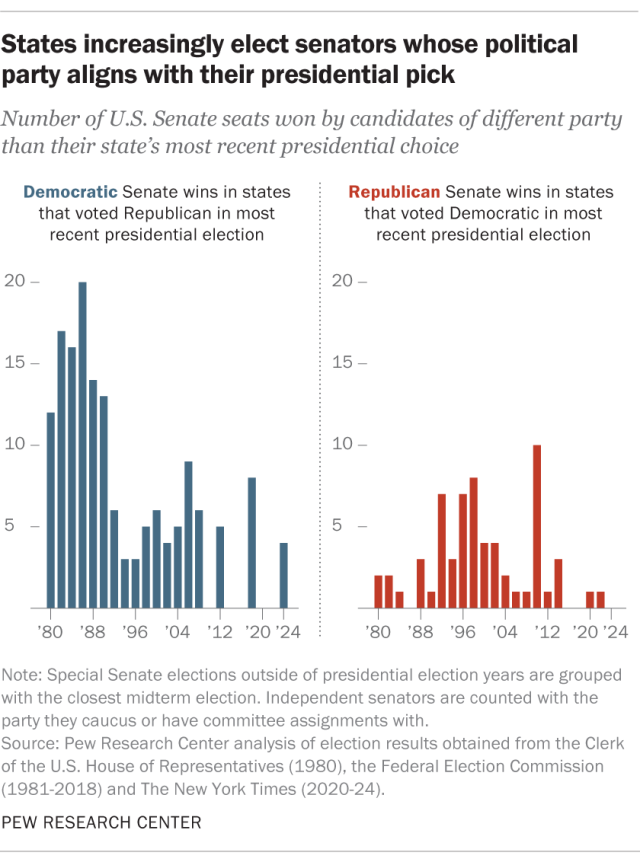
Four states that Republican Donald Trump carried in this month’s presidential election also elected Democratic senators. That may not seem like a lot, but it’s twice as many “mismatches” between states’ presidential and U.S. Senate results as in all Senate elections held in 2020, 2021 and 2022 combined.
  • This year, the states that chose Trump for president and sent a Democrat to the Senate were:Arizona: Rep. Ruben Gallego won the seat that independent Sen. Kyrsten Sinema is vacating.
  • Michigan: Rep. Elissa Slotkin will succeed retiring Sen. Debbie Stabenow.
  • Nevada: Incumbent Sen. Jacky Rosen fended off political newcomer Sam Brown.
  • Wisconsin: Incumbent Sen. Tammy Baldwin edged out financier Eric Hovde.
No states had mismatches in the other direction, electing Republican senators but picking Democrat Kamala Harris for president.

The four mismatches, out of 34 Senate elections this year, made for a “mismatch rate” of nearly 12%. That’s the highest since the 2017-18 cycle, when the mismatch rate was 22%, according to Pew Research Center’s analysis of results going back to 1980. Along with a Democratic win in the 2017 special Senate election in Alabama, seven out of 35 Senate races in the 2018 midterms (including two special elections) went to a different party than the state’s 2016 presidential vote did.

President-Senate mismatches of this sort used to be fairly common. But since 1990, fewer than half of Senate elections have diverged from their state’s most recent presidential vote – and over the past dozen years, the trend has been for fewer and fewer to do so.

BUT the AZ, MI, and NV results ended with same-party delegations in each state. WI remains split-party.  

Hannah Recht and Eric Lau at WP:

Voters in Montana, Ohio, West Virginia and Pennsylvania — states that Donald Trump won on Nov. 5 — also voted for Republicans to take over Senate seats currently held by Democrats, helping Republicans secure control of the upper chamber.

After these flips, only Maine, Pennsylvania and Wisconsin will send a split-party delegation of one Democrat and one Republican to the Senate. That is the lowest number since Americans began directly electing senators more than a century ago.


Friday, November 29, 2024

How Dems Lost Ground in Atlanta and Wayne County

Our most recent book is titled Divided We Stand: The 2020 Elections and American Politics. Our next book will look at the 2024 election. 

 Robert Gebeloff, Eli Murray, Elena Shao, Charlie Smart and Christine Zhang  at NYT:

In Atlanta and its suburbs, both candidates found new voters, but Ms. Harris’s gains in precincts where white voters were the largest racial or ethnic group were canceled out by losses elsewhere. Mr. Trump’s uptick in support from voters of color across Atlanta, along with improved performance in the state’s rural areas, was enough for him to win Georgia — a swing state he narrowly lost to Mr. Biden in 2020.

In Wayne County, which includes Detroit, Ms. Harris struggled to capture the support of Arab-American voters, many of whom had been turned off by the Biden administration’s Middle East policies. In a swath of voting precincts spanning Dearborn and Hamtramck, which have the nation’s highest concentration of people of Arab ancestry, Mr. Trump picked up thousands of votes compared with 2020, while the Democratic Party lost an even bigger number. Countywide, precincts with high shares of Arab residents made up just 6 percent of the electorate but accounted for more than 40 percent of the decline in Democratic votes.

Sunday, October 20, 2024

Musk Schemes

Our most recent book is titled Divided We Stand: The 2020 Elections and American Politics.  Among other things, it discusses party organizations and campaign finance.

Rick Hasen:

Hugo Lowell: “Elon Musk says on stage at a town hall that America PAC will be awarding $1 million every day until the election to a registered Pennsylvania voter who has signed his petition. Musk awarded the first $1 million this evening to someone at the town hall, bringing the guy onto the stage and handing him a jumbo check, lotto-style. Musk is essentially incentivizing likely Trump voters in PA to register to vote: Petition is to support for 1A and 2A, so basically R voters. But they also have to be registered to vote, so if they weren’t already, they would do it now.”

Though maybe some of the other things Musk was doing were of murky legality, this one is clearly illegal. See 52 U.S.C. 10307(c): “Whoever knowingly or willfully gives false information as to his name, address or period of residence in the voting district for the purpose of establishing his eligibility to register or vote, or conspires with another individual for the purpose of encouraging his false registration to vote or illegal voting, or pays or offers to pay or accepts payment either for registration to vote or for voting shall be fined not more than $10,000 or imprisoned not more than five years, or both…” (Emphasis added.)


Friday, October 4, 2024

Trump GOTV

Our most recent book is titled Divided We Stand: The 2020 Elections and American Politics.  Among other things, it discusses party organizations and campaign finance.  Trump is outsourcing his ground game.

Steve Contorno and Fredreka Schouten, CNN:
Targeting irregular voters, teaching supporters to surveil polling places and bombarding states with voting-related lawsuits – this is the machine the Trump campaign has built for an election that many expect to hinge on just tens of thousands of ballots cast across seven battleground states. It’s a gamble, Trump’s campaign internally acknowledges, but one that they insist is built on data they have collected over nearly a decade and tested for the past six months.

That, and tens of millions of dollars injected lately by a super PAC aligned with tech billionaire Elon Musk, one of Trump’s most vocal and influential supporters.

The campaign’s untraditional strategy was on display when conservative commentator Tucker Carlson came to Grand Rapids last month. He urged his audience to download an app – 10xVotes – that promises to help them find the non-voting conservatives among their family and friends. Days later, the Michigan state party chairman also plugged 10xVotes when he rolled into Traverse City, Michigan, alongside Trump running mate JD Vance.

Elsewhere in the state, the Trump campaign is holding “election integrity” training, teaching conservatives to be poll watchers, including in areas where Republicans normally win by wide margins. Meanwhile, the Trump campaign and Republican Party are suing the state of Michigan to keep local Veteran Affairs offices and other federal outposts from offering voter registration.
The approach marks a stark contrast to how Trump won the Grand Rapids metro area and other battlegrounds eight years ago, when voter outreach efforts were coordinated by the Republican Party and organized out of regional field offices. And it’s one that has attracted plenty of detractors among GOP strategists, who say they see little evidence of the sophisticated political apparatus the Trump campaign claims is in motion. They worry too much emphasis has been placed on people who are disengaged from politics and on appeasing Trump’s fixation with relitigating the 2020 election.

“It’s political malpractice,” said Dennis Lennox, a veteran Republican operative in Michigan. “It’s a Hail Mary.”


Sunday, September 15, 2024

Kamala Harris, the Choice of Reaganites

Our most recent book is Divided We Stand: The 2020 Elections and American Politics. Less than 48 hours after Biden's withdrawal, Kamala Harris became the Democratic Party's presumptive nominee.

The last night of the Democratic convention features flags, veterans, and Adam Kinzinger.

Parts of Harris's acceptance speech sounded like ... Reagan.

Aaron Navarro at CBS:

Seventeen former staff members of the late Republican President Ronald Reagan are endorsing the Democratic nominee, Vice President Kamala Harris.

In a joint statement first obtained by CBS News, the staff members wrote that Reagan, if alive, would have supported Harris.

"President Ronald Reagan famously spoke about a 'Time for Choosing.' While he is not here to experience the current moment, we who worked for him in the White House, in the administration, in campaigns and on his personal staff, know he would join us in supporting the Harris-Walz ticket," the group writes. "The time for choosing we face today is a choice between integrity and demagoguery, and the choice must be Harris-Walz," the group added. "Our votes in this election are less about supporting the Democratic Party and more about our resounding support for democracy."

Over 230 former officials for Republican presidents George H.W. Bush and George W. Bush have also backed Harris, in addition to campaign staffers for Republican presidential nominees John McCain and Mitt Romney. Biden received a similar amount of GOP support in his 2020 run against Trump.

Former Reagan staff backing Harris includes Ken Adelman, the U.S. ambassador to the United Nations and U.S. arms control director under Reagan, as well as B. Jay Cooper, the special assistant and deputy press secretary to Reagan. Adelman had endorsed former President Barack Obama's 2008 campaign, as well as President Biden's 2020 run. He backed Republican Mitt Romney's 2012 campaign, but was against Trump's 2016 run.

ROBBIE GRAMER and ERIC BAZAIL-EIMIL  at Politico:

Democratic super PAC is unveiling a new ad campaign across battleground states targeting Americans of Eastern European descent. The message? It touts Vice President KAMALA HARRIS’ record on Ukraine and bashes former President DONALD TRUMP’s approach to Russia.

The campaign, run by the America’s Future Majority Fund super PAC, is expected to include rounds of TV and digital ads in Pennsylvania, followed by two more crucial swing states — Michigan and Wisconsin. All three states have sizable populations with roots in Poland, Ukraine, Lithuania and elsewhere across Eastern Europe.

In the presidential debate on Tuesday, Harris appealed directly to the “800,000 Polish Americans right here in Pennsylvania,” arguing that Poland would be Russia’s next target after Ukraine. “If Donald Trump were president, Putin would be sitting in Kyiv right now,” Harris asserted.

Coupled together, these represent a new tack for the Democrats to take in battleground states, tying their campaign pitch to communities for whom the war in Ukraine has more personal resonance and working to convince them that Trump would abandon Ukraine and allies along NATO’s eastern flank.

...

More than 700,000 people in Pennsylvania, or some 5 percent of the state’s population, are Polish American and around 122,000 are Ukrainian American. Michigan has around 900,000 Polish Americans and 40,000 Ukrainian-Americans and Wisconsin has around 480,000 Polish Americans. In 2020, Biden beat Trump in Pennsylvania by 80,000 votes, Michigan by 154,000 votes and Wisconsin by 20,000 votes.


Thursday, April 18, 2024

Problematic GOP Senate Candidates

Our most recent book is titled Divided We Stand: The 2020 Elections and American Politics.  Among other things, it discusses state and congressional elections. Several Republican Senate candidates are having problems. 

In Montana, GOP recruit Tim Sheehy is having trouble explaining what he had claimed was a war wound.

Wednesday, February 28, 2024

Michigan Primary

Our latest book is titled Divided We Stand: The 2020 Elections and American Politics. The 2024 race has begun. The nomination phase has effectively ended.  But primaries go on.

Nate Cohn at NYT:
In Tuesday night’s results in Michigan, around one in eight Democrats voted “uncommitted” in the Democratic primary — a protest of the Biden administration’s policies toward Israel and the war in Gaza.

In some predominantly Arab American precincts in Dearborn, around three in four Democrats cast a protest vote for uncommitted.

Having one in eight Democrats vote uncommitted in an uncontested primary is not wholly unusual. As recently as the last time a Democratic president sought re-election, in 2012, 11 percent of Michigan Democratic caucusgoers voted for “uncommitted” instead of for Barack Obama.

Having three in four Democratic primary voters in Arab American communities do it, on the other hand, is an eye-popping figure. It goes well beyond the norm, and it’s a powerful indication that the war in Gaza poses serious political risks to President Biden.

Cohn offers some important caveats:

Imagine, for a moment, that in the last election Mr. Biden had lost every single voter in Dearborn, Hamtramck and Dearborn Heights — the three Michigan townships where Arab Americans make up at least 30 percent of the population. He still would have won Michigan — and still would have won it by more than he did Wisconsin, Arizona or Georgia.

For that same reason, Mr. Biden’s deficit in the polling of Michigan can’t mostly be attributed to his weakness among Arab American and Muslim voters. Overall, Arab Americans make up 2 percent of the state’s population and probably an even smaller share of the electorate. There are non-Arab Muslim voters, of course, adding another percentage point or more. In the end, 3 percent of the electorate can only do so much.

Sunday, December 31, 2023

Trumpists Mess Up Michigan GOP

Our most recent book is titled Divided We Stand: The 2020 Elections and American Politics.  Among other things, it discusses state party organizations and campaign finance.

Nick Corasaniti
The mutiny took hold on Mackinac Island.

The Michigan Republican Party’s revered two-day policy and politics gathering, the Mackinac Republican Leadership Conference, was an utter mess.

Attendance had plummeted. Top-tier presidential candidates skipped the September event, and some speakers didn’t show. Guests were baffled by a scoring system that rated their ideology on a scale, from a true conservative to a so-called RINO, or Republican in name only.

And the state party, already deeply in debt, had taken out a $110,000 loan to pay the keynote speaker, Jim Caviezel, an actor who has built an ardent following among the far right after starring in a hit movie this summer about child sex trafficking. The loan came from a trust tied to the wife of the party’s executive director, according to party records.

For some Michigan Republicans, it was the final straw for a chaotic state party leadership that has been plagued by mounting financial problems, lackluster fund-raising, secretive meetings and persistent infighting. Blame has centered on the fiery chairwoman, Kristina Karamo, who skyrocketed to the top of the state party through a combative brand of election denialism but has failed to make good on her promises for new fund-raising sources and armies of activists.
...

The pitched battle for control of the state party in a pre-eminent presidential battleground is the most extreme example of conflicts brewing in state Republican parties across the country. Once dominated largely by moneyed establishment donors and their allies, many state parties have been taken over by grass-roots Republican activists energized by former President Donald J. Trump and his broadsides against the legitimacy of elections.

These activists, now holding positions of state and local power, have elevated others who share their views, prioritizing election denialism over experience and credentials.

The result has been fund-raising problems and division. The Republican Party of Arizona spent much of this year in debt.
The Republican Party of Georgia has had similar difficulties, mostly caused by legal fees related to efforts to subvert the 2020 election. The state’s governor, Brian Kemp, a rare G.O.P. leader to buck Mr. Trump, had been forced to form his own political apparatus outside the state party for his re-election campaign in 2022. The leaders of the party in both states have aligned themselves with the election-denial movement.


Wednesday, November 29, 2023

The Difficult Politics of the Israel-Hamas War

Our latest book is titled Divided We Stand: The 2020 Elections and American Politics.  The 2024 race has begun.  The Gaza war is politically dangerous for Biden. A shocking percentage of young people think that the October 7 massacre was justified.  And Arab Americans in the key state of Michigan may be turning away from the president. 

Russell Contreras at Axios:

Arab American and Muslim American anger over President Biden's handling of the Israel-Hamas war could be endangering his re-election in the majority of 2024 swing states.

Driving the news: Michigan, Virginia, Georgia, Arizona and Pennsylvania all have notable pockets of these populations. There aren't reliable statistics on how many are registered voters — but even tiny shifts of support in any of these super-tight states that Biden won in 2020 could make a difference.
Driving the news: Michigan, Virginia, Georgia, Arizona and Pennsylvania all have notable pockets of these populations. There aren't reliable statistics on how many are registered voters — but even tiny shifts of support in any of these super-tight states that Biden won in 2020 could make a difference.

Why it matters: It's another case of Biden facing possible defections from heavily Democratic groups that in 2020 helped him take down former President Trump, Biden's likely opponent again next year.Like with young voters, Biden faces the prospect of having to devote time to saving part of his base in addition to courting swing voters.

Zoom in: An Axios review of 2020 results in these crucial states shows that if even a sliver of the Arab American and Muslim American vote were to stay home or defect to Republicans, Biden could be in a deep hole.
  • In Michigan, for example, Biden won in 2020 by 154,000 votes. Census estimates put the state's Arab American population around at least 278,000..
  • Biden won Arizona by 10,500 votes. The Arab American population in the Grand Canyon State is estimated to be 60,000.
  • Biden took Georgia by 11,800 votes. The Arab American population there is at least 57,000.

Friday, August 11, 2023

Violence and Intimidation

Our book, Divided We Stand, looks at the 2020 election and the January 6 insurrection.  Some Republican leaders -- and a measurable number of rank-and-file voters -- are open to violent rebellion, coups, and secession.

Dan Merica at The Messenger:
When Michigan State Rep. Matt Maddock took the stage at an Oakland County fundraising pool party in early August – a recording of which was obtained exclusively by The Messenger – he had a clear message he wanted to convey: If the government keeps coming after conservatives, someone is going to get shot or a civil war is going to begin.

Matt Maddock – whose wife, Meshawn Maddock, is a former co-chair of the Michigan Republican Party and one of the 16 fake electors who state attorney general Dana Nessel criminally charged in July – painted a bleak picture of how some conservatives plan to respond to the charges.

“If the government continues to weaponize these departments against conservatives and the citizens that are then the taxpayers, you know what's going to happen to this country,” Matt Maddock asks, according to the audio obtained by The Messenger. After attendees at the event shout possibilities, Maddock answers his own question: “Someone's going to get so pissed off, they're going to shoot someone. That's what's going to happen. Or we're going have a civil war or some sort of revolution. That's where this is, where this is going.”

If that happens, it’s conservatives – like the people at the pool party – who are “going to get squashed,” he added. 


Tuesday, July 25, 2023

Broke State Republican Parties

 Our most recent book is titled Divided We Stand: The 2020 Elections and American Politics.  Among other things, it discusses campaign finance.

Jim Geraghty at NRO:
On the menu today: The seemingly frozen-in-amber GOP presidential primary is getting most of the attention and headlines, but under the radar, in at least a quartet of key states, the state Republican parties are collapsing — going broke and devolving into infighting little fiefdoms. Even worse for the GOP, these aren’t just any states — Arizona, Colorado, Michigan, and Minnesota all rank as either key swing states or once-purple states that would be tantalizing targets in a good year. Meanwhile, the Georgia state Republican Party is spending a small fortune on the legal fees of those “alternate” Republican electors from the 2020 presidential election. If Republicans are disappointed with the results of the 2024 elections — for the fourth straight cycle, mind you — a key factor will be the replacement of competent, boring, regular state-party officials with quite exciting, blustering nutjobs who have little or no interest in the basics of successfully managing a state party or the basic blocking and tackling involved in helping GOP candidates win elections.

Monday, February 20, 2023

The GOP's Widening Gyre

Our most recent book is titled Divided We Stand: The 2020 Elections and American Politics.  Among other things, it discusses the state of the parties. The state of the GOP is not good. Trump and his minions falsely claimed that he won the election, and have kept repeating the Big Lie. 

Neil Vigdor at NYT:
Michigan Republicans on Saturday picked Kristina Karamo to lead the party in the battleground state, fully embracing an election-denying Trump acolyte after her failed bid for statewide office, one in which she unsuccessfully sued to throw out mail-in votes in Detroit and refused to concede.

Ms. Karamo won a majority of delegate votes at the state party’s convention in Lansing, the state capital, after three rounds of voting that — slowed by paper ballots and hand counting — went on hours longer than the period for which the party had originally rented the convention space.

Her victory appeared to be an upset of Matthew DePerno, another vocal champion of former President Donald J. Trump’s election falsehoods who had his backing in the leadership contest.

Despite Mr. Trump’s endorsement of her rival, Ms. Karamo’s victory in some ways signaled an even stronger recommitment to Mr. Trump as the state party’s north star: One of the biggest flourishes of applause from the crowd of more than 2,000 delegates came when Ms. Karamo reminded them of her refusal to concede the secretary of state’s race.

Matt Dixon at Politico:

Florida Republicans on Saturday picked a political consultant with ties to former President Donald Trump advisers to lead the state party heading into the 2024 presidential cycle — a move that some supporters of Gov. Ron DeSantis fear is a “giant Florida win for Trump.”

Christian Ziegler defeated Evan Power 126-100 in the election to chair the Republican Party of Florida. Ziegler previously was the party’s vice chair, while Power served as the statewide GOP chair of chairs and as the leader of the Leon County Republican Party.

...
Both Ziegler and Power have said publicly throughout the race that their job as party chair would be to support Republicans and not meddle in primaries, but the race was viewed as a minor proxy war between supporters of Trump and DeSantis. Trump has already announced he is running for president and is increasingly attacking the Florida governor, who many anticipate will be his strongest challenger for the Republican nomination. DeSantis is expected to declare his candidacy in Spring.

Ziegler, a Republican political consultant with clients across the country, has worked closely with former Trump campaign manager Corey Lewandowski, giving some the perception he was a more Trump-aligned candidate even as he has professed his support for DeSantis since he first took office in 2018. Ziegler’s wife, Bridget, is the co-founder of the conservative parental rights organization Moms for Liberty and was endorsed by DeSantis in her race for Sarasota County school board. [MOMS FOR LIBERTY IS A NOTORIOUS ANTIVAX GROUP.]

Trump’s team did nothing to downplay the proxy war perception after the vote.

“Chair races across the country are and should be important for people running for president,” said a consultant familiar with the Trump campaign’s thinking. The person was granted anonymity to freely discuss the race. “To that extent, the more Trump candidate won today. That means the Trump campaign is likely pleased with the outcome.