Search This Blog

Showing posts with label Marco Rubio. Show all posts

Thursday, January 8, 2026

A Long Time in Venezuela

 Our new book is The Comeback: The 2024 Elections and American Politics. The second Trump administration has been full of ominous developments -- including the snatching of Maduro from Venezuela.

David E. Sanger, Tyler Pager, Katie Rogers, and Zolan Kanno-Youngs at NYT:

During the wide-ranging interview with The New York Times, Mr. Trump did not give a precise time range for how long the United States would remain Venezuela’s political overlord. Would it be three months? Six months? A year? Longer?

“I would say much longer,” the president replied.

Over the course of the interview, Mr. Trump addressed a wide range of topics, including the fatal ICE shooting in Minneapolis, immigration, the Russia-Ukraine war, Greenland and NATO, his health and his plans for further White House renovations.

Mr. Trump did not answer questions about why he recognized Mr. Maduro’s vice president Delcy Rodríguez as Venezuela’s new leader instead of backing María Corina Machado, the opposition leader whose party led a successful election campaign against Mr. Maduro in 2024 and recently won the Nobel Peace Prize. He declined to comment when asked if he had spoken to Ms. Rodríguez.

“But Marco speaks to her all the time,” he said of the secretary of state. Mr. Trump added: “I will tell you that we are in constant communication with her and the administration.”

Mr. Trump also made no commitments about when elections would be held in Venezuela, which had a long democratic tradition from the late 1950s until Hugo Chavez took power in 1999.

Tuesday, December 2, 2025

Bubble Boy

Our new book is The Comeback: The 2024 Elections and American Politics. The second Trump administration has been full of ominous developments.

Jonathan Lemire at The Atlantic:

Every president, of course, deals with being in a bubble, distanced by the demands on his time and the extraordinary security concerns that come with the office. But in his return to the presidency this year, Trump has seldom ventured across the country to anywhere other than his own clubs. He also inhabits something of a news silo, watching far-right cable channels such as One America News and Newsmax along with Fox News. Even his social-media consumption has become narrower: Instead of being on the app formerly known as Twitter, where he’d occasionally encounter contrary views, he now posts solely on Truth Social, which he owns and where he is surrounded by sycophants. And his own White House staff, this time largely populated by true believers and yes-men (and a few yes-women), only adds to the echo chamber.

...

“People voted for him to lower prices, to bring manufacturing back, to stand up to those taking advantage of them,” a close Trump ally told me on the condition of anonymity so as not to antagonize the president. “They didn’t vote for him to build a damn gilded ballroom. He’s not hearing them.”

The Cabinet makes the bubble thicker and darker.  Jack Blanchard and Dash Burns at Politico:

SHOW TIME: It’s a strange place, Washington in 2025, but rarely stranger than when the president assembles his Cabinet for the TV cameras. This town is well acquainted with long, pointless meetings packed full of boastful claims, but these truly bizarre White House events stand out even in such a crowded field.

So once again this morning, we’ll see some of America’s most successful business leaders, politicians, war veterans and legal minds crowd into a room at the White House to pay homage to their boss.

In case you weren’t watching: At the last meeting in October, we were treated to Marco Rubio — a two-term United States senator — telling Trump that no president in modern history could have pulled off a ceasefire deal in the Middle East. Pete Hegseth, a proud war veteran, told Trump it was “a personal honor” to “witness the way you lead.” Doug Burgum — a billionaire businessman and former state governor — told the president he’d delivered “a masterclass in peace through strength.” The previous meeting in August went even further, dragging on for more than three hours as Trump’s team took lengthy turns to out-do one another. Does anyone actually talk to their boss like this?

It’s not entirely clear what the purpose of all this actually is. No other democracy in the Western world showcases its officials paying homage like this to their leader. And how many people are even watching a three-hour Cabinet meeting on live TV? But beyond the wild claims and the flattery, we should actually get some interesting moments today — not least because this will likely be the first public outing for Hegseth since that Washington Post story on Caribbean missile strikes was published Friday afternoon.


Sunday, November 23, 2025

It Sounds Better in the Original Russian


Associated Press:
Lawmakers critical of President Donald Trump’s approach to ending the Russia-Ukraine war said Saturday they spoke with Secretary of State Marco Rubio who told them that the peace plan Trump is pushing Kyiv to accept is a “wish list” of the Russians and not the actual proposal offering Washington’s positions.

A State Department spokesperson denied their account, calling it “blatantly false.”

Rubio himself then took the extraordinary step of suggesting online that the senators were mistaken, even though they said he was their source for the information. The secretary of state doubled down on the assertion that Washington was responsible for a proposal that had surprised many from the beginning for being so favorable to Moscow.

It all added up to a confusing — and potentially embarrassing — turn of events for a Trump administration-blessed peace plan that already faced a potentially rocky future.

The widely leaked 28-point U.S-backed peace plan was, according to the White House, the result of a month of work between Rubio and Trump envoy Steve Witkoff along with input from what it said was both Ukrainians and Russians. The plan acquiesces to many Russian demands that Ukrainian President Volodymyr Zelenskyy has categorically rejected on dozens of occasions, including giving up large pieces of territory. Trump says he wants Ukraine to accept the plan by late next week.

“This administration was not responsible for this release in its current form,” said Republican Mike Rounds from South Dakota, speaking at a security conference in Canada. “They want to utilize it as a starting point.”

Rounds said “it looked more like it was written in Russian to begin with.”

Rounds was not kidding.  Hafiz Rashid at TNR:

The U.S. peace plan presented to Ukraine appears to have been translated from Russian.

The syntax of certain phrases are more common in the Russian language, such as the third point of the 28-point plan: “It is expected that Russia will not invade neighbouring countries and Nato will not expand further.”

“It is expected” is not commonly used in English, but it is common in Russian and appears to come from the phrase ожидается or ozhidayetsya, according to The Guardian’s Luke Harding. Other words that appear to be translated from Russian include “ambiguities” (неоднозначности) and “to enshrine” (закрепить).

It’s no accident, either: The plan was hammered out by President Trump’s envoy Steve Witkoff and Kirill Dmitriev, an adviser to Russian President Vladimir Putin, after the two met last month in Miami. While Secretary of State Marco Rubio was also involved, no Ukrainian or European officials were, which is pretty evident by its contents.

For example, under the proposal, Ukraine would cede Crimea, Luhansk, and Donetsk to Russia and would be banned from joining NATO. Russia would get readmitted to the G8. Ukraine would also reduce the size of its military by hundreds of thousands, and no NATO troops could be stationed in the country. Sanctions against Russia would also be lifted but would snap back if Russia invades Ukraine again.


ChatGPT confirms.: "This is almost certainly a translation, not originally written in English. The underlying source language was almost certainly Russian, with a possibility of Ukrainian, but the linguistic signals point more strongly to Russian → English translation."

Saturday, April 19, 2025

Malevolence Compounded by Incompetence, Higher Education Edition

Our forthcoming book is The Comeback: The 2024 Elections and American Politics. The second Trump administration is off to an ominous start.

Michael S. Schmidt and Michael C. Bender at NYT:
Harvard University received an emailed letter from the Trump administration last Friday that included a series of demands about hiring, admissions and curriculum so onerous that school officials decided they had no choice but to take on the White House.

The university announced its intentions on Monday, setting off a tectonic battle between one of the country’s most prestigious universities and a U.S. president. Then, almost immediately, came a frantic call from a Trump official.

The April 11 letter from the White House’s task force on antisemitism, this official told Harvard, should not have been sent and was “unauthorized,” two people familiar with the matter said.
Trump's efforts to discourage international students will hurt American students, especially those from modest backgrounds. Stephanie Saul and Troy Closson at NYT:
For years, American colleges and universities have attracted growing numbers of international students who often pay full tuition, effectively subsidizing domestic students.

But the Trump administration’s recent move to deport hundreds of students here on visas, and his trade war with China, have stoked fears that the United States is no longer a welcoming place for international students. This week, the administration also asked Harvard to hand over lists of foreign students, adding to a sense of panic on campuses.
...

Losing foreign students could also be bad for the broader economy, experts say. International students pumped nearly $44 billion into the American economy and generated 378,000 jobs last year alone, according to NAFSA: Association of International Educators, which promotes international education.

... 
International student enrollment had been on an upward trajectory for decades. Gaurav Khanna, an economist at the University of California, San Diego, who has studied foreign students, said the revenue they bring in helped some public universities weather the Great Recession.
Dr. Khanna’s research found schools that could attract students from abroad were often able to avoid raising in-state tuition for domestic students and major research and instructional cuts.

“To keep doors open for local students, you need to let in more international students,” he said.

Sunday, March 2, 2025

Disgrace

Our forthcoming book is The Comeback: The 2024 Elections and American Politics. The second Trump administration is off to an ominous start.


Thursday, May 9, 2019

Blasts from the Past

In Defying the Odds, we discuss Trump's dishonesty and his record of disregarding the rule of law.   The update  -- just published --includes a chapter on the 2018 midterms.

Some inconvenient video.

Lindsey Graham, 1998, on the impeachment and subpoenas:


Marco Rubio, 2012, on the need for an attorney general to resign:

Monday, December 11, 2017

The Bizarro Politics of the Tax Bill

In Defying the Odds, we discuss the tax issue in the 2016 campaign.  

Sahil Kapur at Bloomberg:
The 2009 economic-stimulus bill contained a one-year tax break worth $800 for married couples in 95 percent of working households -- a little over $15 a week. A February 2010 poll found that just 12 percent said their taxes had been reduced. More than half, 53 percent, said they saw no change. A remarkable 24 percent thought their taxes had increased.
“Virtually nobody believed they got a tax cut,” said Jared Bernstein, an economist who worked in former President Barack Obama’s White House. He called it a source of frustration at the time.

That 2009 tax cut contains warning signs for President Donald Trump and congressional Republicans. Their tax plans would deliver about the same level of initial relief to households with incomes between $40,000 and $100,000 -- roughly $800 on average -- according to data from Congress’s Joint Committee on Taxation. If those numbers hold, and if history’s any guide, Trump’s working-class voters may not feel the tax cut he has repeatedly promised them.
Alexander Bolton and Naomi Jagoda at The Hill:
Rubio on Friday warned there are “going to be problems” if Senate and House negotiators working on the final legislation reduce the bill’s child tax credit or increase the corporate rate without making the child tax credit refundable to help lower-income families.
“It makes a lot of sense in a tax reform bill to provide some relief to those on the lower end of the income scale as well as the upper end,” said Whit Ayres, a Republican pollster who does work for Rubio.
Ayres said Rubio is right that “it will help the overall perception of this bill if it’s perceived of helping everyone who’s working, not just those at the upper end of the income scale.”

Another Republican senator who commented on the condition of anonymity said that “lowering the corporate rate is never popular.”

“Forty-four percent of the country won’t see anything and then they see headlines about a big corporate rate cut,” said the lawmaker, explaining the weak public support for the bill.

Monday, December 5, 2016

Post-Ideology v. Identity Liberalism

At The Washington Post, James Hohmann reports on the post-election conference at HKS.  He quotes Trump pollster Tony Fabrizio:
“We really live in a world where everybody thinks that ideology is linear, and that, ‘If you answer these 10 questions correctly, that makes you a conservative.’ But not every conservative is pro-life. Not every conservative is anti-gay marriage. Not every conservative puts 100 percent emphasis on this or that.”
“One of the problems is many people tried to look at the Donald Trump phenomenon through the ideological lenses which had defined previous Republicans presidential nominating contests,” Fabrizio added. “Donald Trump is post ideological. His movement transcends ideology … Through his own antennae – and, trust me, many times I had this conversation with him – Donald Trump understood the fold in American politics. It’s the reason so many Trump supporters and so many (Bernie) Sanders supporters agreed on so many things.”
....
“Every time he said something … and doubled down, that was proof to voters he’d speak his mind and not lie to them. It’s what they wanted,” Fabrizio said of Trump.“His best group of voters were those who said they were ‘angry.’ And let me tell you, in the Republican primary, a third of voters would tell you they were outright angry. With another 60 percent telling you they were dissatisfied. So he had a rich pool to tap into.”
...
-- Policy didn’t matter. “What we missed was that nobody cared about solutions,” said Sarah Huckabee Sanders, who managed Mike Huckabee’s campaign until he dropped out and then joined Trump’s operation as a consultant soon after. “They just wanted to burn it all down. They didn’t care about building it back up. They wanted to burn it to the ground and then figure out what to do with the ashes afterwards. There was no understanding of this electorate and the anger on the front end in terms of just how pissed off they were. You may have the best policy in the world to get every single American the best job they’ve ever had. Nobody cared.”
-- Experience didn’t matter. From Marco Rubio campaign manager Terry Sullivan: “We got hit with commercial after commercial about how little experience (Marco had) and how many missed votes in the Senate. It didn’t matter. People don’t care. The Senate sucks. Why would we want to be there? We’re not voting. Who cares? And voters bought into that. Experience was a liability. It was not an asset. We figured that out early, but Trump took it to the next level.”
At The New York Times, Mark Lilla writes:
One of the many lessons of the recent presidential election campaign and its repugnant outcome is that the age of identity liberalism must be brought to an end. Hillary Clinton was at her best and most uplifting when she spoke about American interests in world affairs and how they relate to our understanding of democracy. But when it came to life at home, she tended on the campaign trail to lose that large vision and slip into the rhetoric of diversity, calling out explicitly to African-American, Latino, L.G.B.T. and women voters at every stop. This was a strategic mistake. If you are going to mention groups in America, you had better mention all of them. If you don’t, those left out will notice and feel excluded. Which, as the data show, was exactly what happened with the white working class and those with strong religious convictions. Fully two-thirds of white voters without college degrees voted for Donald Trump, as did over 80 percent of white evangelicals.
(Compare and contrast with Bill Clinton in 1992). 

Wednesday, November 16, 2016

Saving the GOP Senate II

Reid Wilson reports at The Hill:
On the presidential campaign trail, Rubio had trashed Washington. But the Rubio who returned to the Senate was not that Rubio. He threw himself into legislating with new vigor, especially as he sought funding to fight the outbreak of the Zika virus, which hit his state hard. McConnell noticed his young colleague on the floor more often, and he suspected all the talk about hating the Senate had been a facade for Republican primary voters.
McConnell asked Rubio to reconsider his decision not to seek reelection. When Rubio didn’t show up for one of the Senate Republican Conference’s weekly lunches, McConnell told his fellow senators to seek him out and urge him to run again. Ward Baker, the executive director of the National Republican Senatorial Committee (NRSC), organized a parade of phone calls from friends and supporters back in Florida pushing Rubio to get back in the race.
By Memorial Day, Rubio had all but decided to enter the field. He made it official in June, citing the devastating mass shooting at an Orlando nightclub.
...
Sen. Rob Portman’s (R) campaign had focused on the number of jobs Ohio lost during Strickland’s tenure in office, a term that overlapped with the 2008 recession. Those attacks sent Strickland’s favorable ratings plunging 10 points between March and June, and his unfavorable ratings soared even more than that. Before Labor Day, Republicans had spent an incredible $35 million making the case against Strickland.
...
Portman’s advantage: “The flip side of being a longtime D.C. insider is a mountain of money,” a top Democratic strategist lamented.
Indiana was not what Democrats hoped.
Bayh began to look like a candidate whose time had passed, like Tommy Thompson or George Allen before him. He had been a great candidate when he ran in 1998 and 2004; by 2016, he lamented to the Indianapolis Star, politics had changed — and, he may have implied, left him behind.

Tuesday, April 19, 2016

Conservative Intellectuals and the GOP

At Politico, Tevi Troy notes that conservative intellectuals did not play a major role in GOP politics until the 1960s.  Their influence expanded greatly under Reagan, but in this campaign it appears to be on the wane.
In 2016, the old model does not seem to be working. This cycle has revealed a chasm between the expectations of the GOP electorate and the conservative intellectual world. Much of this parting of the ways of course has to do with Trump, who does not appear to engage in outreach to conservative intellectuals and has few if any prominent conservative intellectuals on his team. In addition to dismissing National Review and not engaging with the think tanks, Trump has also made clear he wants to go it alone when it comes to idea generation, saying, “I’m speaking with myself, number one, because I have a very good brain.”
To be fair, though, the emerging separation with GOP intellectuals is not solely a Trump-focused phenomenon. Neither Ted Cruz nor John Kasich are exactly darlings of the intelligentsia, either—or they weren’t in the early stages of the campaign. Conservative intellectuals in this cycle were split by the largest crop of conservative candidates ever, but tended to coalesce at various times around Scott Walker, Jeb Bush and Marco Rubio, all of whom have exited the race. Having think tankers on their side did little to help those candidates connect with voters. Indeed, it could be argued that Jeb Bush’s frequent references to books he was reading may have made it more difficult for him to appeal to voters on the ground.
Mainstream conservative think tank positions on free trade, U.S.-led internationalism, lower personal income tax rates, Social Security reform and immigration regularization simply do not appear to speak to today’s high-anxiety voters. It is possible that the interests of Reagan-era intellectuals were more aligned with the GOP base than they are today. Lower taxes, small government, free-trade, and more immigration appealed to blue-collar voters in Reagan’s day; they don’t so much today. And so far, the elite has been reluctant to adapt.


Tuesday, March 8, 2016

Rubio's Problems

 Ed O'Keefe, Robert Costa and Paul Kane report at The Washington Post:
Party leaders, donors and other supporters of Rubio portray a political operation that continues to come up short in its message, in its attention to the fundamentals of campaigning and in its use of a promising politician. The failures have all but doomed ­Rubio’s chances of securing the GOP nomination, leaving him far behind Trump and Cruz in both delegates and states won.
...
They have no infrastructure,” said Scott Reed, who is unaffiliated with any campaign but serves as the chief political strategist for the U.S. Chamber of Commerce. “His campaign hasn’t been able to keep up with his candidacy. . . . They don’t have the operation in the states to help him get over the top. He should be a finalist going all the way to California, and he’s not.”
...
 There is disagreement among Rubio’s supporters over whether his decision to aggressively attack Trump — belittling his character, his appearance and even his manhood — has worked. Rubio’s advisers felt he had to mock Trump to gain national exposure amid the round-the-clock attention given to the front-runner. But others fret that the attacks have damaged Rubio’s image as a young, optimistic party leader.
...
As more than two dozen senior GOP Senate aides looked on Thursday afternoon at a private lunch presentation about the 2016 presidential race, conservative scholar Henry Olsen turned to Rubio’s chief of staff, Alberto Martinez, and offered a candid assessment of the senator’s campaign pitch.
Olsen said that while he appreciates Rubio’s sweeping call for building a “21st-century economy,” he worries that speaking in such broad terms in a year of populist unrest may be a political mistake.
Later, Olsen gently suggested that Rubio might be better served by fine-tuning his message with a more visceral appeal to working-class Americans who feel left behind and say he’s got their backs.
Martinez listened politely, and the conversation moved on.

Friday, February 26, 2016

Rubio v. Trump

PLAYBOOK FACTS OF LIFE – Rubio’s revenge: One of the wisest Republicans in the land told us two weeks ago the only way to beat Trump is to bully the bully, mock the mocker, punch the puncher. Rubio, the supposed robot who mechanically ducked any conflict with Trump, bullied, mocked and punched his way to a two-person race. And he did it with a smile, self-confidence and surprise.

Rubio advisers telegraphed he would play it safe. ’Twas a brilliant lie. Rubio doesn’t really improvise, as anyone who really knows him will tell you. He premeditates and he premeditated his finest debate performance, one that has the Trump-haters swooning. Cruz wanted to do what Rubio did, but looked like a scold instead of happy warrior.

BUT, BUT, BUT ... Acing one test doesn’t get you an “A” in delegate math. A well-wired Republican friend of Playbook emails: “D.C. is going to celebrate because the candidates finally started swinging at Trump, which is long overdue. But I think D.C. and the anti-Trump crowd are letting their emotions cloud better judgment on the net effect. Perhaps Marco helped himself in minimizing Cruz, but remember the same crowd said that Bush cleaned Trump’s clock a few weeks ago, too.”
TEAM RUBIO’s favorite debate pic, via @AlexConant http://bit.ly/1R6E2Tv
The Rubio Super PAC, Conservative Solutions, follows up:

Wednesday, February 17, 2016

Early Voting in Primaries

Shane Goldmacher and Marc Caputo report at Politico:
Florida and Ohio, the two biggest winner-take-all prizes on the presidential primary calendar in March, aren’t waiting until next month to vote. They’re voting now — and with potentially profound consequences for the 2016 campaign.
Struggling to survive until their home states’ votes are tallied March 15, Ohio’s John Kasich and Floridians Jeb Bush and Marco Rubio are racing to bank tens of thousands of early ballots that are increasingly being cast well before primary day.
... 
 In Florida, nearly 850,000 Republican absentee ballots have so far been requested. Almost 43,000 Floridians have already voted, roughly 25,000 of them Republicans.

...
As Bush and Rubio are busy working the absentee system to carve up Florida’s 99 delegates the main beneficiary of their in-state rivalry might be Ted Cruz or Donald Trump, who continue to outpoll the rest of the field.
But in Ohio, the dynamics could benefit Kasich. Polling stations there open for early in-person voting on Wednesday and Kasich appears to have the state all to himself to collect early ballots and get a jump on Ohio’s 66 delegates.
...
In Florida and beyond, Bush is getting on-the-ground help from Right to Rise, his super PAC, which is sending mailers to frequent absentee voters. "This is a long and expensive process and early voting makes it even harder for candidates with limited resources to compete,” said Paul Lindsay, a spokesman for the Bush super PAC. "Some candidates will have a hard time living hand to mouth with a condensed calendar and multiple states voting at the same time."
The Rubio-backing Conservative Solutions super PAC is doing no similar work.


Sunday, February 14, 2016

Rubio's Good Night

A week after a very bad debate night, Rubio had a good one.  CBS reports:
Immediately after Saturday night's Republican debate, CBS News interviewed a nationally representative sample of debate watchers assembled by GfK's Knowledge Panel who identified themselves as Republicans or independents.
Thirty-two percent of these debate watchers say Marco Rubio won the debate, beating out Donald Trump (24 percent) and John Kasich (19 percent), who are ranked second and third, respectively. Further down on the list are Ted Cruz (12 percent), Ben Carson (8 percent), and Jeb Bush (5 percent).
Marco Rubio is the clear favorite among Republicans, while independents are largely divided between Trump, Kasich, and Rubio.
Donald Trump has been leading national polls for months, and he is seen by Republican and independent debate watchers as the most likely -- with 42 percent -- of the six candidates to win in November should he get the nomination. But Marco Rubio comes in second (22 percent), beating out Ted Cruz (14 percent) by eight points.

Wednesday, February 10, 2016

New Hampshire's GOP Storm

Byron York recalls a January New Hampshire GOP gathering:
What was extraordinary about the gathering was that I talked to a lot of people there, politically active Republicans, and most of them told me they personally didn't know anyone who supported Trump. Asked about the Trump lead, one very well-connected New Hampshire Republican told me, "I don't see it. I don't feel it. I don't hear it, and I spend part of every day with Republican voters."
Readers of the story came to one of two conclusions. Either New Hampshire Republican leaders were so out of touch that they couldn't tell something huge was happening right under their noses, or there really weren't very many Trump voters, and the Trump phenomenon was a mirage that would fade before election day.
Now, with Trump's smashing victory in the New Hampshire primary, we know the answer. There really were a lot of Trump voters out there, and party officials could not, or did not want, to see them.
CNN reports:
Exit poll results from the New Hampshire primary on Tuesday night showed deep discontent with the Republican Party and the federal government, and the candidate who railed hardest on those topics, Donald Trump, won with multiple groups of voters.
Trump won New Hampshire's primary by carrying a range of demographic and ideological groups with more than 30% of the vote. He topped the rest of the field among both men and women, voters under age 64, voters without a college degree, and those who have a college degree but no postgraduate study.
He won among conservatives and moderates, first-time voters and those who've voted before and registered Republicans and those who are undeclared.
Trump won 6-in-10 voters who said they were looking for an outside candidate.
But New Hampshire also exposed a weakness for Trump: late-deciding voters, who made up almost half the Republican vote, broke evenly between Trump and Ohio Gov. John Kasich.
At The Washington Post, Philip Bump looks at how Rubio crashed:
We can say pretty conclusively that a look at polls in New Hampshire on the day of the Iowa caucuses (when Rubio had an average of 9.5 percent) and a look at the final result would suggest that Rubio had no bump during the last week -- or that, if he did, the tide went out as suddenly as it came in.

Rubio was the favorite target of other people in that middle tier over the week, which was precisely why Christie went after him. Maybe that, as much as the debate, was what New Hampshire was reacting to, if it was reacting to anything.

Rubio's speech on Tuesday night may have been wrong. But it was purposeful. Rubio recognized that he did badly in New Hampshire, and, in front of his supporters, pointed to the broken part of his campaign that he said had caused it.

Sunday, February 7, 2016

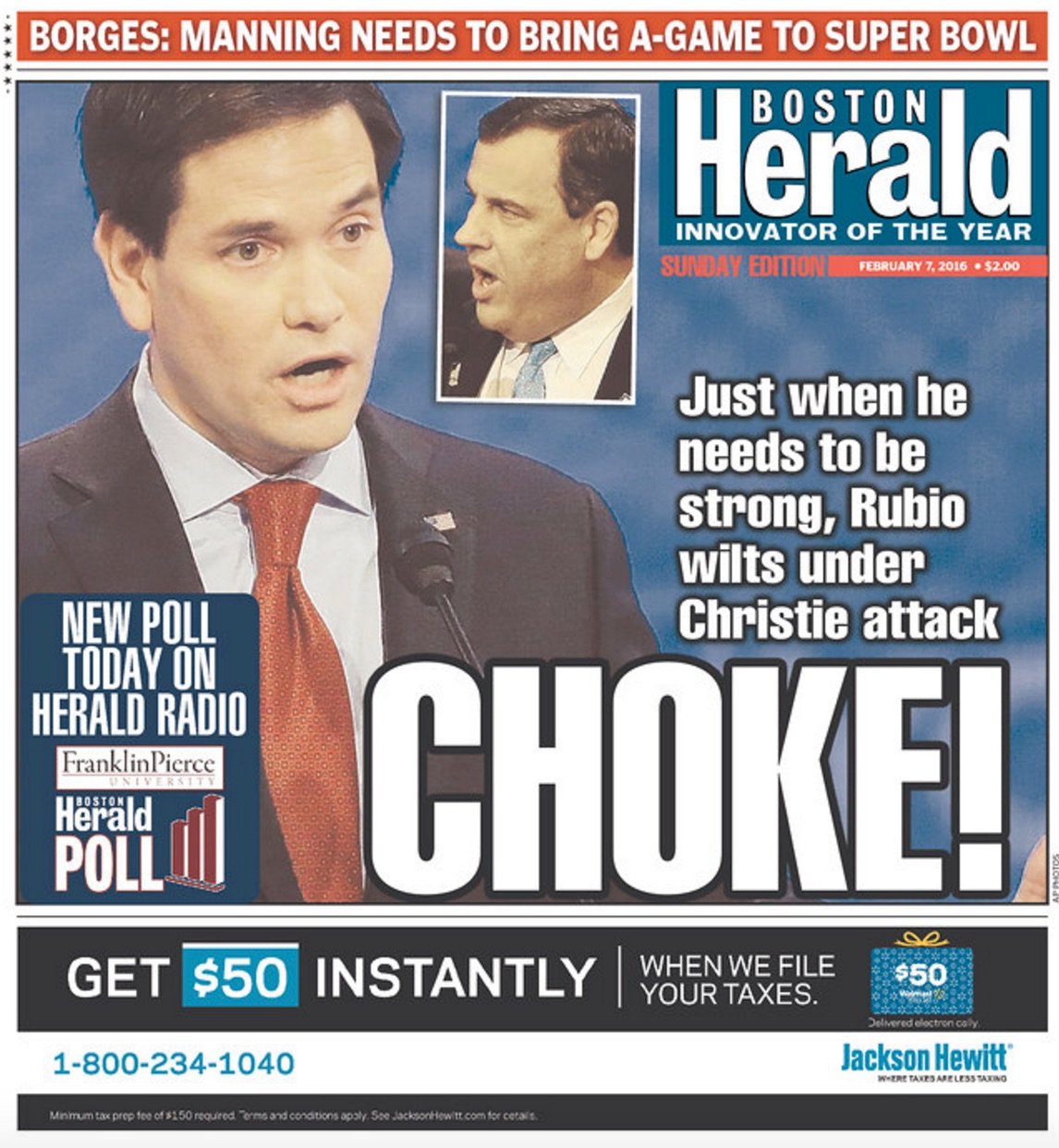
Rubio's Bad Night

Rubio's debate performance last night got brutal reviews.  John Podhoretz is one of many:
Just as the key story for the GOP presidential race in the past week has been the rise of Marco Rubio, so the key question arising from the GOP presidential debate in New Hampshire is: How seriously did the Florida senator hurt himself?

The most consistently excellent debater in the Republican field had a dreadful five minutes in the debate’s opening portion. Under relentless attack from New Jersey Governor Chris Christie, who likened him to Barack Obama in 2008 as an inexperienced lightweight in over his head, Rubio found himself defaulting to the exact same sound bite four times over — and I mean exact.

He said he wanted to dispel the “fiction that Barack Obama doesn’t know what he’s doing. He knows exactly what he’s doing.” Christie pushed back. And Rubio said: “This notion that Barack Obama doesn’t know what he’s doing is just not true. He knows exactly what he’s doing.”

“There it is,” Christie said, “the memorized 25-second speech.”
Unfortunately for Rubio, many New Hampshire voters read this paper:


How many New Hampshire voters saw a Saturday night debate on Super Bowl weekend?  Will the stories about Rubio influence voters who did not see the debate? How many will care?   The answers will be obvious by Wednesday morning. Meanwhile, Nate  Silver wisely urges caution:
As I wrote after the previous debate, political reporters are in the “fog of war” phase of the campaign where our reactions aren’t necessarily good matches for those of voters at home. Some of the reason we reporters thought Rubio’s answer was so awful is because it confirmed some of our gossip about Rubio, namely that he tends to give pat, repetitive answers. But we tend to be more sensitive about that stuff, because we watch every debate from start to finish, and then we see lots of the candidates’ stump speeches and town halls on top of it. There’s a fine line between a candidate who seems stilted and repetitive and one who seems “on message” instead.
Is there any evidence that home viewers saw Rubio’s performance differently? Well, maybe. On Google Trends, there was a huge spike in searches for Rubio during the debate — but it came not during his glitchy moments but instead after an effective answer he delivered on abortion about two hours into the debate. Meanwhile, a Google Consumer Surveyspoll conducted midway through the debate found respondents thought that Trump, Rubio and Cruz (in that order) were winning the debate. Undoubtedly, this mostly just reflects the fact that Trump, Rubio and Cruz are the most popular Republican candidates to begin with, but it’s also a reminder that one bad answer, or one bad evening, may not weigh all that much on voters’ minds.

Thursday, February 4, 2016

Marcomentum?

Next Wednesday, we shall know whether these items are leading indicators or just noise.

Amy R. Connolly reports at UPI:
 Florida Sen. Marco Rubio locked up eight new congressional endorsements and an infusion of cash contributions, bolstering his bid for the Republican presidential nomination and pushing him ahead of the pack for political backing.
Former Republican presidential hopeful Rick Santorum threw his support behind Rubio after the former Kentucky senator announced he was dropping his bid Wednesday.
Republican Sen. Pat Toomey and Rep. Glenn Thompson, both from Pennsylvania, and Rep. Lynn Westmoreland of Georgia are expected to endorse Rubio on Thursday.
They join endorsements from Reps. Steve Womack and Rick Crawford, both Arkansas Republicans, Rep. Matt Salmon of Arizona and South Carolina Sen. Tim Scott.
Catherine Ho writes at The Washington Post:
In the wake of his strong showing in Iowa, Marco Rubio is gaining momentum among the lobbyists and big-time donors who can super-charge his campaign heading into a crucial stretch.
The Rubio campaign said it raised $2 million in the 24 hours after Iowa, where he placed third behind Ted Cruz and Donald Trump.
Behind-the-scenes, money is flowing to the Florida senator from those with ties to the lobbying business — who often contribute big checks to super PACs supporting candidates or bundle money from their friends and colleagues to give directly to campaigns. Some of those donors previously contributed to a pro-Jeb Bush super PAC, Right to Rise, which only took in $15 million in the second half of 2015 compared to $103 million during the first half.
Brad Richardson reports at The Hill:
Republican presidential hopeful Marco Rubio on Thursday vaulted into second place in a daily tracking poll, but he still trails front-runner Donald Trump by double digits in the New Hampshire primary
The real estate mogul leads the GOP field, with 36 percent support, according to the WHDH/UMass Lowell poll, followed by the Florida senator, with 15 percent support; Sen. Ted Cruz (R-Texas), with 14 percent support; former Florida Gov. Jeb Bush, with 8 percent support; and Ohio Gov. John Kasich, with 7 percent support.
New Jersey Gov. Chris Christie places sixth in the state, with 5 percent support, followed by retired pediatric neurosurgeon Ben Carson, at 4 percent support, and business executive Carly Fiorina, at 3 percent support.
The daily poll shows a boost for Rubio, who gained 3 points overnight and 7 points since his stronger-than-expected finish in the Iowa caucuses on Monday.

Wednesday, February 3, 2016

Trump: Pathetic Loser

Kenneth P. Vogel and Darren Samuelsohn report at Politico:
For months, Donald Trump’s allies urged him to invest in the technology necessary to identify and mobilize his supporters, sources close to Trump’s campaign told POLITICO, but the billionaire barely budged, apparently believing his star power would provide a new way to mobilize voters.
By the time his campaign began investing in voter data and targeting analytics, his rivals for the GOP nomination — particularly Iowa winner Ted Cruz and third-place finisher Marco Rubio — had spent millions building sophisticated voter-targeting machines.

Trump’s campaign lacked the voter-targeting and turnout capabilities to translate a 7-point polling lead in Iowa into a win in Monday’s Iowa caucuses, and his disappointing second-place finish hinted at potential trouble for him in upcoming states that should otherwise be more favorable.
Cruz and Rubio’s campaigns ran circles around Trump’s bare-bones operation, which gambled that Trump’s star appeal could overpower modern organizing tactics, and relied instead on big rallies, an outlandish social media presence, a flashy endorsement from Sarah Palin and a late advertising blitz to try to get supporters to the polls.
Philip Bump reports at The Washington Post:
The unexpected sense of generosity that marked Donald Trump's concession speech in Iowa on Monday night began to fray during his speech in New Hampshire on Tuesday -- and appears to have evaporated completely, given what Trump tweeted Wednesday morning. By the end of his tirade against Ted Cruz's Iowa win, Trump suggested that a new election should be held. 
Trump's initial tweet read:
 Embedded image permalink

Notice that the word "and" is written as "any." Trump has a habit of deleting tweets with typos and then retweeting them, which he did in this case, too. But he also took out the word "illegally."

Tuesday, February 2, 2016

Iowa, Psychology, and Arithmetic

My article today in Fox and Hounds:
The Iowa story is about psychology, not arithmetic.
Iowa sends 44 pledged delegates to the Democratic National Convention, 30 to the Republican National Convention. In each case, the state accounts for only about one percent of the total number of delegates.
About 171,000 Democrats and 180,000 Republicans took part in the caucuses. Although news stories are talking about high levels of participation, the combined total of 351,000 adds up to just 18 percent of Iowa’s 1.9 million active registered voters. Or to put the matter into a California perspective, Iowa caucus turnout was about 20 percent less than the number of San Diego County residents who cast ballots in the not-very-exciting 2014 gubernatorial primary.
Iowa is neither representative nor predictive. In contrast to America’s growing ethnic diversity, 87 percent of Iowans are non-Hispanic whites. Only three non-incumbent victors in the caucuses – Jimmy Carter in 1976, George W. Bush in 2000, and Barack Obama in 2008 – have gone on to win the general election.
So why are commentators and political operatives getting so excited about such a bad bellwether? After months of unreliable polls and unfounded speculation, the Iowa caucuses represent the first official event of the nomination process. With no other “real” numbers to go on, observers assign outsized significance to the Iowa results.
This significance, in turn, depends less on winning delegates than on beating expectations. Cruz, Trump, and Rubio all got similar numbers of delegates (8,7, and 7), but Cruz and Rubio were the “winners” because they did better than the pundits expected. Trump had been the putative favorite, so he was the “loser” – or in Trumpian terms, a huge, disgusting, pathetic, sad loser.
On the Democratic side, the results are a statistical dead heat, meaning that Clinton and Sanders will come away with about the same number of convention delegates. Because Clinton has a tiny numerical advantage (as of early Tuesday morning anyway), her supporters are declaring victory. But because polls and pundits had previously put Clinton ahead, Sanders is claiming bragging rights.
Despite a weak statistical basis, the perceptions coming out of Iowa do have some real-world consequences. Campaign contributors and political leaders pay close attention, so the “winners” pick up money and organizational support while the losers face pressure to exit the race. Indeed, even before bedtime last night, Republican Mike Huckabee and Democrat Martin O’Malley dropped out. Others will soon follow suit.
As more states hold primaries and caucuses, the focus will shift from symbolic outcomes to the actual delegate totals that will determine the nominees. In the end, contests will be about arithmetic, not psychology

Tuesday, January 12, 2016

Right to Rise Copies Hubert Humphrey Anti-Nixon Ad

The pro-Bush super PAC Right to Rise is attacking Marco Rubio with an ad that is remarkably similar to an attack ad that Hubert Humphrey ran against Nixon in 1968.