Search This Blog

Wednesday, April 10, 2024

Divided, Indeed

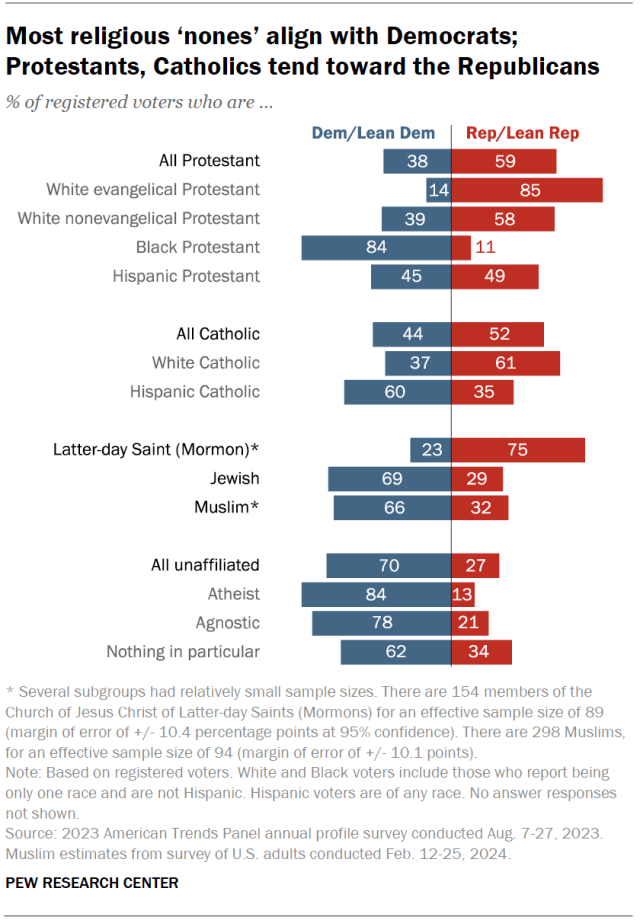
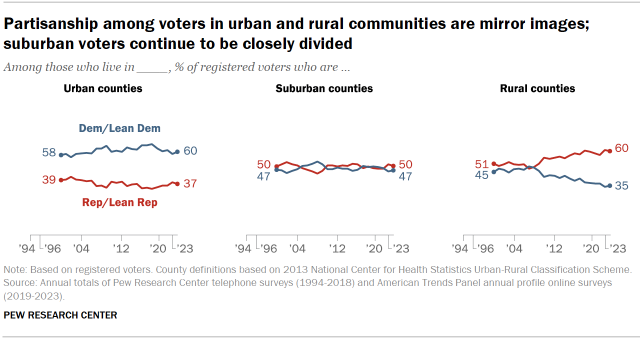
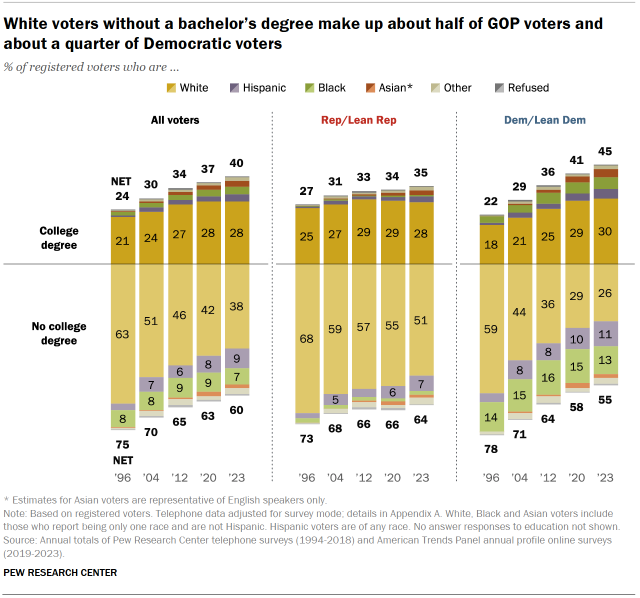
 In Defying the Odds, we talk about the social and economic divides that enabled Trump to enter the White House. In Divided We Stand, we discuss how these divides played out in 2020.    It is the "coalition of the ascendant" v. "the coalition of the resentful.

From Pew:

The rural - urban divide


RFK and Other Stalking Horses

Our most recent book is titled Divided We Stand: The 2020 Elections and American Politics. The 2024 race has begun.

 Voters are not happy about having to choose between Trump and Biden. Trump forces are exploiting that sentiment.

Jonathan Swan, Maggie Haberman, Shane Goldmacher and Rebecca Davis O’Brien at NYT:
Allies of Donald J. Trump are discussing ways to elevate third-party candidates in battleground states to divert votes away from President Biden, along with other covert tactics to diminish Democratic votes.

They plan to promote the independent candidate Robert F. Kennedy Jr. as a “champion for choice” to give voters for whom abortion is a top issue — and who also don’t like Mr. Biden — another option on the ballot, according to one person who is involved in the effort and who, like several others, spoke on the condition of anonymity to discuss the plans.

Trump allies also plan to amplify the progressive environmental records of Mr. Kennedy and the expected Green Party candidate, Jill Stein, in key states — contrasting their policies against the record-high oil production under Mr. Biden that has disappointed some climate activists.

A third parallel effort in Michigan is meant to diminish Democratic turnout in November by amplifying Muslim voters’ concerns about Mr. Biden’s support for Israel’s war in Gaza. Trump allies are discussing running ads in Dearborn, Mich., and other parts of the state with large Muslim populations that would thank Mr. Biden for standing with Israel, according to three people familiar with the effort, which is expected to be led by an outside group unaffiliated with the Trump campaign.

Many of these third-party-boosting efforts will probably be run out of dark-money entities that are loosely supportive of Mr. Trump. Both the Trump campaign and the main super PAC supporting the former president, MAGA Inc., are already aggressively framing Mr. Kennedy as a far-left radical to draw potential Democratic voters away from Mr. Biden.

 Andrew Kaczynski,at CNN:

A New York-based campaign official for Robert F. Kennedy Jr. who raised the possibility that voting for the independent presidential candidate would help Donald Trump defeat President Joe Biden previously promoted false claims that the 2020 election was rigged and attended “Stop the Steal” rallies after the election, including the rally on January 6, 2021, in Washington, DC, that preceded the deadly riot at the US Capitol.

Rita Palma, who has identified herself as the Kennedy campaign’s state director in New York, also repeatedly called Trump her “favorite president,” according to tweets along with comments she posted on the conservative social media site Parler that have since been made private.

According to a KFILE examination of those now-private posts, Palma also posed for a photo at the former Trump International Hotel in Washington, DC, alongside Sidney Powell – the pro-Trump attorney who pleaded guilty in Georgia’s election subversion case.

In February 2021, Palma tweeted her support for Trump as a presidential candidate in 2024 and even asked whether he could run for a third term in 2028 – which is not constitutionally allowed as a president can serve only two full terms.
Tuesday, April 9, 2024

Abortion and Arizona

Our 2020 book is titled Divided We Stand: The 2020 Elections and American Politics.  Among other things, it discusses the state of the parties. The state of the GOP is not good. Abortion was a big issue in the 2022 midterm. It will be a big issue in 2024.

And within hours, Arizona proved Bill Kristol correct.

 Jonathan J. Cooper at Politico:

Democrats pounced Tuesday on an Arizona Supreme Court ruling that permits enforcement of an 1864 law effectively banning abortion in the state, blaming former President Donald Trump and Republicans and pressing for political advantage on an issue that could dominate a critical 2024 battleground.

The ruling permits doctors or others to be prosecuted for performing an abortion at any time unless the mother’s life is in danger, with no exceptions for rape or incest. President Joe Biden ‘s campaign immediately blamed the ruling on Trump’s appointment of three Supreme Court justices who voted to overturn a federally guaranteed right to an abortion.

“The girls today and the young women do not have the rights that we once did because of Donald Trump,” said Phoenix Mayor Kate Gallego, a Democrat. “Donald Trump is dangerous and reckless.”

Abortion Politics

Our 2020 book is titled Divided We Stand: The 2020 Elections and American Politics.  Among other things, it discusses the state of the parties. The state of the GOP is not good. Abortion was a big issue in the 2022 midterm. It will be a big issue in 2024.

 Leigh Ann Caldwell and Theodoric Meyer at WP:

GOP candidates running for Senate in swing states are largely embracing the states’ rights message on abortion that Donald Trump outlined yesterday.

The former president tried to defang the issue by neither endorsing nor explicitly ruling out a 15-week federal abortion ban, instead saying in a video message that states should determine their own abortion laws.

It’s the latest evolution of Republicans’ shifting position on abortion, as they have worked to find a message palatable for voters who have bucked Republican candidates’ antiabortion positions since Roe v. Wade was overturned nearly two years ago.

... 

With his video announcement yesterday that included no mention of a federal abortion ban, Trump bucked one camp of abortion opponents that had wanted him to back a 15-week ban — a group that included his former adviser Kellyanne Conway, Graham and Susan B. Anthony Pro-Life America, our colleagues Josh Dawsey and Hannah Knowles report. Instead, he listened to other antiabortion advocates who wanted him to avoid being pinned down on a specific gestational limit that Congress wouldn’t be able to pass anyway.

Trump says he’s on the right side of politics. And he challenged Graham and others who disagreed.

“Many Good Republicans lost Elections because of this Issue, and people like Lindsey Graham, that are unrelenting, are handing Democrats their dream of the House, Senate, and perhaps even the Presidency,” Trump wrote on Truth Social yesterday, responding to Graham’s criticism that he “respectfully disagrees” that Trump didn't back a 15-week national ban because fetuses “feel pain” at that stage of gestation.

Monday, April 8, 2024

Useful Idiots

Our latest book is titled Divided We Stand: The 2020 Elections and American Politics.  Among other things, it discusses foreign influence and Trump's attack on democracy. 

In an ongoing campaign that seeks to influence congressional and other political debates to stoke anti-Ukraine sentiment, Kremlin-linked political strategists and trolls have written thousands of fabricated news articles, social media posts and comments that promote American isolationism, stir fear over the United States’ border security and attempt to amplify U.S. economic and racial tensions, according to a trove of internal Kremlin documents obtained by a European intelligence service and reviewed by The Washington Post.z...

One of the documents reviewed by The Post called for the use of Trump’s Truth Social platform as the only way to disseminate posts “without censorship,” while “short-lived” accounts would be created for Facebook, Twitter (now known as X) and YouTube.
Alexandra Marquez at NBC
GOP Rep. Mike Turner on Sunday said that Russian propaganda has taken hold among some of his House Republican colleagues and is even "being uttered on the House floor."

"We see directly coming from Russia ... communications that are anti-Ukraine and pro-Russia messages, some of which we even hear being uttered on the House floor," Turner, the chair of the House Permanent Select Committee on Intelligence said in an interview on CNN's "State of the Union."

"There are members of Congress today who still incorrectly say that this conflict between Russia and Ukraine is over NATO, which of course it is not," he added.

Turner's office did not immediately respond to NBC News' request for clarification about which members of Congress he was referring to.

His comments come on the heels of remarks House Foreign Relations Committee Chair Michael McCaul made this week about how Russian propaganda has taken root among the GOP.

McCaul, a Texas Republican, told Puck News that he thinks "Russian propaganda has made its way into the United States, unfortunately, and it’s infected a good chunk of my party’s base."

 Ally Sammarco at Los Angeles Magazine:

Then, in an interview with Twins Podcast, F. Kennedy Jr. parroted Russian propaganda almost word for word when discussing Russia’s invasion of Ukraine, saying that Putin just wanted to "de-Nazify" Ukraine.

"Putin said 'Look I don't want to go into Crimea. Let's negotiate a peace,’” Kennedy said. “Alright, and the three things he wanted — he wanted to keep NATO out of Ukraine. That was number one. He wanted to de-Nazify the Ukrainian government."

Ukrainian President Volodymyr Zelenskyy is Jewish.

Putin said in televised remarks in February 2022 that his goal was to "seek to demilitarize and de-Nazify Ukraine, as well as bring to trial those who perpetrated numerous bloody crimes against civilians, including against citizens of the Russian Federation."


Sunday, April 7, 2024

Roots of Rural Resentment

In Defying the Odds, we talk about the social and economic divides that enabled Trump to enter the White House. In Divided We Stand, we discuss how these divides played out in 2020.  

Democrats have paid a steep price for their withdrawal from rural America.

Lloyd Green at The Guardian:
The fact is, residents of Republican-run states are more than 20% more likely to join the military and after Iraq and the great recession, the disconnect between white rural America and coastal and cognitive elites swiftly became a chasm.

In 2016, parts of the US that felt the effects of the 9/11 wars more as reality than abstract moved to the Republican column. According to Douglas Kriner of Boston University and Francis Shen of the University of Minnesota, “Wisconsin, Pennsylvania, and Michigan could very well have been winners for [Hillary] Clinton if their war casualties were lower.”

Wisconsin is the 20th-most rural state. A quarter of Michigan is rural. Pennsylvania has been characterized as Philadelphia in the east, Pittsburgh in the west and Alabama in the middle. As Trump prepares for his rematch with Joe Biden, all three states are toss-ups.

Schaller and Waldman also downplay the impact in rural areas of Democratic messaging on hot-button issues such as crime. It’s no longer just “the economy, stupid”. Culture wars pack an outsized punch. Outside New England, white rural Democrats are a relative rarity.

Inexplicably, Schaller and Waldman do not examine the case of Jon Tester, the three-term Democratic senator from deep-red, highly rural Montana who faces a stern fight to keep his seat this year. In 2020, in the aftermath of widespread protests for racial justice after the murder of George Floyd, a Black man, by a white Minneapolis officer, but also rioting and looting, Tester criticized his party.

See state data on the cost of post-9/11 wars. 

From CDC:

Drug overdoses are the leading cause of injury death in the United States, resulting in approximately 52,000 deaths in 2015. Rates of drug overdose deaths are rising in rural areas, surpassing rates in urban areas. Although the percentage of people reporting illicit drug use is lower in rural areas, the effects of use appear to be higher. The percentage of people with drug use disorders among those reporting past-year illicit drug use in rural areas was similar to that in urban areas.

Most overdose deaths occurred in homes, where rescue efforts may fall to relatives who have limited knowledge of or access to naloxone and overdose follow-up care. Understanding differences in illicit drug use, illicit drug use disorders, and drug overdose deaths in urban and rural areas can help public health professionals to identify, monitor, and prioritize responses

Saturday, April 6, 2024

Resentment, Not Rage, in Rural America

In Defying the Odds, we talk about the social and economic divides that enabled Trump to enter the White House. In Divided We Stand, we discuss how these divides played out in 2020.  

Nicholas Jacobs at Politico:
Academics can and do disagree on what is motivating non-college-educated whites to vote for Donald Trump. I don’t pretend that we have settled on a single answer. I do know that there is something particular about Trump’s appeal in rural America and that demographics alone do not explain it. In rural America, women are more likely to vote for Trump; so are young people; so are poor as well as rich. Place matters.

But ruralness is not reducible to rage. And to say so is to overlook the nuanced ways in which rural Americans engage in politics. They are driven by a sense of place, community and often, a desire for recognition and respect. This, as I have recently argued in a new book, is the defining aspect of the rural-urban divide — a sense of shared fate among rural voters, what academics call a “politics of place,” that is expressed as a belief in self-reliance, rooted in local community and concerned that rural ways of living will soon be forced to disappear.

In recent years, that rural political identity has morphed into resentment — a collective grievance against experts, bureaucrats, intellectuals and the political party that seeks to empower them, Democrats.

Yes, such resentment is a real phenomenon in rural areas. But words matter; rage and resentment are not interchangeable terms. Rage implies irrationality, anger that is unjustified and out of proportion. You can’t talk to someone who is enraged. Resentment is rational, a reaction based on some sort of negative experience. You may not agree that someone has been treated unfairly, but there is room to empathize.

Research both by me and by others has illuminated how resentment is driven by the complex rural identity that, while occasionally intersecting with national political currents, is rooted in the unique context of rural life. Rage, both as a soundbite and as presented in the book, oversimplifies and misrepresents these debates. And so does the assumption that all the holders of these views are white, and that this rage is motivated by racism. Racism exists in all parts of the country and is embedded in American politics. But what the research shows is that while there are deep and persistent racial resentments in rural communities, despite a slight correlation between the two, rural resentment is an attitude distinct from racial prejudice.

...

 Taken as a whole, rural voters are not merely reacting against change — be it demographic or economic. They are actively seeking to preserve a sense of agency over their future and a continuity of their community’s values and social structures. Some might call this conservatism, but I think it is the same thing motivating fears of gentrification in urban areas, or the desire to “keep Portland weird.” Place matters for a whole bunch of people — but especially for rural folks.