Search This Blog

Showing posts with label Iraq. Show all posts

Thursday, May 7, 2026

The Thumpin' Redux? 2006 and 2026 Parallels


Theodoric Meyer at WP:
“A year ago, no one thought we had a chance to take back the Senate,” Schumer said. “I was one of the very few. And I laid out a plan which is now working.”

For months, Democrats have been far more bullish about retaking the House, which requires flipping only a few seats. But Trump’s unpopularity has made Republicans in both chambers appear more vulnerable.

Thirty-seven percent of Americans approve of Trump’s job performance, according to a recent Washington Post-ABC News-Ipsos poll. Sixty-two percent disapprove, the highest level of either of Trump’s terms. Trump’s approval rating was even lower for his handling of the economy and inflation, which both parties view as crucial to the midterms.

A recent Pew Research Center survey found Trump faring even worse: 34 percent of Americans approved of his performance, and 64 percent disapproved.

Schumer said the political environment feels similar to 2006, when Democrats capitalized on discontent with the Iraq War in President George W. Bush’s second term to pick up six Senate seats and flipped the chamber against the odds.

“There’s a very unpopular president, there’s a war on, and it’s a really hard Senate map,” J.B. Poersch, who runs Senate Majority PAC, the flagship Democratic super PAC in Senate races, said in an interview. “Those are all similarities to ’06. We won in a scenario where we weren’t supposed to win [in 2006] because the map was so challenging — and this one’s challenging, too.”

Sunday, April 7, 2024

Roots of Rural Resentment

In Defying the Odds, we talk about the social and economic divides that enabled Trump to enter the White House. In Divided We Stand, we discuss how these divides played out in 2020.  

Democrats have paid a steep price for their withdrawal from rural America.

Lloyd Green at The Guardian:
The fact is, residents of Republican-run states are more than 20% more likely to join the military and after Iraq and the great recession, the disconnect between white rural America and coastal and cognitive elites swiftly became a chasm.

In 2016, parts of the US that felt the effects of the 9/11 wars more as reality than abstract moved to the Republican column. According to Douglas Kriner of Boston University and Francis Shen of the University of Minnesota, “Wisconsin, Pennsylvania, and Michigan could very well have been winners for [Hillary] Clinton if their war casualties were lower.”

Wisconsin is the 20th-most rural state. A quarter of Michigan is rural. Pennsylvania has been characterized as Philadelphia in the east, Pittsburgh in the west and Alabama in the middle. As Trump prepares for his rematch with Joe Biden, all three states are toss-ups.

Schaller and Waldman also downplay the impact in rural areas of Democratic messaging on hot-button issues such as crime. It’s no longer just “the economy, stupid”. Culture wars pack an outsized punch. Outside New England, white rural Democrats are a relative rarity.

Inexplicably, Schaller and Waldman do not examine the case of Jon Tester, the three-term Democratic senator from deep-red, highly rural Montana who faces a stern fight to keep his seat this year. In 2020, in the aftermath of widespread protests for racial justice after the murder of George Floyd, a Black man, by a white Minneapolis officer, but also rioting and looting, Tester criticized his party.

See state data on the cost of post-9/11 wars. 

From CDC:

Drug overdoses are the leading cause of injury death in the United States, resulting in approximately 52,000 deaths in 2015. Rates of drug overdose deaths are rising in rural areas, surpassing rates in urban areas. Although the percentage of people reporting illicit drug use is lower in rural areas, the effects of use appear to be higher. The percentage of people with drug use disorders among those reporting past-year illicit drug use in rural areas was similar to that in urban areas.

Most overdose deaths occurred in homes, where rescue efforts may fall to relatives who have limited knowledge of or access to naloxone and overdose follow-up care. Understanding differences in illicit drug use, illicit drug use disorders, and drug overdose deaths in urban and rural areas can help public health professionals to identify, monitor, and prioritize responses

Sunday, May 12, 2019

Trump and War Crimes

In Defying the Odds, we discuss Trump's dishonesty and his record of disregarding the rule of law.   The update  -- just published --includes a chapter on the 2018 midterms.

Waitman Wade Beorn, historian and  combat veteran of Iraq, writes at WP:
On Monday, President Trump pardoned the convicted war criminal Michael Behenna, who had murdered Ali Mansur, an unarmed, naked Iraqi, by shooting him in the head and chest. Making a specious claim of self-defense, Behenna argued that Mansur threw a piece of concrete at him and “ stood up like he’s coming at me.” And so he neutralized this threat, a naked man, already released by the Army. Behenna was supposed to be returning Mansur home to his village. A military court convicted Behenna of unpremeditated murder. American soldiers testified against him. The military court of appeals and a review panel upheld that conviction, though he was paroled early, in 2014.
Even before pardoning Behenna, Trump demonstrated a disturbing flippancy toward war crimes. He has repeatedly expressed support for former Navy SEAL Edward Gallagher, another alleged war criminal. ...Trump tweeted that Gallagher would be given better conditions in confinement “in honor of his past service,” an honor many would say he threw away long ago.
Trump has also publicly supported Maj. Matt Golsteyn, who is charged with premeditated murder in the shooting of an unarmed man and the burning of his body in Afghanistan. “I will be reviewing the case of a ‘U.S. Military hero,’ ” the president tweeted.
In at least three instances, then, our commander in chief appears to have preferred to overlook serious war crimes in favor of a warped notion of patriotism and heroism. Trump subscribes to a “bad things happen in war” mentality — odd for a man who actively avoided military service.
This attitude is incredibly dangerous. It doesn’t just undermine the enforcement of military justice; it also sends a message to our armed forces about just what kind of conduct the United States takes seriously.

Thursday, December 27, 2018

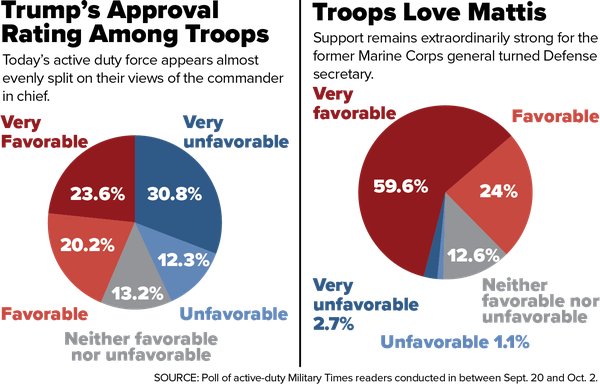
The Troops and Trump

In Defying the Odds, we discuss foreign policy issues in the 2016 campaign.

Benjy Sarlin at NBC:
President Donald Trump, on an unannounced visit to American military personnel in Iraq, said Wednesday he will do "whatever it takes" to secure border wall funding and attacked Democrats for blocking him.
"We need a wall," Trump said at the Al-Asad Air Base west of Baghdad. "We need safety for our country."
Presidents normally avoid partisan fights in military settings as part of a bipartisan tradition of keeping national security institutions separate from politics. Trump, who has frequently disregarded this norm, used his speech to soldiers to attack Democrats over the standoff, saying they only opposed a wall "because I want it."
At Military Times, Leo Shane III reports that Trump's approval rating among active-duty military members has declined.


And at NYT, Steve Eder reveals how Trump probably got his phony medical excuse from the Vietnam draft:
In the fall of 1968, Donald J. Trump received a timely diagnosis of bone spurs in his heels that led to his medical exemption from the military during Vietnam.

For 50 years, the details of how the exemption came about, and who made the diagnosis, have remained a mystery, with Mr. Trump himself saying during the presidential campaign that he could not recall who had signed off on the medical documentation.

Now a possible explanation has emerged about the documentation. It involves a foot doctor in Queens who rented his office from Mr. Trump’s father, Fred C. Trump, and a suggestion that the diagnosis was granted as a courtesy to the elder Mr. Trump.

The podiatrist, Dr. Larry Braunstein, died in 2007. But his daughters say their father often told the story of coming to the aid of a young Mr. Trump during the Vietnam War as a favor to his father.

“I know it was a favor,” said one daughter, Dr. Elysa Braunstein, 56, who along with her sister, Sharon Kessel, 53, shared the family’s account for the first time publicly when contacted by The New York Times.

Elysa Braunstein said the implication from her father was that Mr. Trump did not have a disqualifying foot ailment. “But did he examine him? I don’t know,” she said.

Monday, June 27, 2016

Hillary the Hawk

James Hohmann writes at The Washington Post:
Obama, who opposed going into Iraq in 2003, has been reluctant to embrace his role as a wartime commander-in-chief; Clinton allies insist she would be less reticent. “Unexpectedly, in the bombastic, testosterone-fueled presidential election of 2016, Clinton is the last true hawk left in the race,” Mark Landler wrote in a New York Times Magazine cover story in April.
And, of course, she was in the Situation Room during the Osama bin Laden raid. When it looked like Joe Biden might challenge her in the primaries, Clinton took to telling audience that she supported the risky operation and the vice president opposed it.
While she was embracing the president during the primaries to lock up the African American vote, one of the few issues she broke with Obama on was deploying more special operations forces to Iraq than Obama had committed. She also advocated a partial no-fly zone in Syria, which he has resisted.
-- Hillary’s hawkishness goes back much farther than Foggy Bottom. Clinton made a strategic decision when she arrived in the Senate after her husband’s administration ended to get a seat on the Armed Services Committee. She voted for the Iraq war and sat on an emerging threats subcommittee, all with her sights set on seeking the presidency in 2008.
The chief strategist on that campaign, Mark Penn, outlined his theory of the case for how she could win in a 2006 memo. ...
“And the best role model proves the case,” Penn continued. “Margaret Thatcher was the longest serving Prime Minister in British history, serving longer than Winston Churchill. She represents the most successful elected woman leader in this century – and the adjectives that were used about her (Iron Lady) were not of good humor or warmth. They were of smart, tough leadership. As we move forward, it is important to understand who we are and who we are not. We are more Thatcher than anyone else.”
Of course, it was Hillary Clinton who gave the name to the 1992 War Room. 

Monday, February 22, 2016

Trump Lies About Opposing Iraq

Trump claims that he was a vigorous early opponent of Iraq.  He is lying, as Buzzfeed documents:
Some of Trump’s past statements, unearthed by BuzzFeed News, contradict his narrative that he was against the war before it began. Trump offered tepid support in September 2002, answering a question from Howard Stern on whether he would invade Iraq by saying “Yeah, I guess so.” And one day into the war, Trump still called the invasion a “tremendous success from a military standpoint.”
Trump did, however, express concerns about the invasion of Iraq by late March 2003 and repeatedly throughout the year. But many of his comments suggest he still supported aspects of the war, such as the toppling of Saddam Hussein. In April 2004 — again, in an interview on Howard Stern — Trump emerged as a staunch opponent of the war, and began to push the idea he was never a supporter, claiming, “I was never a fan.”

Sunday, February 14, 2016

Trump at the Debate

James Hohmann writes at The Washington Post:
The billionaire was flustered and cranky. Not only was he thrown off his game by sustained boos from the crowd and a pile-on by his rivals, but he often sounded more like a Democrat than a Republican.
He didn’t just call George W. Bush’s decision to invade Iraq a disaster – which he has done before – but he blamed him for 9/11 and said that the former president “lied” about the presence of weapons of mass destruction as a pretext for war. “Obviously the war in Iraq was a big, fat mistake,” the frontrunner said at the Peace Center. “George Bush made a mistake. We can make mistakes, but that one was a beauty. We should have never been in Iraq. We have destabilized the Middle East.”
Trump again defended Planned Parenthood, as everyone else promised to defund it. “It does wonderful things, but not as it relates to abortion,” he said. “Wonderful things that have to do with women’s health.”
Keep in mind that he said this in the buckle of the Bible Belt, just down the road from Furman and Bob Jones universities.
Eli Stokols reports at Politico:
Holding a 20-point lead in the state over his nearest rival with a week to go, Trump blasted the former president for the national security record his brother’s campaign plans to tout, blaming him not just for the Iraq War but for the 9/11 terror attacks.

“The World Trade Center came down during your brother’s reign. Remember that," Trump said to the former Florida governor, prompting a long, contentious back-and-forth.
In a state that’s home to a large number of military installations and veterans, the supercharged showdown between two candidates who’ve been sparring for months could play big, potentially reordering the race in the final week.
Our Principles PAC, launched last month with the purpose of attacking Trump, is preparing to blanket South Carolina's airwaves with a new ad featuring Trump's past statement that impeaching George W. Bush "would have been a good thing."


Politifact rebuts his claim to have been an early opponent of Iraq:
Trump often repeats this line, and we’ve rated a similar Trump claim Mostly False, because he didn’t appear to take any public position on the war until after the March 2003 invasion. In this more recent version of the statement, he also said he stated his opposition to the war "loud and clear." But the public record of his positions is thin.
Kevin Drum is more direct:
He's lying. He didn't oppose the Iraq War before it started. Long ago he promised us 25 clippings proving that he spoke up against the war, but he's never coughed them up. That's because he can't. It's pathetic.

Wednesday, May 13, 2015

Bush Stumbles on Iraq

The New York Times reports:
Jeb Bush on Tuesday sought to arrest a chorus of criticism from Democrats and some conservatives after he told an interviewer that, knowing what history has since shown about intelligence failures, he still would have authorized the 2003 invasion of Iraq.
Calling in to Sean Hannity’s syndicated radio show, Mr. Bush said he had misunderstood a question that one of Mr. Hannity’s Fox News colleagues, Megyn Kelly, had asked him in an interview shown on Sunday and Monday nights.
“I interpreted the question wrong, I guess,” Mr. Bush said. “I was talking about, given what people knew then.”
The attempt at mopping-up was quick, but it did not bring the controversy to an immediate end: When Mr. Hannity asked about the 2003 Iraq invasion again, in yes-or-no fashion, Mr. Bush said he did not know what the answer would have been, saying,
“That’s a hypothetical.” Then, he seemed to go out of his way to absolve his brother, former President George W. Bush, who ordered the invasion: “Mistakes were made, as they always are in life,” Mr. Bush said.

Sunday, September 14, 2014

Bad Poll News for Dems

Mark Murray writes at NBC:
Nearly 70 percent of Americans say they lack confidence that the U.S. will achieve its goals in fighting the terrorist group ISIS, according to a new NBC News/Wall Street Journal/Annenberg poll. The findings come in the wake of President Barack Obama’s national address announcing new measures to combat the Sunni militants.
Pressure is mounting on the U.S. and its allies to cripple the militants, who have waged a brutal campaign across Syria and Iraq. ISIS already has beheaded two American journalists and on Saturday released a video showing the execution of a third Westerner, British aid worker David Haines.

The poll – conducted before the latest execution emerged – showed that a combined 68 percent of Americans say they have “very little” or “just some” confidence that Obama’s goals of degrading and eliminating the threat posed by ISIS will be achieved. Just 28 percent said they had “a great deal” or “quite a bit” of confidence. Still, 62 percent of voters say they support Obama’s decision to take action against ISIS in Iraq and Syria, while 22 percent oppose it.
At The Wall Street Journal, Janet Hook reports on an earlier poll:
Democrats have a lot to worry about in the midterm elections but one of their sturdiest bulwarks against a GOP rout in the fall has been support among women. They have held significant leads over Republicans among women by a number of polling measures.
But the latest Wall Street Journal/NBC News Poll has some warning signs for Democrats who are counting on women to help them weather a tough political climate.
An important bellwether is the question of which party voters would prefer to control Congress, and it has long been the case that men prefer a Republican Congress and women favor a Democratic Congress.

But the poll conducted Sept. 3-7 found that women’s Democratic preference had shrunk to a 47%-40% margin — down from 51% -37% a month earlier. The swing was especially sharp among white women, who gave Democrats a 4 point edge in August; in the new poll, Republicans enjoyed 48%-40% advantage.
It is hard to assess what accounts for that shift but, if it proves a durable trend, the stakes are high. GOP pollster Bill McInturff said that maintaining support among women is critical for Democrats in the midterm elections, or else “a difficult cycle becomes a really terrible cycle for Democrats.”
Jay Cost has more on the earlier NBC poll:
Breaking it down by issues, we can see why Republicans are in better shape. They are more trusted on the more salient issues. Democrats have a net advantage of 28 points on who is better “looking out for the interests of women,” where 45 percent say Democrats and 17 percent say Republicans. They have a 27 point advantage on the environment, and a 15 point edge on abortion. On health care, they have an 8 point edge, which is close to their lowest advantage since 1991. But that is it for Democrats. On taxes (R+4), immigration (R+7), economy (R+10), foreign policy (R+18), the deficit (R+18) and a strong national defense (R+38), the GOP has the edge. Moreover, this advantage has either stayed the same or expanded in the last month. And on every one of these metric the party is improved from a year ago, often substantially so.
The immigration item is of most interest to me. Democrats are not dummies. There was a good reason they did not pass a comprehensive reform bill when they had complete control of government back in 2009-2010. The reality is that wide swaths of any such bill are bound to be unpopular. Once you satisfy the “stakeholders” (Obamaspeak for: interest groups that have purchased undue access to policymakers), you wind up with a rotten piece of sausage that John Q. Public does not want to eat. This is why Democrats need Republicans -- as cover on the issue. They thought they had it a year ago, and when it looked like the GOP might give in, the public favored Democrats on immigration by four points last September, 30-26. But Republicans like Jeff Sessions have been arguing passionately and effectively about how it is a bad deal for the working class (regardless of race or ethnicity), and lo and behold the issue has flipped from a year ago, to a 35-28 advantage for the GOP.

Thursday, September 11, 2014

Terrorism, ISIS, and Party Politics

Last night, POTUS went on national TV to discuss strategy against ISIS. Rich Galen points out:

  • A few months after Senator Obama became President Obama a memo was issued that stated the phrase "Global War on Terror" was no longer operationable and would henceforth be referred to as "Overseas Contingency Operations."
  • I am not making this up. The relevant Washington Post article in on today's Secret Decoder Ring.
  • Last night he used the root word "terror" (including terrorist(s), terrorize, terrorism, etc.) no fewer than 20 times in his 13 minute speech.

Gallup reports:
The Republican Party has expanded its historical edge over the Democratic Party in Americans' minds as being better able to protect the U.S. from international terrorism and military threats. At this point, 55% of Americans choose the GOP on this dimension, while 32% choose the Democratic Party. This is the widest Republican advantage in Gallup's history of asking this question since 2002.

The latest update on this 12-year trend comes from Gallup's Sept. 4-7 Governance poll, finished just days before President Barack Obama's speech to the nation Wednesday night, in which he outlined his plans for addressing the challenges presented by the Islamic State in Iraq and Syria (ISIS) and other international threats.

Republicans have held a perceptual edge on this question in all but two of the 12 years that it has been asked -- 2007 and 2012. The GOP's edge has been significant in many of the other years, although the 19-percentage-point gap measured in 2002, which was previously the largest, is eclipsed by this year's 23-point Republican edge.

Thursday, July 10, 2014

First-Term Seeds of Second-Term Trouble

At The Daily Beast, Jeff Greenfield explains that first terms often contain the seeds of trouble for the second term.
Let me explain. My case, which is spelled out in detail here, looks back at what bedeviled Presidents as the glow of their return to office

faded. For Lyndon Johnson, it was the stealth escalation in Vietnam he plotted even as he ran as a peace candidate in 1964. For Nixon, it was the Watergate break-in, designed to filch political plans of his 1972 foes. For Clinton, it was Monica Lewinsky’s arrival at the White House during the government shutdown of 1995. For George W. Bush, it was the 2003 invasion of Iraq and the disastrous post-invasion fiasco. 
And Obama? In that 2012 piece, I wrote that the first-term roots of second term trouble might come “mostly from abroad, where the potential for instability, violence and anti-American hostility could make presidential decisions look very bad. … Imagine Iraq exploding into a new civil war, or aligning itself with a still-governing Assad in Syria, or with Iran.”

The presidential decisions now undergoing very tough judgments include not just the decision to withdraw completely from Iraq, but the decision to keep Prime Minister Nouri-al-Maliki in power despite overwhelming evidence that he was assembling a sectarian Shiite state. Ali Khedery, who was at one time the longest-serving American in Iraq, has just published a lengthy, agonizing account of U.S. policy blindness. It follows the blistering critiques of American missteps by The New Yorker’s Dexter Filkins, one of the most experienced of American war journalists writing today.

Monday, June 16, 2014

Iraq and the Midterm Election

In the short term, events in Iraq will have only a limited effect on domestic American politics.  President Obama's critics say that the situation reflects his administration's incompetence, but others blame President George W. Bush.

The real political impact could come via the economy.  Mideast turmoil could possibly mean an oil shock, which would probably trigger a recession, which would certainly hurt Democrats.

Alan Mattich writes at The Wall Street Journal:
“The correlation between oil shocks and economic recessions appears to be too strong to be just a coincidence,” wrote James Hamilton, an economics professor at the University of Southern California, San Diego, in a 2011 analysis of historic relationships between oil and economic growth.
Substantial rises in oil prices have been associated with most of the recessions the U.S. has faced since the end of the Second World War. And in a few of the cases where only a modest rise in oil prices preceded the economic downturn, concurrent price controls on fuel make it hard to gauge where prices might have been under free market conditions.
What’s more, as the oil shock associated with the Gulf War of 1990 shows, Iraq matters.
Iraq is a key oil producer, the world’s eighth largest in 2013. And a jump in total production (including natural gas) to 3.1 million barrels per day (bpd) in 2013 from 2.4 million barrels in 2009 has been a major contributor in the overall growth in global output to 90.3 million bpd last year from 85 million over the same period.
Voters might not blame the current president for the Iraq situation , but they always blame recessions on the in-party

Saturday, December 21, 2013

Schweitzer for President?

Chris Cillizza writes at The Washington Post:
Former Montana Gov. Brian Schweitzer went to Iowa Wednesday night. And, as he has a knack for doing, he made news.
“I didn’t vote for that war, and I didn’t think it was a good idea,” Schweitzer said of Iraq. “George Bush got a bunch of Democrats to go to that war, I was just shaking my head in Montana.”
There’s, of course, only one Democrat who voted for “that war” who is thinking about running for president in 2016: Hillary Clinton. Schweitzer and everyone else in the audience — and the broader political world — knew who he meant. In case you missed that, he added this gem: “Gosh, we had Bush, Bush, Bush and Clinton, Clinton and now we’re talking about a Bush or a Clinton again and I think in America we’re always looking for leadership that takes us to the future and we’re not often looking in the rear view mirror for our leadership.”
There’s a very clear reason that Schweitzer targeted Clinton. He knows that no matter how big a frontrunner Clinton is in the 2016 race, there will always be a desire on the liberal left to get behind a candidate who isn’t part of the D.C. political establishment. If that candidate isn’t Massachusetts Sen. Elizabeth Warren — and she has given every indication it won’t be – then, Schweitzer figures, why shouldn’t it be him? (“Why not me” is a surprisingly common reason for running for offices.)
AP reports that he has not yet decided...
But he noted that his rural roots may appeal to Iowa voters: "If I did run for president, I'd be the first one who came to Iowa who could tell you how many kernels of corn to plant per acre."

Visits to Iowa from Democrats eyeing the presidential race have been sparse this year, with many hopefuls watching to see whether Hillary Clinton decides to run. The former first lady, U.S. senator and secretary of state would be the leading contender for the Democratic nomination.

But Iowa Democrats said that even if Clinton runs, voters will want to consider their options, possibly providing an opening for someone like Schweitzer, who has little name recognition in the state.

"Secretary Clinton is obviously very popular among Iowa Democrats. But at the same time, Iowa Democrats I can't imagine are looking for a coronation," Democratic political consultant Jeff Link said.
The Des Moines Register offers a reality check:
 But most Iowans don’t know who the heck Schweitzer is. A Des Moines Register Iowa Poll published Sunday shows 68 percent of Iowa adults of all political leanings and 70 percent of Iowa Democrats don’t know enough about Schweitzer to form an opinion.