Search This Blog

Monday, December 8, 2014

i360

Mike Allen and Kenneth P. Vogel write at Politico that the Kochs and allies are putting millions into a data company that’s developing profiles of 250 million Americans.
The Koch network also has developed in-house expertise in polling, message-testing, fact-checking, advertising, media buying, dial groups and donor maintenance. Add mastery of election law, a corporate-minded aggressiveness and years of patient experimentation — plus seemingly limitless cash — and the Koch operation actually exceeds the RNC’s data operation in many important respects.
...
The least-known vehicle for the Kochs is a for-profit company known as i360, started by a former adviser to John McCain’s presidential campaign after McCain lost to Barack Obama in 2008. Subsequently, it merged with a Koch-funded data nonprofit. The Koch-affiliated Freedom Partners, formed in late 2011, eventually became an investor, officials confirmed to POLITICO.
Spending more than $50 million in cash over the past four years, i360 links voter information with consumer data purchased from credit bureaus and other vendors. Information from social networks is blended in, along with any interaction the voter may have had with affiliated campaigns and advocacy groups. Then come estimated income, recent addresses, how often a person has voted, and even the brand of car they drive. Another i360 service slices and dices information about TV viewing to help campaigns target ads more precisely and cost efficiently.
GOP campaigns can get less-expensive data through the RNC, but happily pay i360 for its superior profiles. Midterm clients included several of the GOP’s marquee Senate and gubernatorial victors, including Sens.-elect Tom Cotton of Arkansas and Joni Ernst of Iowa, and Gov.-elect Larry Hogan in Maryland.

Michael Palmer, a Florida native who started i360 after being chief technology officer of Sen. John McCain’s 2008 presidential campaign, said i360 has been able to develop superior campaign tools precisely because it isn’t beholden to the political calendar. With a steady stream of money comes the ability to think about the long term, he said.
“Right now, we’re talking about and building things that you won’t see in 2016, because it’s not going to be ready until 2018,” Palmer said.

Sunday, December 7, 2014

Deep Red: Aftermath of the Louisiana Runoff

Nate Cohn writes at The New York Times:
As Mary Landrieu, a Democratic senator from Louisiana, loss re-election in Saturday’s runoff election, as expected, the Republicans vanquished the last vestige of Democratic strength in the once solidly Democratic Deep South. In a region stretching from the high plains of Texas to the Atlantic coast of the Carolinas, Republicans control not only every Senate seat, but every governor’s mansion and every state legislative body.

Democrats held or controlled nearly every one of them when Mr. Johnson signed that bill in 1964. And they still held a majority as recently as a decade ago. Ms. Landrieu’s defeat would essentially mark an end to the era of the Southern Democrats: the conservative, Southern, white officials, supported by white Southerners, whose conflicted views helped define American politics for half a century.

Today, nearly all of the Democrats holding federal or statewide office in the South will represent so-called “majority-minority” districts or areas with a large number of new residents from outside the region. In the states of the former Confederacy, Democrats will control Senate seats or governors’ mansions only in Virginia and Florida. Not coincidentally, those are the two Southern states where people born outside the state represent a majority of the population. These Democrats bear little resemblance to the Southern Democrats who won by attracting conservative white voters.
AP reports:
Republicans will hold at least 246 House seats come January, according to election results Saturday, giving the GOP a commanding majority that matches the party's post-World War II high during Democratic President Harry S. Truman's administration.
The GOP retained control of two seats in runoffs in Louisiana, expanding the advantage for Speaker John Boehner, R-Ohio, who can afford defections from his increasingly conservative caucus and still get legislation passed. Combined with the Republican takeover of the Senate, Congress will be all-GOP for the final two years of President Barack Obama's second term.
...
In a Democratic-held district in the Tucson, Arizona-area, an automatic recount will determine whether Rep. Ron Barber keeps his seat or Republican challenger Martha McSally prevails. McSally led by fewer than 200 votes.
If McSally wins, Republicans would have 247 seats, the largest majority since 1929-31 when the GOP controlled 270 seats in President Herbert Hoover's administration.
Philip Klein writes at The Washington Examiner:
On Dec. 24, 2009, the Democratic-controlled Senate passed President Obama’s healthcare law with a filibuster-proof 60-vote majority, triggering a massive backlash that propelled Republicans to control of the House the following year. On the Senate side, going into this year's midterm elections, 25 senators who voted for Obamacare were already out or not going be part of the new Senate being sworn in next month. After Democratic losses on Nov. 4 and Saturday's defeat of Sen. Mary Landrieu, D-La., the number has risen to 30. In other words, half of the Senators who voted for Obamacare will not be part of the new Senate
Lost and replaced by a Republican:
Left Senate and replaced by a Republican:
Left Senate and replaced by a Democrat:
  • Jim Webb, D-Va.
  • Joe Lieberman, I-Conn.
  • Herb Kohl, D-Wis.
  • Daniel Akaka, D-Hawaii
  • Jeff Bingaman, D-N.M.
  • Chris Dodd, D-Conn.
  • Paul Kirk, D-Mass. (appointed to replace Ted Kennedy -- seat later held by Repub Scott Brown)
  • John Kerry, D-Mass.
  • Ted Kauffman, D-Del.
  • Kent Conrad, D-N.D.
  • Sen. Carl Levin, D-Mich.
Died in office:
  • Robert Byrd, D-W.V
  • Daniel Inouye, D-Hawaii
  • Frank Lautenberg, D- N.J

Saturday, December 6, 2014

How Many Romney Staffers Did It Take to Send a Tweet? Twenty-Two. No Joke.

At New Media and Society, Daniel Kreiss has an article titled Seizing the Moment: The
Presidential Campaigns’ Use of Twitter During the 2012 Electoral Cycle"

The abstract:
Drawing on interviews with staffers from the 2012 Obama and Romney presidential campaigns and qualitative content analysis of their Twitter feeds, this article provides the first inside look at how staffers used the platform to influence the agendas and frames of professional journalists, as well as appeal to strong supporters. These campaigns sought to influence journalists in direct and indirect ways, and planned their strategic communication efforts around political events such as debates well in advance. Despite these similarities, staffers cite that Obama’s campaign had much greater ability to respond in real time to unfolding commentary around political events given an organizational structure that provided digital staffers with a high degree of autonomy. After analyzing the ways staffers discuss effective communication on the platform, this article argues that at extraordinary moments campaigns can exercise what Isaac Reed calls “performative power,” influence over other actors’ definitions of the situation and  their consequent actions through well-timed, resonant, and rhetorically effective  communicative action and interaction.
From the article:
The Romney campaign, by contrast, was organized very differently. The digital
department had a seat at the senior staff table, at the same level as political, policy,
operations, and finance. However, in contrast to the Obama campaign, Romney’s digitalteam had to go through an extensive vetting process for all of its public communications,meaning that the temporal workflow of the campaign did not match the speed of social media. As Caitlin Checkett (2014, personal communication), the campaign’s digital integration director, describes,
So whether it was a tweet, Facebook post, blog post, photo—anything you could imagine—it had to be sent around to everyone for approval. Towards the end of the campaign that was 22 individuals who had to approve it. … The digital team unfortunately did not have the opportunity to think of things on their own and post them. … The downfall of that of course is as fast as we are moving it can take a little bit of time to get that approval to happen.
Zac Moffatt (2014, personal communication), Romney’s digital director, went so far
as to describe the campaign as having “the best tweets ever written by 17 people … It
was the best they all could agree on every single time.” A number of staffers on the
Romney campaign cite that while the initial challenge of the campaign was resources
given an extended primary, in the long run it was the lack of organizational autonomy
that undermined digital efforts on behalf of the candidate. Without a large staff during the primaries, the challenge was producing the various types of rich digital content the
Obama campaign was producing (such as interviews with field volunteers and staffers). But the broader issue of the approval process meant that by the end of the campaign, even when it had staffed up considerably, staffers were often repackaging press releases across platforms because everyone knew they were approved. As Checkett (2014, personal communication) describes,
So you get into the cycle where a press release is sent to us, it is something that we can add to the site, you can pull a Facebook message from that, some Twitter copy, and you don’t have to go through the approval process because it was already approved. So I felt like that was a huge problem because of course people don’t want to go to your website and read press releases and we knew that.

Friday, December 5, 2014

GOP Edge In Party Identification

Gallup reports:
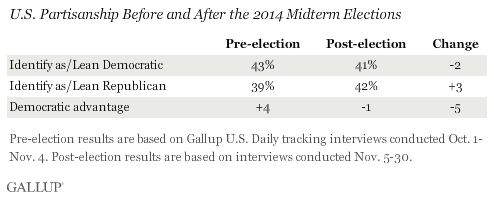
Since the Republican Party's strong showing on Election Day last month, Americans' political allegiances have shifted toward the GOP. Prior to the elections, 43% of Americans identified as Democrats or leaned toward the Democratic Party, while 39% identified as or leaned Republican. Since then, Republicans have opened up a slight advantage, 42% to 41%, representing a net shift of five percentage points in the partisanship gap.
U.S. Partisanship Before and After the 2014 Midterm Elections
The pre-election results are based on Gallup Daily tracking interviews with 17,259 U.S. adults, conducted between Oct. 1 and Nov. 4. The post-election interviews are based on 12,671 interviews conducted Nov. 5-30.

Thursday, December 4, 2014

The California Exception

Mark DiCamillo, director of The Field Poll, explains at Opinion Today why California bucked GOP tides in 2010 and 2014.  First, even in a low-turnout election, the CA electorate has more minorities than the US electorate, but the behavior of white voters is different, too.
While the California exit poll available publicly didn’t subdivide the electorate with regard to voter preferences in House races across the state, a good substitute would be to examine the preferences of voters in the state’s six partisan candidate elections other than governor (i.e., the “down-ballot” races) as measured in the final pre-election Field Poll, whose results closely corresponded to election outcomes in each race.
What it shows is that this year the state’s white non-Hispanic voters were evenly divided in their preferences between the Democrat and Republican candidates across the six down-ballot races, with each party’s candidates averaging about 44% of the voting preferences. This is in stark contrast to the 24-percentage point advantage that Republicans held over the Democrats in House races across the country.
Thus, one of the major factors underlying the very different election outcomes nationally and in California relates to the voting preferences of white non-Hispanics.
Second, region and ethnicity worked in tandem.
According to the [final Field pre-election] poll, white non-Hispanic voters living in the state’s thirty-eight inland counties were supporting Republican candidates in these races by an average of 20 points, 51% to 31%, similar to the 24-point Republican edge in House races.
By contrast, the poll shows that white non-Hispanics living in the state’s twenty coastal counties were supporting Democratic candidates in the down-ballot races by an average of ten points, 46% to 36%.
Thus, one of the biggest contributors to the Democratic Party’s electoral successes here versus its dismal showing across the country relates to the very different voting preferences of the state’s white non-Hispanic voters, and in particular, those living along the coast.

Wednesday, December 3, 2014

Health Care and the Democrats

At The New York Times, Thomas Edsall ponders Charles Schumer's contention that health care has hurt the Democrats.
A United Technologies/National Journal Congressional connection poll of 1,013 adults in mid-November 2013 found that by a 25-point margin, 59-34, respondents said that the health care law (which includes a major expansion of Medicaid to cover anyone up to 133 percent of the poverty line, and subsidies for the purchase of private insurance for those between 133 percent and 400 percent of the poverty line) would make things better for the poor. But respondents also said, by a 16-point margin, 49-33, that the law would make things worse for “people like you and your family.” White respondents were even more critical, with 58 percent saying that Obamacare would make things worse for people like you and your family, and 63 percent saying it would make things worse “for the middle class.”
Exit poll data from 1994, after President Clinton’s failed bid to pass health care reform, as well as from 2010 and 2014, provides further support for the Schumer argument. In each of those three midterm elections there were huge white defections from the Democratic Party; in 2010 and 2014, there were comparable defections of senior voters.

The loss of white supporters of House Democratic candidates can be seen in the data. In 1992, white voters split 50-50 between Democratic and Republican House candidates; in 1994, after the Hillarycare debacle, they voted Republican 58-42. By 2010 and 2014, whites voted for Republican House candidates by a 24-point margin, 62-38. The defection of seniors is most striking when comparing exit poll data from 2006 and 2010. In 2006, seniors of all races voted 52-48 for Democratic House candidates; in 2010, they voted 58-42 for Republican House candidates.
...
A Brookings Institution analysis of the winners and losers from Obamacare found that the program redistributes costs to the top 80 percent of the income distribution in order to provide benefits to the bottom 20 percent. The analysis, shown in Figure 1, reports that
incomes in the bottom one-fifth of the distribution will increase almost 6 percent; those in the bottom one-tenth of the distribution will rise more than 7 percent. These estimated gains represent averages. Most people already have insurance coverage that will be left largely unaffected by reform. Those who gain subsidized insurance will see bigger percentage gains in their income.

Tuesday, December 2, 2014

Landrieu's Racial Politics

The Louisiana Senate runoff is Saturday. James Hohmann reports at Politico that Mary Landrieu is stiff-arming Obama with white audiences, embracing him with black audiences.
Landrieu’s campaign released a radio ad to the press on Monday in which a woman tells her husband: “We’re not voting for Obama. We’re voting for us and our future.” Her television commercials on general-interest stations have said “she took on the president.”
During their final debate Monday, Cassidy attacked Landrieu for telling NBC’s Chuck Todd that racism is a factor behind Obama’s unpopularity. “Just because you disagree with the president doesn’t make you a racist,” the congressman said.
Landrieu responded that the quote was taken out of context, and that she also outlined her policy disagreements with Obama. “I said the South has not always been the friendliest place for African-Americans,” she said. “I will make no apologies for something that is a historical fact.”
Other Democrats in red states with sizeable black populations tried ahead of the midterms to link themselves with Obama in radio ads targeting black audiences. North Carolina Sen. Kay Hagan, who ended up losing, released a television ad saying she was not a rubber stamp for Obama, even as she ran an ad on African-American radio stations carrying an endorsement from the president.
Just like Landrieu, these Democrats did not circulate the pro-Obama ads to the press. But the spread of social media networks has made it harder for such tactics to escape broader notice.
In the past two weeks, a conservative Bayou State blog known as The Hayride has picked up two other ads authorized by the Landrieu campaign. Both were captured on radio stations primarily aimed at African-American voters.
In one, picked up on KBZE Radio in Berwick, a narrator says, “They have shown our president so much disrespect: from playing the race card in commercials, talking about trying to impeach him to lying about the progress the country has made under his leadership.”