Search This Blog

Showing posts with label Nevada. Show all posts

Wednesday, December 4, 2024

President-Senate "Mismatches"

Our most recent book is titled Divided We Stand: The 2020 Elections and American Politics.  Among other things, it discusses state and congressional elections.

Drew DeSilver at Pew:
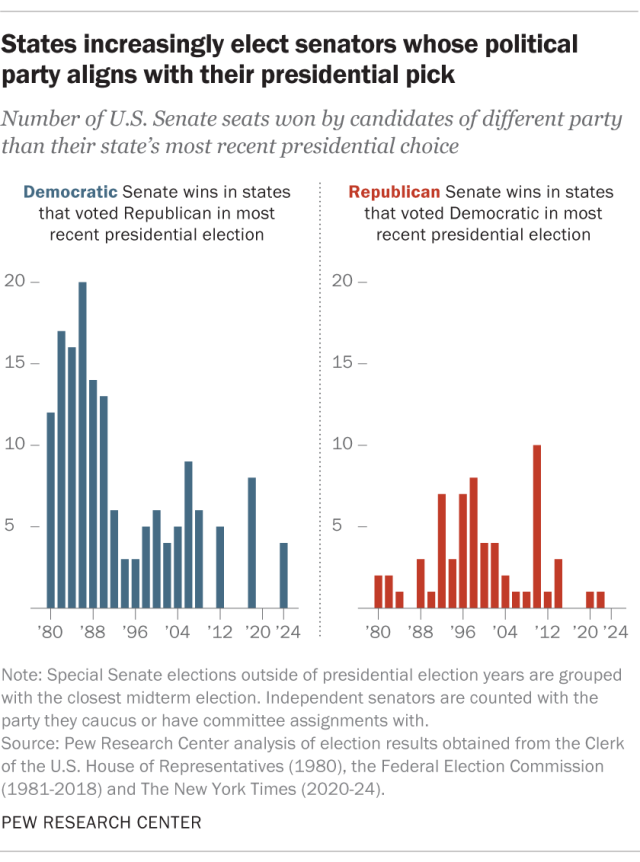
Four states that Republican Donald Trump carried in this month’s presidential election also elected Democratic senators. That may not seem like a lot, but it’s twice as many “mismatches” between states’ presidential and U.S. Senate results as in all Senate elections held in 2020, 2021 and 2022 combined.
  • This year, the states that chose Trump for president and sent a Democrat to the Senate were:Arizona: Rep. Ruben Gallego won the seat that independent Sen. Kyrsten Sinema is vacating.
  • Michigan: Rep. Elissa Slotkin will succeed retiring Sen. Debbie Stabenow.
  • Nevada: Incumbent Sen. Jacky Rosen fended off political newcomer Sam Brown.
  • Wisconsin: Incumbent Sen. Tammy Baldwin edged out financier Eric Hovde.
No states had mismatches in the other direction, electing Republican senators but picking Democrat Kamala Harris for president.

The four mismatches, out of 34 Senate elections this year, made for a “mismatch rate” of nearly 12%. That’s the highest since the 2017-18 cycle, when the mismatch rate was 22%, according to Pew Research Center’s analysis of results going back to 1980. Along with a Democratic win in the 2017 special Senate election in Alabama, seven out of 35 Senate races in the 2018 midterms (including two special elections) went to a different party than the state’s 2016 presidential vote did.

President-Senate mismatches of this sort used to be fairly common. But since 1990, fewer than half of Senate elections have diverged from their state’s most recent presidential vote – and over the past dozen years, the trend has been for fewer and fewer to do so.

BUT the AZ, MI, and NV results ended with same-party delegations in each state. WI remains split-party.  

Hannah Recht and Eric Lau at WP:

Voters in Montana, Ohio, West Virginia and Pennsylvania — states that Donald Trump won on Nov. 5 — also voted for Republicans to take over Senate seats currently held by Democrats, helping Republicans secure control of the upper chamber.

After these flips, only Maine, Pennsylvania and Wisconsin will send a split-party delegation of one Democrat and one Republican to the Senate. That is the lowest number since Americans began directly electing senators more than a century ago.


Monday, October 24, 2022

Ultimate Election Denial

 Our recent book is titled Divided We Stand: The 2020 Elections and American Politics.  Among other things, it discusses the state of the partiesThe state of the GOP is not good. Trump and his minions falsely claimed that he won the election, and have kept repeating the Big Lie And we now know how close he came to subverting the Constitution.   

Daniel Dale at CNN:
Jim Marchant, the Republican candidate for Nevada elections chief, has repeatedly promoted false conspiracy theories about elections in his closely contested state.

Now, with the November 8 midterms fast approaching, Marchant is going further – pushing a preposterous claim that prominent congressional Democrats in California and New York did not legitimately win reelection, though they actually won fair and square by overwhelming margins.

Marchant is one of at least 11 Republican candidates for state secretary of state in 2022 who have rejected, questioned or tried to overturn the results of the 2020 presidential election. He is the first, though, to run a campaign ad rejecting the legitimacy of the dominant victories earned by House Speaker Nancy Pelosi and Rep. Adam Schiff of California and Senate Majority Leader Chuck Schumer and Rep. Jerry Nadler of New York.

Brendan Nyhan, a Dartmouth College political science professor who studies political misinformation and co-organizes an initiative that monitors the state of democracy in the US, tweeted that the Marchant ad is “terrifying.” Nyhan explained in a message to CNN that he finds it “chilling” that a secretary of state candidate is running an ad “questioning the legitimacy of Democrats winning *any* elections.” He said Marchant “could easily throw the 2024 election into chaos.”

Thursday, October 13, 2022

Laxalt Family Values

Our book is titled Divided We Stand: The 2020 Elections and American Politics.  Among other things, it discusses state and congressional elections

Gabe Stern at Yahoo:
Less than a month before Election Day, 14 members of Nevada Republican Senate candidate Adam Laxalt’s family sent a letter endorsing his opponent, Democratic U.S. Sen. Catherine Cortez Masto.

“We staunchly believe that Catherine is well equipped with her own ‘Nevada grit’ — a quality that she will take forward in representation of our home state for six more years across the halls of Congress,” the letter states.

The letter, first obtained by The Nevada Independent, does not mention Laxalt by name.

Instead, it talks of Cortez Masto’s understanding of “the daily realities of dogged hard work” and mentions her experience in public education as well as her commitment to law enforcement.

The family members also wrote that Cortez Masto’s career demonstrates she is "an authentic advocate of Nevada.”

It marks the second time that some of Laxalt’s family has endorsed his opponent. During his unsuccessful gubernatorial run in 2018, a dozen family members endorsed Democrat Steve Sisolak in an op-ed to the Reno Gazette-Journal. That letter more explicitly criticized Laxalt, saying he “leveraged and exploited” the family name throughout his campaign.

Wednesday, June 15, 2022

Yesterday's Results

Our book is titled Divided We Stand: The 2020 Elections and American Politics.  Among other things, it discusses state and congressional elections

Lloyd Green at The Guardian:

On Tuesday, Republicans flipped a congressional seat in a heavily Hispanic district in south Texas, sent packing a pro-impeachment Republican congressman from South Carolina and nominated a passel of Trump loyalists in Nevada. It was a good night for the 45th president and an even better one for his party.

In Texas’s 34th congressional district, Mayra Flores, a Republican, garnered 51% of the vote in a special election in a district that voted for Joe Biden by double digits. Flores is the first Republican elected from the district, and the first Latina Republican in Texas’s congressional delegation.

The Democrats have plenty to worry about. Flores campaigned on being born in Mexico and arriving in the US with her migrant parents. From the looks of things, the Democrats’ hold on Latino voters appears to be rapidly eroding. The cracks that appeared in the 2020 elections continue to grow.

...

In South Carolina’s seventh congressional district, incumbent representative Tom Rice suffered defeat after voting to impeach Trump for his role in the January 6 insurrection.

The congressman lost to Russell Fry, a state legislator endorsed by Trump. Rice remained unrepentant to the end. “I was livid,” he said. “I took an oath to protect the constitution and I did it then and I would do it again tomorrow.” His constituents were unimpressed.

Elsewhere in South Carolina, Representative Nancy Mace defeated Katie Arrington, a one-term former state legislator who had Trump’s backing. Mace offended Trump by voting to certify Joe Biden as the winner of the 2020 presidential election and criticizing the insurrection.

Unlike Rice, Mace opposed impeachment. Beyond that, on the campaign trail, she repeatedly stressed her personal support for Trump, and let his backers know that she still stood with them.

...

Trump loyalists also had a good night in Nevada. There, denial of Trump’s loss in the 2020 election emerged as the coin of the realm. Jim Marchant won the Republican nomination for secretary of state. His embrace of the big lie was a central tenet of his candidacy.

Elsewhere on the ballot, Trump’s pick for the US Senate, Adam Laxalt, prevailed in the Republican primary with a 55-36 win over Sam Brown, an Afghanistan war veteran. Laxalt is a former Nevada attorney general, and the grandson of the late Paul Laxalt, a US senator.

...
Likewise, Joe Lombardo, another Trump-backed candidate, won the Republican nod for governor. He is the sheriff of Clark county, and will take on Steve Sisolak, the Democratic incumbent.

Hearings held by the House special committee did not affect Tuesday’s primaries; they were irrelevant. Whether that is the case in November remains to be seen.

Sunday, March 28, 2021

Shape-Shifting Candidate

Our new book is titled Divided We Stand: The 2020 Elections and American Politics.  Among other things, it discusses the state of the parties.

The state of the GOP is not good.  A New Jersey-born former wrestler who lost a House race in Nevada is now a commie-bashing Texan.


Emily Singer at The American Independent:
\A Republican former professional wrestler is district hopping in the hopes of winning a U.S. House seat — and is totally changing his personality in the hopes of making his congressional dreams a reality.

Dan Rodimer won the GOP nomination in Nevada's 3rd District in November in 2020. He went on to lose to Democratic Rep. Susie Lee by a 3-point margin in the suburban Las Vegas-based seat.

A little more than four months later, he's back, this time running in a special election in a Dallas-based seat more than 1,200 miles away — and he's almost unrecognizable from his previously failed bid.

In his Nevada race, Rodimer ran ads painting himself as a clean-cut, family man — wearing a collared shirt and seated on a couch with his wife and five children.

In the ad, he was defending himself from reports that he had been accused of assault three times between 2010 and 2013. According to a report from the Associated Press in October 2019, Rodimer was accused of punching men "at or outside of nightclubs."

Now, Rodimer is back and running in a special election in Texas' 6th District — a Dallas-based House seat left vacant after Rep. Ron Wright died following a COVID-19 diagnosis.

And Rodimer looks like a totally different person, donning a cowboy hat and positioning himself as a rodeo bull rider with a Texas accent. The ad hits on every right-wing culture war issue of the day and is being touted by Benny Johnson — a far-right instigator who works for the conservative organization Turning Point USA. 

Monday, September 14, 2020

Endangerment

In Defying the Odds, we discuss the 2016 campaign. The 2019 update includes a chapter on the 2018 midterms. The 2020 race, the subject of our next book, is well underway.   It unfolds as Coronavirus presents unprecedented challenges to public policy and the electoral process.

 Stephen Collinson at CNN:

President Donald Trump offered a glaring new example of his refusal to put medical science before politics with a large indoor rally Sunday night that made a mockery of social distancing, while the pandemic he mismanaged has now claimed more than 194,000 American lives.
The event in Nevada -- his second rally in the state in as many days -- did not only risk the health of those present, thousands of whom were packed together inside a manufacturing facility in defiance of the state's ban on local gatherings of 50 people or more. It also has the potential to turn into a super spreader event that could seed Covid-19 outbreaks in the wider community. Trump hadn't held an indoor rally in nearly three months, since his last one, in Tulsa, Oklahoma, after which the city saw a surge in cases and multiple campaign staffers along with Secret Service agents tested positive for the virus.


Saturday, February 29, 2020

Threshold

In Defying the Odds, we discuss the 2016 campaign. The 2019 update includes a chapter on the 2018 midterms. The 2020 race, the subject of our next book, is well under way.

If several candidates remain in the race but fall short of the 15% threshold, that enlarges the delegate haul for the candidates above the 15% threshold. As the winner of the New Hampshire primary and the Nevada caucuses, and a close second in the Iowa caucuses, Sanders has already benefited disproportionately in delegate allotments. In Iowa, Sanders won 26% of the vote but got 30% of the delegates; in New Hampshire, he won 26% of the vote but got 38% of the delegates; and in Nevada, he won 47% of the vote but secured 67% of the delegates.
A candidate with a solid base of supporters, like Sanders, is well positioned to collect some delegates in almost every contest. Until the field narrows, meanwhile, the anti-Sanders vote will be splintered. The longer this splintering continues, the easier it is for Sanders to build his delegate lead.

Sunday, February 23, 2020

Bernie Wins Nevada

In Defying the Odds, we discuss the 2016 campaign. The 2019 update includes a chapter on the 2018 midterms. The 2020 race, the subject of our next book, is well under way.

Matt Viser at WP:
Sen. Bernie Sanders won a resounding victory in the Nevada caucuses Saturday, providing another boost to an insurgent campaign that is challenging the Democratic establishment and stifling the plans of rivals who still hold out hope of stopping him.

Sanders’s advantage in Nevada was overwhelming, with substantial leads in nearly every demographic group, allowing him to set down a marker in the first state with a significant share of nonwhite voters. Sanders expanded the electorate by attracting relatively large numbers of first-time caucus-goers, providing momentum as the race shifts into a critical stretch over the next 10 days.

He prevailed among those with college degrees and those without; those living in union and nonunion households; and in every age group except those over 65. He won more than half of Hispanic caucus-goers — almost four times as much support as his nearest rival, former vice president Joe Biden — and even narrowly prevailed among those who identified as moderate or conservative. Despite attacks on his health proposal by the powerful Culinary Union, he won in caucus sites filled with union members.
Ryan Lizza at Politico:
The powerful Culinary Union, which opposes Sanders’ Medicare for All plan and spent the final weeks of the campaign in a high-profile fight with his campaign, was supposed to weaken him. And yet the Sanders’s ranks were speckled with red-shirted Culinary members. (Overall, Sanders won 34% of caucus-goers from union households, besting all of his rivals.)

Sanders wasn’t supposed to be able to break through with black and brown voters, but the group was racially and ethnically diverse. (Sanders won 27% of African Americans and 53% of Hispanics across the state.) The Sanders movement is supposed to be limited to those crazy college kids who don’t remember socialist as a slur. But there were plenty of older Sanders backers at the Bellagio chanting “Bernie” along with their 20-something comrades. (Sanders won every age category in the state except Nevadans over 65, which he ceded to Joe Biden.)
Sure, the numbers are tiny. In a state of 3 million people, turnout of over 100,000 participants is considered enormous. Candidate events here on the days leading up to the caucuses were sleepy affairs, with fewer attendees than in Iowa and New Hampshire where the big cities are a fraction of the size of Vegas.
But the Sanders victory still exploded a lot of myths. He was said to have a ceiling of 30% or so. Remarkably, against a much larger field of candidates Sanders is poised to come close to the same level of support as he did in 2016 in a one-on-one race against Hillary Clinton, to whom he lost 47%-53%. (He was at 46% with a quarter of precincts reporting as of this writing.) He was said to be unable to attract anyone outside his core base. But he held his own with moderate voters (22%) and won across every issue area except voters who cared most about foreign policy, who went with Biden.

Tuesday, December 18, 2018

Wise Words from Jim Brulte

In Defying the Odds, we discuss state and congressional elections as well as the presidential race.   California is an important part of the story.

At The Hill, California Republican chair Jim Brulte writes that demographics are driving the state party's decline -- and could portend growing problems for the party elsewhere.
In 1996, the white, non-Hispanic population in California was approximately 51 percent, and GOP registration statewide was 37 percent. Today, the white, non-Hispanic population is under 37 percent and GOP registration has dropped to 25 percent. And given our party’s inability to generate significant voter registration in the rapidly-growing Hispanic and Asian voting groups, this decline in voter registration is actually accelerating.

It is easy to forget it was not always like this. California has a long and rich history of thriving under Republican stewardship. We are the party of Earl Warren and Ronald Reagan. Since 1862, California has elected successive Democrats to be governor just twice — once was in 1886 and the other was last month when Gavin Newsom was elected to succeed Jerry Brown.

What changed? The quick answer is the voting population: Our party and our candidates have yet to figure out how to consistently attract support from Hispanics and Asians.

California is one of five majority-minority states. Another of those five states, Hawaii, is solidly Democratic. New Mexico just elected a Democratic governor and added to its legislative majorities that include a two-thirds majority in the lower House. Nevada elected a Democratic governor, flipped a Republican-held U.S. Senate seat and increased Democrats’ numbers in the state legislature, which brought about a two-thirds majority in the lower house. And in Texas, long held as an example of Republican excellence, Republicans managed to win all statewide races, but lost two congressional seats, two state Senate seats and 12 lower House seats.

By the end of next year, a majority of children in this country under age 18 will be non-white. And by 2044, a majority of the population of our country will made up of individuals from current minority groups.

Tuesday, June 27, 2017

Trumpcare: Stupid Is as Stupid Does

Mitch McConnell had to delay Senate Trumpcare.  Jonathan Martin and Glenn Thrush report at The New York Times:
Mr. McConnell made clear his unhappiness to the White House after a “super PAC” aligned with Mr. Trump started an ad campaign against Senator Dean Heller, Republican of Nevada, when he said last week that he opposed the health care bill.
The majority leader called the White House chief of staff, Reince Priebus, to complain that the attacks were “beyond stupid,” according to two Republicans with knowledge of the tense exchange on Saturday.
Mr. McConnell, who has been toiling for weeks, mostly in private, to put together a measure that would satisfy hard-liners and moderates, told Mr. Priebus in his call that the assault by the group, America First, not only jeopardized the bill’s prospects but also imperiled Mr. Heller’s already difficult path to re-election.
America First was founded by a group of Mr. Trump’s loyalists — many of them with deep connections to Mr. Pence, including Nick Ayers, a Republican consultant who is regarded as the vice president’s top political adviser. The PAC compared Mr. Heller to Representative Nancy Pelosi, the House Democratic leader, and vowed a seven-figure advertising campaign against him.
Josh Holmes, Mr. McConnell’s former chief of staff, said, “That the White House is asking people to take a tough vote and then running ads against members while we’re still in negotiations is so dumb it’s amazing we even have to have the conversation.”

Tuesday, February 21, 2017

Iowa to the Right, Nevada to the Left

Thomas Beaumont writes at AP:
After decades as the crossroads of prairie populists and checkbook conservatives, Iowa has suddenly become solidly Republican like many of its Midwestern neighbors.
It was one of four states — along with Kentucky, Missouri and New Hampshire — that flipped to complete GOP control in the November election, but Iowa's rush of new legislation has been the most intense.
In an all-night session last week, Iowa lawmakers approved a bill similar to one enacted in Wisconsin six years ago that strips most public sector unions of long-held collective bargaining rights, including health insurance.

Jeff Orvis, a veteran northern Iowa high school teacher, said he sees the measure leaving permanent damage to Iowa's century-old reputation for quality schools, enshrined on the state's 2004 commemorative quarter: "Foundation in education."
"Now, I don't even see how Iowa is going to attract good teachers," said Jeff Orvis, a union representative from northern Iowa. "That's my biggest worry."
Jeff Singer writes at Daily Kos:
Daily Kos Elections’ project to calculate the 2016 presidential results for every state legislative seat in the nation hits Nevada, a rare Democratic bright spot in 2016. You can find our master list of states here, which we'll be updating as we add new states; you can also find all our data from 2016 and past cycles here.
Hillary Clinton carried the Silver State 48-46, a drop from Barack Obama’s 52-46 win against Mitt Romney. However, Clinton’s narrow victory, thanks in no small part to the formidable get-out-the-vote machine built by retiring Sen. Harry Reid, helped Team Blue avenge its embarrassing loss of both chambers of the state legislature two years before. Democrats all but conceded the 2014 gubernatorial race against GOP incumbent Brian Sandoval, and uninspired Democratic voters largely stayed home; Team Red won a 27-15 majority in the Assembly, and an 11-10 edge in the Senate.
But 2016 was a complete reversal, with Democrats taking back a 27-15 Assembly majority and an 11-10 Senate edge. A few days later one Republican, state Sen. Patricia Farley, announced that she was becoming an independent and caucusing with the Democrats, giving her new allies a 12-9 majority. The entire Assembly is up every two years, while half the Senate was up in 2016 and the other half, including Farley, will be up in 2018.

Tuesday, November 8, 2016

Fearless Forecast


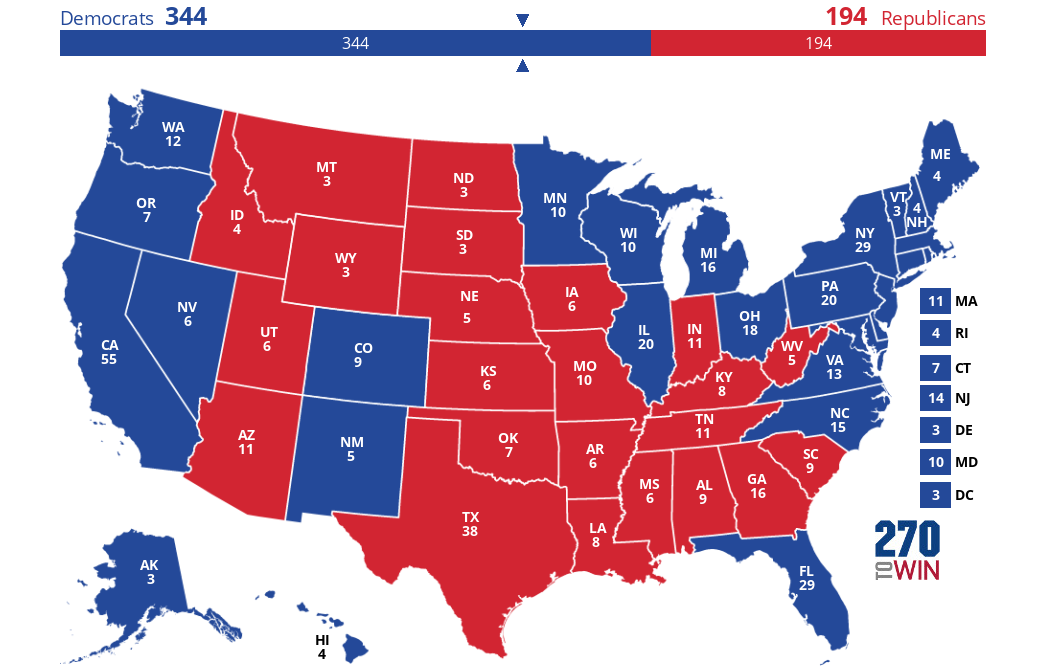
Click the map to create your own at 270toWin.com


Popular vote:Clinton 49 Trump 44 Johnson 4 Stein 2 Other 1

House: net GOP loss of 19 seats, including 4 in California (Issa, Denham, Valadao, Knight) 

Senate: Dems win North Carolina, Missouri, Illinois, Wisconsin, Pennsylvania, for a 51-49 majority.

My D numbers are a bit higher than consensus, for two reasons.

1.  Demographics.  I think the likely-voter screens are missing some Latino low-propensity voters who will  turn out for Clinton.  RCP average has Trump ahead in Nevada, even though Clinton has already locked up the state thanks to Hispanic early voters.  I suspect that the same dynamic will tip Florida.  In North Carolina, black early vote was down, in part because there weren't enough early-voting sites.  Dems will make up some of that deficit today.  Also, the D advantage among college-educated whites will make a difference in NC, too.

2.  Mobilization.  Democrats have an even greater advantage in GOTV than they did 4 years ago, which is saying a lot.

The story of key Senate races is a revolt against insiders. That's why Blunt and Burr are in trouble, and why Bayh will probably fail.

Note Alaska.  My Hail Mary longshot prediction is that Clinton wins. Not as crazy as it sounds:  she has actually led some polls there.  Reason:  Trump's issues do not resonate with Alaska whites, but they have alienated Native Alaskans.

Monday, February 22, 2016

Learning the Right and Wrong Lessons

Reposted from Fox and Hounds:
Defeat can be a much better teacher than victory. Hillary Clinton entered the 2008 nomination as the odds-on favorite, but in a stunning upset, lost to a young senator from Illinois. Her loss was emotionally searing but politically educational. Specifically, she learned three lessons that she has been applying during the 2016 contest.
First, organize the caucus states. Assuming that primaries were the main event of 2008, the Clinton campaign failed to put enough money and labor into the caucuses (though she did win Nevada). In the end she actually edged out Obama among delegates from states with contested primaries, but Obama became the inevitable nominee by building an insurmountable lead in the caucus states. This time, she is not taking the caucuses for granted, and her superior organization enabled her to prevent a surging Sanders from winning Nevada.
Second, pay attention to the superdelegates. The Democratic Party provides a certain number of convention seats (712 in 2016) to elected officials and other party figures who are free to exercise their own judgment. In 2008, Obama worked the superdelegates much more skillfully than Clinton, even persuading some high-profile Clinton supporters (e.g., Rep. John Lewis of Georgia) to switch sides. This time, Clinton already has the support of more than 400 superdelegates. Expect her campaign to keep careful watch on them: there will be no poaching in this field of delegate dreams.
Third, hang on to the African American vote, which accounts for a huge chunk of the Democratic electorate. Surprising as it may seem today, Clinton started the 2008 campaign with a big advantage over Obama among African Americans. After Obama won Iowa, however, this constituency shifted in his direction. In 2016, Clinton does not have to worry about battling a charismatic African American senator. Still, she is taking no chances, and her campaign surrogates are constantly belittling the depth of Bernie Sanders’s commitment to civil rights. The Clinton line of attack has produced an odd side effect: the Sanders campaign is crowing at the discovery of 1963 photo showing Chicago police grabbing Sanders at a civil rights protest. It is quite rare for candidates to brag about their arrest records, but this novel approach is probably not enough to overcome Clinton’s long ties with civil rights leaders. In Nevada, Clinton won 76 percent of African American caucus-goers, compared with just 22 percent for Sanders.
If Hillary Clinton learned useful lessons from her earlier failure, Jeb Bush learned the wrong lessons from his family’s success. He planned to start the campaign with a huge warchest and list of endorsements, just as George W. Bush had done before the 2000 campaign. This “shock and awe” strategy aimed to intimidate other candidates so Bush could clinch the nomination early in the season.
Under certain circumstances, that strategy could make sense, but in this case, it underestimated the liabilities of the Bush name. Conservatives lament the expansion of government during the last Bush administration, and many other voters have bad memories of the Iraq War. The strategy also overlooked the demagogic appeal of a billionaire celebrity.
In 2000, George W. Bush essentially secured his nomination by defeating John McCain in the South Carolina primary. Sixteen years later, that same state put an end to his brother’s campaign.

Friday, March 20, 2015

The $20 Million Cover Charge

Karl Rove explains why the rock-bottom cover charge for the 2016 campaign is $20 million.
One way to get a rough sense of the likely buy-in to the GOP race is to examine the cost of running four weeks of television in each of the sanctioned contests in February 2016—Iowa, New Hampshire, South Carolina and Nevada. These first four states collectively have 133 delegates, or only 5.4% of the 2,471 delegates likely to be at the convention.

A week of television—enough for an average viewer to see an ad about 10 times—in the four states would cost roughly $4 million, according to GOP TV buyers. It’s reasonable to expect most campaigns would look for at least four weeks of TV, making the cost to run ads in the February states right around $16 million.

Of course, TV is not the only way campaigns would convey messages. In addition, the prices TV stations are quoting are for third-party groups like Super PACs. The law guarantees candidates the lowest rate, which stations are loath to estimate now.

But even if candidates paid less for TV, the additional costs for Internet activity, mail, phones and radio would mean candidates could still spend close to $20 million to mount strong campaigns in all the February contests.

Sunday, November 2, 2014

Crossroads GPS Keeps After Horsford, Who Bring in Obama


Justin Sink reports at The Hill:
But one Nevada Democrat — Rep. Steven Horsford — is hoping the president can help him turn out the Democratic base after a late surge of Republican spending propelled challenger Cresent Hardy into contention.

Horsford’s campaign will begin airing a new ad featuring the president praising Horsford as a “tireless advocate” on their behalf, and touting his bipartisan credentials.
...
“Steven has worked with Republicans and Democrats to get laws passed — laws that created thousands of jobs right here in Nevada,” Obama continues.
...
To that point, the Democratic Congressional Campaign Committee announced Thursday it was planning to spend $360,000 on the race. Republicans are also pouring big money into the contest, with Karl Rove's Crossroads GPS buying nearly $1 million in ad time.

Thursday, October 23, 2014

The Crossroads Groups Use Obama & Obamacare in House Races

In House races, the Crossroads groups are linking Democrats to Obama and Obamacare.

In Arkansas 2, American Crossroads attacks Patrick Henry Hays:


In Nevada 4, Crossroads GPS highlights Rep. Steven Horsford's pro-Obama voting record:


In New Jersey 3, Crossroads GPS focuses on Aimee Belgard's local record, but works in a reference to her support for Obamacare.


Tuesday, March 18, 2014

Brian Sandoval

Nevada Governor Brian Sandoval is a start, except to Beltway types of both parties, writes Lloyd Green writes at The Daily Beast:
Rank-and-file Nevadans are a whole other story. Sandoval’s approval ratings are just under 70 percent, a number any politician would envy. In-state Republicans love him, independents like him a lot, and even Democrats are favorably disposed. Right now, Sandoval is projected to coast to reelection in November, according to Politico. 
So how did Sandoval manage to offend the powers that be, but find favor across the board in his home state? Could it be by being the anti-Reid, the anti-Obama, and the anti-Christie all rolled into one? Could it be by being in touch with reality and appearing responsive to the citizenry at large, as opposed to just narrow interests? Could it be by exuding sunshine and optimism, and unhesitatingly reaching across the aisle?

Sandoval is more committed to overall fiscal responsibility than wedded to ideology at any cost. But, he is also not profligate. In 2012, the free-market oriented Cato Institute gave Sandoval and Christie a “B”, while New York’s Andrew Cuomo and California’s Jerry Brown both earned dismal “Ds”. According to Cato, “Sandoval proposed a nine percent cut to the budget for fiscal 2012, and the legislature ending up approving a cut of about five percent.”
Impressively, Sandoval’s success comes amidst Nevada having gone Democratic in the last two presidential elections. But part of it is also about Sandoval’s own story. Sandoval is the first Latino elected to statewide office in Nevada, winning the attorney general’s seat in 2002, before unseating the incumbent Governor Jim Gibbons in the 2010 Republican Primary, and then defeating Rory Reid—Harry Reid’s son, in the general election.

Wednesday, December 12, 2012

Resurgent Republic on the Hispanic Vote


Resurgent Republic and the Hispanic Leadership Network surveyed Hispanics who voted in the 2012 Presidential election in Florida, Colorado, Nevada, and New Mexico.  Some findings:

  • Majorities of Hispanic voters say that, regardless of how they typically vote, the Republican Party does not respect the values and concerns of the Hispanic community. Combined with the overwhelming view that the Democratic Party, rather than the Republican Party, better understands the needs and concerns of Hispanic voters, the results of this question should be sobering for Republican candidates at every level. Hispanic voters say the Republican Party does not respect the values and concerns of the Hispanic community by 51 to 44 percent in Florida, 54 to 40 percent in New Mexico, 59 to 35 percent in Nevada, and 63 to 30 percent in Colorado.
  • But Republican statewide elected officials are far more popular than the Republican Party in general, and Mitt Romney specifically. In Florida, Senator Marco Rubio has a 49 to 37 percent favorable-unfavorable rating, compared to Romney’s 44 to 51 percent. In New Mexico, Governor Susana Martinez has a 53 to 35 percent favorable-unfavorable rating, compared to Romney’s 34 to 58 percent. And in Nevada, Governor Brian Sandoval has a 47 to 27 percent favorable-unfavorable rating, compared to Romney’s 32 to 62 percent. As seen with the Republican Party overall, Mitt Romney’s worst favorable-unfavorable rating is in Colorado, at 26 to 69 percent (including 51 percent very unfavorable).
  • Disturbingly, majorities of voters in each state say that “Is anti-immigrant” better describes the Republican Party, while the Democratic Party has big leads on “Understands the needs and concerns of Hispanic voters,” and “Makes an effort to win Hispanic voters.” But one area of potential concern for Democrats is seen on “Views the Hispanic community as a group, rather than as individuals,” where they lead Republicans in every state by double-digit margins. This suggests a sense among some Hispanic voters that the Democratic Party takes them and their vote for granted, thus offering Republicans an opportunity to make inroads among these voters with a results-oriented agenda that does not pander.
  • Only in Florida was the Romney campaign close to par with the Obama campaign in its Hispanic voter contact effort. Given that voters say that the Democratic Party, rather than the Republican Party, makes an effort to win Hispanic voters, it is not surprising to see a decided Democratic outreach advantage in the recent presidential campaign.

Tuesday, October 30, 2012

Crossroads GPS, Final-Week Hits

Crossroads GPS is running ads in Senate races.

Against Tim Kaine in Virginia, -- linking him to Obama:


Another against Kaine -- highlighting his support for cap and trade:


 Against Heitkamp in North Dakota -- depicting her as a roadblock to a Romney agenda:


Against Berkley in Nevada -- hitting her ethics very hard:


Against Sherrod Brown in Ohio -- linking him to economic decline:


Against Angus King in Maine -- attacking his ethics and support for Obamacare:

Thursday, October 25, 2012

Latest Crossroads GPS Ads in House Races

Crossroads GPS gets tough again in Nevada 4:


Another hit on Tim Bishop's ethics in New York 1:


A tax attack in CA 21:


And in Indiana 2, the Democrat is "one of them."