One astute conservative student of the realignment likened the legislation “to a death march through a series of choices that nobody really wanted to be making.”
“[It’s] not something that has an especially coherent logic to it or much prospect of actually accomplishing the things that I think people want,” Oren Cass, founder of the think tank American Compass and a leading advocate of conservative economic populism, told POLITICO Magazine recently.
The failure to imbue the legislation with more of a Trumpist ideological throughline may be due to a few factors; perhaps it’s Trump’s well-known aversion to wonky policy details, or the fact that most Republican lawmakers are still loyal to the Reaganite economic policy they came up with even as they now publicly bow to Trump.
But whether the sprawling bill is ultimately judged a policy success or failure, it lacks an original vision to hold together the constituencies Trump has improbably knitted together — tax relief, border spending, safety net cuts and Biden policy rollbacks aren’t a theory of the case. Sure, it has a few Trumpian frills that nod to the president’s populist campaign pledges, but they are largely small-bore and were scaled back by senators anyway. “No tax on tips” became a temporary tax deduction on tips, for instance. The brief musings about a tax hike on upper-income earners quickly were extinguished by opposition from Republicans on Capitol Hill.
Decades from now, no one will point to this legislation as a key building block of a lasting Republican coalition. It’s more likely to be remembered for the $3.3 trillion it is estimated to add to the national debt.
The legislation isn’t just a missed opportunity. It’s also a striking departure from the more disciplined efforts to reshape and reckon with an evolving party that happened in the last Republican administration before Trump. When George W. Bush occupied the White House, Karl Rove, his political architect, pursued a master plan to lock in the party’s newly emerging coalition and ensure its viability over the long haul. The creation of Medicare Part D, the program’s new prescription drug benefit, was designed to blunt the Democratic advantage on health care issues. Immigration reform, which failed, was a nod toward consolidating Bush’s gains with Latino voters.
The Iraq debacle made the efforts moot, but some of the residual effects of Rove’s work remains visible today: the GOP’s edge in the exurbs, its dominant position among evangelicals, the party’s gains with Catholics.
If anything, the megabill threatens to peel off some of the new constituencies of the ascendant Republican coalition or give them cause for concern. The Medicaid spending cuts stand to hit working class people of color and in rural America hard, from the Trump Belt of Appalachia to the Southwest. The income tax cuts and expanded child care tax credit will be warmly welcomed, but wealthier Americans will benefit more.
It’s revealing that there is no quarter of the new coalition that is wildly enthusiastic about the package. Polling suggests Americans largely disapprove of the megabill, though there is support for some of its individual provisions. More important, from the standpoint of the future of the MAGA coalition, are findings like this one: According to a June Washington Post-Ipsos poll on the bill, non-white, non-college graduates — an important part of the new coalition — oppose it by a 41 percent to 18 percent margin. Without voters like them, it isn’t really much of a realignment.
Showing posts with label realignment. Show all posts
Showing posts with label realignment. Show all posts
Thursday, July 3, 2025
The Megabill Missed Opportunity


Sunday, November 10, 2019
Virginia Blue
In Defying the Odds, we discuss state and congressional elections as well as the presidential race. The update -- recently published -- looks at political and demographic trends through the 2018 midterm.
In 2000, the GOP had unified control of Virginia government. As of the 2019 elections, the Democrats do.
Sabrina Tavernise and Robert Gebeloff at NYT:
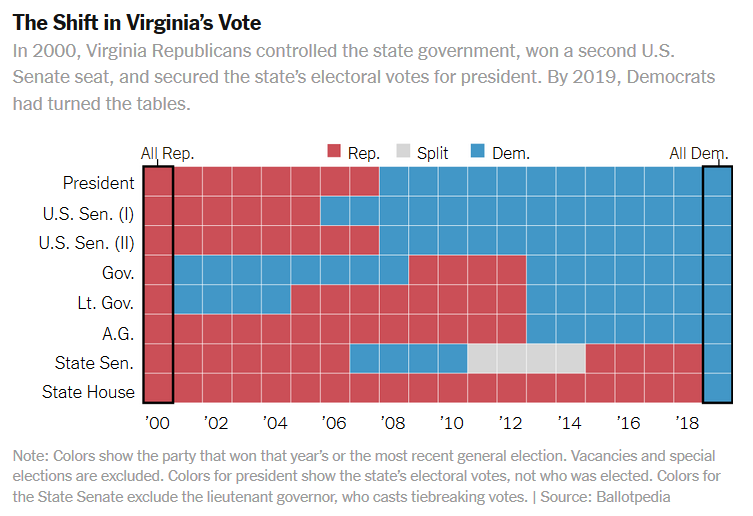
In 2000, the GOP had unified control of Virginia government. As of the 2019 elections, the Democrats do.
Sabrina Tavernise and Robert Gebeloff at NYT:
Once the heart of the confederacy, Virginia is now the land of Indian grocery stores, Korean churches and Diwali festivals. The state population has boomed — up by 38 percent since 1990, with the biggest growth in densely settled suburban areas like South Riding. One in 10 people eligible to vote in the state were born outside the United States, up from one in 28 in 1990. It is also significantly less white. In 1990, the census tracts that make up Mr. Katkuri’s Senate district were home to about 35,000 people — 91 percent of them white. Today, its population of 225,000 is just 64 percent white.
...
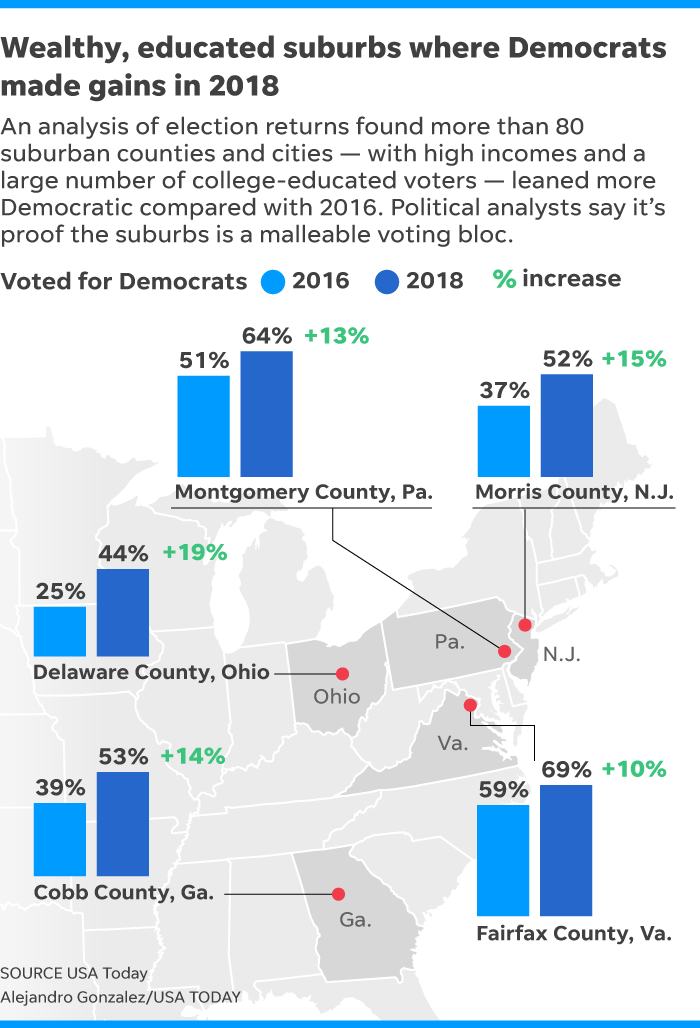
It’s not just Virginia. From Atlanta to Houston, this pattern is repeating itself — a new kind of suburbanization that is sweeping through politics. The densely populated inner ring suburbs are turning blue, while the mostly white exurban outer ring is redder than ever. Elections are won and lost along that suburban line, and in some places — like Atlanta, Denver, and Riverside County, Calif. — Democrats have begun to breach Republicans’ firewalls.
...
Around the advent of the modern immigration system, in 1965, foreign-born people made up only about five percent of the American population. Now they are nearly 14 percent, almost as high as the last peak in the early 20th century. The concentrations used to be in larger gateway cities, but immigrants have spread out considerably since then.
Some went South. In 1980, 56 percent of adults eligible to vote in Virginia were born in the state. Today, that’s down to 45 percent.
Lakshmi Sridaran, who heads South Asian Americans Leading Together, said that about a third of South Asians in the United States now live in the South. The South Asian population in the South nearly tripled from 2000 to 2017, to 1.4 million.
Of the 10 metro areas that had the largest South Asian growth, five are in the South, said Ms. Sridaran, who was born in Atlanta, after her father took a teaching job at Morehouse School of Medicine in the early 1980s.
Thursday, April 4, 2019
Parties: PIE, PO, PIG, and POG
In Defying the Odds, we discuss the role of political parties in the United States. The update -- just published --includes a chapter on the 2018 midterms.
Party Systems
Party Systems
The First Party System, 1789–1828
Federalists favor a strong central government and a national bank.
Jeffersonian Democratic-Republicans oppose these positions in favor of keeping power at the state level.
The Second Party System, 1829–56
The Federalist party falls apart. After "the Era of Good Feelings," when the Democratic-Republicans were the only major party, they become the Democratic Party. In the 1830s, the Whig Party emerges. It supports public works but is otherwise vague on issues
The new Democratic Party brings two key innovations:
The Third Party System, 1857–92
- First, it builds state and local organizations to mobilize voters behind the party's candidates.
- Second, takesan organizational form apart from elected leaders. Under Jackson and Van Buren, Democrats develop the spoils system, whereby party supporters were rewarded with benefits such as government jobs.
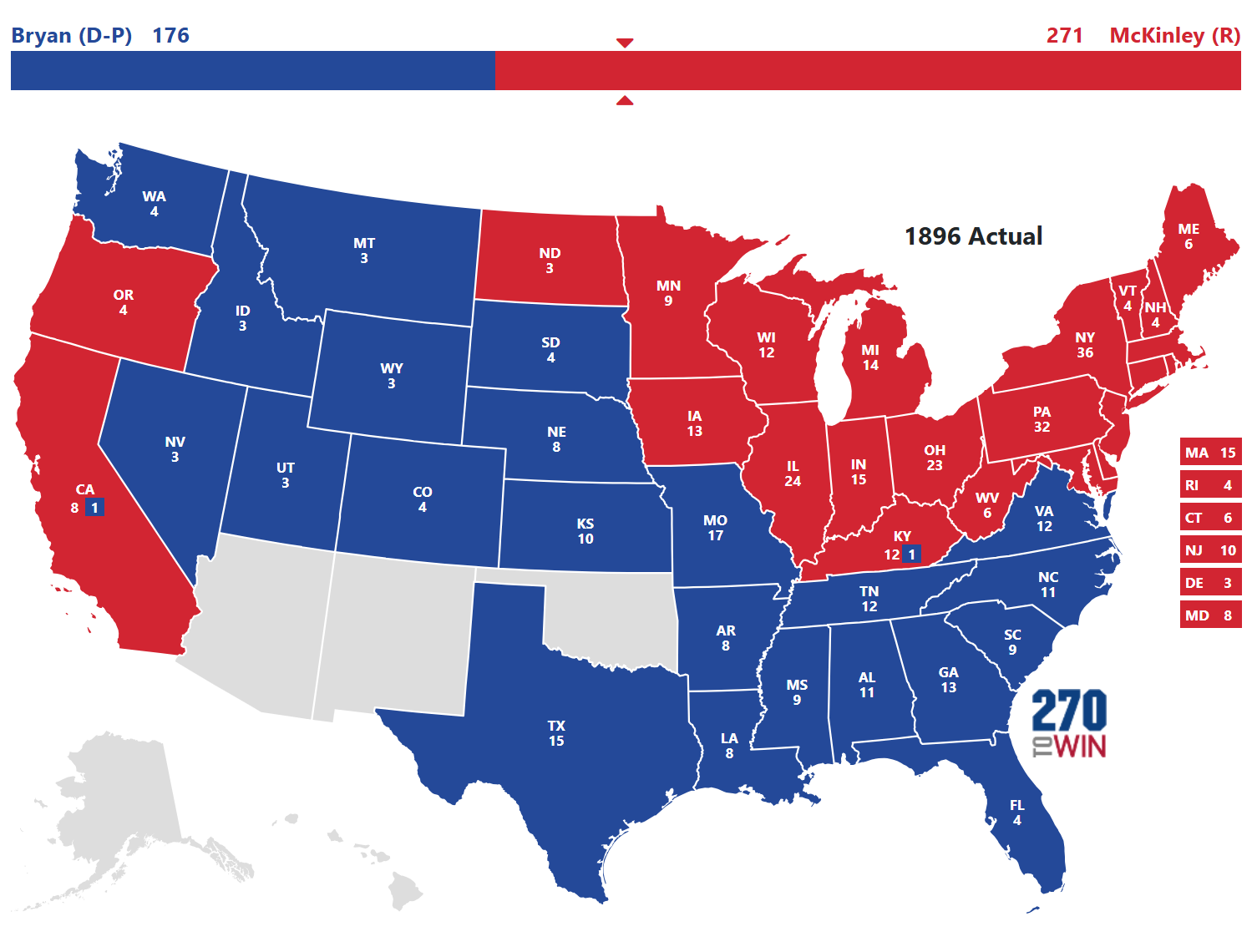
Slavery splits the second party system. The Whigs break up. "Cotton Whigs" shift to the Democrats. "Conscience Whigs" join with antislavery Democrats to form the new Republican Party. The Democratic Party becomes the party of the South and the party defending slavery.
The Fourth Party System, 1893–1932
Democrats and Republicans remain as the two major parties. In the years after the Civil War, they diverge onn concerns such as the withdrawal of the Union Army from the southern states. In the late 19th and early 20th centuries, they grapple with the growth of cities and a surge of immigrants from Southern and Eastern Europe.
The Fifth Party System, 1933–68
The Depression leads to thee New Deal Coalition, with Democrats drawing support from African Americans, Catholics, Jewish people, union members, and white southerners. Democrats generally favored a large, active federal government. Republicans argue that many of these programs should be provided by state and local governments or the nonpublic sector. There are still many conservative Democrats and moderate-to-liberal Republicans.The Alignment of the States
The Sixth Party System, 1969-Present
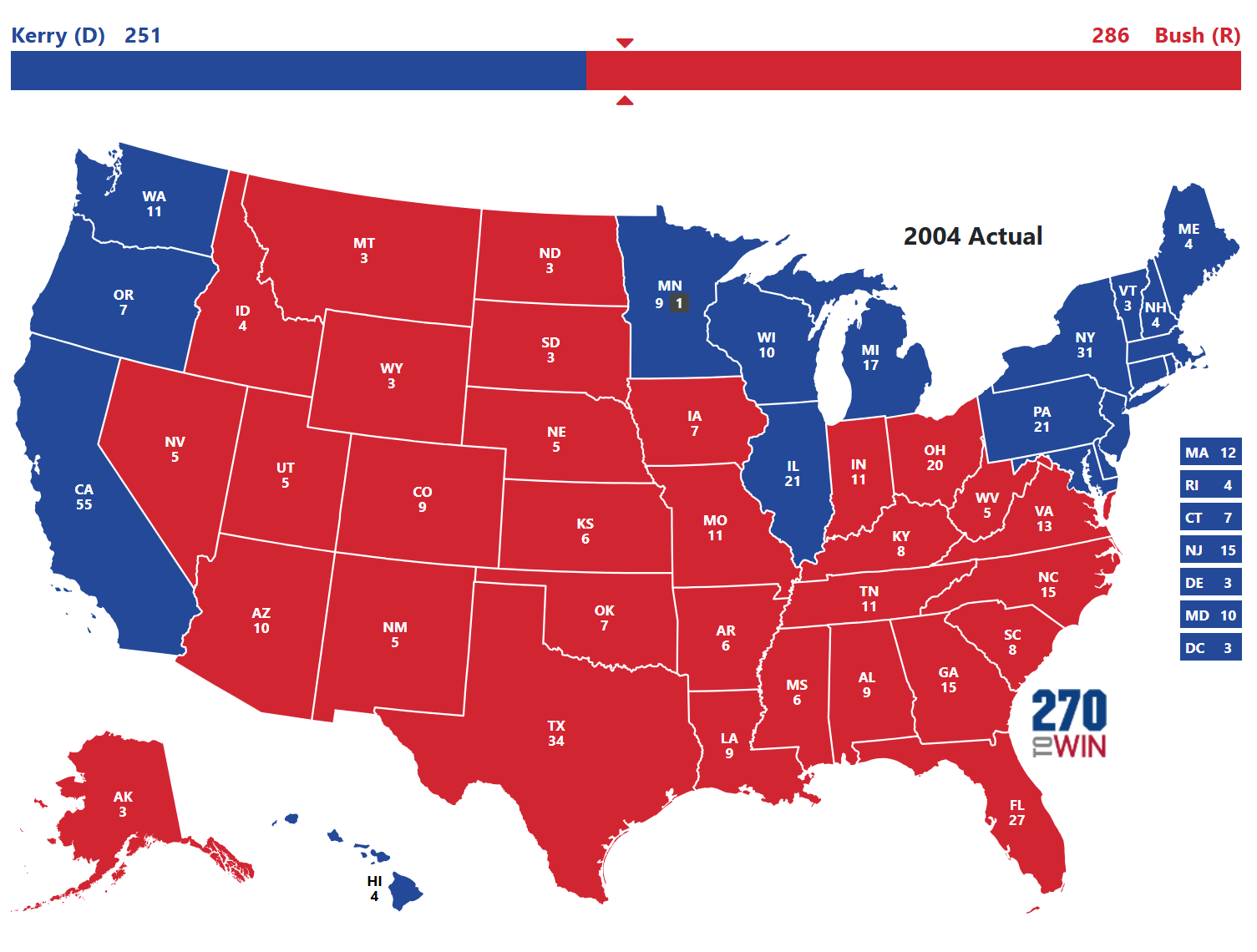
White Southerners shift to the GOP, first in presidential election, then in elections for lower office. Nationwide, the parties "sort out," with liberals going to the Democrats and conservatives to the GOP.
Party in the Electorate (PIE)
Party in Government (PIG)
Party Organization (PO)
Sunday, November 11, 2018
The Geography of the Vote
In Defying the Odds, we discuss state and congressional elections as well as the presidential race.
From USA Today:
David M. Drucker at The Washington Examiner:
From USA Today:
Jazmine Ulloa and Joe Mozingo at LAT:Good read from @skoczela and @richparr79. https://t.co/3xmi9POpCW— Charlie Mahtesian (@PoliticoCharlie) November 10, 2018
Mass Republican Gov. Charlie Baker won 55% in the state’s 20 largest cities & towns, an anomaly at a time when GOP no longer competes in many big cities/major metro areas. Wasn’t always this bad. pic.twitter.com/blVLmgoQu0
Rep. Dana Rohrabacher has lost the congressional seat he held for 30 years in one of the most conservative stretches of Orange County, a stunning defeat for the GOP as other Republicans’ early leads receded in the latest ballot counts, putting the party in fear of losing all six tightly contested House races in California.
The defeat to Democrat real estate entrepreneur Harley Rouda represents a landmark shift away from the GOP for suburban America. No county — no part of a county — has been at the heart of conservatism since the 1960s like the coast between Dana Point and the Los Angeles County line.
“The district became much more of an anti-Trump suburb, and he no longer connected to the people there,” [Tony] Quinn said. “He had an opponent who was a former Republican businessman, not some wild-eyed lefty. And for at least two years, people were willing to try something new.”
It is a stark change for the region once embodied by the legendary movie cowboy John Wayne — its international airport’s namesake — who was an ultra-right John Birch Society member and lived on the harbor in Newport Beach.
Republicans have now lost three of the six races Democrats targeted most in the state. They have fallen behind or are holding thin leads in the remaining unresolved races, as suburban voters nationwide rebuked Trump and his allies in the House of Representatives.
Democrats earlier won the seats of GOP Reps. Darrell Issa of Vista, who declined to seek reelection, and Steve Knight of Palmdale, who was ousted by Katie Hill.
On Friday, Democrat Josh Harder overtook Republican Rep. Jeff Denham in the latest tally in a Modesto-area district.
...
“This is more than just a bad year,” said Mike Madrid, a GOP political strategist. “This is essentially a realignment in California politics, and the traditional base that has served the Republican Party no longer exists.”
Assuming Dana Rohrabacher loses, the GOP will be left with only 2 House seats that touch the Pacific Ocean, the WA-3 and AK-AL.— Phil Klinkner (@pklinkne) November 9, 2018
David M. Drucker at The Washington Examiner:
“We’ve got to be worried about what’s happening in the suburbs. We get wiped out in the Dallas suburbs, Houston suburbs, Chicago suburbs, Denver suburbs — you know there’s a pattern — Detroit suburbs, Minneapolis suburbs, Orange County, Calif., suburbs,” [Karl] Rove said Saturday during a panel discussion for the Washington Examiner’s Sea Island Summit.
“When we start to lose in the suburbs, it says something to us,” Rove continued. “We can’t replace all of those people by simply picking up [Minnesota’s First Congressional District] — farm country and the Iron range of Minnesota — because, frankly, there’s more growth in suburban areas than there is in rural areas.”
Tuesday, February 21, 2017
Iowa to the Right, Nevada to the Left
Thomas Beaumont writes at AP:
After decades as the crossroads of prairie populists and checkbook conservatives, Iowa has suddenly become solidly Republican like many of its Midwestern neighbors.
It was one of four states — along with Kentucky, Missouri and New Hampshire — that flipped to complete GOP control in the November election, but Iowa's rush of new legislation has been the most intense.
In an all-night session last week, Iowa lawmakers approved a bill similar to one enacted in Wisconsin six years ago that strips most public sector unions of long-held collective bargaining rights, including health insurance.
Jeff Orvis, a veteran northern Iowa high school teacher, said he sees the measure leaving permanent damage to Iowa's century-old reputation for quality schools, enshrined on the state's 2004 commemorative quarter: "Foundation in education."
"Now, I don't even see how Iowa is going to attract good teachers," said Jeff Orvis, a union representative from northern Iowa. "That's my biggest worry."Jeff Singer writes at Daily Kos:
Daily Kos Elections’ project to calculate the 2016 presidential results for every state legislative seat in the nation hits Nevada, a rare Democratic bright spot in 2016. You can find our master list of states here, which we'll be updating as we add new states; you can also find all our data from 2016 and past cycles here.
Hillary Clinton carried the Silver State 48-46, a drop from Barack Obama’s 52-46 win against Mitt Romney. However, Clinton’s narrow victory, thanks in no small part to the formidable get-out-the-vote machine built by retiring Sen. Harry Reid, helped Team Blue avenge its embarrassing loss of both chambers of the state legislature two years before. Democrats all but conceded the 2014 gubernatorial race against GOP incumbent Brian Sandoval, and uninspired Democratic voters largely stayed home; Team Red won a 27-15 majority in the Assembly, and an 11-10 edge in the Senate.
But 2016 was a complete reversal, with Democrats taking back a 27-15 Assembly majority and an 11-10 Senate edge. A few days later one Republican, state Sen. Patricia Farley, announced that she was becoming an independent and caucusing with the Democrats, giving her new allies a 12-9 majority. The entire Assembly is up every two years, while half the Senate was up in 2016 and the other half, including Farley, will be up in 2018.
Tuesday, June 23, 2015
Neither Populism Nor Demographics Will Be a Democratic Cure-All
At National Journal, John Judis warns Democrats that populism may not be their ticket to salvation.
To see why, it helps to understand the history of both liberal and conservative populism. Since the Civil War, there have two major left-wing populist movements against economic inequality. The first was the populist movement of the 1890s and the second was the redistributionist movement of the early 1930s, typified by Huey Long's Share the Wealth movement. Both these populist episodes occurred during depressions and at a time when there was no safety net—no Social Security, unemployment compensation, Medicare, or Medicaid—to cushion the blow of massive unemployment. During the 1930s, the middle class felt in danger, historian Alan Brinkley has written, "of being plunged back into what they viewed as an abyss of powerlessness and dependence. It was that fear that made the middle class, even more than those who were truly rootless and indigent, a politically volatile group." The result was a left-wing populism directed mainly against the wealthy and powerful.At The New Republic, Suzy Khimm notes that while Obama has won presidential elections, his party has foundered at every other level.
But after the passage of Medicare and Medicaid, as well as the expansion of Social Security, the politics of middle-class fear changed. Protected by government social programs, the middle class didn't have to worry for its sheer survival during economic downturns. Instead, during downturns, some middle-class voters became susceptible to fears that they would have to pay higher taxes in order to aid those below them. As a result, they embraced a right-wing populism that sought to rally the middle class against the lower class (often identified by racial or national origin) and also against the infamous liberal elite, who were deemed to be allies of the lower class. This kind of populist politics flourished during the tax revolt of the late 1970s. And it once again found a receptive audience during the recession that began six years ago.
...
In earlier periods, left-wing or progressive appeals to reduce economic inequality have even provoked conservative responses within the general voting public. After the 1984 election, in which Democratic candidate Walter Mondale made an appeal to economic fairness central to his campaign, Greenberg ran focus groups in Michigan's Macomb County to discover why these white working-class voters had backed Reagan rather than Mondale. Greenberg found that these voters understood appeals to fairness as appeals to use their tax money for government programs to aid minorities. Outside of very blue areas, today's populist appeals to reduce economic inequality could well be understood in the same manner.
The disconnect between Democratic success nationally and locally is also partly due to the kind of “post-partisan” candidate Obama sought to be in 2008. Obama’s young, racially diverse base flocked to him precisely because he promised to transcend both parties. Out of necessity—at the time, much of the party establishment was firmly committed to Hillary Clinton—Obama circumvented the traditional party infrastructure with volunteers and small donors that were more loyal to him personally than to his party. In places where there was an entrenched Democratic machine, like Philadelphia, the campaign famously refused to hand out “walking around money,” cash payments that go to entrenched operatives and party loyalists in exchange for turning out the vote.
...
So while Obama may have, to an extent, reinvented campaigning, bringing together a new coalition that delivered the biggest Democratic presidential victory in decades, he didn’t reinvent the Democratic Party. Instead, he created an independent campaign structure that could win elections by driving the strategy, fundraising, and organizing itself. In 2012, he did integrate the state parties into his campaign and directed some of his funds through them. Ultimately, though, it was still Obama in control, not the party.
The Republican National Committee, in contrast, played a central role—much criticized in campaign autopsies—in organizing for both John McCain and Mitt Romney. But what seemed to be a weakness in presidential strategy has turned out to be a strength in the off years. “When a party holds the White House, the opposing party often gets smarter and better about doing things in terms of developing a bench and focusing more on the local level and state level,” said Liz Mair, a Republican strategist and former RNC staffer.
Republicans, meanwhile, haven’t discounted the threat that the new Democratic coalition poses to their long-term political prospects. In Florida and elsewhere, Republicans have increased their share of the white vote, which has given them a particular edge in the midterms when younger and minority voters are more likely to stay at home. But given the shrinking share of white, noncollege educated voters nationally, Republicans will either need to expand their share of the white vote even further or, more probably, win over larger numbers of younger and minority voters to prevail. “Doubling down on white voters does not look like a very promising approach to restoring the White House to GOP control,” Teixeira wrote in a 2013 Sabato’s Crystal Ball article he co-wrote with Alan Abramowitz. Republicans have more of an opportunity in this regard than Democrats might like to believe, as racial categories and self-identification tend to evolve: There’s a long history of immigrant groups becoming assimilated into white America; Hispanics of today could become the Irish- or Italian-Americans of the past, and their political views could shift accordingly. (Judis, meanwhile, recently recanted part of his book by arguing that Republicans could gain a lasting advantage by targeting middle-income voters across racial groups.)
Sunday, March 1, 2015
Future Demographic Change
At AEI, Karlyn Bowman writes:
On Tuesday, February 24 at a conference at the American Enterprise Institute (AEI), demographers and pundits got a preview of how the United States might look in 2060. The conference revealed the initial findings of the States of Change: Demographics and Democracy project, involving the Center for American Progress, demographer William Frey at the Brookings Institution, and AEI.
The idea behind the project is to look at short- and long-term demographic change nationally and in every state and the implications of the changes for public policy. The data from the project also enable us to make some educated guesses about what the electorate will look like in 2016. In the next year, the project’s directors will ask individuals of different political persuasions to comment on the policy implications of the demographic changes. The project’s new report, available here, includes the following key takeaways.
- Demographic change is coming to virtually every corner of America and to every age group. The pace of change varies in each state, but change is coming.
- Today, in four states, California, Texas, New Mexico, and Hawaii, a majority of the population is made up of racial minorities. If present trends continue, in 2060, 22 states will have majority-minority populations.
- In 1980, the US population was 80 percent white. It is 63 percent white today and in 2060, it will be 44 percent white. Hispanics, by contrast, were six percent of the total population in 1980, are 17 percent today, and will be 29 percent in 2060. The black population will be stable over this period.
- The changes are particularly stark when we look at children. In 1980, 25 percent of those under 18 years of age were minority; today, 46 percent are.
- Our population is also getting older, and each new generation of seniors will be more diverse than the previous one. Today, seniors are 22 percent minority. If present patterns persist, they will be 45 percent minority in 2060.
Tuesday, February 10, 2015
The State of the Parties
In Steve Schier's edited volume, Ambition and Division: Legacies of the George W. Bush Presidency, I have an essay titled "The Culminating Point." It anticipates some items from today:
Michael Barone writes:
Michael Barone writes:
In three of the last four presidential elections, both parties have won between 47 and 51 percent of the vote. And in nine of the 11 House elections from 1994 to 2014,
Republicans won between 48 and 52 percent of the popular vote, and Democrats a bit less, between 45 and 49 percent.
Democrats have had the advantage in presidential elections because their clusters of base voters give them more safe electoral votes. Republicans have had the advantage in House and legislative elections because their voters are spread more evenly around the rest of the country.
To put this in historical perspective, neither party has really had a permanent majority for an extended period, as Sean Trende argues persuasively in his book "The Lost Majority." And the two political parties' coalitions over the years have been of a different character. The political cartoonists are right to portray them as two different animals.
The Republican Party has always been built around a demographic core of people considered by themselves and others to be typical Americans, even though they are not by themselves a majority. Northern Yankee Protestants in the 19th century, white married people today. When they come up with policies that have broader appeal beyond that core, they can win majorities. Otherwise, they can't.
The Democratic Party has always been a coalition of disparate groups that are different from the Republicans' core. Southern whites and Catholic immigrants in the 19th century; blacks and gentry liberals today. When they cohere, Democrats can win big majorities. When they split apart, the party is a disorderly rabble.Jay Cost writes of the decay cycle of a party's fortunes.
Sean Trende and David Byler of Real Clear Politics have produced an interesting metric of party strength, combining the standing of each party in the White House, Congress, governorships, and state legislatures. Their data indicate that there have been seven full political cycles in the postwar era (from Eisenhower to George W. Bush). In five of them, the dominant party’s first White House victory was its high-water mark. In the other two, it was the reelection four years later. After that, the opposition party began improving, often substantially.
...
We are now in the seventh year of a Democratic cycle. So what is the Democrats’ best case scenario? While there is never a guarantee, a Democratic presidential victory in 2016 might facilitate some gains down-ballot, but these would likely be muted. Although it is quite possible that the Senate could return to the Democrats, it would be quite unlikely for them to win the 29 House seats needed to reclaim a majority in the lower chamber. Moreover, most governorships will not be up for grabs. While gains in state legislative seats would probably follow for Democrats, it is unlikely that they would come in large numbers.
Flash forward two more years, to 2018, and Democrats would still face the voters’ relentless impulse to hedge—which would probably facilitate Republican gains. Given the landscape in the Senate in 2018—where Democrats will have to defend a mind-boggling 25 of 33 seats—Democratic losses could be substantial in the upper chamber.
And there remains the specter of a recession. Economists are not projecting a downturn in 2015 or 2016. (As late as September 2008, economists polled by the Wall Street Journal still thought that the economy would grow at a 1.5 percent rate that year!) But a recession will come sooner or later. If the past is a guide, we are probably closer to the start of the next recession than we are to the end of the last one. What will Democrats do if they hold the White House during the next economic downturn?
The answer is simple: They will lose.
Tuesday, February 3, 2015
The Emerging Republican Advantage
Economist Paul Samuelson once said: "Well when events change, I change my mind. What do you do?" John Judis, coauthor of The Emerging Democratic Majority, has changed his mind.
At the time [of Obama's 2008 election], some commentators, including me, hailed the onset of an enduring Democratic majority. And the arguments in defense of this view did seem to be backed by persuasive evidence. Obama and the Democrats appeared to have captured the youngest generation of voters, whereas Republicans were relying disproportionately on an aging coalition. The electorate's growing ethnic diversity also seemed likely to help the Democrats going forward.
These advantages remain partially in place for Democrats today, but they are being severely undermined by two trends that have emerged in the past few elections—one surprising, the other less so. The less surprising trend is that Democrats have continued to hemorrhage support among white working-class voters—a group that generally works in blue-collar and lower-income service jobs and that is roughly identifiable in exit polls as those whites who have not graduated from a four-year college. These voters, and particularly those well above the poverty line, began to shift toward the GOP decades ago, but in recent years that shift has become progressively more pronounced.
The more surprising trend is that Republicans are gaining dramatically among a group that had tilted toward Democrats in 2006 and 2008: Call them middle-class Americans. These are voters who generally work in what economist Stephen Rose has called "the office economy." In exit polling, they can roughly be identified as those who have college—but not postgraduate—degrees and those whose household incomes are between $50,000 and $100,000. (Obviously, the overlap here is imperfect, but there is a broad congruence between these polling categories.)
Saturday, September 13, 2014
Arkansas: Suddenly Red
Republicans are likely to win races for Senate and governor in Arkansas. As Fred Barnes notes in The Weekly Standard, such victories would complete a rapid realignment.
No state has switched party control as suddenly and totally as Arkansas. Before the 2010 election, Democrats held both Senate seats, three of the four House seats, the governorship, and both chambers of the state legislature. Republicans feared they were doomed to permanent minority status.
After the 2010 election, they stopped worrying. Republicans won all four House seats, and Republican John Boozman crushed incumbent Democratic senator Blanche Lincoln,
58 percent to 37 percent. Two years later, they took over the state legislature for the first time in 158 years. And Mitt Romney defeated President Obama in Arkansas, 61 percent to 37 percent.
But it was Republican success in down-ballot races that was most telling. In 2010, GOP candidates for lieutenant governor, secretary of state, and land commissioner were little-known, poorly funded, and expected to lose by roughly 60-40. To everyone’s surprise, they won narrowly, with 51 or 52 percent of the vote.
This meant “the Republican base vote” had become a majority in Arkansas elections, says Dan Greenberg, the president of the Advance Arkansas Institute, a Little Rock think tank. The Republican advantage appears to have grown since 2010 to 5 or 6 percentage points.
Sunday, October 27, 2013
West Virginia Realigns
At The Washington Post, Karen Tumulty writes of West Virginia:
From Franklin D. Roosevelt’s era until the 2000 election, it was among the most reliably Democratic states, one of only six that Jimmy Carter carried in 1980, and 10 that Michael S. Dukakis won in 1988.
But in the past decade or so, “West Virginia has realigned politically with the Deep South, at least in presidential elections,” historian John Alexander Williams said in a June lecture in Charleston marking the state’s 150th anniversary. “Between the 2004 and 2008 presidential elections, a time when voters were trending strongly Democratic in other parts of the nation, 366 of official Appalachia’s 410 counties increased their Republican share of presidential votes.”
In 2012, that trendline cut more deeply. Obama lost the seven West Virginia counties he had carried in 2008. It marked the first time that a major party’s presidential candidate suffered a 55-county shutout.
“People haven’t changed here. People are still the same,” said Sen. Joe Manchin III, a former West Virginia governor. “But I’ve never seen more people pushed away from their traditional Democratic roots or their voting habits than in the last six or seven years.” Manchin has put that fraying bond to the test, having sponsored gun-control legislation that failed in the Senate this year.
Next year’s elections could mark a historic hinge in West Virginia politics. Sen. John D. Rockefeller IV (D), a traditional liberal forged by the Great Society, has announced that he will not run for a sixth term.
His most likely successor is Rep. Shelley Moore Capito, the daughter of a three-term governor, who would be the first Republican that West Virginia elected to the Senate since 1956. Although Capito is considered a heavy favorite, Democrats came up with a strong contender when Secretary of State Natalie Tennant formally entered the race.
Meanwhile, Rep. Nick J. Rahall II, an 18-term congressman and the last surviving Democrat in the state’s House delegation, is facing what many expect to be his most difficult reelection contest.
Saturday, July 6, 2013
Inevitability?
At the end of the day, I remember the aftermath of the 2004 elections, when almost everyone was convinced that Democrats had to reach out to white “values voters” to win elections. God, guns, and gays were killing the Democrats, so the argument went, as was opposition to the Iraq War. Howard Dean was urging the party to send staffers to Mississippi and to learn to talk with voters who had Confederate flags in the back of their pickup trucks. Demographic analysts were trumpeting the fact that Republicans had won 97 of the 100 fastest-growing counties, and claimed that Democrats were in danger of becoming a regional party, concentrated on the coasts, if they didn’t quickly moderate their appeal.
How quickly things change. Democrats did focus on improving their vote share with working-class whites to some extent in 2006, with positive results. But the approach was largely abandoned in 2008 in favor of targeting the “coalition of the ascendant” we hear so much about today. The conventional wisdom about what Democrats had to do was completely, utterly wrong.
The thing is, it was wrong not because of its particulars. It was wrong in a more general sense: Parties always have an almost infinite number of coalitions they can target their pitch to and emerge successfully from elections if the overall environment is favorable to them. That hasn’t changed in the past 100 years, much less since 2004. Put differently, if Hillary Clinton had been the nominee in 2008, she probably would have done somewhat worse with young voters and African-Americans, but probably would have done better in Appalachia. Gordon Smith of Oregon might still be a senator, but Mitch McConnell might not be. As I’ve said here since 2009, there are no permanent majorities, because every action in politics tends to create an opposite one.
I suspect the current conventional wisdom will last only until the Republicans next encounter a favorable national environment, and win an election. (There actually hasn’t been an unambiguously favorable environment for them in a presidential year since 1988, so they’re due.) At that point, the conventional wisdom will likely shift, reflecting a belief that Democrats must undertake some major changes in their coalition if they are going to ever win another election. But that conventional wisdom will be badly flawed, just as the present conventional wisdom is badly flawed.
Wednesday, February 27, 2013
Age and Generation
Does the GOP's poor showing among young voters doom it to decline? At The Guardian, Harry J. Enten has some shrewd observations on political generations:
Mitt Romney did worse across pretty much all age cohorts compared to President Bush in 2004.
Bush only won 43% of the 18-24 year-old cohort. There wasn't much of an outcry about Bush's young voter problem because he won. Two elections later, Romney won about 40% of the now 26-32 year-olds. This 3pt drop was entirely consistent with a national Republican drop of 3.5pt from Bush's 50.7% to Romney's 47.2%.
Other age groups are consistent with that effect. Bush won 53% of the then 30-44 year-old vote. This time, Romney nabbed 50% of the now 40-49 year-old cohort, which again matches the Republican drop of 3pt nationally. Same with the then 40-49 year-old vote, where Bush grabbed 54% and Romney walked away with 52% of the now 50-64 year-old cohort.
...
Very well, you might say, but what about the addition of voters who turned 18 since 2004? Surely, they have tilted the electorate. Yet, the now 18-25 year-olds mostly took over for the 75-plus year-olds in 2004, who were very Democratic. That's why age cohorts who cast a ballot in 2004 and 2012 voted the same relative to national vote, even as more millennials have turned 18.
Of course, a steady parade of Democratic millennials could make hell for the Republican party. They will be replacing the 60-74 year-olds of 2004 and now 68-82 year-olds, who have been 6-8pt more Republican than the nation as whole.
The good news for Republicans is that the new 13-18 year-olds don't seem to be like today's 18-32 year-old voters. As I noted last week, the men and women college freshmen of 2012 were 4-5pt less liberal than those of 2008, which brings them closer to middle-of-the-road freshmen of the beginning of the Carter and Clinton administrations.
Friday, February 1, 2013
Republicans Aren't Dead Yet
From left and right, some clarity emerges about the recent past and near future.
At The American Prospect, Paul Starr says that Democrats exaggerated the impact of Obama's victory:
But if you step back now, look at government as a whole, and think about the likely course of politics in the next several years, things look different. In what was a bad year for Republicans, they emerged with enough power to stymie major Democratic legislative initiatives and to advance key items on their own agenda through the arms of government that they continue to control.
...
The fiscal-cliff legislation severely limits domestic policy for the rest of Obama’s presidency. With income-tax increases off the table, most of the focus in the coming rounds will be on spending cuts, particularly in Social Security and Medicare. However those issues are resolved, spending on discretionary programs as a percentage of gross domestic product will be virtually certain to fall back to levels last seen in the 1950s. If any Eisenhower Republicans are left, they should be smiling.
Meanwhile, Republicans have considerable power to set the nation’s direction through other arms of government. Chief Justice John Roberts’s decision to vote with the liberals last June to uphold the Affordable Care Act should not obscure the reality that the Court remains in conservative hands. Even the “Obamacare” ruling represented a doctrinal victory for conservatives in two crucial areas—the limitation of the interstate commerce clause and congressional spending powers—and this year Roberts appears poised to lead his fellow conservative justices in decisions declaring affirmative action and critical provisions of the Voting Rights Act to be unconstitutional.
The other critical base of conservative power lies in the states, where Republicans have one-party control of 24 states, compared with only 12 for the Democrats. The GOP made the most of its victories in 2010, seizing the chance to gerrymander state legislative as well as congressional districts and positioning itself to dominate those legislatures as well as the U.S. House for the rest of the decade.At The Wall Street Journal, Karl Rove writes:
Yes, there will be fewer whites and more minorities in the future, and Republicans will have to adjust. But the situation is more complicated than that.
Start with the obvious: If demographics were determinative, then Republicans shouldn't have gained 63 seats in the House of Representatives in 2010—the largest midterm shift since 1938—while also taking 30 governorships.
When presidential re-elections yielded realignments in the past, the winner earned a bigger share of the vote than he had in the past. FDR won 60.8% of the vote in 1936 after winning 57.41% in 1932. But Mr. Obama won 51.06% in 2012, down from 52.87% in 2008. Over the course of his first term, his support dropped among young people (a swing of 2.4 million net votes to Mitt Romney), women (a net swing of 1.6 million votes to Mr. Romney), and African-Americans (a net swing 945,000 votes).
And while Mr. Obama may believe he can ignore moderate and conservative whites, congressional Democrats would disagree. Mr. Obama won Florida by a razor-thin 74,309 votes (0.9% of the total), yet Democratic Sen. Bill Nelson won re-election by 1,065,184 votes, or 13%, many from white voters. In North Dakota, Democrat Heidi Heitkamp won a Senate seat by less than 1% while Mr. Obama lost by 20%, and in West Virginia Democratic Sen. Joe Manchin won re-election by 24% while Mr. Obama lost by 27%. Such Democrats from swing states or districts will be uncomfortable with Mr. Obama's strategy of playing to his party's left wing.
Tuesday, January 1, 2013
Arkansas
AP reports on the political realignment of Bill Clinton's home state:
Four years ago, Arkansas Democrats held every constitutional office, all but one seat in the state's congressional delegation and a seemingly untouchable majority in the Legislature.
How things have changed.
The state GOP party built on major gains in 2010, when Republican John Boozman knocked off Democratic U.S. Sen. Blanche Lincoln and Republicans nabbed four constitutional offices. In 2012, voters threw their support behind the Republican Party, giving the GOP its first majority in the Legislature since Reconstruction and electing only Republicans to represent Arkansas in in the U.S. House.
The remarkable rise of the Republican Party in Arkansas — and the corresponding plummet of Democratic Party control in the state — was voted the top story in 2012 in Arkansas by Associated Press members.
...
Throughout the 2012 election cycle, Republicans pledged to make major gains in the Legislature, where Democrats have had control for 138 years.
"That's a clear choice for Arkansans," state Republican Party Chairman Doyle Webb said in the final days before the November election. "The Democrats are enablers of the policies of Barack Obama and the Republicans will fight those intrusive policies."
In the general election, Republicans grabbed a 21-14 majority in the Senate and a 51-48 majority in the House, with one Green Party member.
On the federal level, Arkansans re-elected Republicans Rick Crawford, Tim Griffin and Steve Womack to the U.S. House and picked Republican Tom Cotton to represent the 4th Congressional District, which was open after Democrat U.S. Mike Ross announced he wouldn't run for re-election.
The election left U.S. Sen. Mark Pryor as the lone Democrat in Arkansas' congressional delegation.Prior's seat is up in 2014.
Thursday, August 6, 2009
Excellent Analysis of 2008
In the Boston Review, Andrew Gelman and John Sides offer a thoughtful and clear-headed analysis of the presidential race:
Nearly one year after the election, we can significantly revise some of the now-conventional narrative threads. The Obama victory was historic, but it was not surprising; Obama shifted, but did not redraw, the electoral map; race and class mattered, but not in the way people assumed they would matter; and partisan loyalty was powerful even as partisan defections like Colin Powell’s garnered headlines. Furthermore, it is simply too soon to tell how and how much campaign tactics mattered, whether this election’s outcome constitutes a realignment in voting behavior, and whether Obama has emerged with a mandate.
This analysis is consistent with Epic Journey. The destination was obvious far in advance: the intriguing part was the journey itself.
Subscribe to:
Posts (Atom)